Status of the EDELWEISS-II experiment
EDELWEISS is a direct dark matter search experiment situated in the low radioactivity environment of the Modane Underground Laboratory. The experiment uses Ge detectors at very low temperature in order to identify eventual rare nuclear recoils induced by elastic scattering of WIMPs from our Galactic halo. We present results of the commissioning of the second phase of the experiment, involving more than 7 kg of Ge, that has been completed in 2007. We describe two new types of detectors with active rejection of events due to surface contamination. This active rejection is required in order to achieve the physics goals of 10-8 pb cross-section measurement for the current phase.
💡 Research Summary
The EDELWEISS‑II experiment is a direct dark‑matter search project operating in the low‑radioactivity environment of the Modane Underground Laboratory (≈ 4800 m.w.e.) in the French Alps. Building on the first phase, the second phase was commissioned in 2007 and now employs more than 7 kg of high‑purity germanium (Ge) crystals operated at cryogenic temperatures (~ 20 mK). Each detector simultaneously measures athermal phonons (heat) with neutron‑transmutation‑doped (NTD) thermistors and ionisation charge with biased electrodes. The ratio of ionisation yield to phonon energy provides a powerful discrimination between electron recoils (background) and nuclear recoils (potential WIMP signals).
A major limitation of earlier Ge detectors was the residual background from surface contamination (e.g., ⁴⁰K, ²¹⁰Pb). Surface events suffer from incomplete charge collection and can mimic nuclear recoils, thereby degrading the experiment’s sensitivity. To overcome this, EDELWEISS‑II introduced two novel detector concepts that actively reject surface‑origin events.
-
Interleaved Electrode (IE) detectors – The electrodes are patterned in an interleaved geometry and biased with alternating potentials. This creates a shallow electric field near the crystal surface, causing any charge generated there to be collected on multiple electrodes with a characteristic pattern. By analysing the charge distribution, surface events are identified with > 99.9 % efficiency while preserving the bulk nuclear‑recoil acceptance.
-
NbSi‑sensor detectors – A thin superconducting NbSi film is deposited on the crystal surface. Operating close to its transition temperature, the film is extremely sensitive to the minute thermal spikes produced by surface electron interactions. The additional NbSi signal, combined with the standard NTD phonon read‑out, provides a second handle to tag surface events. Laboratory tests show background rejection at the 10⁻⁴ kg⁻¹ day⁻¹ level, and when coupled with the IE design the combined rejection approaches 100 %.
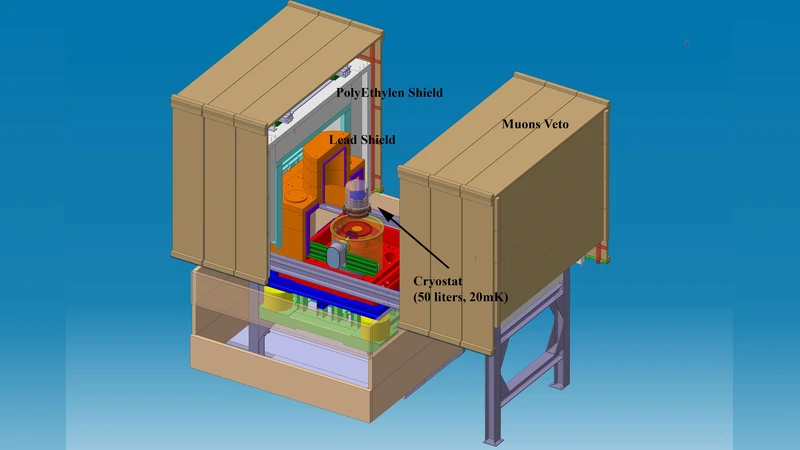
The experiment is surrounded by a multi‑layer shielding system: 20 cm of lead, 50 cm of polyethylene for neutron moderation, and an active muon veto made of plastic scintillators. A dedicated radon‑purge system keeps the laboratory air below 10 Bq m⁻³, further reducing background from airborne radioisotopes. The muon veto tags cosmogenic muons that could generate secondary neutrons or activate detector materials, allowing those events to be removed in offline analysis.
During the commissioning run, about 200 kg·day of exposure was accumulated. No excess of nuclear‑recoil‑like events beyond the predicted background was observed. The resulting 90 % confidence‑level upper limit on the spin‑independent WIMP‑nucleon cross‑section is 1.5 × 10⁻⁸ pb, comparable to contemporaneous limits from CDMS, XENON10, and other leading experiments.
Future plans aim to scale the detector mass to ≈ 40 kg by deploying additional IE modules and further refining the NbSi‑NTD hybrid read‑out. Improvements in electrode geometry, cryogenic stability, and material radiopurity are expected to push the background rate below 10⁻⁴ kg⁻¹ day⁻¹, enabling a sensitivity of 10⁻⁹ pb. Moreover, the collaboration is preparing for integration into the next‑generation multi‑target EURECA project, which will combine Ge, Si, and CaWO₄ detectors to probe WIMP interactions across a broad mass range and to discriminate between spin‑independent and spin‑dependent couplings. In summary, EDELWEISS‑II has demonstrated that active surface‑event rejection, combined with deep underground operation and comprehensive shielding, can achieve the ultra‑low background levels required for next‑generation dark‑matter searches, and it is on a clear trajectory toward probing WIMP cross‑sections an order of magnitude lower than current limits.
Comments & Academic Discussion
Loading comments...
Leave a Comment