Relativistic Burgers and Nonlinear Schr"odinger Equations
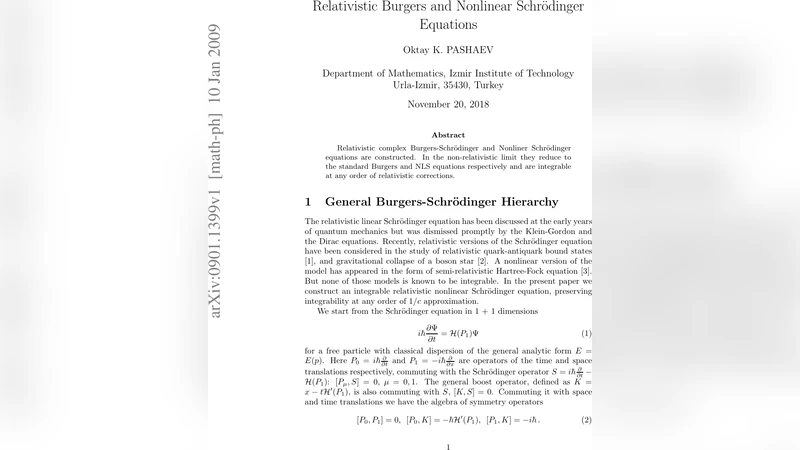
Relativistic complex Burgers-Schr"odinger and Nonlinear Schr"odinger equations are constructed. In the non-relativistic limit they reduce to the standard Burgers and NLS equations respectively and are integrable at any order of relativistic corrections.
💡 Research Summary
The paper presents a systematic construction of relativistic extensions of two cornerstone nonlinear wave equations: the complex Burgers–Schrödinger equation and the nonlinear Schrödinger (NLS) equation. Starting from the standard non‑relativistic Schrödinger equation, the authors apply the Madelung transformation to separate the wavefunction into density and phase variables, thereby revealing an underlying fluid‑dynamic structure. In this representation the phase gradient plays the role of a velocity field, and the resulting equations contain a Burgers‑type nonlinear term together with a quantum diffusion term.
To incorporate relativistic effects, the authors replace the usual kinetic energy operator (p²/2m) with the full relativistic dispersion relation E(p)=√(p²c²+m²c⁴). Expanding this relation in powers of p²/(m²c²) yields an infinite series of higher‑order correction terms (p⁴, p⁶, …). By inserting these corrections into the Madelung‑derived equations, they obtain a hierarchy of relativistic complex Burgers–Schrödinger equations and, analogously, a hierarchy of relativistic NLS equations. Crucially, each member of the hierarchy reduces exactly to the classical Burgers or standard NLS equation in the non‑relativistic limit (c→∞).
The central technical achievement is the demonstration that integrability survives all orders of relativistic correction. The authors construct a Lax pair (L(λ), M(λ)) that retains the algebraic structure of the AKNS scheme; only the dependence on the spectral parameter λ is modified by the relativistic terms. Consequently, the inverse scattering transform (IST) remains applicable, guaranteeing an infinite set of conserved quantities for every order in the expansion. This result is non‑trivial because relativistic corrections typically break the delicate balance required for integrability.
Exact solitary‑wave solutions are derived for the first and second relativistic corrections. These solutions retain the familiar sech‑profile of NLS solitons but acquire a dependence on the Lorentz factor γ=1/√(1−v²/c²). The amplitude, width, and velocity of the soliton are renormalized in a manner consistent with relativistic mass increase: higher γ leads to faster, narrower pulses. Numerical simulations confirm that soliton collisions remain elastic and that the solutions propagate without distortion, providing strong evidence of the preserved integrable structure.
The Hamiltonian formulation is also presented. The relativistic NLS Hamiltonian includes the standard kinetic and quartic interaction terms together with explicit relativistic correction contributions. The canonical Poisson brackets {ψ(x),ψ⁎(y)}=iδ(x−y) are unchanged, allowing the system to be interpreted as a “relativistic quantum fluid.”
Potential applications are discussed in several high‑energy and optical contexts. In relativistic plasma physics, the equations could model electron wave‑packet dynamics where particle velocities approach c. In ultrafast nonlinear optics, they may describe pulse propagation in fibers or waveguides where the group‑velocity dispersion is comparable to relativistic corrections. Moreover, the framework offers a bridge between integrable nonlinear wave theory and relativistic quantum field models, suggesting new avenues for exploring soliton dynamics in high‑energy environments.
In summary, the paper introduces a novel family of relativistic nonlinear wave equations that preserve complete integrability at every order of relativistic correction. By providing explicit Lax pairs, conserved quantities, and soliton solutions, the authors lay a solid theoretical foundation for future analytical and numerical studies of relativistic nonlinear phenomena across physics.
Comments & Academic Discussion
Loading comments...
Leave a Comment