Adaptive threshold-based decision for efficient hybrid deflection and retransmission scheme in OBS networks
Burst contention is a well-known challenging problem in Optical Burst Switching (OBS) networks. Deflection routing is used to resolve contention. Burst retransmission is used to reduce the Burst Loss Ratio (BLR) by retransmitting dropped bursts. Previous works show that combining deflection and retransmission outperforms both pure deflection and pure retransmission approaches. This paper proposes a new Adaptive Hybrid Deflection and Retransmission (AHDR) approach that dynamically combines deflection and retransmission approaches based on network conditions such as BLR and link utilization. Network Simulator 2 (ns-2) is used to simulate the proposed approach on different network topologies. Simulation results show that the proposed approach outperforms static approaches in terms of BLR by using an adaptive decision threshold.
💡 Research Summary
The paper addresses the long‑standing contention problem in Optical Burst Switching (OBS) networks, where bursts may be dropped because the control packet (Burst Header Packet, BHP) cannot reserve resources in time. Traditional contention resolution techniques include wavelength conversion, fiber‑delay‑line buffering, burst segmentation, and especially deflection routing. While deflection routing avoids additional hardware, it can become unstable under high load, and it does not eliminate burst loss. Retransmission at the OBS layer, as proposed by Torra et al., can reduce the Burst Loss Ratio (BLR) but incurs extra delay. Earlier hybrid schemes—HDR and its limited variant LHDR—combine deflection and retransmission, yet they suffer from static decision policies: HDR always tries deflection first, even when the network is heavily loaded, and LHDR limits deflection too conservatively.
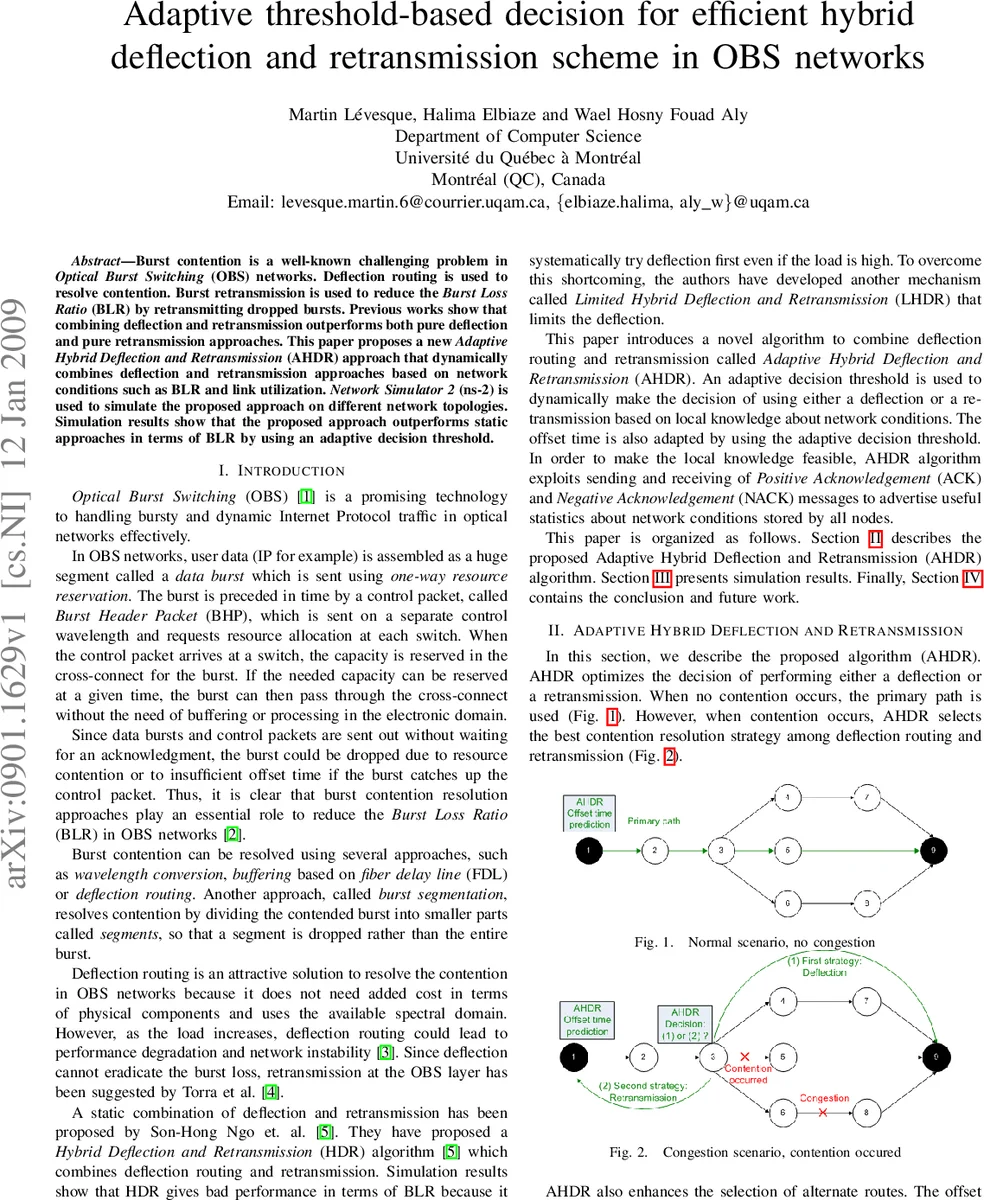
The authors propose Adaptive Hybrid Deflection and Retransmission (AHDR), an algorithm that dynamically decides between deflection and retransmission based on real‑time network metrics. The key components are:
-
Statistics Dissemination via ACK/NAK – When a BHP reaches its destination, an ACK is sent back; if it is dropped, a NACK is generated. Both messages carry local measurements of the per‑link BLR and link utilization (U). As these control packets traverse the network, each node aggregates the information, gradually building a global view without requiring a separate signaling channel.
-
Metric Model – For any adjacent node pair (n_i, n_{i+1}), the dropping probability is defined as
DP(n_i,n_{i+1}) = α_BLR·BLR(n_i,n_{i+1}) + α_U·U(n_i,n_{i+1}),
where α_BLR + α_U = 1. The success probability of a candidate route R (with |R| hops) is the product of link‑wise success probabilities:
SP(R) = ∏{i=1}^{|R|-1} (1 – DP(n_i,n{i+1})). -
Adaptive Decision Threshold – A global threshold SP_th is computed from the overall network BLR and average utilization:
SP_th = β_BLR·BLR_topo + β_U·U_topo, with β_BLR + β_U ≤ 1. Empirical results on NSFNET show a strong linear correlation (R² ≈ 0.91) between BLR and the optimal threshold, enabling the use of a regression line to adjust SP_th on‑the‑fly. When SP(candidate) ≥ SP_th, the candidate is accepted for deflection; otherwise a NACK triggers retransmission. -
Offset‑Time Adaptation – The offset time (the gap between BHP and its data burst) is traditionally calculated as t_offset = t_conf + N_hops·t_p. AHDR replaces the static hop count with the length of the selected route: if a deflection is allowed, the hop count of the best deflection path is used; otherwise the shortest‑path hop count is employed. This prevents insufficient offset when a longer deflection path is taken and avoids excessive offset when the network is congested.
-
Routing Table Update – Periodically, each node recomputes the cost of each next‑hop‑destination pair as Cost = 1 – SP(route). Next hops are sorted by increasing cost, ensuring that the forwarding decision can be made quickly without recomputing SP for every packet.
The authors evaluate AHDR using ns‑2 with an OBS extension on two topologies: NSFNET (low connectivity, C = 0.23) and COST239 (higher connectivity, C = 0.47). Simulation parameters include 1 Gbps per wavelength, 2 control channels, 4 data channels per link, burst sizes of 400 KB (NSFNET) and 4 MB (COST239), Poisson traffic, and a single allowed retransmission (N_ret = 1). For comparison, they adapt LHDR into a multi‑candidate version (MLHDR) that sequentially tries the shortest, second‑shortest, etc., deflection alternatives.
Results:
- BLR: AHDR consistently outperforms MLHDR, achieving up to a 45 % reduction in BLR across both topologies, especially noticeable at higher loads (≥ 0.6).
- End‑to‑End Delay: The adaptive scheme adds at most 5–6 ms of extra delay compared with MLHDR, a negligible increase for most applications.
- Deflection Ratio: At low loads (≤ 0.25), AHDR utilizes almost all available deflection paths (ratio ≈ 0.8), while MLHDR remains around 0.08. As load rises, AHDR automatically reduces the deflection ratio to avoid instability, whereas MLHDR either under‑deflects or over‑deflects depending on the load region.
- Offset Time: The adaptive offset time closely follows the actual path length, reducing unnecessary waiting when the network is congested and extending the offset when a longer deflection path is selected, thereby limiting additional burst loss.
The paper discusses potential extensions: learning the weighting coefficients (α, β) via probabilistic graphical models or neural networks, exploring larger N_ret values, integrating with fiber‑delay‑line buffers, and evaluating the overhead of statistics propagation in larger networks.
In conclusion, AHDR introduces a practical, low‑overhead mechanism that leverages real‑time BLR and utilization metrics to make informed, adaptive decisions between deflection and retransmission. By coupling an adaptive decision threshold with a dynamic offset‑time calculation, it achieves significantly lower burst loss while keeping latency overhead minimal, making it a promising candidate for future high‑performance OBS deployments.
Comments & Academic Discussion
Loading comments...
Leave a Comment