Quasiperiodic Motion for the Pentagram Map
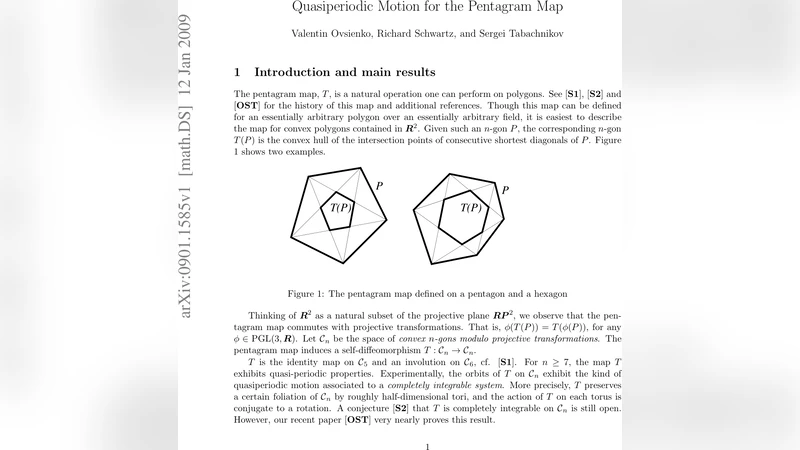
The pentagram map is a projectively natural iteration defined on polygons, and also on a generalized notion of a polygon which we call {\it twisted polygons}. In this note we describe our recent work on the pentagram map, in which we find a Poisson structure on the space of twisted polygons and show that the pentagram map relative to this Poisson structure is completely integrable in the sense of Arnold-Liouville. For certain families of twisted polygons, such as those we call {\it universally convex}, we translate the integrability into a statement about the quasi-periodic notion of the pentagram-map orbits. We also explain how the continuous limit of the Pentagram map is the classical Boissinesq equation, a completely integrable PDE.
💡 Research Summary
The pentagram map, introduced by Schwartz in the early 1990s, is a projectively natural iteration on planar polygons: each vertex is replaced by the intersection of the two shortest diagonals emanating from it, and the process is repeated. Although the map exhibits striking quasi‑periodic behavior in numerical experiments, a rigorous dynamical‑systems framework had been missing. This paper resolves that gap by extending the domain from ordinary closed n‑gons to “twisted polygons,” i.e., infinite sequences of vertices ({v_i}{i\in\mathbb Z}) satisfying a fixed projective monodromy (v{i+n}=M\cdot v_i). The twisted condition turns the space of polygons into a finite‑dimensional manifold equipped with natural coordinates given by cross‑ratios of four consecutive vertices.
Using these cross‑ratio coordinates the authors construct a skew‑symmetric bivector that defines a Poisson bracket on the twisted‑polygon space. The central technical theorem shows that the pentagram map is a Poisson automorphism: it preserves the bracket and therefore defines a Hamiltonian flow. To prove complete integrability in the Arnold–Liouville sense, the authors exhibit a family of independent, commuting first integrals. Each integral is a logarithmic sum of cross‑ratios; the number of such integrals equals half the dimension of the phase space, satisfying the Liouville condition. Consequently, the pentagram map is completely integrable on the generic symplectic leaf.
A particularly important subclass is the “universally convex” twisted polygons, for which all cross‑ratios are positive. In this regime the logarithmic integrals are real‑valued, the symplectic leaves are tori, and the Hamiltonian flow reduces to a linear translation on a torus. Hence every orbit is quasi‑periodic: the discrete pentagram iteration corresponds to an irrational winding on a torus, explaining the observed near‑periodic patterns.
The paper also investigates the continuous limit. By letting the number of vertices tend to infinity while scaling the polygon to a smooth curve, the discrete pentagram map converges to a differential operator that yields the classical Boussinesq equation \