Condition for Energy Efficient Watermarking with Random Vector Model without WSS Assumption
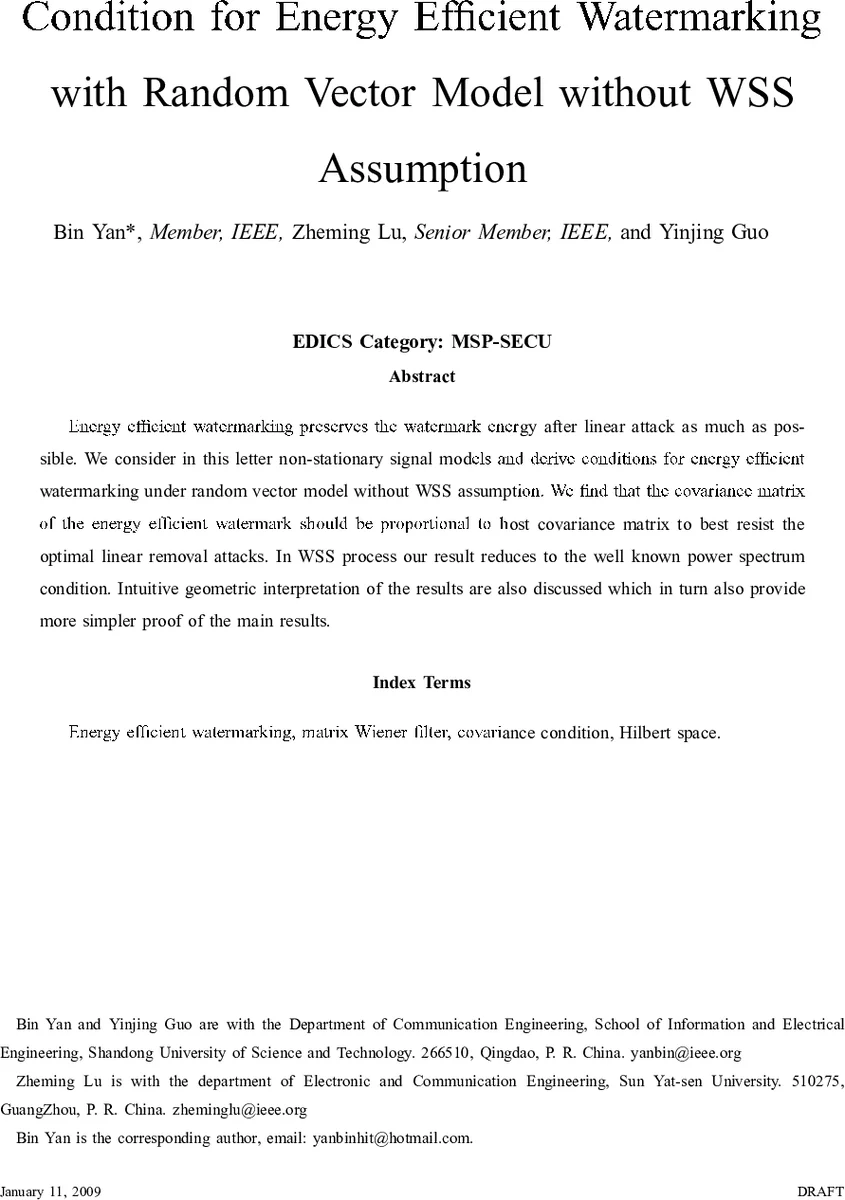
Energy efficient watermarking preserves the watermark energy after linear attack as much as possible. We consider in this letter non-stationary signal models and derive conditions for energy efficient watermarking under random vector model without WSS assumption. We find that the covariance matrix of the energy efficient watermark should be proportional to host covariance matrix to best resist the optimal linear removal attacks. In WSS process our result reduces to the well known power spectrum condition. Intuitive geometric interpretation of the results are also discussed which in turn also provide more simpler proof of the main results.
💡 Research Summary
The paper addresses the problem of designing watermarking schemes that preserve as much watermark energy as possible after a linear attack, a property termed “energy‑efficient watermarking.” While most prior work assumes that the host signal is wide‑sense stationary (WSS) and derives a power‑spectrum matching condition, real‑world media (images, audio, biomedical signals) often exhibit non‑stationary statistics. To bridge this gap, the authors model the host as a random vector x ∈ ℝⁿ with an arbitrary positive‑definite covariance matrix Σₓ, without invoking any stationarity assumption.
The attack model is linear: y = A x + n, where A is a deterministic linear operator and n is additive noise. The attacker is assumed to know the watermark and chooses an optimal linear estimator W (the MMSE filter) to minimize the mean‑square error between the extracted watermark and the original watermark w. The watermark itself is a zero‑mean random vector with covariance C_w and a fixed total power P_w = Tr(C_w).
The central question is: how should C_w be chosen so that the expected post‑attack watermark energy, E
Comments & Academic Discussion
Loading comments...
Leave a Comment