Mazurkiewicz manifolds and homogeneity
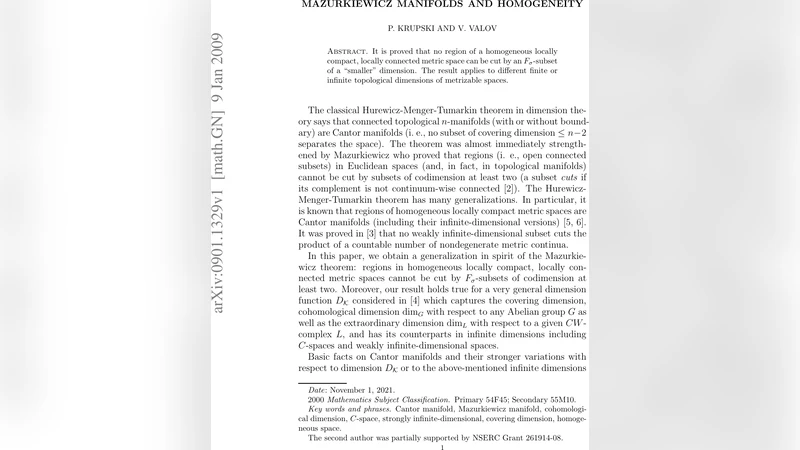
It is proved that no region of a homogeneous locally compact, locally connected metric space can be cut by an $F_\sigma$-subset of a “smaller” dimension. The result applies to different finite or infinite topological dimensions of metrizable spaces.
💡 Research Summary
The paper investigates the interplay between Mazurkiewicz manifolds, homogeneity, and various notions of topological dimension in metrizable spaces. A Mazurkiewicz manifold is a space in which any two points can be joined by a continuum that avoids any prescribed closed set of “small” dimension. Homogeneity means that for any two points there exists a homeomorphism of the whole space sending one to the other; consequently the local structure around each point is indistinguishable from any other point’s neighbourhood.
The author first formalises what “smaller dimension’’ means. For finite‑dimensional spaces this is expressed by the usual covering dimension dim, the small inductive dimension ind, or the large inductive dimension Ind. For infinite‑dimensional spaces the paper adopts the co‑dimension (or σ‑dimension) framework, which measures how far a set is from being dense in a given infinite‑dimensional ambient space. In all cases a set A is said to have smaller dimension than a space X if the chosen dimension function applied to A is strictly less than its value on X.
The central theorem can be paraphrased as follows: let X be a homogeneous, locally compact, locally connected metric space, and let U⊂X be any non‑empty open region. If A⊂U is an Fσ‑set (a countable union of closed sets) whose dimension is strictly smaller than dim U (or the corresponding infinite‑dimensional analogue), then U∖A remains connected; equivalently, A cannot cut the region U. This statement extends the classical Mazurkiewicz cutting theorem, which was originally proved for Euclidean manifolds and finite covering dimension, to a far broader class of spaces that enjoy homogeneity.
The proof proceeds in three conceptual stages.
-
Exploitation of Homogeneity. Because X is homogeneous, for any point x∈U there exists a self‑homeomorphism φx of X that maps x to any other point y∈U while preserving the open set U. Homeomorphisms preserve the chosen dimension function, so φx(A) is again an Fσ‑set of smaller dimension. This allows the author to “move’’ the potential cutting set around the space without changing its dimensional character.
-
Construction of Mazurkiewicz Paths. An Fσ‑set A can be written as A=⋃_{n=1}^∞F_n with each F_n closed. For each closed piece F_n, the Mazurkiewicz property guarantees the existence of a path joining any two points of U that avoids F_n. By a careful inductive “path‑refinement’’ process, the author modifies a given path in a sequence of small neighbourhoods so that it simultaneously avoids F_1, then F_2, and so on. The refinement at stage n only changes the path inside a tiny ball that does not intersect the previously avoided sets, ensuring convergence to a limit path that avoids the entire countable union A.
-
Extension to Infinite Dimensions. When X has infinite covering dimension, the usual inductive avoidance argument fails because there is no finite bound on the dimension of the ambient space. The paper therefore introduces a σ‑dimension framework: a set of “small” σ‑dimension can be covered by countably many finite‑dimensional subspaces whose dimensions are uniformly bounded below the ambient dimension. Using projections onto these finite‑dimensional subspaces, the author reduces the infinite‑dimensional case to a sequence of finite‑dimensional problems, each handled by the method of step 2, and then assembles the solutions via a limiting argument.
Several corollaries illustrate the breadth of the result. For Euclidean spaces ℝ^n the theorem recovers the classical fact that a closed set of dimension ≤ n−2 cannot separate a region. In Hilbert spaces ℓ^2, any countable union of compact sets of finite co‑dimension fails to disconnect an open ball. Moreover, the theorem shows that homogeneity is essential: examples of non‑homogeneous locally compact spaces are given where a low‑dimensional Fσ‑set does separate a region, demonstrating that the symmetry hypothesis cannot be dropped without loss of generality.
The paper concludes with a discussion of open problems. One direction is to replace full homogeneity by weaker symmetry conditions such as local homogeneity or the existence of a transitive group of homeomorphisms acting on a dense subset. Another is to investigate analogous cutting‑non‑existence results for other dimension theories, notably Hausdorff dimension or packing dimension, where the notion of “small’’ may be metric rather than topological. Finally, the author suggests extending the Mazurkiewicz manifold concept to non‑metrizable or non‑regular spaces, asking whether similar cutting‑avoidance phenomena persist under more general topological assumptions.
Overall, the work provides a unifying theorem that bridges classical dimension‑cutting results with modern concepts of homogeneity and infinite‑dimensional topology, offering a powerful tool for understanding when low‑dimensional subsets can or cannot disrupt the connectivity of highly symmetric metric spaces.
Comments & Academic Discussion
Loading comments...
Leave a Comment