Construction of Large Constant Dimension Codes With a Prescribed Minimum Distance
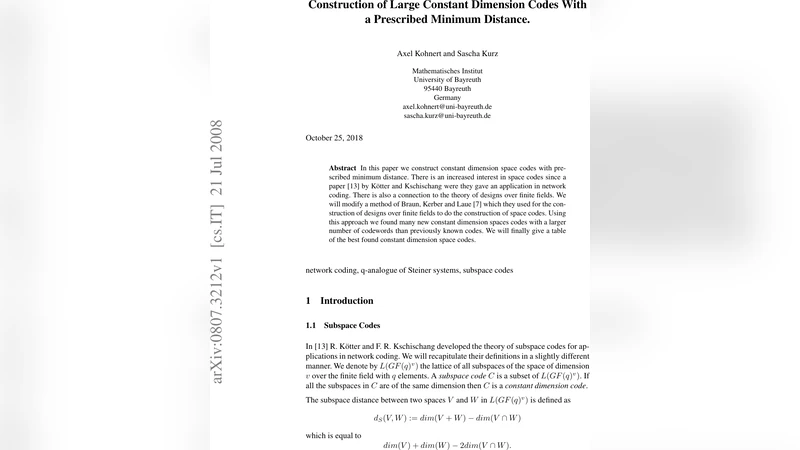
In this paper we construct constant dimension space codes with prescribed minimum distance. There is an increased interest in space codes since a paper by Koetter and Kschischang were they gave an application in network coding. There is also a connection to the theory of designs over finite fields. We will modify a method of Braun, Kerber and Laue which they used for the construction of designs over finite fields to do the construction of space codes. Using this approach we found many new constant dimension spaces codes with a larger number of codewords than previously known codes. We will finally give a table of the best found constant dimension space codes.
💡 Research Summary
**
The paper addresses the construction of large constant‑dimension subspace codes (often abbreviated as CDCs) with a prescribed minimum subspace distance, a problem that has gained considerable attention since the seminal work of Kötter and Kschischang on network coding. The authors build upon the connection between CDCs and q‑analogs of combinatorial designs, particularly the q‑analog of Steiner systems, and adapt a method originally developed by Braun, Kerber, and Laue for constructing designs over finite fields.
The central theoretical contribution is a reformulation of the CDC existence problem as a system of Diophantine (0‑1) linear equations. For a given ambient space GF(q)^v, a target dimension k, and a desired minimum distance 2d, one considers the incidence matrix M whose rows correspond to all (k‑d+1)-dimensional subspaces and whose columns correspond to all k‑dimensional subspaces. An entry M_{W,V} equals 1 if the (k‑d+1)-subspace W is contained in the k‑subspace V, and 0 otherwise. Theorem 1 states that a CDC with m codewords and minimum distance at least 2d exists if and only if there is a binary vector x satisfying
- Σ x_i = m,
- M x ≤ 1 (component‑wise).
Thus each row of M may be “covered” by at most one selected k‑subspace, guaranteeing that no (k‑d+1)-subspace is shared by two codewords, which is precisely the distance condition. This formulation generalises the earlier Diophantine description of q‑analog Steiner systems, where the inequality becomes an equality.
Directly solving the system is infeasible for realistic parameters because the number of k‑subspaces grows as the Gaussian binomial coefficient (\binom{v}{k}_q). To overcome this combinatorial explosion, the authors introduce two complementary reduction techniques.
(i) Prescribed Automorphism Groups.
By fixing a subgroup G ≤ GL(v,q) that is required to be contained in the automorphism group of the desired code, the incidence matrix can be compressed. All k‑subspaces belonging to the same G‑orbit are merged into a single variable, and all (k‑d+1)-subspaces in the same orbit give rise to a single inequality. The resulting reduced matrix M_G has far fewer rows and columns, making integer‑linear programming (ILP) tractable. Theorem 2 formalises this reduction, showing that a (0‑1) solution to the compressed system yields a CDC whose automorphism group contains G.
(ii) Singer Cycles.
A particularly effective choice for G is a Singer subgroup, which acts regularly on the one‑dimensional subspaces of GF(q)^v. Under this action, each k‑subspace can be represented by a set of integers (the exponents of the generator that map a fixed 1‑space to the points of the subspace). The authors define the distance distribution D_U of a k‑subspace U as the multiset of modular distances between all pairs of its constituent 1‑spaces. Lemma 1 proves that a Singer orbit yields a CDC with minimum distance 2(k‑1) precisely when D_U contains no repeated values; in other words, any two distinct points of the orbit intersect in at most a line. This observation allows the construction of large CDCs without solving a full ILP: one merely selects orbits whose distance distributions are pairwise distinct.
The paper demonstrates the practicality of these ideas with concrete examples. For GF(2)^7, k=3, and desired distance 4, the full incidence matrix would have 1 181 columns and 2 667 rows. By choosing a small cyclic automorphism group G, the authors reduce the problem to 567 variables and 129 constraints. Using the commercial ILP solver CPLEX, they obtain a solution with 16 selected orbits, which corresponds to a CDC of size 304—significantly larger than the previously best known codes of size 289 and 294.
Further, the Singer‑cycle construction is illustrated for q=2, v=5, k=2. Here each 2‑subspace contains three 1‑subspaces; the orbit length under the Singer group is 31, and the distance distributions of the 31 orbits are computed. Selecting orbits with pairwise distinct distance multisets yields a CDC achieving the theoretical bound 2(k‑1)=2.
From an algorithmic standpoint, the authors employ several tools: a custom LLL‑based heuristic for feasibility testing (due to Wassermann), CPLEX for exact ILP optimisation, and CLIQUER for maximum‑weight clique extraction when the problem is reformulated as a graph‑theoretic independence‑set problem. They also discuss how additional independent‑set constraints can be added to tighten the ILP formulation, thereby improving solver performance.
The experimental results are summarised in a table that lists the best known CDC parameters discovered by the authors for various (q, v, k, d) tuples. In most cases the new codes surpass previously reported constructions, especially in the regime where k is moderate relative to v and the field size q is small.
In conclusion, the paper contributes a unified framework that (1) translates the CDC design problem into a Diophantine system, (2) leverages group symmetry (automorphisms and Singer cycles) to dramatically reduce problem size, and (3) applies modern integer‑programming and graph‑theoretic solvers to obtain concrete codes that improve upon the state of the art. These methods not only advance the construction of subspace codes for network coding but also provide a versatile toolbox for related combinatorial design problems over finite fields.
Comments & Academic Discussion
Loading comments...
Leave a Comment