A method to construct both classical and quantum completely integrable systems from (Jordan-Lie) comodule algebras is introduced. Several integrable models based on a so(2,1) comodule algebra, two non-standard Schrodinger comodule algebras, the (classical and quantum) q-oscillator algebra and the Reflection Equation algebra are explicitly obtained.
Deep Dive into Comodule algebras and integrable systems.
A method to construct both classical and quantum completely integrable systems from (Jordan-Lie) comodule algebras is introduced. Several integrable models based on a so(2,1) comodule algebra, two non-standard Schrodinger comodule algebras, the (classical and quantum) q-oscillator algebra and the Reflection Equation algebra are explicitly obtained.
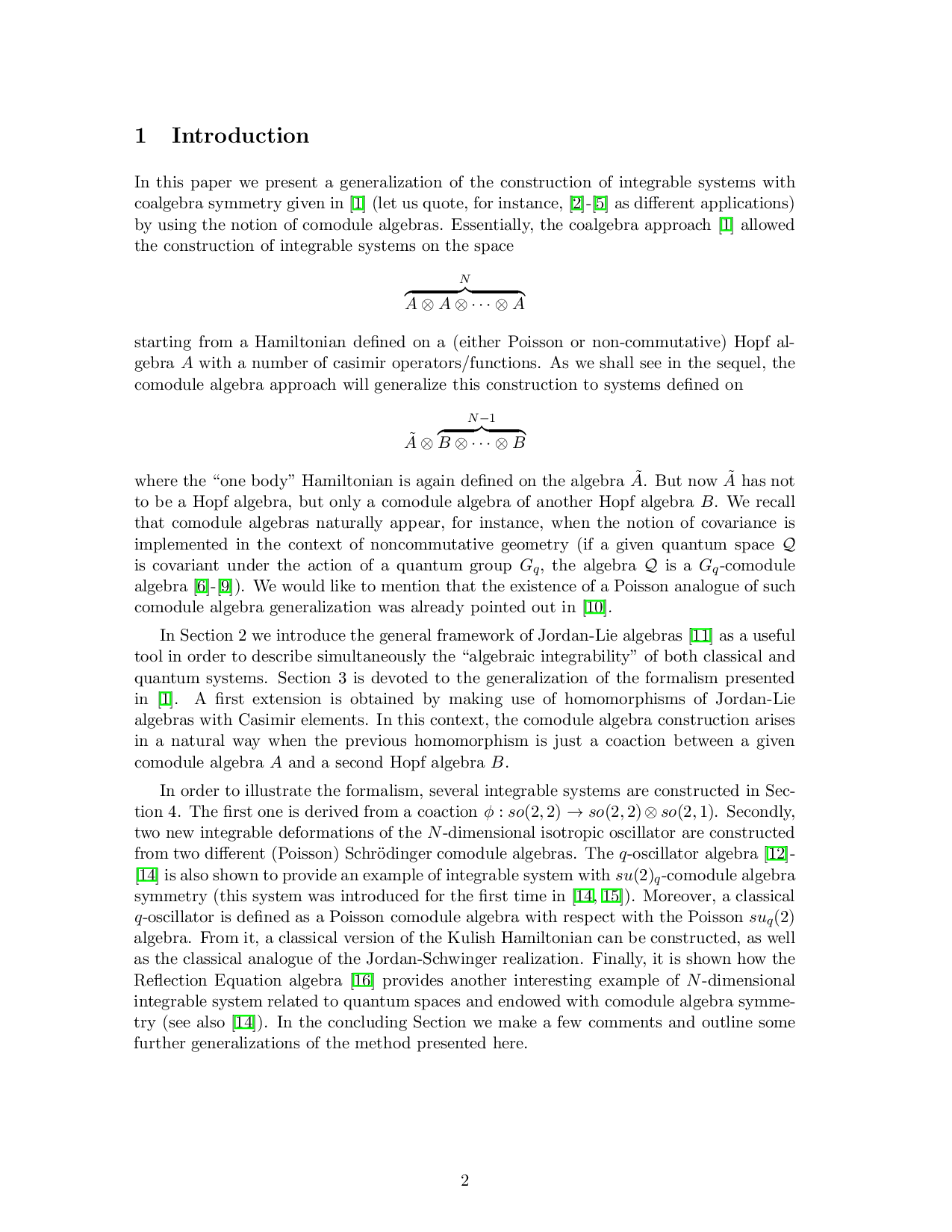
In this paper we present a generalization of the construction of integrable systems with coalgebra symmetry given in [1] (let us quote, for instance, [2]- [5] as different applications) by using the notion of comodule algebras. Essentially, the coalgebra approach [1] allowed the construction of integrable systems on the space
starting from a Hamiltonian defined on a (either Poisson or non-commutative) Hopf algebra A with a number of casimir operators/functions. As we shall see in the sequel, the comodule algebra approach will generalize this construction to systems defined on
where the “one body” Hamiltonian is again defined on the algebra Ã. But now à has not to be a Hopf algebra, but only a comodule algebra of another Hopf algebra B. We recall that comodule algebras naturally appear, for instance, when the notion of covariance is implemented in the context of noncommutative geometry (if a given quantum space Q is covariant under the action of a quantum group G q , the algebra Q is a G q -comodule algebra [6]- [9]). We would like to mention that the existence of a Poisson analogue of such comodule algebra generalization was already pointed out in [10].
In Section 2 we introduce the general framework of Jordan-Lie algebras [11] as a useful tool in order to describe simultaneously the “algebraic integrability” of both classical and quantum systems. Section 3 is devoted to the generalization of the formalism presented in [1]. A first extension is obtained by making use of homomorphisms of Jordan-Lie algebras with Casimir elements. In this context, the comodule algebra construction arises in a natural way when the previous homomorphism is just a coaction between a given comodule algebra A and a second Hopf algebra B.
In order to illustrate the formalism, several integrable systems are constructed in Section 4. The first one is derived from a coaction φ : so(2, 2) → so(2, 2) ⊗ so (2,1). Secondly, two new integrable deformations of the N -dimensional isotropic oscillator are constructed from two different (Poisson) Schrödinger comodule algebras. The q-oscillator algebra [12]- [14] is also shown to provide an example of integrable system with su(2) q -comodule algebra symmetry (this system was introduced for the first time in [14,15]). Moreover, a classical q-oscillator is defined as a Poisson comodule algebra with respect with the Poisson su q (2) algebra. From it, a classical version of the Kulish Hamiltonian can be constructed, as well as the classical analogue of the Jordan-Schwinger realization. Finally, it is shown how the Reflection Equation algebra [16] provides another interesting example of N -dimensional integrable system related to quantum spaces and endowed with comodule algebra symmetry (see also [14]). In the concluding Section we make a few comments and outline some further generalizations of the method presented here.
We tersely recall the algebraic structure of classical and quantum observables. A classical observable is a smooth function F : P → R where P is a Poisson manifold. The space of classical observables is naturally equipped with two bilinear operations: the pointwise multiplication
x ∈ P and the Poisson bracket [, ] given in local coordinates by:
where P ij is a Poisson tensor. The pointwise multiplication is a unital, associative and commutative product, while the Poisson bracket is a Lie product; the two structures are coupled by the Leibnitz rule (i.e. the Lie product is a derivation for the associative product).
On the other hand, a quantum observable is a self-adjoint operator on a given Hilbert space. The space of quantum observables is again equipped with two bilinear operations defined through the operator composition: the anticommutator (a • b) := ab + ba that is a commutative but not associative unital product, and the Lie product We notice that both the “classical” and the “quantum” products obey the Jordan identity, namely:
Hence both classical and quantum observables give rise to “Jordan-Lie algebras” [11].
It is straightforward to generalize the definition of Jordan-Lie algebra by replacing the Jordan product • with an associative but not necessarily commutative product •. This is the kind of Jordan-Lie algebra that we shall consider in this paper: while the classical product will be again given by pointwise multiplication, the quantum product will be just the operator (noncommutative) composition:
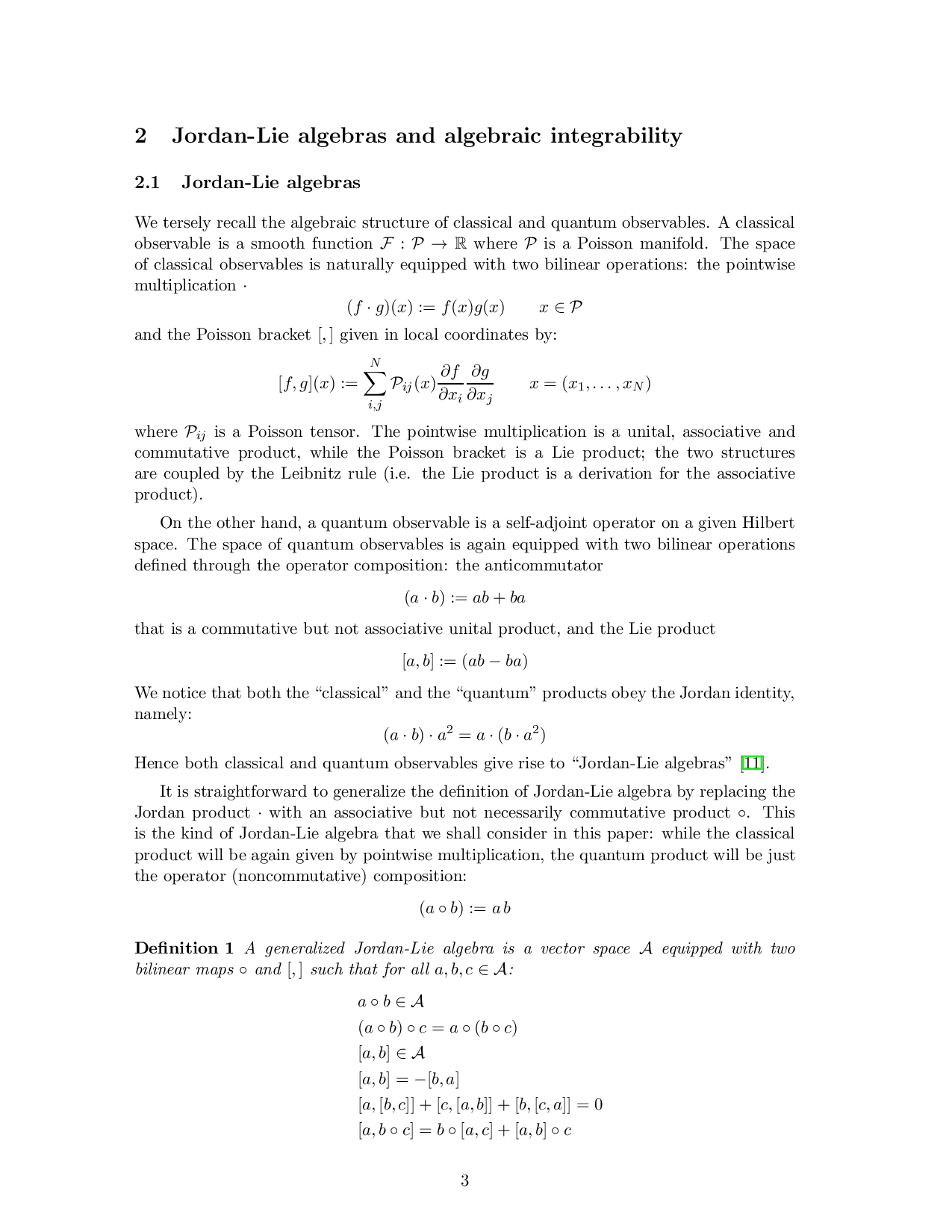
Definition 1 A generalized Jordan-Lie algebra is a vector space A equipped with two bilinear maps • and [, ] such that for all a, b, c ∈ A:
Remark: In the sequel, we will restrict considerations either to “Classical Jordan-Lie” algebras (hereby referred to as CJL), where the associative product • is commutative, or to “Quantum Jordan-Lie” algebras (hereby referred to as QJL), where the Lie product [, ] is defined through the associative product
2.2 Dynamics and algebraic integrability ¿From a purely algebraic point of view we can describe a Hamiltonian system as a
…(Full text truncated)…
This content is AI-processed based on ArXiv data.