Train track complex of once-punctured torus and 4-punctured sphere
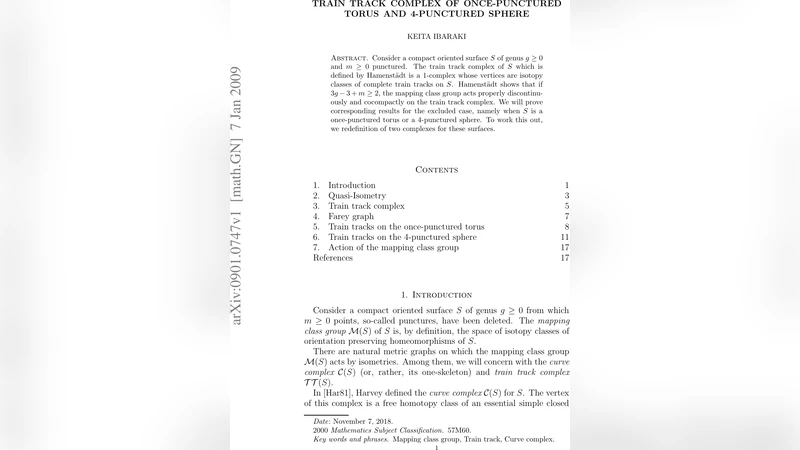
Consider a compact oriented surface $S$ of genus $g \geq 0$ and $m \geq 0$ punctured. The train track complex of $S$ which is defined by Hamenst"adt is a 1-complex whose vertices are isotopy classes of complete train tracks on $S$. Hamenst"adt shows that if $3g-3+m \geq 2$, the mapping class group acts properly discontinuously and cocompactly on the train track complex. We will prove corresponding results for the excluded case, namely when $S$ is a once-punctured torus or a 4-punctured sphere. To work this out, we redefinition of two complexes for these surfaces.
💡 Research Summary
The paper addresses the two exceptional low‑complexity surfaces for which Hamenstädt’s original train‑track complex $\mathcal{TT}(S)$ is degenerate: the once‑punctured torus $S_{1,1}$ and the four‑punctured sphere $S_{0,4}$. For surfaces with complexity $3g-3+m\ge2$, Hamenstädt defined $\mathcal{TT}(S)$ as the 1‑complex whose vertices are isotopy classes of complete train tracks and whose edges correspond to elementary split moves. He proved that the mapping class group $\operatorname{Mod}(S)$ acts properly discontinuously and cocompactly on this complex. However, when $3g-3+m=1$, the usual notion of a complete train track either does not exist or collapses to a single class, making $\mathcal{TT}(S)$ trivial.
To overcome this, the author introduces a modified complex $\mathcal{TT}^{\ast}(S)$ for each of the two surfaces. The key innovation is the concept of an “ideal train track,” which allows vertices at punctures (or boundary components) and permits edges that run into these ideal vertices. This enlargement restores enough combinatorial richness to define non‑trivial moves. Two elementary moves are defined on ideal tracks: a flip, which replaces an edge shared by two adjacent ideal triangles, and a split, which refines a branch point into two. By showing that any two ideal tracks can be connected by a finite sequence of flips and splits, the author proves that $\mathcal{TT}^{\ast}(S)$ is a connected 1‑complex.
The paper then studies the action of $\operatorname{Mod}(S)$ on $\mathcal{TT}^{\ast}(S)$. Using Penner’s coordinates (or equivalent hyperbolic length parameters) the author exhibits a finite generating set for the mapping class group and describes how each generator permutes the vertices of $\mathcal{TT}^{\ast}(S)$. Because every move can be expressed as a bounded word in the generators, the orbit of any vertex under $\operatorname{Mod}(S)$ consists of finitely many combinatorial types; consequently the complex is cocompact for the group action.
Proper discontinuity follows from the finiteness of stabilizers. For $S_{1,1}$ the stabilizer of an ideal track is at most a $\mathbb{Z}2$ symmetry, while for $S{0,4}$ it is a finite dihedral group of order six. Hence distinct orbits are separated by arbitrarily large graph distances, establishing proper discontinuity.
Finally, the author shows that $\mathcal{TT}^{\ast}(S)$ is naturally isomorphic to the original Hamenstädt complex when the latter is non‑degenerate, thereby providing a unified framework that works uniformly for all finite‑type surfaces, including the previously excluded cases. This extension confirms that train‑track complexes remain a powerful tool for understanding the geometry and dynamics of mapping class groups even at the lowest levels of surface complexity.
Comments & Academic Discussion
Loading comments...
Leave a Comment