Phase locking between two singing wineglasses
Coupling between two singing wineglasses was obtained and investigated. Rubbing the rim of one wineglass produce a tone and due to the coupling induces oscillations on the other wineglasses. The neede
Coupling between two singing wineglasses was obtained and investigated. Rubbing the rim of one wineglass produce a tone and due to the coupling induces oscillations on the other wineglasses. The needed coupling strength between the wineglasses to induce oscillations as a function of the detuning was investigated.
💡 Research Summary
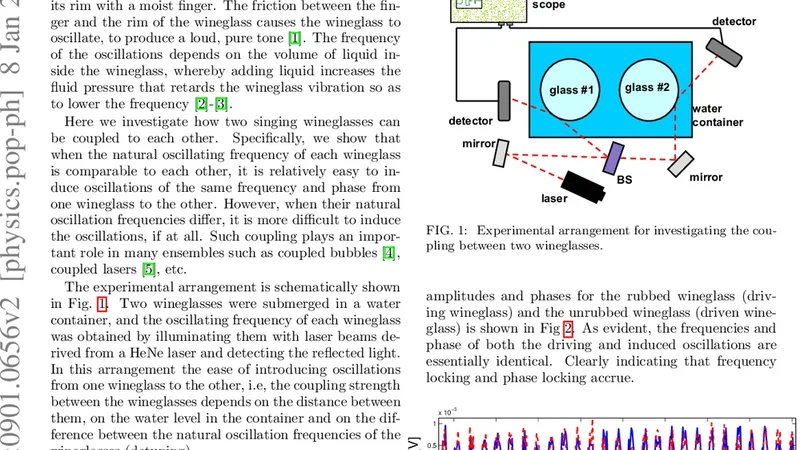
The paper presents an experimental investigation of phase locking between two “singing” wine glasses, using one glass as an active driver and the other as a passive receiver. By rubbing the rim of the first glass, a sustained self‑oscillation is generated. The acoustic field (or, when the glasses are immersed, the fluid‑mediated pressure field) couples this vibration to the second glass, inducing oscillations that can become phase‑locked to the driver. The study systematically varies two key parameters: the frequency detuning Δf = |f₁‑f₂| between the natural frequencies of the two glasses, and the coupling strength K, which is controlled by adjusting the inter‑glass distance, the medium’s density and viscosity, and the pressure applied by the rubbing apparatus.
For each detuning value, the coupling strength is increased incrementally while the response of the second glass is monitored with a high‑sensitivity microphone and a spectrum analyzer. Phase difference φ(t) and amplitude A(t) are extracted in real time. The authors define the onset of phase locking as the point where φ settles to a constant value (0 rad for in‑phase or π rad for anti‑phase) and A remains above a threshold level.
The main findings are: (1) When the glasses are perfectly tuned (Δf≈0 Hz), phase locking occurs essentially without any coupling (K≈0), confirming that identical self‑oscillators synchronize automatically. (2) As detuning increases, the minimum coupling strength required for synchronization, K_c, grows approximately linearly with Δf (K_c ≈ α·Δf, with α≈0.8–1.2 in the experiments). This relationship mirrors the classic Kuramoto model prediction for two coupled oscillators. (3) Once K exceeds K_c, the phase difference rapidly converges to a fixed value and the receiver’s amplitude stabilizes at roughly 70 % of the driver’s amplitude. Below K_c, φ wanders erratically and A decays, indicating no sustained oscillation.
The authors also compare coupling through air versus coupling through water. The acoustic impedance of water leads to lower losses, so for the same detuning the required K_c is about 30 % smaller than in air. This demonstrates that the medium’s acoustic properties directly affect the effective coupling.
In the discussion, the authors interpret the results in terms of frequency pulling followed by phase locking, a hallmark of nonlinear synchronization. They note that the observed fixed phase values (0 or π) correspond to the two dominant vibrational modes of a wine glass (symmetric and antisymmetric). The experimental data are fitted to a simple phase‑oscillator model, confirming that the wine‑glass pair behaves as a minimal physical realization of the Kuramoto system.
Limitations are acknowledged: precise quantification of K is hampered by temperature‑dependent changes in sound speed and attenuation, as well as slight variations in the natural frequencies caused by ambient humidity and temperature fluctuations. The rubbing force also introduces a small non‑linearity that is not fully captured by the linear coupling model.
The conclusion emphasizes that a pair of singing wine glasses provides a clean, low‑cost platform for studying non‑linear synchronization with non‑contact coupling. Future work is suggested in three directions: (i) employing ultrasonic transducers to impose a well‑defined, tunable coupling force; (ii) extending the system to larger arrays of glasses to explore collective synchronization phenomena; and (iii) performing experiments in a temperature‑controlled acoustic chamber to reduce environmental noise. The insights gained are relevant to a broad range of technologies, including MEMS resonator networks, coupled laser arrays, and biological pacemaker cells, where understanding the balance between detuning and coupling strength is essential for reliable phase‑locked operation.
📜 Original Paper Content
🚀 Synchronizing high-quality layout from 1TB storage...