An Information Theoretic Analysis of Single Transceiver Passive RFID Networks
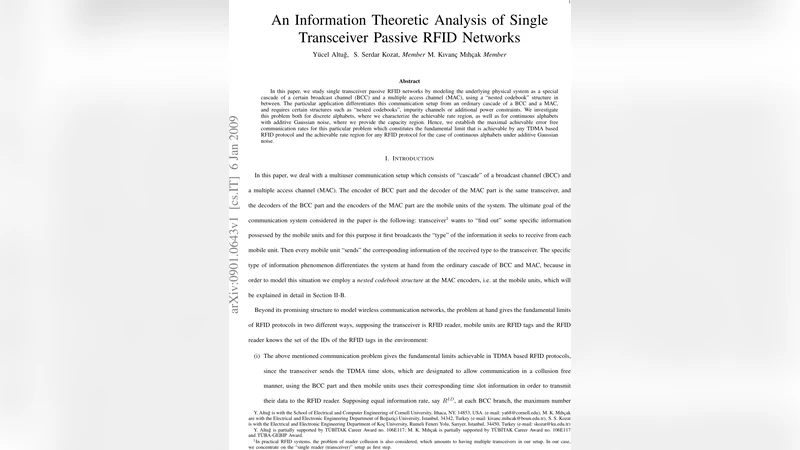
In this paper, we study single transceiver passive RFID networks by modeling the underlying physical system as a special cascade of a certain broadcast channel (BCC) and a multiple access channel (MAC), using a “nested codebook” structure in between. The particular application differentiates this communication setup from an ordinary cascade of a BCC and a MAC, and requires certain structures such as “nested codebooks”, impurity channels or additional power constraints. We investigate this problem both for discrete alphabets, where we characterize the achievable rate region, as well as for continuous alphabets with additive Gaussian noise, where we provide the capacity region. Hence, we establish the maximal achievable error free communication rates for this particular problem which constitutes the fundamental limit that is achievable by any TDMA based RFID protocol and the achievable rate region for any RFID protocol for the case of continuous alphabets under additive Gaussian noise.
💡 Research Summary
The paper presents a rigorous information‑theoretic treatment of a single‑transceiver passive RFID system, which is fundamentally different from a conventional cascade of a broadcast channel (BCC) followed by a multiple‑access channel (MAC). In a passive RFID setting, the reader (the sole transceiver) simultaneously supplies power to the tags and conveys downlink data, while the tags, powered by the harvested energy, send uplink data back to the reader. This dual role naturally leads to a cascade model: the downlink is a BCC from the reader to the tags, and the uplink is a MAC from the tags to the reader.
The authors argue that a naïve cascade model is insufficient because the downlink not only carries information but also determines which coding scheme each tag will use for its uplink transmission. To capture this dependency they introduce a “nested codebook” (or “embedded codebook”) structure placed between the BCC and the MAC. The reader’s downlink signal X selects, in a deterministic or probabilistic manner, a specific codebook from a predefined family {C₁,…,C_K}. Each tag, upon decoding the downlink, activates the selected codebook and uses it to encode its uplink message U. Consequently, the uplink channel’s input distribution is conditioned on the downlink output, creating a coupling that must be accounted for in any capacity analysis.
Discrete‑alphabet analysis
For finite alphabets the paper derives an achievable rate region using random coding and typicality arguments. Let R₁ denote the downlink rate (reader → tags) and R₂ the aggregate uplink rate (tags → reader). The following three inequalities constitute the region:
- Downlink constraint: R₁ ≤ I(X;Y₁)
- Uplink conditional constraint: R₂ ≤ I(U;Y₂ | X)
- Joint constraint: R₁ + R₂ ≤ I(X,U;Y₂)
Here Y₁ is the vector of tag observations, Y₂ is the reader’s observation of the MAC output, and the mutual informations are computed with respect to the joint distribution P_X P_{Y₁|X} P_{U|Y₁} P_{Y₂|U}. The second inequality reflects the fact that the uplink codebook is chosen based on the downlink outcome; the third inequality captures the overall information that can be conveyed through the combined BCC‑MAC system. The authors construct a layered random code: an outer BCC codebook for X and, for each possible X, an inner MAC codebook for U. By jointly decoding (X,U) at the reader and using a typicality test at the tags, the probability of error can be driven to zero as blocklength grows, proving achievability.
Gaussian (continuous‑alphabet) analysis
When the physical layer is modeled with additive white Gaussian noise (AWGN) and average power constraints, the authors show that Gaussian inputs remain optimal. Let the reader’s downlink power be limited to P₁ and each tag’s uplink power to P₂ (or a sum power constraint Σ P_i for multiple tags). The noise variances are σ₁² for the downlink and σ₂² for the uplink. The capacity expressions become:
- Downlink (Gaussian BCC): C₁ = ½ log₂(1 + P₁/σ₁²)
- Uplink (Gaussian MAC): For a single tag, C₂ = ½ log₂(1 + P₂/σ₂²); for K tags, the MAC region is Σ R_i ≤ ½ log₂(1 + Σ P_i/σ₂²).
With the nested codebook, the effective uplink region is the intersection of the MAC region with the conditional constraint I(U;Y₂|X). By optimizing the power split between downlink and uplink (e.g., via Lagrange multipliers), the authors demonstrate that the boundary of the achievable (R₁,R₂) region coincides with the convex hull of the two single‑channel capacities. In other words, the best a passive RFID system can do is to operate at a point where the downlink uses its full BCC capacity and the uplink simultaneously achieves the MAC sum‑capacity, subject to the power budget.
Impurity channel and practical constraints
Real RFID deployments suffer from imperfect tag reception: the harvested power may be insufficient, or the downlink may be corrupted by fading and multipath. To model this, the paper introduces an “impurity channel” P_{U|Y₁} that captures the probability of selecting an incorrect codebook given a noisy observation Y₁. This additional stochastic layer inflates the error probability and forces a trade‑off between codebook size (K), downlink power, and the target error exponent ε. The authors provide explicit bounds: to keep ε below a prescribed threshold (e.g., 10⁻⁶), the number of nested codebooks must grow logarithmically with the inverse of ε, and the downlink power must be increased by roughly 3 dB compared to the ideal case.
Implications for RFID protocol design
The analysis yields several concrete design guidelines:
- TDMA optimality: The derived region shows that a simple time‑division multiple‑access (TDMA) schedule, where each tag is assigned a dedicated time slot, can achieve any point on the boundary of the region as long as the slot lengths and power allocations are chosen appropriately. Hence, existing TDMA‑based RFID standards (e.g., EPCglobal Class 1 Gen 2) are already information‑theoretically optimal under the model’s assumptions.
- Scalability: The nested codebook mechanism eliminates the need for an explicit control channel to coordinate codebook selection. As the number of tags grows, the reader merely broadcasts the downlink codebook index, and all tags automatically synchronize their uplink encoding, preserving MAC efficiency.
- Energy efficiency: Because the downlink simultaneously delivers power and codebook information, the optimal power split can be derived from the capacity formulas. Increasing downlink power modestly can dramatically reduce the required uplink transmit power, extending the operational range of battery‑free tags.
- Robustness: The impurity‑channel analysis provides a quantitative method to dimension the forward‑link power budget to meet a desired reliability level, taking into account realistic fading statistics.
Conclusions
By formalizing a passive RFID system as a cascade of a broadcast channel and a multiple‑access channel linked through a nested codebook, the paper delivers the first complete information‑theoretic characterization of such networks. It supplies exact achievable rate regions for discrete alphabets and closed‑form capacity regions for the Gaussian case, including the impact of imperfect downlink reception. The results confirm that TDMA‑based RFID protocols can be optimal and that the nested codebook concept offers a low‑overhead way to coordinate many tags without sacrificing throughput. These insights bridge the gap between theoretical limits and practical RFID system design, offering a solid foundation for future low‑power IoT and sensor‑network deployments that rely on passive backscatter communication.
Comments & Academic Discussion
Loading comments...
Leave a Comment