Whispering gallery mode enhanced optical force with resonant tunneling excitation in the Kretschmann geometry
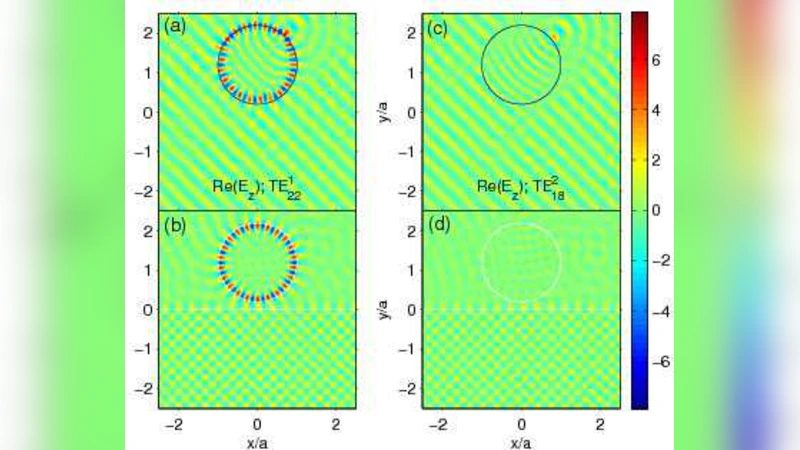
The boundary element method is applied to investigate the optical forces when whispering gallery modes (WGMs) are excited by a total internally reflected wave. Such evanescent wave is particularly effective in exciting the high-$Q$ WGM, while the low angular or high radial order modes are suppressed relatively. This results in a large contrast between the forces on and off resonance, and thus allows for high size-selectivity. We fully incorporate the prism-particle interaction and found that the optical force behaves differently at different separations. Optimal separation is found which corresponds to a compromise between intensity and $Q$ factor.
💡 Research Summary
This paper investigates how whispering‑gallery modes (WGMs) can be efficiently excited in a dielectric microsphere by an evanescent field generated in the Kretschmann configuration, and how the resulting optical forces depend on particle‑prism separation. Using the boundary‑element method (BEM), the authors solve the full Maxwell equations for a system that includes the prism, the surrounding medium, and the spherical particle, thereby capturing the complex near‑field interaction that is often omitted in simpler models. The evanescent wave, produced by total internal reflection inside a high‑index prism, decays exponentially away from the prism surface. When a sphere is placed within a few hundred nanometres of the surface, the evanescent field couples strongly to high‑Q WGMs whose angular momentum is large and radial order is low. Because the spatial profile of the evanescent field matches these modes, they are preferentially excited while low‑angular‑momentum or high‑radial‑order modes are strongly suppressed. Consequently, the optical force on resonance can be tens to hundreds of times larger than the off‑resonant force, providing a pronounced contrast that can be exploited for size‑selective manipulation.
The authors systematically vary the particle‑prism gap and find that the force does not increase monotonically with decreasing distance. At very small gaps, the proximity to the high‑index prism introduces additional radiation leakage, degrading the Q‑factor and reducing the resonant enhancement. At larger gaps, the evanescent intensity drops rapidly, weakening the coupling to the WGM. An optimal separation—typically around 100–200 nm for the parameters studied—emerges as a compromise between maintaining a high field intensity and preserving the intrinsic high Q of the mode. This optimum is robust against modest changes in particle size, refractive index, and illumination wavelength.
The study demonstrates that by carefully tuning the particle‑prism distance, one can achieve strong, resonantly enhanced optical forces while keeping the required laser power low. The large force contrast enables high‑resolution sorting of particles based on minute differences in size or refractive index, because only particles whose resonant wavelength matches the illumination experience the amplified pull. Moreover, the Kretschmann geometry is compatible with surface‑plasmon‑resonance platforms, suggesting that hybrid devices could combine plasmonic field enhancement with WGM‑mediated force amplification. The authors conclude that evanescent‑field‑driven WGM excitation offers a powerful route toward precise, low‑power optical manipulation and sensing in micro‑ and nano‑scale systems.
Comments & Academic Discussion
Loading comments...
Leave a Comment