Invariance of generalized wordlength patterns
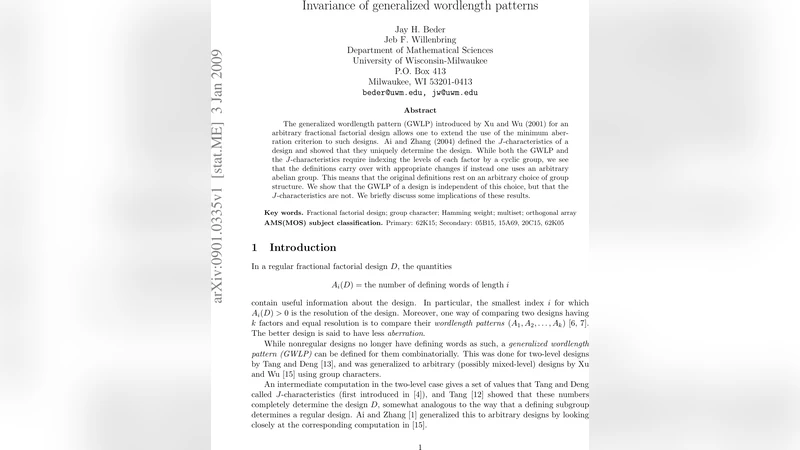
The generalized wordlength pattern (GWLP) introduced by Xu and Wu (2001) for an arbitrary fractional factorial design allows one to extend the use of the minimum aberration criterion to such designs. Ai and Zhang (2004) defined the $J$-characteristics of a design and showed that they uniquely determine the design. While both the GWLP and the $J$-characteristics require indexing the levels of each factor by a cyclic group, we see that the definitions carry over with appropriate changes if instead one uses an arbitrary abelian group. This means that the original definitions rest on an arbitrary choice of group structure. We show that the GWLP of a design is independent of this choice, but that the $J$-characteristics are not. We briefly discuss some implications of these results.
💡 Research Summary
The paper investigates two fundamental descriptors of fractional factorial designs – the generalized wordlength pattern (GWLP) and the J‑characteristics – and clarifies how their definitions depend on the algebraic structure used to index factor levels. Historically, both quantities have been introduced under the assumption that each factor’s levels are labeled by the elements of a cyclic group (typically ℤₖ). The authors first observe that this assumption is not essential: any finite abelian group can be used to label the levels, provided the appropriate modifications are made to the definitions of GWLP and J‑characteristics. This observation raises the question of whether the numerical values of these descriptors are invariant under a change of the underlying group.
The main theoretical contribution is a proof that the GWLP is indeed invariant under the choice of abelian group. The GWLP is defined as a sequence of numbers A₁, A₂, …, Aₙ, where A_j is the average squared contrast for all j‑factor projections of the design. The authors show that these averages can be expressed purely in terms of the design’s indicator function and the orthogonal decomposition of the treatment space, both of which are independent of the specific character table used. Consequently, any two abelian groups that are isomorphic (or even non‑isomorphic) yield the same GWLP for a given design. This result guarantees that GWLP can serve as a robust, group‑free criterion for comparing designs, extending the minimum aberration principle without the need to fix a particular labeling scheme.
In contrast, the J‑characteristics are defined as the set of inner products between the design’s incidence matrix and the characters of the chosen group. Because characters are homomorphisms that depend explicitly on the group’s structure, the resulting J‑values change when a different abelian group is employed. The paper provides concrete examples (e.g., using ℤ₂ versus ℤ₄ for a two‑level factor) that illustrate how the same design can produce distinct J‑characteristic vectors under different group choices. This non‑invariance implies that J‑characteristics, while still uniquely determining a design, are not suitable as a universal, group‑independent summary statistic.
The authors discuss practical implications of these findings. Since GWLP is group‑independent, experimenters can label factor levels in any convenient way—numeric codes, colors, or textual tags—without affecting the GWLP calculation. This flexibility simplifies the use of GWLP in design construction algorithms, optimization procedures, and software implementations, where arbitrary labeling often occurs. On the other hand, when J‑characteristics are employed (for instance, in design identification or database storage), the specific group used must be recorded to ensure reproducibility. The paper suggests that future work could focus on either redefining J‑characteristics in a group‑free manner or combining GWLP with additional invariant descriptors to capture the full information that J‑characteristics provide.
Finally, the paper outlines several avenues for further research. One direction is to explore extensions of the invariance proof to non‑abelian groups or to designs with continuous factor levels. Another is to develop algorithms that exploit GWLP’s invariance to reduce computational overhead in large‑scale design searches. A third possibility is to construct hybrid criteria that retain the uniqueness property of J‑characteristics while shedding their dependence on group choice, perhaps by averaging over all possible character tables. In sum, the work establishes GWLP as a robust, universally applicable tool for evaluating fractional factorial designs and clarifies the limitations of J‑characteristics, thereby guiding both theoretical developments and practical applications in experimental design.
Comments & Academic Discussion
Loading comments...
Leave a Comment