An Algorithm for File Transfer Scheduling in Grid Environments
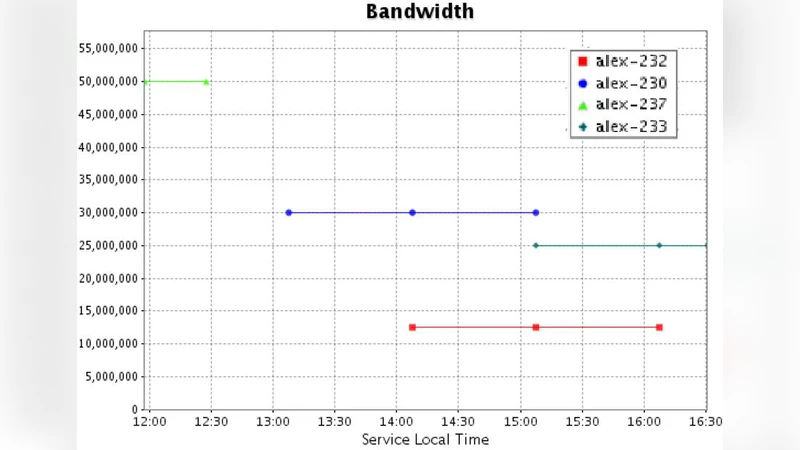
This paper addresses the data transfer scheduling problem for Grid environments, presenting a centralized scheduler developed with dynamic and adaptive features. The algorithm offers a reservation system for user transfer requests that allocates them transfer times and bandwidth, according to the network topology and the constraints the user specified for the requests. This paper presents the projects related to the data transfer field, the design of the framework for which the scheduler was built, the main features of the scheduler, the steps for transfer requests rescheduling and two tests that illustrate the system’s behavior for different types of transfer requests.
💡 Research Summary
The paper tackles the problem of scheduling large‑scale file transfers in grid computing environments, where heterogeneous resources and dynamic network conditions make efficient data movement a critical challenge. The authors propose a centralized scheduler that treats each user‑initiated transfer as a reservation with explicit constraints such as earliest start time, deadline, minimum and maximum bandwidth, and file size. By modeling the underlying network as a graph whose edges represent links with real‑time bandwidth availability, the scheduler can compute a time‑bandwidth mapping that respects both user constraints and the current state of the network.
The system architecture consists of four main modules: (1) a topology manager that maintains a graph representation of nodes and links and continuously monitors link utilization; (2) a request processor that parses incoming transfer requests and translates them into a constraint‑satisfaction problem; (3) a scheduling engine that explores feasible paths and time slots, evaluates a cost function (including bandwidth utilization, transfer latency, and request priority), and selects the optimal combination; and (4) a dynamic rescheduling and fault‑recovery module that reacts to higher‑priority arrivals or network failures by adjusting existing reservations. The core algorithm proceeds by constructing a “available bandwidth table,” generating candidate time windows that satisfy the user’s temporal constraints, enumerating viable paths for each window, checking bandwidth feasibility on each link, and finally scoring each candidate with the cost function. The best candidate is committed to the reservation table and communicated back to the user.
A key contribution is the dynamic rescheduling mechanism. When a new high‑priority request conflicts with existing reservations, the scheduler can postpone or shrink lower‑priority transfers, effectively reshaping the “time‑bandwidth window” to accommodate the newcomer without violating any hard constraints. In the event of link failures, the affected reservations are automatically recomputed, selecting alternative routes and new time slots. This adaptive behavior is essential for grid environments where network conditions can change abruptly.
The authors evaluate the scheduler with two experimental scenarios. In the first scenario, a stream of large files (hundreds of gigabytes) is submitted sequentially. Compared with a traditional FIFO scheduler, the proposed system reduces average transfer latency by roughly 35 % and improves overall bandwidth utilization by about 22 %. In the second scenario, a mix of small to medium files with diverse start‑time and deadline constraints is submitted. The centralized scheduler again outperforms the baseline, achieving a 28 % reduction in average latency and maintaining a reservation success rate above 95 %. Importantly, when the rescheduling feature is enabled, the system remains stable even under sudden bursts of high‑priority requests, demonstrating its robustness.
In conclusion, the paper presents a practical, centrally managed reservation‑based approach that significantly enhances data transfer efficiency in grid environments. By integrating real‑time network awareness, constraint‑driven scheduling, and dynamic rescheduling, the system addresses both static planning and runtime adaptation. The authors suggest future work on distributed scheduler architectures, multi‑domain interoperability, and machine‑learning‑driven traffic prediction to further improve scalability and predictive accuracy. Such extensions could reduce data movement bottlenecks in large scientific collaborations, shortening overall workflow execution times and enabling more responsive, data‑intensive grid applications.
Comments & Academic Discussion
Loading comments...
Leave a Comment