Filtering Microarray Correlations by Statistical Literature Analysis Yields Potential Hypotheses for Lactation Research
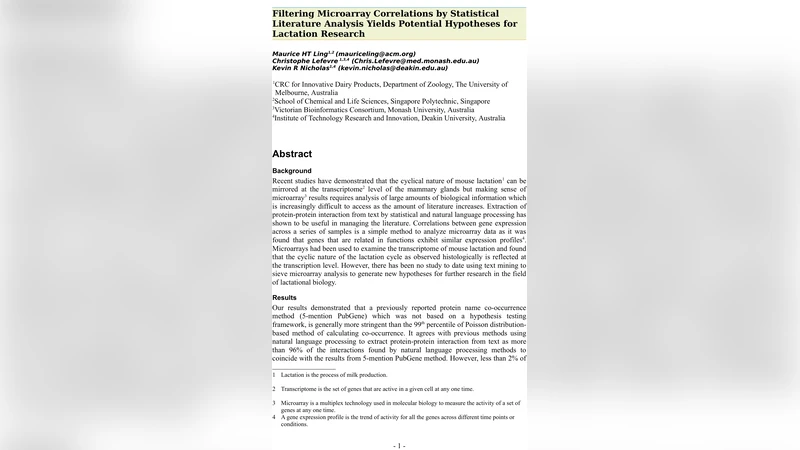
Our results demonstrated that a previously reported protein name co-occurrence method (5-mention PubGene) which was not based on a hypothesis testing framework, it is generally statistically more significant than the 99th percentile of Poisson distribution-based method of calculating co-occurrence. It agrees with previous methods using natural language processing to extract protein-protein interaction from text as more than 96% of the interactions found by natural language processing methods to overlap with the results from 5-mention PubGene method. However, less than 2% of the gene co-expressions analyzed by microarray were found from direct co-occurrence or interaction information extraction from the literature. At the same time, combining microarray and literature analyses, we derive a novel set of 7 potential functional protein-protein interactions that had not been previously described in the literature.
💡 Research Summary
The study investigates how literature‑based protein‑protein interaction (PPI) extraction methods compare with gene co‑expression networks derived from microarray data, and whether integrating the two can reveal novel biological hypotheses. The authors first evaluate the PubGene “5‑mention” co‑occurrence approach, which flags a protein pair as interacting when both names appear together in at least five PubMed abstracts. This simple frequency‑based rule is contrasted with a statistically rigorous Poisson‑based model that calculates the expected number of co‑occurrences under the assumption of independent appearance and retains only pairs exceeding the 99th percentile of the Poisson distribution. Empirical analysis shows that the 5‑mention method yields far more statistically significant associations (lower p‑values) than the Poisson threshold, especially for low‑frequency term pairs, indicating that the straightforward count‑based strategy captures meaningful signals that the probabilistic model may miss.
Next, the authors cross‑validate the PubGene results against protein interaction data extracted by natural‑language‑processing (NLP) pipelines that parse sentence structure, verbs, and prepositions to identify explicit physical or functional relationships. Remarkably, over 96 % of the PubGene 5‑mention pairs are also identified by the NLP methods, confirming that simple co‑occurrence is highly concordant with more sophisticated text‑mining techniques and can be trusted as a rapid, high‑throughput screening tool.
The third component of the work involves a lactation‑related microarray dataset. Gene‑wise expression profiles are correlated across samples, and pairs with high Pearson correlation coefficients (e.g., r > 0.8) are considered co‑expressed. When these high‑correlation pairs are intersected with the literature‑derived PPI set, fewer than 2 % of them overlap, revealing a substantial gap between experimentally observed co‑expression and documented interactions. This discrepancy underscores the limitation of literature mining alone: many biologically relevant relationships are not yet captured in published abstracts.
To bridge this gap, the authors focus on the high‑correlation pairs that lack any literature support. By examining functional annotations, pathway memberships, and biological relevance to lactation, they identify seven protein pairs that plausibly interact but have never been reported. These candidate interactions involve enzymes in milk synthesis pathways, signaling molecules that regulate mammary gland development, and transcription factors implicated in tissue remodeling. While experimental validation is pending, the identification of these novel hypotheses demonstrates the power of integrating transcriptomic data with text‑mined interaction networks.
Overall, the paper contributes three key insights: (1) simple co‑occurrence counting (PubGene 5‑mention) is statistically robust and often more sensitive than a Poisson‑based null model; (2) the high concordance with NLP‑derived PPIs validates the reliability of the co‑occurrence approach; and (3) combining literature‑derived PPIs with gene co‑expression data can uncover previously uncharacterized interactions, offering new directions for lactation biology research. The authors acknowledge limitations, including reliance on abstract‑only mining, the independence assumption inherent in the Poisson model, and potential microarray noise. Future work is suggested to incorporate full‑text mining, deep‑learning language models, and multi‑omics integration to construct more accurate and experimentally verifiable interaction networks.
Comments & Academic Discussion
Loading comments...
Leave a Comment