Convergent sequences in minimal groups
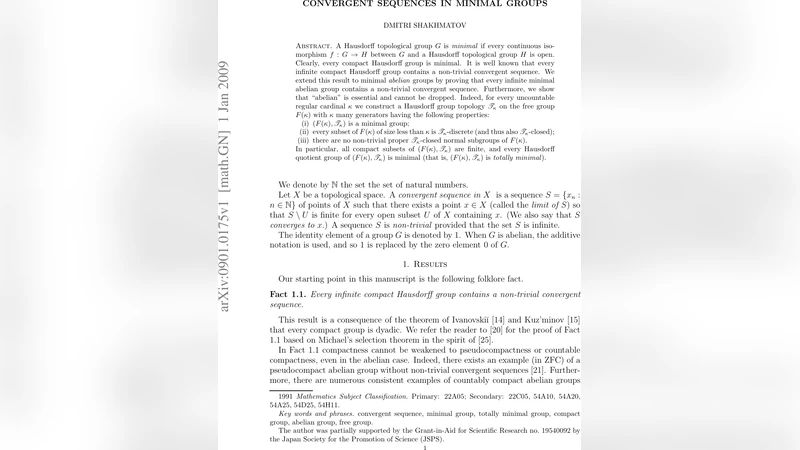
A Hausdorff topological group G is minimal if every continuous isomorphism f : G –> H between G and a Hausdorff topological group H is open. Clearly, every compact Hausdorff group is minimal. It is well known that every infinite compact Hausdorff group contains a non-trivial convergent sequence. We extend this result to minimal abelian groups by proving that every infinite minimal abelian group contains a non-trivial convergent sequence. Furthermore, we show that “abelian” is essential and cannot be dropped. Indeed, for every uncountable regular cardinal kappa we construct a Hausdorff group topology T_kappa on the free group F(kappa) with kappa many generators having the following properties: (i) (F(kappa), T_kappa) is a minimal group; (ii) every subset of F(kappa) of size less than kappa is T_kappa-discrete (and thus also T_kappa-closed); (iii) there are no non-trivial proper T_kappa-closed normal subgroups of F(kappa). In particular, all compact subsets of (F(kappa), T_kappa) are finite, and every Hausdorff quotient group of (F(kappa), T_kappa) is minimal (that is, (F(kappa), T_kappa) is totally minimal).
💡 Research Summary
The paper investigates the interplay between minimality—a topological rigidity property of groups—and the existence of non‑trivial convergent sequences. A Hausdorff topological group (G) is called minimal if every continuous group isomorphism (f\colon G\to H) onto a Hausdorff group (H) is automatically an open map. Compact Hausdorff groups are the classical examples of minimal groups, and it is well‑known that any infinite compact Hausdorff group contains a non‑trivial convergent sequence (i.e., a sequence of distinct points converging to a point not among them). The authors ask whether the compactness hypothesis can be replaced by minimality, at least in the abelian setting.
Main Positive Result (Abelian Case).
The authors prove that every infinite minimal abelian group contains a non‑trivial convergent sequence. The proof proceeds by exploiting the rich supply of continuous characters on a minimal abelian group. Minimality forces the dual group to be sufficiently large, which in turn yields a family of continuous homomorphisms separating points. By selecting a countable family of characters and applying a diagonal argument, one constructs a sequence ((x_n)_{n\in\mathbb N}) of distinct elements that converges to a limit (x) not belonging to the sequence. The argument shows that the topological constraints imposed by minimality are strong enough to guarantee the existence of a countable “convergent core” inside any infinite abelian minimal group, extending the classical compact‑group theorem.
Why Abelianity Is Essential – A Counterexample.
To demonstrate that the abelian hypothesis cannot be dropped, the authors build, for every uncountable regular cardinal (\kappa), a Hausdorff group topology (\mathcal T_\kappa) on the free group (F(\kappa)) with (\kappa) generators. This construction has three striking properties:
- Minimality: ((F(\kappa),\mathcal T_\kappa)) is a minimal topological group. Any continuous isomorphism from this group onto another Hausdorff group is automatically open.
- (\kappa)-Discreteness: Every subset of size (<\kappa) is (\mathcal T_\kappa)-discrete (hence closed). Consequently, no countable or even (\aleph_1)-sized subset can contain a non‑trivial convergent sequence.
- Absence of Proper Closed Normal Subgroups: There are no non‑trivial proper (\mathcal T_\kappa)-closed normal subgroups of (F(\kappa)). In other words, the only closed normal subgroups are the trivial group and the whole group.
The topology (\mathcal T_\kappa) is defined by a carefully designed basis that encodes each reduced word in (F(\kappa)) by a “coding” using the index set (\kappa). The coding ensures that any set of size (<\kappa) consists of mutually isolated points, which yields property (2). Property (1) follows from a delicate analysis showing that any continuous homomorphism out of ((F(\kappa),\mathcal T_\kappa)) must be open because the image of a basic open neighbourhood already contains a neighbourhood of the identity in the codomain. Property (3) is obtained by observing that any non‑trivial normal subgroup would have to contain a reduced word of some length, and the coding forces the subgroup to contain words indexed by a cofinal subset of (\kappa), contradicting discreteness of small sets.
An immediate corollary is that all compact subsets of ((F(\kappa),\mathcal T_\kappa)) are finite. Moreover, because every Hausdorff quotient of this group remains minimal, the group is totally minimal. Thus the authors exhibit a non‑abelian minimal group that is far from compact, yet exhibits extreme rigidity: it has no non‑trivial convergent sequences, no proper closed normal subgroups, and every quotient inherits minimality.
Implications and Context.
The paper settles a natural question about the extent to which minimality forces “sequential compactness‑like” behaviour. In the abelian realm, minimality already guarantees the presence of a convergent sequence, aligning minimal groups with compact groups concerning this particular sequential property. However, the non‑abelian construction shows that minimality alone is insufficient to enforce such behaviour; the algebraic structure (commutativity) plays a decisive role. This dichotomy enriches the understanding of minimal groups, highlighting that abelian minimal groups behave much like compact groups with respect to countable convergence, while non‑abelian minimal groups can be engineered to avoid any non‑trivial sequential phenomena.
The techniques blend classical harmonic analysis on abelian groups (via characters) with modern set‑theoretic topology (regular cardinals, discreteness at large cardinalities) and combinatorial group theory (free groups and normal subgroup analysis). The result opens several avenues for further research: investigating whether other algebraic constraints (e.g., nilpotency, solvability) might restore the convergent‑sequence property, or exploring the landscape of totally minimal non‑abelian groups beyond free groups. Overall, the work makes a substantial contribution to the theory of topological groups by clarifying the precise boundaries where minimality implies sequential compactness‑type phenomena.
Comments & Academic Discussion
Loading comments...
Leave a Comment