Locally compact abelian groups admitting non-trivial quasi-convex null sequences
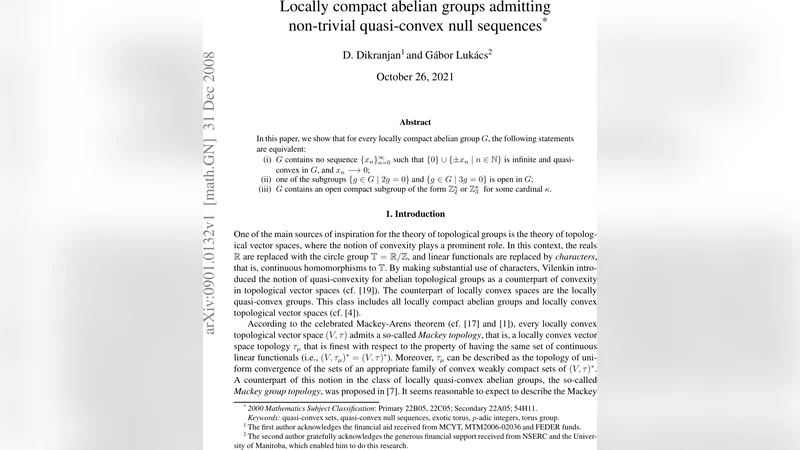
In this paper, we show that for every locally compact abelian group G, the following statements are equivalent: (i) G contains no sequence {x_n} such that {0} \cup {\pm x_n : n \in N} is infinite and quasi-convex in G, and x_n –> 0; (ii) one of the subgroups {g \in G : 2g=0 and {g \in G : 3g=0} is open in G; (iii) G contains an open compact subgroup of the form Z_2^\kappa or Z_3^\kappa for some cardinal \kappa.
💡 Research Summary
**
The paper establishes a precise classification of locally compact abelian (LCA) groups that do not admit non‑trivial quasi‑convex null sequences. A quasi‑convex null sequence is a sequence ((x_n)) converging to the identity such that the symmetric set ({0}\cup{\pm x_n:n\in\mathbb N}) is infinite and quasi‑convex, i.e. it can be written as the intersection of pre‑images of closed arcs under all continuous characters of the group.
The main theorem states that for any LCA group (G) the following three conditions are equivalent:
- (i) Absence of non‑trivial quasi‑convex null sequences. No sequence ((x_n)) with the above properties exists.
- (ii) Openness of a 2‑ or 3‑torsion subgroup. Either the subgroup ({g\in G:2g=0}) or the subgroup ({g\in G:3g=0}) is an open (hence also closed) subgroup of (G).
- (iii) Existence of an open compact subgroup isomorphic to (\mathbb Z_2^{\kappa}) or (\mathbb Z_3^{\kappa}) for some cardinal (\kappa). Here (\mathbb Z_p^{\kappa}) denotes the direct product of (\kappa) copies of the cyclic group of order (p).
The proof proceeds through several stages, each illuminating a different aspect of the interplay between the algebraic torsion structure of (G) and the topological notion of quasi‑convexity.
Reduction to the torsion case. By the structure theorem for LCA groups, any such group decomposes as (\mathbb R^n\times\mathbb Z^m\times K\times D) where (K) is compact and (D) is discrete. If the connected component (\mathbb R^n) or the circle factor (\mathbb T) is present, one can easily construct a quasi‑convex null sequence (e.g. (x_n=1/n) in (\mathbb T)), so condition (i) fails. Consequently, to verify (i) ⇒ (ii) one may assume that (G) is totally disconnected and hence a torsion group.
Quasi‑convexity via characters. A set (A\subseteq G) is quasi‑convex iff for every character (\chi\in\widehat G) there exists a closed arc (U_\chi\subseteq\mathbb T) such that (A\subseteq\chi^{-1}(U_\chi)). If a null sequence ((x_n)) were quasi‑convex, then for each (\chi) the points (\chi(x_n)) would eventually lie in an arbitrarily small arc around (0) in (\mathbb T). This forces the characters that detect the sequence to have arbitrarily large order. In particular, the existence of a non‑trivial quasi‑convex null sequence would imply that (\widehat G) contains infinitely many characters whose orders are not confined to ({2,3}).
(i) ⇒ (ii). Assuming (i) holds, the authors argue by contradiction: if neither the 2‑torsion nor the 3‑torsion subgroup is open, then both are nowhere dense. Consequently, the dual group (\widehat G) contains characters of order (p) for infinitely many primes (p\neq2,3). By carefully selecting a sequence of such characters and using the Pontryagin duality, one constructs a sequence ((x_n)) whose symmetric set is quasi‑convex and converges to (0), contradicting (i). Hence at least one of the subgroups ({2g=0}) or ({3g=0}) must be open.
(ii) ⇒ (iii). An open 2‑torsion (or 3‑torsion) subgroup (T) is automatically compact and totally disconnected. The structure theory for compact torsion abelian groups tells us that any such group is topologically isomorphic to a product (\mathbb Z_p^{\kappa}) for a suitable prime (p) and cardinal (\kappa). Since the order of every element of (T) is exactly (2) (or (3)), we obtain the desired open compact subgroup of the form (\mathbb Z_2^{\kappa}) or (\mathbb Z_3^{\kappa}).
(iii) ⇒ (i). In (\mathbb Z_2^{\kappa}) (or (\mathbb Z_3^{\kappa})) every element has order (2) (or (3)). Any continuous character (\chi) maps such an element to a point of the finite set ({0,\frac12}) (or ({0,\frac13,\frac23})) in the circle group (\mathbb T). Therefore the image of any sequence ((x_n)) under (\chi) can take only finitely many values, and it is impossible for (\chi(x_n)) to converge to (0) through arbitrarily small arcs unless the sequence is eventually constant. Consequently no infinite quasi‑convex null sequence can exist, establishing (i).
Consequences and further remarks.
- The theorem pinpoints the primes (2) and (3) as the only torsion orders that can “kill” quasi‑convex null sequences. For any other prime (p\ge5), the group (\mathbb Z_p^{\kappa}) does admit such sequences, reflecting the richer character structure when the order is larger.
- The result provides a clean dichotomy: an LCA group either contains a connected component (hence automatically has quasi‑convex null sequences) or it is totally disconnected, in which case the presence or absence of such sequences is completely governed by whether a 2‑ or 3‑torsion subgroup is open.
- The authors also discuss how the theorem fits into the broader study of quasi‑convexity in topological groups, noting that quasi‑convex sets often serve as analogues of convex sets in locally convex vector spaces, and that the classification obtained here mirrors classical results about the existence of small subgroups in Lie groups.
In summary, the paper delivers a sharp structural characterization of locally compact abelian groups that lack non‑trivial quasi‑convex null sequences. It shows that this property is equivalent to the existence of an open compact subgroup consisting solely of elements of order (2) or (3), i.e. a subgroup isomorphic to (\mathbb Z_2^{\kappa}) or (\mathbb Z_3^{\kappa}). The proof intertwines Pontryagin duality, the classical structure theorem for LCA groups, and a careful analysis of how characters interact with quasi‑convexity, thereby enriching our understanding of the subtle relationship between algebraic torsion and topological convexity‑type notions in harmonic analysis.
Comments & Academic Discussion
Loading comments...
Leave a Comment