Towards Provable Secure Neighbor Discovery in Wireless Networks
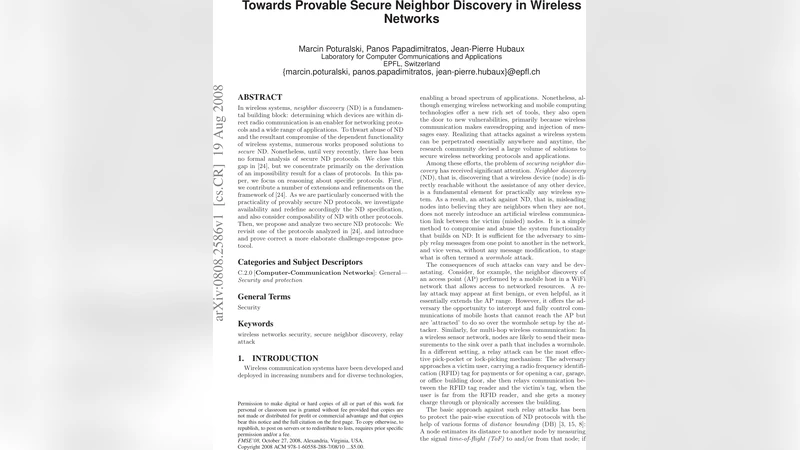
In wireless systems, neighbor discovery (ND) is a fundamental building block: determining which devices are within direct radio communication is an enabler for networking protocols and a wide range of applications. To thwart abuse of ND and the resultant compromise of the dependent functionality of wireless systems, numerous works proposed solutions to secure ND. Nonetheless, until very recently, there has been no formal analysis of secure ND protocols. We close this gap in \cite{asiaccs08}, but we concentrate primarily on the derivation of an impossibility result for a class of protocols. In this paper, we focus on reasoning about specific protocols. First, we contribute a number of extensions and refinements on the framework of [24]. As we are particularly concerned with the practicality of provably secure ND protocols, we investigate availability and redefine accordingly the ND specification, and also consider composability of ND with other protocols. Then, we propose and analyze two secure ND protocols: We revisit one of the protocols analyzed in [24], and introduce and prove correct a more elaborate challenge-response protocol.
💡 Research Summary
The paper addresses a fundamental problem in wireless systems: neighbor discovery (ND), the process by which a device determines which other devices are within direct radio range. While many heuristic and cryptographic solutions have been proposed to “secure” ND, none had been subjected to a rigorous, formal analysis until the authors’ earlier work (cited as
Comments & Academic Discussion
Loading comments...
Leave a Comment