Divisibility, Smoothness and Cryptographic Applications
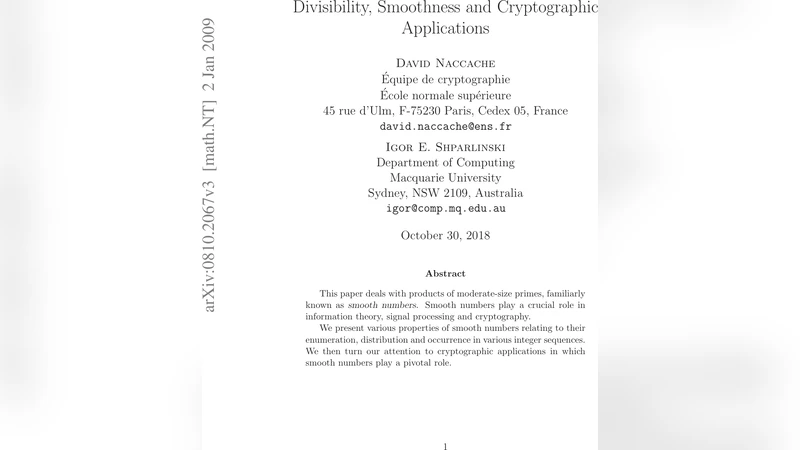
This paper deals with products of moderate-size primes, familiarly known as smooth numbers. Smooth numbers play a crucial role in information theory, signal processing and cryptography. We present various properties of smooth numbers relating to their enumeration, distribution and occurrence in various integer sequences. We then turn our attention to cryptographic applications in which smooth numbers play a pivotal role.
💡 Research Summary
**
The manuscript “Divisibility, Smoothness and Cryptographic Applications” offers a comprehensive survey of smooth (or “y‑smooth”) numbers—integers whose prime factors are all bounded by a parameter y—and their pivotal role in both analytic number theory and modern cryptography. After a brief introductory motivation, the authors set up a precise notation: a number n is y‑smooth if its largest prime divisor P(n)≤y, and they denote by ψ(x,y) the count of y‑smooth integers up to x. The Dickman–de Bruijn function ρ(u), defined recursively by ρ(u)=1 for 0≤u≤1 and ρ(u)=∫₍u₋₁₎^u ρ(t)/t dt for u>1, is presented as the central tool for estimating ψ(x,y). Its asymptotic behavior ρ(u)=u^{‑u+o(u)} captures the rapid decay of smooth‑number density as the smoothness bound becomes small relative to x.
The paper then reviews classical results on the distribution of primes, beginning with the Prime Number Theorem in the form π(x)=li x+O(x exp(−c(log x)^{3/5}(log log x)^{−1/5})). It discusses the Siegel–Walfisz theorem, the Bombieri–Vinogradov average‑case bound, and the Brun–Titchmarsh inequality, emphasizing the ranges of moduli q for which uniform estimates for π(x;q,a) are known without assuming any unproven hypothesis. These results are essential when one studies the occurrence of smooth numbers in arithmetic progressions or the likelihood that a random integer has a large smooth divisor.
Mertens’ formulas for sums over reciprocals of primes, the product ∏_{p≤x}(1−1/p), and related constants (Euler–Mascheroni γ, etc.) are recalled, together with Vinogradov’s sharp error bounds. The authors then turn to the Riemann zeta function ζ(s) and its Euler product, explaining how zero‑free regions (e.g., Ford’s explicit zero‑free region) translate into explicit error terms for π(x) and θ(x). They caution that while the Generalized Riemann Hypothesis (GRH) yields strong average results, many unconditional theorems (e.g., Brun–Titchmarsh, Bombieri–Vinogradov) actually provide stronger statements in certain ranges.
A substantial portion of the manuscript is devoted to the Euler totient function ϕ(n). Basic identities such as ∑{d|n}ϕ(d)=n and ϕ(n)=n∏{p|n}(1−1/p) are presented, followed by asymptotic averages (ϕ(n)≈n·e^{−γ}/log log n) and inequalities (ϕ(n)>n·e^{−γ}/(log log n)² for n≥3). The authors discuss the counting function F(x)=#{ϕ(n)≤x}, citing Ford’s precise asymptotic and the resolution of the Serpinski conjecture on the number of solutions to ϕ(n)=m. These results are directly relevant to cryptographic settings where the smoothness of p−1 (or p+1) determines the vulnerability of RSA moduli to certain factor‑recovery attacks.
Section 4 warns against naïve probabilistic heuristics that treat divisibility by distinct primes as independent events. The authors illustrate the pitfall by deriving an incorrect estimate ψ(x,y)≈x·u^{‑u} from the product ∏_{p>y}(1−1/p)≈log y/log x, emphasizing that such reasoning neglects correlations among prime divisibility and leads to dramatically wrong predictions for smooth‑number density.
The paper then presents the state‑of‑the‑art estimates for ψ(x,y). The Canfield–Erdős–Pomerance bound ψ(x,y)=x·u^{‑u+o(u)} holds for u≤y^{1−ε} (equivalently y≥(log x)^{1+ε}), while the more precise Hildebrand–Tenenbaum asymptotic ψ(x,y)=x·ρ(u)(1+o(1)) is valid in a narrower range (u≤exp((log y)^{3/5−ε}) or y≥exp((log log x)^{5/3+ε})). Saias’s work on the error term is mentioned, and the authors note that extending these results to the regime y≈log x remains a major open problem.
The final sections focus on cryptographic applications. First, the authors discuss the Dixon factorisation algorithm and its “smoothness‑based” variants, citing Croft, Granville, Pomerance & Télal for tight bounds on the algorithm’s stopping time when the target integer is y‑smooth. Second, they revisit the Coprime‑Smith attack on RSA moduli with partially known factors, showing how results on the distribution of divisors d|n with d≡a (mod k) (stemming from work of Coppersmith, Howgrave‑Graham & Graham) can be leveraged to recover φ(n) or the private exponent. Third, they explain how the Cooley–Tukey FFT decomposition naturally exploits the factorisation n=2^k·m with m y‑smooth, yielding sub‑quadratic multiplication algorithms that are valuable for polynomial‑based cryptosystems (e.g., NTRU, Ring‑LWE). Finally, the manuscript touches on smooth‑number based random‑number generators and hash functions, arguing that the statistical uniformity of y‑smooth inputs (as quantified by ρ(u)) can improve collision resistance and unpredictability.
In the concluding remarks, the authors acknowledge that the precise error term for ψ(x,y) in the critical region y≈log x is still unknown, and they propose several research directions: developing hybrid analytic–combinatorial techniques, exploring higher‑dimensional signal‑processing analogues, and investigating side‑channel implications of smooth‑number‑driven algorithms. Overall, the paper succeeds in bridging classical analytic number theory with concrete cryptographic practice, demonstrating that smooth numbers are not merely a theoretical curiosity but a fundamental resource—and sometimes a vulnerability—in the design and analysis of modern cryptographic systems.
Comments & Academic Discussion
Loading comments...
Leave a Comment