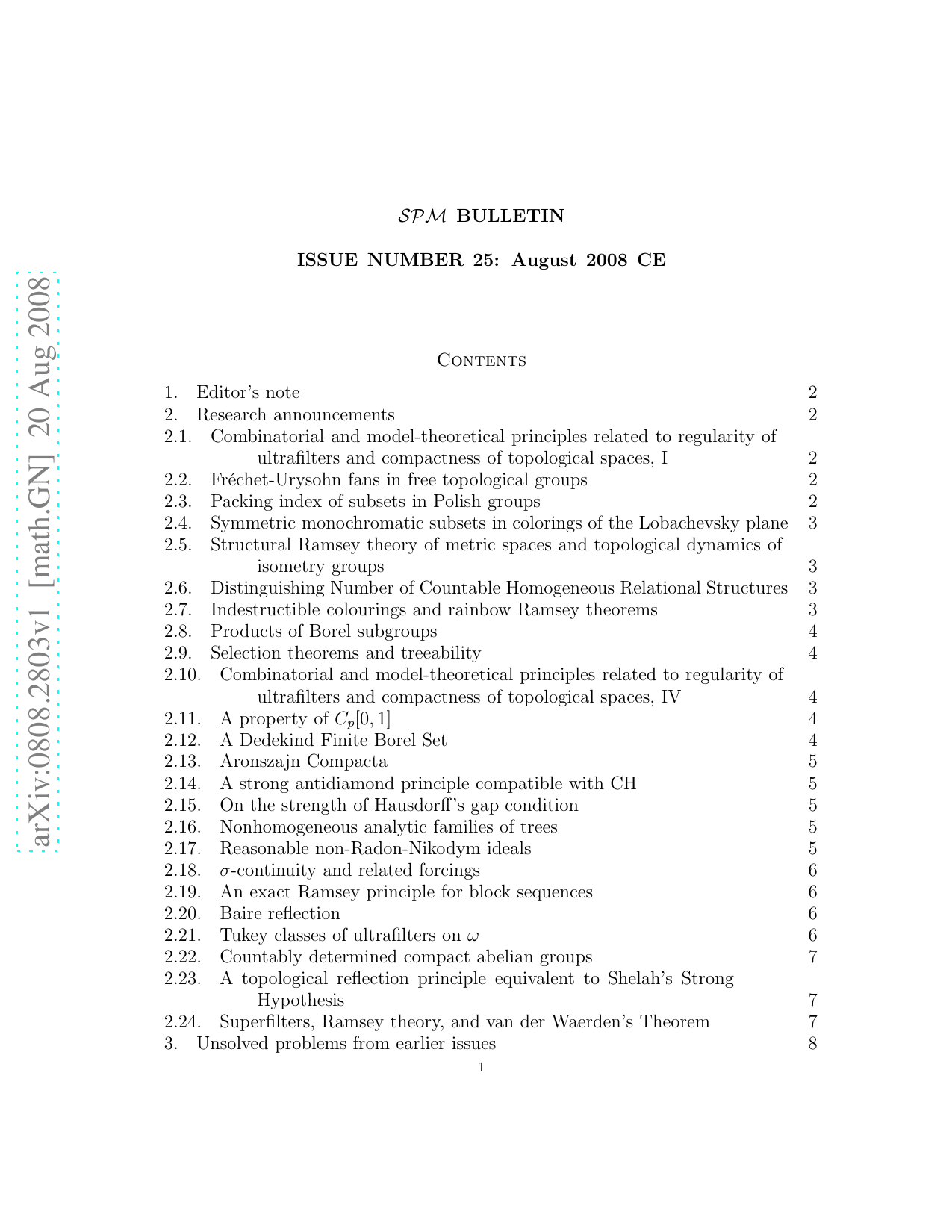
Contents: 1. Combinatorial and model-theoretical principles related to regularity of ultrafilters and compactness of topological spaces, I; 2. Frechet-Urysohn fans in free topological groups; 3. Packing index of subsets in Polish groups; 4. Symmetric monochromatic subsets in colorings of the Lobachevsky plane; 5. Structural Ramsey theory of metric spaces and topological dynamics of isometry groups; 6. Distinguishing Number of Countable Homogeneous Relational Structures; 7. Indestructible colourings and rainbow Ramsey theorems; 8. Products of Borel subgroups; 9. Selection theorems and treeability; 10. Combinatorial and model-theoretical principles related to regularity of ultrafilters and compactness of topological spaces, IV; 11. A property of Cp[0, 1]; 12. A Dedekind Finite Borel Set; 13. Aronszajn Compacta; 14. A strong antidiamond principle compatible with CH; 15. On the strength of Hausdorff's gap condition; 16. Nonhomogeneous analytic families of trees; 17. Reasonable non-Radon-Nikodym ideals; 18. Continuity and related forcing; 19. An exact Ramsey principle for block sequences; 20. Baire reflection; 21. Tukey classes of ultrafilters on; 22. Countably determined compact abelian groups; 23. A topological reflection principle equivalent to Shelah's Strong Hypothesis; 24. Superfilters, Ramsey theory, and van der Waerden's Theorem.
💡 Deep Analysis
Deep Dive into SPM Bulletin 25.
Contents: 1. Combinatorial and model-theoretical principles related to regularity of ultrafilters and compactness of topological spaces, I; 2. Frechet-Urysohn fans in free topological groups; 3. Packing index of subsets in Polish groups; 4. Symmetric monochromatic subsets in colorings of the Lobachevsky plane; 5. Structural Ramsey theory of metric spaces and topological dynamics of isometry groups; 6. Distinguishing Number of Countable Homogeneous Relational Structures; 7. Indestructible colourings and rainbow Ramsey theorems; 8. Products of Borel subgroups; 9. Selection theorems and treeability; 10. Combinatorial and model-theoretical principles related to regularity of ultrafilters and compactness of topological spaces, IV; 11. A property of Cp[0, 1]; 12. A Dedekind Finite Borel Set; 13. Aronszajn Compacta; 14. A strong antidiamond principle compatible with CH; 15. On the strength of Hausdorff’s gap condition; 16. Nonhomogeneous analytic families of trees; 17. Reasonable non-Radon-
📄 Full Content
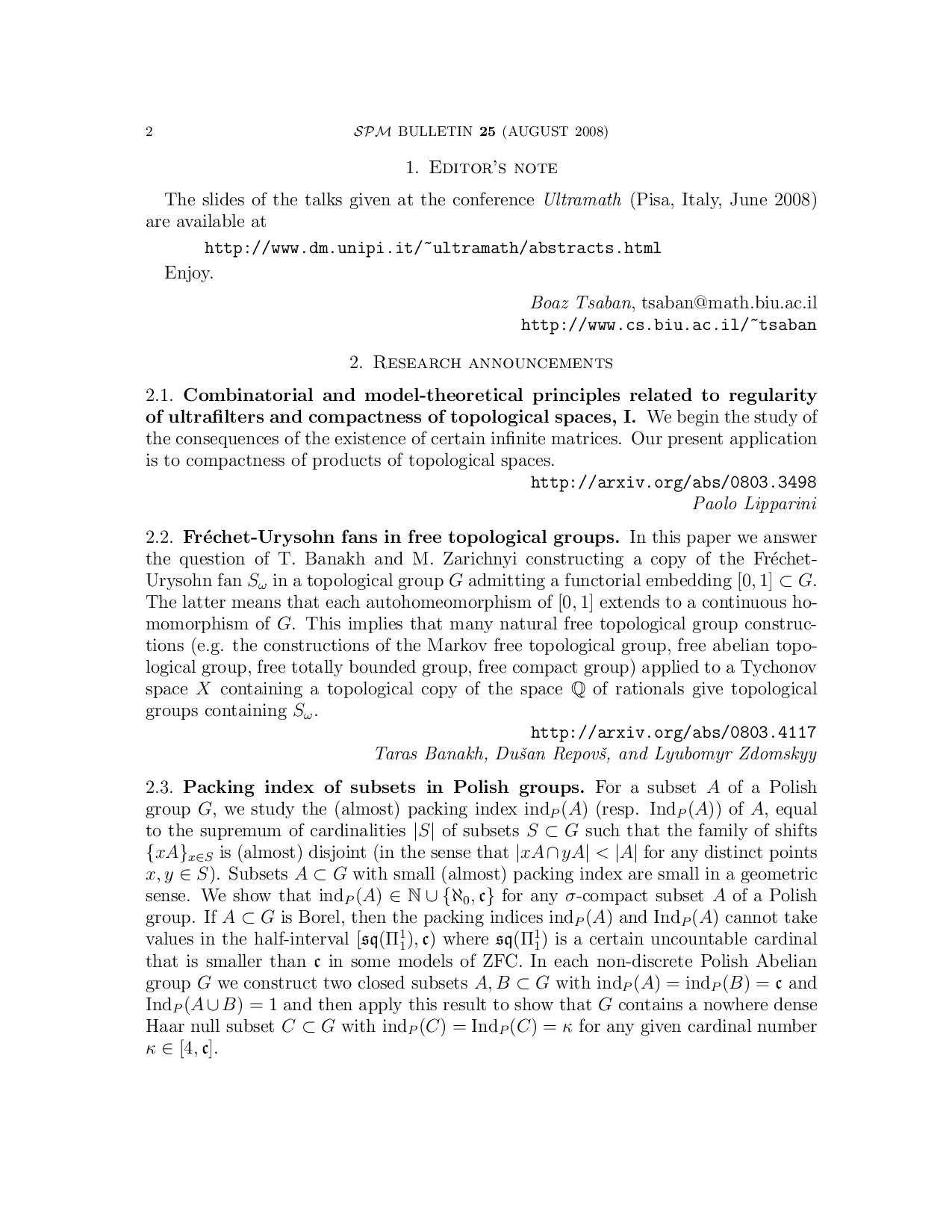
The slides of the talks given at the conference Ultramath (Pisa, Italy, June 2008) are available at http://www.dm.unipi.it/~ultramath/abstracts.html Enjoy.
Boaz Tsaban, tsaban@math.biu.ac.ilhttp://www.cs.biu.ac.il/~tsaban
2. Research announcements 2.1. Combinatorial and model-theoretical principles related to regularity of ultrafilters and compactness of topological spaces, I. We begin the study of the consequences of the existence of certain infinite matrices. Our present application is to compactness of products of topological spaces.
Fréchet-Urysohn fans in free topological groups. In this paper we answer the question of T. Banakh and M. Zarichnyi constructing a copy of the Fréchet-Urysohn fan S ω in a topological group G admitting a functorial embedding [0, 1] ⊂ G.
The latter means that each autohomeomorphism of [0, 1] extends to a continuous homomorphism of G. This implies that many natural free topological group constructions (e.g. the constructions of the Markov free topological group, free abelian topological group, free totally bounded group, free compact group) applied to a Tychonov space X containing a topological copy of the space Q of rationals give topological groups containing S ω . http://arxiv.org/abs/0803.4117
Taras Banakh, Dušan Repovš, and Lyubomyr Zdomskyy 2.3. Packing index of subsets in Polish groups. For a subset A of a Polish group G, we study the (almost) packing index ind P (A) (resp. Ind P (A)) of A, equal to the supremum of cardinalities |S| of subsets S ⊂ G such that the family of shifts {xA} x∈S is (almost) disjoint (in the sense that |xA ∩ yA| < |A| for any distinct points x, y ∈ S). Subsets A ⊂ G with small (almost) packing index are small in a geometric sense. We show that ind P (A) ∈ N ∪ {ℵ 0 , c} for any σ-compact subset A of a Polish group. If A ⊂ G is Borel, then the packing indices ind P (A) and Ind P (A) cannot take values in the half-interval [sq(Π 1 1 ), c) where sq(Π 1 1 ) is a certain uncountable cardinal that is smaller than c in some models of ZFC. In each non-discrete Polish Abelian group G we construct two closed subsets A, B ⊂ G with ind P (A) = ind P (B) = c and Ind P (A ∪ B) = 1 and then apply this result to show that G contains a nowhere dense Haar null subset C ⊂ G with ind P (C) = Ind P (C) = κ for any given cardinal number κ ∈ [4, c]. The distinguishing number of a graph G is the smallest positive integer r such that G has a labeling of its vertices with r labels for which there is no non-trivial automorphism of G preserving these labels. Albertson and Collins computed the distinguishing number for various finite graphs, and Imrich, Klavžar and Trofimov computed the distinguishing number of some infinite graphs, showing in particular that the Random Graph has distinguishing number 2. We compute the distinguishing number of various other finite and countable homogeneous structures, including undirected and directed graphs, and posets. We show that this number is in most cases two or infinite, and besides a few exceptions conjecture that this is so for all primitive homogeneous countable structures. http://arxiv.org/abs/0804.4019 C. Laflamme, L. Nguyen Van Thé, N. W. Sauer 2.7. Indestructible colourings and rainbow Ramsey theorems. We give a negative answer to a question of Erdos and Hajnal: it is consistent that GCH holds and there is a colouring c :
2 such that some colouring g : [ω 1 ] 2 → 2 can not be embedded into c. It is also consistent that 2 ω 1 is arbitrarily large, and a function g establishes 2
ω 1 such that there is no uncountable g-rainbow subset of 2 ω 1 . We also show that for each k ∈ ω it is consistent with Martin’s Axiom that the negative partition relation * c) is shown to be consistent with CH. This principle can be stated as a “P -ideal dichotomy”: every P -ideal on omega -1 (i.e. an ideal that is σ-directed under inclusion modulo finite) either has a closed unbounded subset of ω 1 locally inside of it, or else has a stationary subset of ω 1 orthogonal to it. We rely on Shelah’s theory of parameterized properness for NNR iterations, and make a contribution to the theory with a method of constructing the properness parameter simultaneously with the iteration. Our handling of the application of the NNR iteration theory involves definability of forcing notions in third order arithmetic, analogous to Souslin forcing in second order arithmetic. http://arxiv.org/abs/0806.4220
James Hirschorn 2.15. On the strength of Hausdorff’s gap condition. Hausdorff’s gap condition was satisfied by his original 1936 construction of an (ω 1 , ω 1 ) gap in P (N)/F in.
We solve an open problem in determining whether Hausdorff’s condition is actually stronger than the more modern indestructibility condition, by constructing an indestructible (ω 1 , ω 1 ) gap not equivalent to any gap satisfying Hausdorff’s condition, from uncountably many random reals. http://arxiv.org/abs/0806.4732
James Hirschorn 2.1