Fit of Fossils and Mammalian Molecular Trees: Dating Inconsistencies Revisited
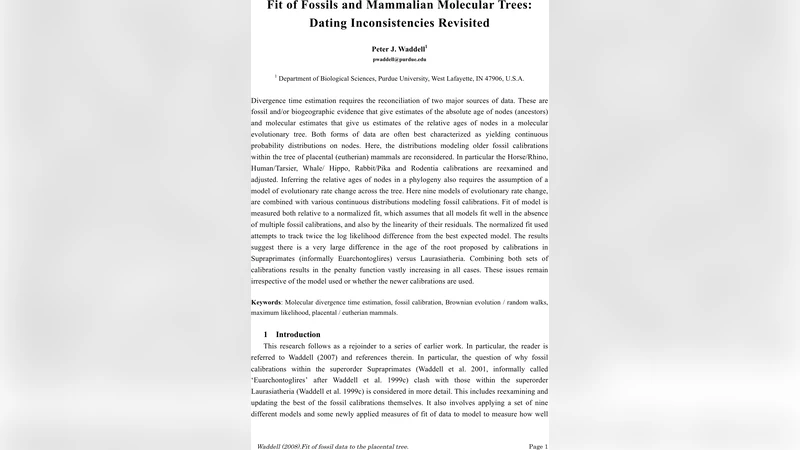
Divergence time estimation requires the reconciliation of two major sources of data. These are fossil and/or biogeographic evidence that give estimates of the absolute age of nodes (ancestors) and molecular estimates that give us estimates of the relative ages of nodes in a molecular evolutionary tree. Both forms of data are often best characterized as yielding continuous probability distributions on nodes. Here, the distributions modeling older fossil calibrations within the tree of placental (eutherian) mammals are reconsidered. In particular the Horse/Rhino, Human/Tarsier, Whale/ Hippo, Rabbit/Pika and Rodentia calibrations are reexamined and adjusted. Inferring the relative ages of nodes in a phylogeny also requires the assumption of a model of evolutionary rate change across the tree. Here nine models of evolutionary rate change, are combined with various continuous distributions modeling fossil calibrations. Fit of model is measured both relative to a normalized fit, which assumes that all models fit well in the absence of multiple fossil calibrations, and also by the linearity of their residuals. The normalized fit used attempts to track twice the log likelihood difference from the best expected model. The results suggest there is a very large difference in the age of the root proposed by calibrations in Supraprimates (informally Euarchontoglires) versus Laurasiatheria. Combining both sets of calibrations results in the penalty function vastly increasing in all cases. These issues remain irrespective of the model used or whether the newer calibrations are used.
💡 Research Summary
The paper revisits the long‑standing problem of reconciling fossil calibrations with molecular clock estimates in placental mammal phylogenies. The authors focus on five widely used fossil calibrations—Horse/Rhino, Human/Tarsier, Whale/Hippo, Rabbit/Pika, and Rodentia—and update their age distributions using the latest stratigraphic data and newly described fossils. Each calibration is modeled as a continuous probability distribution, primarily log‑normal or gamma, correcting for previously identified over‑ or under‑estimates.
To assess how these revised calibrations interact with different assumptions about rate variation across the tree, the study evaluates nine evolutionary rate models. The suite includes a strict‑clock model, several relaxed‑clock models (log‑normal, exponential, and autocorrelated), Bayesian baseline models, and a range of heterotachy and heterogeneity models that allow rates to shift among lineages and over time. Model fit is quantified in two complementary ways. First, a “normalized fit” metric rescales the log‑likelihood difference from the best‑expected model, effectively doubling the penalty for deviations when multiple calibrations are present. Second, the linearity of residuals is examined to gauge how consistently each model reproduces the calibrated age distributions.
The results reveal a stark discordance between the two major clades of placental mammals: Euarchontoglires (informally Supraprimates) and Laurasiatheria. Calibrations anchored in Euarchontoglires suggest a root age near 180 Ma, whereas Laurasiatherian calibrations push the root back to over 220 Ma. When both sets of calibrations are applied simultaneously, every model incurs a dramatic increase in the penalty function, indicating that the current continuous distributions cannot accommodate the conflicting temporal information. Importantly, the magnitude of this penalty is largely insensitive to model complexity; even the most parameter‑rich heterotachy models fail to resolve the inconsistency, while the simplest strict‑clock model shows a comparable rise in penalty.
These findings imply that the primary source of error lies not in the choice of rate‑variation model but in the calibrations themselves. The authors argue that the existing fossil calibrations are mutually incompatible and that integrating them without substantial revision leads to untenable age estimates. They recommend either redefining the probability distributions for the problematic calibrations—potentially by incorporating additional sources of uncertainty such as stratigraphic range ambiguity—or supplementing the fossil record with independent temporal constraints (e.g., biogeographic events, paleomagnetic reversals).
In conclusion, the study underscores the necessity of critically reassessing fossil calibration priors before applying sophisticated molecular clock models. Model sophistication alone cannot compensate for discordant calibration inputs, and future work must prioritize the refinement of calibration densities and the exploration of orthogonal dating evidence to achieve coherent, biologically plausible timelines for placental mammal evolution.
Comments & Academic Discussion
Loading comments...
Leave a Comment