Note on the 2-component Analogue of 2-dimensional Long Wave-Short Wave Resonance Interaction System
An integrable two-component analogue of the two-dimensional long wave-short wave resonance interaction (2c-2d-LSRI) system is studied. Wronskian solutions of 2c-2d-LSRI system are presented. A reduced case, which describes resonant interaction betwee…
Authors: ** K. M. (주 저자) 외 다수 (논문에 명시된 전체 저자 목록이 제공되지 않음) **
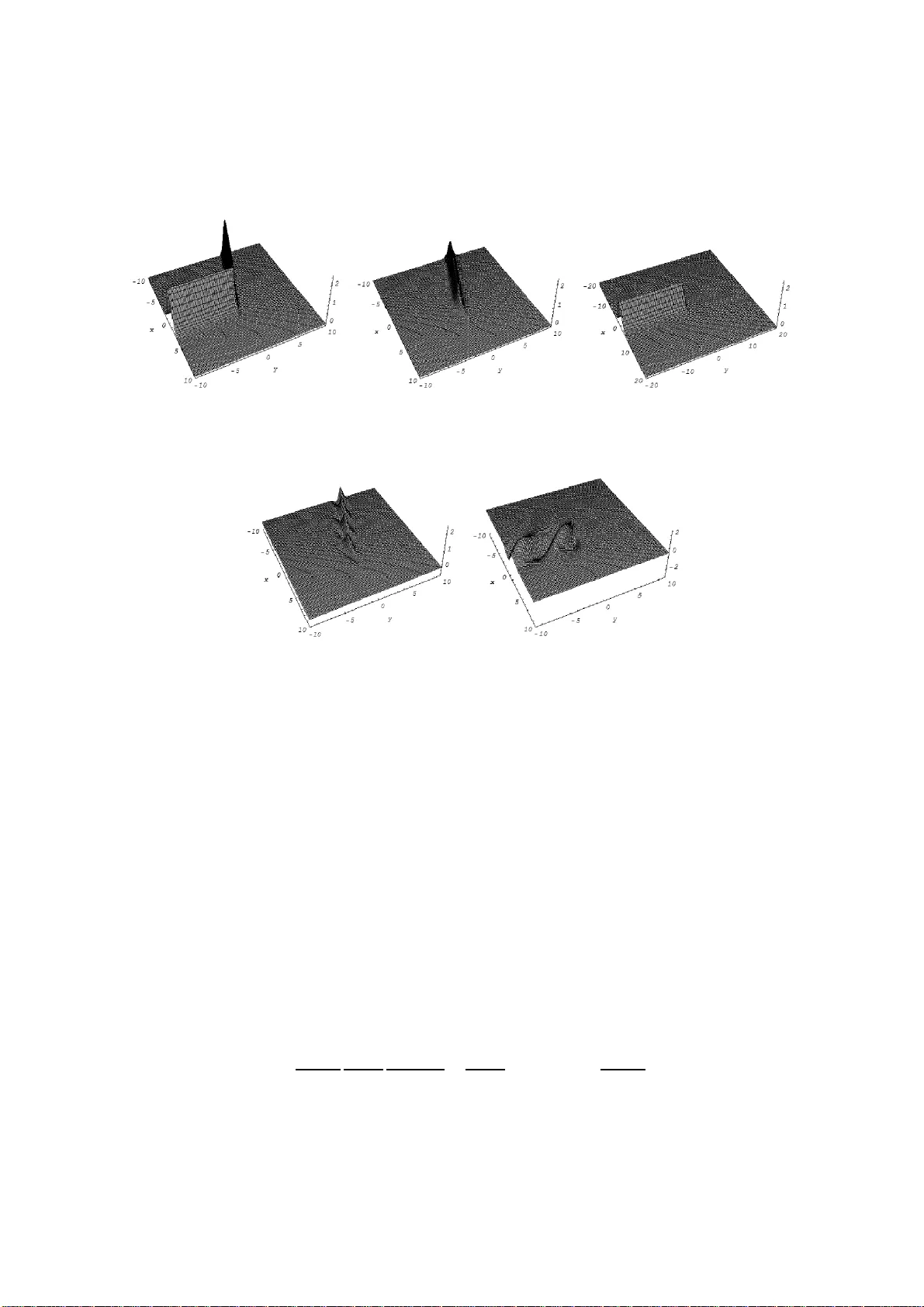
Note on the 2-compone nt Analogue of 2-dimensi onal Long W a ve-Short W a v e Resonance Interactio n System Ke n-ichi Maruno Departmen t of Mathematics, The University of T exas-Pan American, Edinburg, TX 78541 Y asuh iro Ohta Departmen t of Mathematics, K obe University , Rokko, K obe 657-850 1, Japan Masayuki Oikaw a Research Institute for Applied Mechanics, Kyushu Uni versity , Kasuga, Fukuok a, 816-8 580, Japan November 17, 2018 Abstract An integrable tw o-comp onent analogue of the two-dimensional long wa ve- short wa ve resonance interaction (2c-2d-LSRI) system is stud ied. Wron- skian so lutions of 2c-2d- LSRI system are presented. A redu ced case, which describes resonant interaction between an interfacial wa ve and two sur face wa ve packets in a tw o layer fluid, is also discussed. 2000 Mathematics Subject Classification. 3 5Q51, 35Q55, 37K40 1 Introd uction In these past decades, ve ctor soli ton equatio ns ha ve recei ved so much attention in mathematic al physics and nonlinear physics [1 , 2, 3, 4 ]. Recently , we deriv ed the follo wing system in a two-layer fluid usin g reducti ve perturb ation meth od, which was moti v ated by a paper by Onorato et. al. [5 , 6]: i ( S ( 1 ) t + S ( 1 ) y ) − S ( 1 ) xx + LS ( 1 ) = 0 , i ( S ( 2 ) t − S ( 2 ) y ) − S ( 2 ) xx + LS ( 2 ) = 0 , L t = 2 ( | S ( 1 ) | 2 + | S ( 2 ) | 2 ) x . (1) This system is an extensio n of the two-dimensio nal long wa ve-sh ort wa ve reso- nance interaction system[7, 8 ] and describ es the two -dimension al resonant inte rac- tion between an in terfac ial gravit y wav e and two surface gra vity packe ts propagat- ing in direc tions symmetric about the propagat ion direction of the interfac ial wav e in a two- layer fl uid. 1 In this paper , we will study this system and its integrab le m odificatio n, i ( S ( 1 ) t + S ( 1 ) y ) − S ( 1 ) xx + LS ( 1 ) = 2i S ( 2 ) ∗ Q , i ( S ( 2 ) t − S ( 2 ) y ) − S ( 2 ) xx + LS ( 2 ) = 2i S ( 1 ) ∗ Q , L t = 2 ( | S ( 1 ) | 2 + | S ( 2 ) | 2 ) x , Q x = S ( 1 ) S ( 2 ) . (2) where ∗ means comple x conjugat e. In our recent paper [9], we studied i ( S ( 1 ) t + S ( 1 ) y ) − S ( 1 ) xx + LS ( 1 ) = 0 , i ( S ( 2 ) t + S ( 2 ) y ) − S ( 2 ) xx + LS ( 2 ) = 0 , L t = 2 ( | S ( 1 ) | 2 + | S ( 2 ) | 2 ) x . (3) Note that this system is dif ferent from the system (1) only in the sign of y -deri v ati ve term S ( 2 ) y . 2 Bilinear F orms and Wr onskian Solutions Consider a two-compo nent analogue of two -dimension al long wav e-short wa v e resona nce interaction (2c-2d-LSRI) syst em (2). Using the dependen t varia ble trans- formatio n L = − ( 2 log F ) xx , S ( 1 ) = G / F , S ( 2 ) = H / F , Q = − K ∗ / F , we obtain ( D 2 x − i ( D t + D y )) G · F = 2i H ∗ K ∗ , D x D t F · F = − 2 ( GG ∗ + H H ∗ ) , ( D 2 x − i ( D t − D y )) H · F = 2i G ∗ K ∗ , D x K · F = − G ∗ H ∗ . (4) These bilinea r forms hav e the three-compo nent Wronsk ian solution [10, 11, 12]. Consider the follo wing three-co mponent Wrons kian: τ N M L = | ϕ ψ χ | , where ϕ , ψ and χ are ( N + M + L ) × N , ( N + M + L ) × M and ( N + M + L ) × L matrices, respecti v ely: ϕ = ( ∂ j − 1 x 1 ϕ i ) 1 ≤ j ≤ N 1 ≤ i ≤ N + M + L , ψ = ( ∂ j − 1 x 1 ψ i ) 1 ≤ j ≤ M 1 ≤ i ≤ N + M + L and χ = ( ∂ j − 1 x 1 χ i ) 1 ≤ j ≤ L 1 ≤ i ≤ N + M + L , and ϕ i is an arbitrary function of x 1 and x 2 satisfy ing ∂ x 2 ϕ i = ∂ 2 x 1 ϕ i , a nd ψ i and χ i are arbitrary functions of y 1 and z 1 , re specti v ely . The abov e Wronski an satisfies ( D 2 x 1 − D x 2 ) τ N + 1 , M − 1 , L · τ N M L = 0 , ( D 2 x 1 − D x 2 ) τ N + 1 , M , L − 1 · τ N M L = 0 , D x 1 D y 1 τ N M L · τ N M L = 2 τ N + 1 , M − 1 , L τ N − 1 , M + 1 , L , D x 1 D z 1 τ N M L · τ N M L = 2 τ N + 1 , M , L − 1 τ N − 1 , M , L + 1 , D x 1 τ N , M + 1 , L − 1 · τ N M L = − τ N − 1 , M + 1 , L τ N + 1 , M , L − 1 , D y 1 τ N − 1 , M , L + 1 · τ N M L = − τ N , M − 1 , L + 1 τ N − 1 , M + 1 , L , D z 1 τ N + 1 , M − 1 , L · τ N M L = − τ N + 1 , M , L − 1 τ N , M − 1 , L + 1 . Setting f = τ N M L , g = τ N + 1 , M − 1 , L , h = τ N − 1 , M , L + 1 , k = τ N , M + 1 , L − 1 , ¯ g = τ N − 1 , M + 1 , L , ¯ h = τ N + 1 , M , L − 1 , ¯ k = τ N , M − 1 , L + 1 , 2 we ha ve the follo wing bilinea r forms: ( D 2 x 1 − D x 2 ) g · f = 0 , ( D 2 x 1 + D x 2 ) ¯ g · f = 0 , D x 1 D y 1 f · f = 2 g ¯ g , ( D 2 x 1 + D x 2 ) h · f = 0 , ( D 2 x 1 − D x 2 ) ¯ h · f = 0 , D x 1 D z 1 f · f = 2 h ¯ h , D x 1 k · f = − ¯ g ¯ h , D y 1 h · f = − ¯ g ¯ k , D z 1 g · f = − ¯ h ¯ k , D x 1 ¯ k · f = gh , D y 1 ¯ h · f = gk , D z 1 ¯ g · f = hk . By the change of independe nt v ariables x 1 = x , x 2 = − i y , y 1 = y − t , z 1 = − y − t ( x , y , t : real ) , we ha ve ∂ x = ∂ x 1 , ∂ y = − i ∂ x 2 + ∂ y 1 − ∂ z 1 , ∂ t = − ∂ y 1 − ∂ z 1 . Thus we obtain ( D 2 x − i ( D t + D y )) g · f = − 2i ¯ h ¯ k , ( D 2 x + i ( D t + D y )) ¯ g · f = − 2i hk , ( D 2 x − i ( D t − D y )) h · f = − 2i ¯ g ¯ k , ( D 2 x + i ( D t − D y )) ¯ h · f = − 2 igk , D x D t f · f = − 2 ( g ¯ g + h ¯ h ) , D x k · f = − ¯ g ¯ h , D x ¯ k · f = gh . Consider soluti ons satisfying the follo wing condition ¯ g G = ( g G ) ∗ , ¯ h G = ( h G ) ∗ , ¯ k G = − ( k G ) ∗ , f G : real , (5) where G is a gauge factor . Then, for F = f G , G = g G , H = h G , K = k G , w e will obtain the bilinear equations of the 2c-2d-LSRI system (4 ). Thus the 2c-2d -LSRI system has a three- componen t Wronskian solution. T o satisfy the condit ion (5), we consid er the follo wing constrain ed ca se: N = M + L , ψ i = 0 for 2 M + 1 ≤ i ≤ 2 M + 2 L , χ i = 0 for 1 ≤ i ≤ 2 M and ϕ i = e ξ i , ϕ M + i = e − ξ ∗ i , ξ i = p i x 1 + p 2 i x 2 , ψ i = a i e η i , ψ M + i = a M + i e − η ∗ i , η i = q i y 1 + η i 0 , for i = 1 , 2 , · · · , M , and ϕ 2 M + i = e θ i , ϕ 2 M + L + i = e − θ ∗ i , θ i = s i x 1 + s 2 i x 2 , χ 2 M + i = b i e ζ i , χ 2 M + L + i = b L + i e − ζ ∗ i , ζ i = r i z 1 + ζ i 0 , for i = 1 , 2 , · · · , L , where p i , s i , q i , r i are wa v e numbers and η i 0 , ζ i 0 are ph ase consta nts. The parameters a i and b i must be determined from the conditio n of comple x con jugac y . By using the standard tech nique [13], a i and b i are d etermined as a i = M ∏ k = 1 k 6 = i p k − p i q k − q i M ∏ k = 1 p ∗ k + p i q ∗ k + q i , a M + i = L ∏ k = 1 ( s k + p ∗ i )( s ∗ k − p ∗ i ) , 1 ≤ i ≤ M , b i = L ∏ k = 1 k 6 = i s k − s i r k − r i L ∏ k = 1 s ∗ k + s i r ∗ k + r i , b L + i = M ∏ k = 1 ( p k + s ∗ i )( p ∗ k − s ∗ i ) , 1 ≤ i ≤ L , 3 (a) (b) (c) (d) (e) Figure 1: Singl e line solito n of eqs.(2), which is obta ined by tau-fu nctions of (6). (a) − L , (b) | S ( 1 ) | , (c) | S ( 2 ) | , (d) Re [ S ( 1 ) ] , (e) Re [ S ( 2 ) ] . The parameters are p = 1 + i , q = − 1 + 2i , r = − 2 + i. and the condit ion (5) is satisfied for the gauge factor , G = ∏ 1 ≤ i < j ≤ M ( p ∗ j − p ∗ i )( q i − q j ) ∏ 1 ≤ i < j ≤ L ( s ∗ j − s ∗ i )( r i − r j ) M ∏ i = 1 L ∏ j = 1 ( p i − s j ) × e ∑ M i = 1 ( ξ ∗ i − η i )+ ∑ L j = 1 ( θ ∗ j − ζ j ) . This solution represents the ( M + L ) -soliton , i.e., M soliton s propa gate on the first compone nt of short wa ve S ( 1 ) whose co mplex wa v e numbers are giv en by p i , q i and comple x phase consta nts ar e η i 0 , and L soliton s propagate on the second one S ( 2 ) whose comple x wa ve numbers and phas e constants are s i , r i and ζ i 0 . For ins tance by taking M = L = 1, (1+1)-so liton solution is giv en as G f = c p + p ∗ q + q ∗ s + s ∗ r + r ∗ 1 | p + s ∗ | 2 − s + s ∗ r + r ∗ e ξ + ξ ∗ − η − η ∗ − p + p ∗ q + q ∗ e θ + θ ∗ − ζ − ζ ∗ + | p − s | 2 e ξ + ξ ∗ − η − η ∗ + θ + θ ∗ − ζ − ζ ∗ , 4 G g = c ( p + p ∗ ) e ξ − η s + s ∗ r + r ∗ 1 p ∗ + s − ( p − s ) e θ + θ ∗ − ζ − ζ ∗ , G h = − c ( s + s ∗ ) e θ ∗ − ζ ∗ p + p ∗ q + q ∗ 1 p ∗ + s + ( p ∗ − s ∗ ) e ξ + ξ ∗ − η − η ∗ , G k = c ( p + p ∗ )( s + s ∗ ) p + s ∗ e ξ ∗ − η ∗ + θ − ζ , where c = −| ( p − s )( p + s ∗ ) | 2 and we droppe d the inde x 1 for simplicity . In order to satisfy the regular ity cond ition f 6 = 0, we can tak e Re p > 0, Re s > 0, Re q < 0 and Re r < 0. After remo ving the gau ge and constan t facto rs, by choosing the same wa ve number in x direction for th e abo ve two solitons, i.e., s = p , we obtain the single soliton soluti on, f = 1 p + p ∗ − e ξ + ξ ∗ (( q + q ∗ ) e − η − η ∗ + ( r + r ∗ ) e − ζ − ζ ∗ ) , g = ( q + q ∗ ) e ξ − η , h = − ( r + r ∗ ) e ξ ∗ − ζ ∗ , k = ( q + q ∗ )( r + r ∗ ) e ξ + ξ ∗ − η ∗ − ζ , (6) where ξ = px − i p 2 y , η = q ( y − t ) + η 0 and ζ = − r ( y + t ) + ζ 0 . Figure 1 s ho ws the plots of this sing le soliton solut ion. L shows V -shap e soliton, | S ( 1 ) | and | S ( 2 ) sho ws solito ff beha viou r [14]. 3 Solutions in the case without Q W e consider the 2c-2d-LSRI system (1) without the fourth field Q in (2). T his system (1) descri bes wav es in the two-la yer fl uid. Setting L = − ( 2 log F ) xx , S ( 1 ) = G / F , S ( 2 ) = H / F , we hav e [ i ( D t + D y ) − D 2 x ] G · F = 0 , [ i ( D t − D y ) − D 2 x ] H · F = 0 , − ( D t D x − 2 c ) F · F = 2 GG ∗ + 2 H H ∗ . Here we consid er the case of c = 0. Using t he proced ure of the Hiro ta bil inear method, we obtain the sin gle solit on soluti on F = 1 + A 11 exp ( η 1 + η ∗ 1 ) , G = a 1 exp ( η 1 ) , H = b 1 exp ( ξ 1 ) , η j = p j x + i q j y + λ j t + η ( 0 ) j , ξ j = p j x − i q j y + λ j t + η ( 0 ) j , A 11 = − a 1 a ∗ 1 + b 1 b ∗ 1 ( p 1 + p ∗ 1 )( λ 1 + λ ∗ 1 ) , λ 1 = − i p 2 1 − i q 1 . Here q j is a real number . W e can rewrite A 11 as A 11 = − a 1 a ∗ 1 + b 1 b ∗ 1 ( p 1 + p ∗ 1 ) 2 ( i p ∗ 1 − i p 1 ) . 5 Thus we ha ve S ( 1 ) = a 1 exp ( η 1 ) 1 + A 11 exp ( η 1 + η ∗ 1 ) , S ( 2 ) = b 1 exp ( ξ 1 ) 1 + A 11 exp ( η 1 + η ∗ 1 ) , L = − 2 ∂ 2 ∂ x 2 log ( 1 + A 11 exp ( η 1 + η ∗ 1 )) . Since | S ( 1 ) | 2 = GG ∗ / F 2 , | S ( 2 ) | 2 = H H ∗ / F 2 , L = − 2 ∂ 2 ∂ x 2 log F do not include y , all solito ns propagate in the x direction. There is an exac t solution depending on y -vari able, S ( 1 ) = A 1 exp ( px + qy + rt ) 1 + exp ( 2 ( px + qy + rt )) exp ( i ( k 1 x + l 1 y + m 1 t )) , S ( 2 ) = A 2 exp ( px + qy + rt ) 1 + exp ( 2 ( px + qy + rt )) exp ( i ( k 2 x + l 2 y + m 2 t )) , L = A exp ( 2 ( px + qy + rt )) ( 1 + exp ( 2 ( px + qy + rt ))) 2 , where p , q , r , k 1 , l 1 , m 1 , k 2 , l 2 , m 2 , A 1 , A 2 , A satisfy the relations r = ( k 1 + k 2 ) p , q = ( k 1 − k 2 ) p , m 1 = k 2 1 − l 1 − p 2 , m 2 = k 2 2 + l 2 − p 2 , A = − 8 p 2 , A 2 1 + A 2 2 = − 4 ( k 1 + k 2 ) p 2 , and p , q , k 1 , l 1 , l 2 are arbitrary para meters. In figure 2, we see that wa ve s in S ( 1 ) and S ( 2 ) ha ve dif ferent modulation property , i.e., carrie r wav es in S ( 1 ) and S ( 2 ) has dif ferent directions of propagati on. Note that the solutions o f equations (2 ) also ha ve this prop erty . It seems that eqs.(1) are non integ rable and do not admit general N -soliton so- lution . Similar syst em (2) has an N -soliton solution , but its p hysical deri v ation has not been done yet. 4 Concludin g Remarks W e hav e studied solutions o f a new integrab le two-c omponent tw o-dimens ional long wa v e-short wa ve res onant interaction (2c-2d LSR I) system (2). W e presented a Wronskian formula for 2c -2d LSRI system (2) with complex conjugac y condi - tion. W e ha ve also p resented solutions of the system (1) in the case of two-layer fluid, i.e. the 2c-2d L SRI system without Q . In this case, the syste m (1) seems to be non -inte grable, i.e. the sys tem (1) does not ha ve multi- soliton solutions . W e ha ve found that w av es in S ( 1 ) and S ( 2 ) in both sy stems hav e d iff erent modu lation proper ty , i.e., car rier wav es in S ( 1 ) and S ( 2 ) has dif ferent direction s of propa gation. But the system (2) has much mor e inter esting solut ions such as the V -shape soliton and solito ff because of integ rability . One of authors (K. M. ) wishes to ackno wledge organ izers for provid ing the financial suppo rt for the ISLAND 3 (Inte grable Systems: Linear And Nonlin ear Dynamics 3) confere nce. 6 (a) (b) (c) (d) (e) Figure 2: Line soliton of eqs.(1). (a) − L , (b) | S ( 1 ) | , (c) | S ( 2 ) | , (d) Re [ S ( 1 ) ] , (e) Re [ S ( 2 ) ] . The parameters are k 1 = − 1 , k 2 = − 2 , A 1 = 1 , A 2 = 2 , l 1 = 3 , l 2 = 4. Refer ences [1] M. J. Ablo witz, B . Prinari and A. D. T rub atch, Discr ete and Continuous Nonlinea r Schr ¨ oding er Systems , (Cambridge Univ ersity Press, 2004). [2] S . V . Manak ov , On the theory of two-dimension al statio nary self-focusin g of electr omagne tic waves , Sov . Phys. JETP 38 (1974), 248–253. [3] R. Radhak rishnan, M. Lakshmanan , and J. Hie tarinta, Inelas tic collision an d switch ing of coupled bright solitons i n optical fiber s , Phys. Rev . E 56 (1997), 2213– 2216. [4] M. J. Ablowitz, B. P rinari and A. D. T rubatch , Solit on interac tions in the vector NLS equat ion , In v . Probl. 20 (20 04), 1217–1237 . 7 [5] M. Oikaw a, Y . O hta, K. M aruno , In prepar ation : T alk at the RIAM confe r- ence 2006 , Kyushu Uni ver sity . [6] M. Onorato, A. R. Osborne and M. Serio, Mod ulationa l Instability in Cr oss- ing Sea States: A P ossible Mecha nism for the F ormation of F rea k W aves , Phys. Re v . Lett. 96 (2006), 014503 -1–0145 03-4. [7] N. Y ajima and M. Oikawa, F ormation an d inter actio n of sonic -Langmuir solito ns –in verse scatte ring method , Prog. Theo r . Phys. 56 (1 976), 1719– 1739. [8] M. Oikawa, M. Okamura and M. Funak oshi, T wo-Dimensiona l Resonant In- tera ction between L ong and Short W aves , J. Phys. Soc. Jpn. 5 8 (1989), 4416– 4430. [9] Y . Ohta, K. Maruno and M. Oikawa, T wo-component anal ogue of two- dimensio nal long wave-short wave res onance intera ction equation s: a deriva tion and solutions , J. Phys.A: Math. Theor . 40 (2007), 7659–76 72. [10] E. Date, M. Jimbo, M. K ashiwa ra and T . Miwa, T r ansfor mation gr oups for solito n equations. III. Opera tor appr oach to the Kadomtse v-P etviashvili equati on , J. Phys. Soc. Jpn. 50 (1981), 3806–38 12. [11] E. Date , M. Jimbo, M. Kashiw ara and T . M iwa, T ransforma tion gr oup for solito n eq uations : Euclid ean Lie algebr as and r eduction of the KP hier ar c hy , Publ. Res. Inst. Math. Sci. 18 (198 2), 1077–111 1. [12] R. Hirota, T he Dir ect M ethod in Solito n Theory , (Cambridge Univ ersity Press, 2004 ). [13] J. Hietar inta and R. Hirota, Multidr omion solut ions to the D ave y- Stewart son equati on , P hys. Lett . A 145 (1990), 237–244. [14] C.R. G ilson, Resonant behaviou r in the Dave y-S tewarts on equation , Phys. Lett. A 161 (1992 ), 423–428. 8
Original Paper
Loading high-quality paper...
Comments & Academic Discussion
Loading comments...
Leave a Comment