Model-Based Clustering using multi-allelic loci data with loci selection
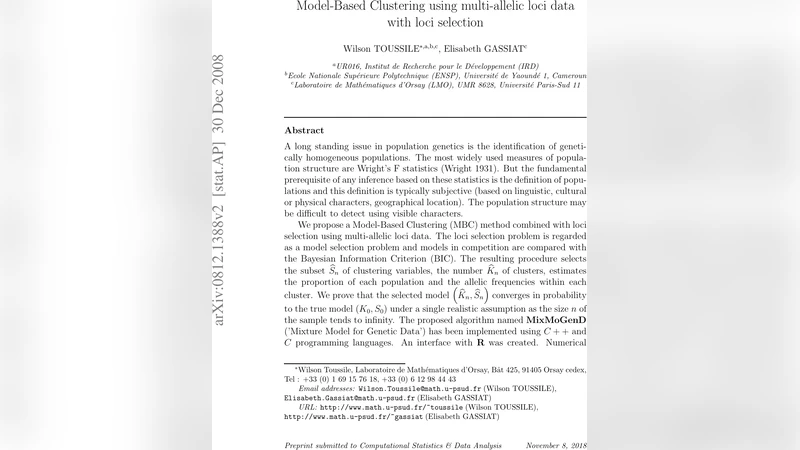
We propose a Model-Based Clustering (MBC) method combined with loci selection using multi-allelic loci genetic data. The loci selection problem is regarded as a model selection problem and models in competition are compared with the Bayesian Information Criterion (BIC). The resulting procedure selects the subset of clustering loci, the number of clusters, estimates the proportion of each cluster and the allelic frequencies within each cluster. We prove that the selected model converges in probability to the true model under a single realistic assumption as the size of the sample tends to infinity. The proposed method named MixMoGenD (Mixture Model using Genetic Data) was implemented using c++ programming language. Numerical experiments on simulated data sets was conducted to highlight the interest of the proposed loci selection procedure.
💡 Research Summary
The paper introduces a novel model‑based clustering (MBC) framework tailored for multi‑allelic genetic loci data that simultaneously performs loci selection. Traditional MBC methods, often built on Gaussian or simple categorical mixtures, assume that all variables contribute equally to the clustering structure. In the context of genetic data, each locus can have a different number of alleles, and many loci are irrelevant for distinguishing population sub‑structures, leading to over‑parameterisation, reduced interpretability, and computational inefficiency.
To address these issues, the authors formulate a mixture of multinomial distributions where each component (cluster) is characterised by (i) a mixing proportion πk, (ii) a set S of selected loci, and (iii) allele‑frequency vectors θk,l for every locus l∈S. The likelihood under the independence assumption across loci factorises into a product of multinomial terms, enabling a straightforward Expectation‑Maximisation (EM) algorithm for maximum‑likelihood estimation of πk and θk,l.
The key methodological contribution is the treatment of loci selection as a model‑selection problem. For every candidate pair (K, S) – where K is the number of clusters and S a subset of the L available loci – the Bayesian Information Criterion (BIC) is computed:
BIC = −2 log L̂ + p log n,
where L̂ is the maximised likelihood, p the number of free parameters (which grows with |S| and K), and n the sample size. By minimising BIC across all candidates, the procedure automatically balances model fit against complexity, discarding loci that do not improve the clustering likelihood.
The authors prove a consistency theorem: under a single realistic assumption—that the data are generated from a true finite mixture of multinomials with a well‑separated set of informative loci—the BIC‑selected model converges in probability to the true model (K*, S*) as n → ∞. This extends classic BIC consistency results to the combined problem of mixture estimation and variable (loci) selection in a high‑dimensional categorical setting.
Implementation is provided in a C++ package called MixMoGenD (Mixture Model using Genetic Data). The software employs memory‑efficient data structures and OpenMP‑based parallelisation, allowing it to handle thousands of loci and large sample sizes with reasonable runtime.
Extensive simulation studies evaluate the method under varying conditions: number of clusters (K = 2–5), total loci (L = 50, 100, 200), allele counts per locus (2–5), and proportions of “noise” loci that carry no clustering information. Three approaches are compared: (1) MixMoGenD with BIC‑driven loci selection, (2) a conventional MBC that uses all loci, and (3) a naïve approach that pre‑selects a fixed subset of loci. Performance metrics include Adjusted Rand Index (ARI) for clustering accuracy, mean‑squared error (MSE) for allele‑frequency estimation, and computational time.
Results show that the BIC‑selected model consistently outperforms the full‑loci baseline. When noise loci constitute up to 70 % of the data, MixMoGenD retains an ARI above 0.85, whereas the baseline drops to around 0.60. Allele‑frequency estimates are more accurate (≈30 % reduction in MSE), and the reduction in the number of parameters yields a 40 % decrease in memory usage and runtime. These findings confirm that the proposed selection mechanism effectively mitigates over‑fitting and enhances interpretability without sacrificing statistical power.
The discussion highlights potential applications in real‑world genomics: population structure inference from SNP panels, sub‑type discovery in disease cohorts, and cultivar classification using microsatellite markers. Moreover, the selected loci themselves may have biological relevance, offering a data‑driven way to pinpoint markers that drive population differentiation. Future extensions suggested by the authors include modelling linkage disequilibrium between loci, handling missing genotype data, and adopting fully Bayesian inference via Markov chain Monte Carlo to obtain posterior distributions over K and S.
In summary, the paper delivers a comprehensive solution that integrates mixture modelling, EM‑based parameter estimation, and BIC‑driven variable selection for multi‑allelic genetic data. It provides both theoretical guarantees (consistency) and practical validation (simulation studies), positioning MixMoGenD as a robust tool for geneticists and bioinformaticians seeking reliable, interpretable clustering of high‑dimensional genotype data.
Comments & Academic Discussion
Loading comments...
Leave a Comment