In this work we have studied the research activity for countries of Europe, Latin America and Africa for all sciences between 1945 and November 2008. All the data are captured from the Web of Science database during this period. The analysis of the experimental data shows that, within a nonextensive thermostatistical formalism, the Tsallis \emph{q}-exponential distribution $N(c)$ satisfactorily describes Institute of Scientific Information citations. The data which are examined in the present survey can be fitted successfully as a first approach by applying a {\it single} curve (namely, $N(c) \propto 1/[1+(q-1) c/T]^{\frac{1}{q-1}}$ with $q\simeq 4/3$ for {\it all} the available citations $c$, $T$ being an "effective temperature". The present analysis ultimately suggests that the phenomenon might essentially be {\it one and the same} along the {\it entire} range of the citation number. Finally, this manuscript provides a new ranking index, via the "effective temperature" $T$, for the impact level of the research activity in these countries, taking into account the number of the publications and their citations.
Deep Dive into Tsallis $q$-exponential describes the distribution of scientific citations - A new characterization of the impact.
In this work we have studied the research activity for countries of Europe, Latin America and Africa for all sciences between 1945 and November 2008. All the data are captured from the Web of Science database during this period. The analysis of the experimental data shows that, within a nonextensive thermostatistical formalism, the Tsallis \emph{q}-exponential distribution $N(c)$ satisfactorily describes Institute of Scientific Information citations. The data which are examined in the present survey can be fitted successfully as a first approach by applying a {\it single} curve (namely, $N(c) \propto 1/[1+(q-1) c/T]^{\frac{1}{q-1}}$ with $q\simeq 4/3$ for {\it all} the available citations $c$, $T$ being an “effective temperature”. The present analysis ultimately suggests that the phenomenon might essentially be {\it one and the same} along the {\it entire} range of the citation number. Finally, this manuscript provides a new ranking index, via the “effective temperature” $T$, for the i
The analysis of the citations of scientific papers is an important issue that can enable a better understanding of the research activity of the authors, the institutions and their countries [13,5,32,14]. The evaluation of the productivity of individual scientists has traditionally relied on the number of papers they have published. Nowadays, with the easy access to the Internet and to large databases, including the Web of Science [14], the comparison of the impact of scientific contributions is a much easier and more rapid process.
Many measures of research productivity have been proposed. In many surveys, research productivity is usually represented by two different variables, namely the number of total publications and their citations [18]. The first measure reflects research quantity and the other reflects research impact. The degree to which published works are cited by other authors is generally considered as a reflection of the quality of those works [23].
There has been considerable work in the area of citation analysis. Prior citation analysis has analyzed a wide variety of factors such as (i) the distribution of citation rates [25] [17], [37], [16], (ii) the variation in the distribution of citation rates across research fields and geographical regions [17], (iii) the geographic distribution of highly cited scientists [7,8], (iv) various indicators of the scientific performance of countries [20]. Finally, citation analysis and other methodologies based on research productivity have been used to rank journals [15,22,29] and also universities [40,31,32].
The assessment of scientific research is an extremely delicate and sophisticated venture [11]. The scientific position of a given country in the international context can usually be analyzed from both qualitative and quantitative points of view. Firstly, the number of publications of a country and its contribution to the total world can be used. Secondly, the impact of its research outputs, preferably by scientific disciplines, can be measured through citations or some other surrogate Impact Factor measures [13,14]. Scientometric analysis plays an important role in the assessment of the performance of scientific research, for it can address some structural problems such as the impact of research outputs of some countries on several scientific fields, the scale and characteristics of the international comparison, the structure of several fields, and the relationship which exists between them [13,14,6,18].
With regard to the distribution of citations, many works have been done [16,25,37]. A stretched exponential fitting was applied for modeling citation distributions based on multiplicative processes [16]. Lehmann [17] attempted to fit both a power law and stretched exponential to the citation distribution of 281 717 papers in the SPIRES [30] database and showed it is impossible to discriminate between the two models. Redner analyzed the ISI and Physical Review databases [25]. In Redner’s work the applied fitting distribution had only partial success while the same numerical data for large citation count c showed that can be fitted quite satisfactorily with a single curve by using nonextensive thermostatistical formalism [37].
In the present work, we have considered the scientific research activity in terms of the number of publications and number of citations. The current study uses data from Thomson ISI Web of Science database [14] for many different countries from Latin America, Europe and South Africa. The period that is investigated is between 1945 to November 2008. We show that the data for all the tested countries can be satisfactorily fitted with a single curve, namely N (c) ∝ 1/[1 + (q -1) c/T ] 1 q-1 (with q ≃ 4/3), which naturally emerges within the Tsallis theory. The present analysis ultimately suggests that this phenomenon might essentially be one and the same along the entire range of the citation number c for each different case.
Nowadays, the idea of nonextensivity has been used in many applications. Nonextensive statistical mechanics has been applied successfully in physics (astrophysics, astronomy, cosmology, nonlinear dynamics) [26,27], biology [41], economics [38], human and computer sciences [1,4,2,39] and provide interesting insights into a variety of physical systems (two-dimensional turbulence in pure-electron plasma [10], variety of self-organized critical models [33], long-range interaction conservative systems [3], and among others [42]). Thomson ISI Web of Science [14] is a widely used database source for such works.
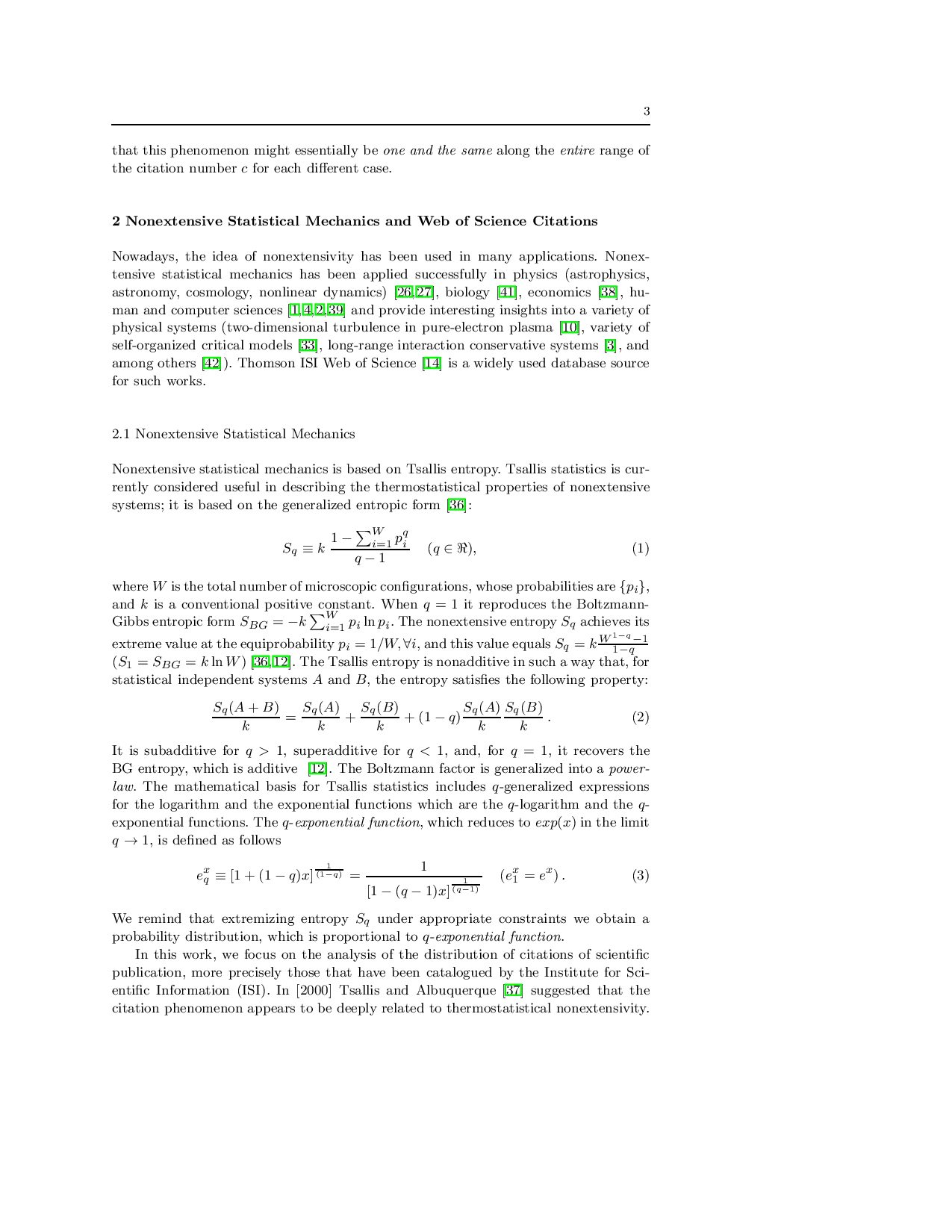
Nonextensive statistical mechanics is based on Tsallis entropy. Tsallis statistics is currently considered useful in describing the thermostatistical properties of nonextensive systems; it is based on the generalized entropic form [36]:
where W is the total number of microscopic configurations, whose probabilities are {p i }, and k is a conventional positive constant. When q = 1 it reproduces the Boltzm
…(Full text truncated)…
This content is AI-processed based on ArXiv data.