Asteroids in rooted and directed path graphs
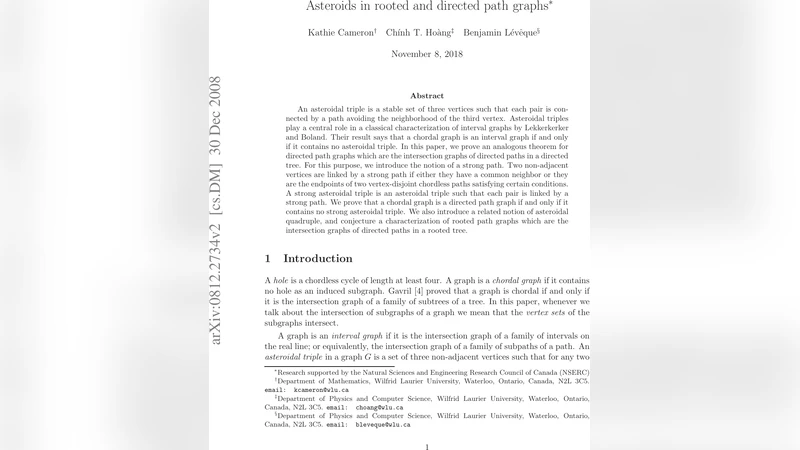
An asteroidal triple is a stable set of three vertices such that each pair is connected by a path avoiding the neighborhood of the third vertex. Asteroidal triples play a central role in a classical characterization of interval graphs by Lekkerkerker and Boland. Their result says that a chordal graph is an interval graph if and only if it contains no asteroidal triple. In this paper, we prove an analogous theorem for directed path graphs which are the intersection graphs of directed paths in a directed tree. For this purpose, we introduce the notion of a strong path. Two non-adjacent vertices are linked by a strong path if either they have a common neighbor or they are the endpoints of two vertex-disjoint chordless paths satisfying certain conditions. A strong asteroidal triple is an asteroidal triple such that each pair is linked by a strong path. We prove that a chordal graph is a directed path graph if and only if it contains no strong asteroidal triple. We also introduce a related notion of asteroidal quadruple, and conjecture a characterization of rooted path graphs which are the intersection graphs of directed paths in a rooted tree.
💡 Research Summary
The paper investigates structural characterizations of two graph families that arise from directed paths in trees: directed path graphs (DPGs) and rooted path graphs (RPGs). The authors build on the classic Lekkerkerker–Boland theorem, which states that a chordal graph is an interval graph if and only if it contains no asteroidal triple (AT). An AT is a stable set of three vertices such that each pair can be connected by a path that avoids the closed neighbourhood of the third vertex. While interval graphs are intersection graphs of intervals on a line, DPGs are intersection graphs of directed paths in a directed tree, and RPGs are the same but with a distinguished root in the tree.
To extend the AT‑based characterization to DPGs, the authors introduce the notion of a strong path. Two non‑adjacent vertices u and v are linked by a strong path if either they share a common neighbour, or they are the endpoints of two vertex‑disjoint chordless paths that satisfy additional “neighbour‑avoidance” constraints. A strong asteroidal triple (SAT) is an AT in which every pair of vertices is linked by a strong path.
The central theorem proved is:
Theorem. A chordal graph G is a directed path graph if and only if G contains no strong asteroidal triple.
The proof proceeds in two directions. For the “only‑if” direction, the authors show that the existence of an SAT forces a configuration that cannot be realized by directed paths in any directed tree, essentially because the required strong paths would create unavoidable cycles or intersecting sub‑paths that violate the definition of a DPG. For the “if” direction, they construct a strong clique tree from a chordal graph that lacks an SAT. This tree refines the usual clique tree by ensuring that each edge of the tree corresponds to a strong path in the original graph. By mapping cliques to vertices of a directed tree and arranging the strong paths as directed arcs, they obtain a representation of G as an intersection of directed paths, establishing that G is a DPG.
Beyond DPGs, the paper proposes a related concept called an asteroidal quadruple (AQ)—a set of four vertices with pairwise AT‑type avoidance properties. The authors conjecture that a chordal graph is a rooted path graph precisely when it contains neither a strong asteroidal triple nor an asteroidal quadruple. Although a full proof is not provided, they verify the conjecture for several restricted families (e.g., trees of bounded depth, certain hierarchical root placements) and outline a potential algorithmic approach: detect SATs and AQs using extensions of known AT‑detection procedures, then construct a rooted strong clique tree if none are found.
The paper’s contributions are threefold. First, it generalizes the AT‑free characterization from interval graphs to the more expressive class of directed path graphs. Second, it introduces the strong path concept, which captures the extra constraints imposed by directionality and provides a clean combinatorial obstruction (the SAT). Third, it opens a new line of inquiry for rooted path graphs by formulating the AQ obstruction and a conjectural SAT‑and‑AQ‑free characterization.
Algorithmically, the SAT‑free test can be performed in polynomial time by enumerating candidate triples and checking the strong‑path conditions, which are themselves tractable due to the chordal structure. This yields a practical recognition algorithm for DPGs. For RPGs, the authors suggest a two‑stage algorithm: first eliminate SATs, then search for AQs; if both searches fail, a rooted strong clique tree can be built, giving a representation as an RPG.
In conclusion, the work deepens our understanding of how directionality interacts with chordality, provides a clean forbidden‑substructure characterization for directed path graphs, and lays the groundwork for a similar theory for rooted path graphs. Future research directions include proving the RPG conjecture, designing efficient SAT/AQ detection algorithms, and exploring applications of DPGs and RPGs in network routing, temporal data analysis, and hierarchical data structures.
Comments & Academic Discussion
Loading comments...
Leave a Comment