Decentralized sequential change detection using physical layer fusion
The problem of decentralized sequential detection with conditionally independent observations is studied. The sensors form a star topology with a central node called fusion center as the hub. The sensors make noisy observations of a parameter that ch…
Authors: ** Leena Zacharias (Beceem Communications Pvt. Ltd., Bangalore, India) Rajesh Sundaresan (Department of Electrical Communication Engineering
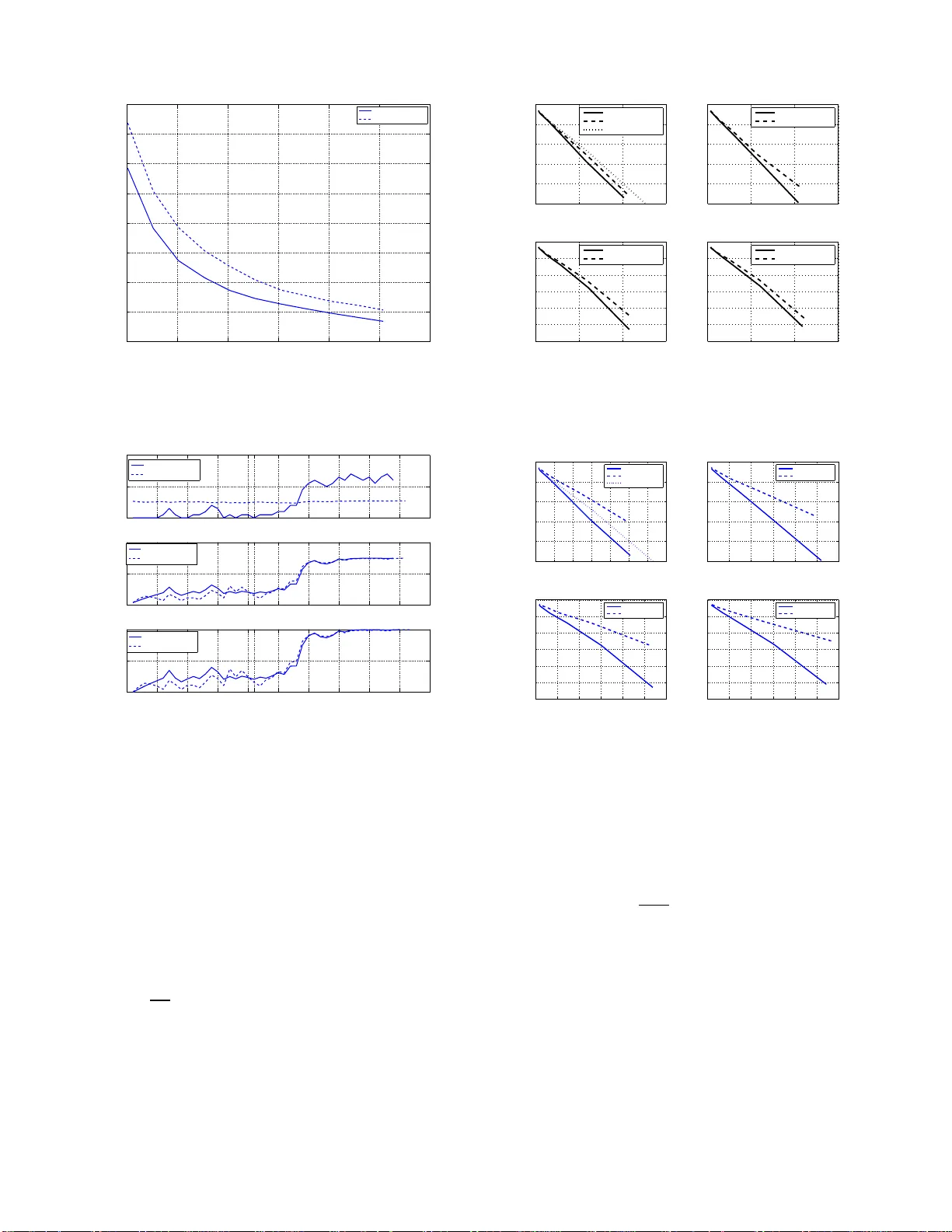
1 Decentra lized Sequential Change Detecti on Using Physical Layer Fusion Leena Zacharias and Rajesh Sund aresan Abstract — The problem of decentralized sequ ential d etection with conditionally independent obser va tions is studied . The sensors form a star topology with a central n ode called fu sion center as the hub. The sen sors make noisy observ ations of a parameter that changes from an initial sta te to a final state at a random time where the random change time has a geometric distribution. The sensors amplify and f orward the observ ations ov er a wireless Ga ussian multiple access channel and operate under either a power constraint or an energy constraint. The optimal transmission strategy at each stage is shown to be the one that maximizes a certain Ali-S ilvey distance between the distributions for the hypotheses befo re and after the change. Simulations demonstrate that the proposed analog technique has lower detection delays when c ompared with existing schemes. Simulations further demonstrate that the energy-constrained fo rmulation enables better u se of the total a va ilable energy than the po wer -constrained f ormulation in the change detection problem. Index T erms — Ali-Silvey distance, change detection, correla- tion, Markov decision pr ocess, m ultiple access channel, sequential detection, sensor network I . I N T R O D U C T I O N Consider the use of a wire less sensor network for detection of a disru ption o r a chan ge in environment. Th e cha nge is required to b e detec ted with minim um d elay sub ject to a false alarm constraint. The standard mediu m access control and physical layer design fo r such a network (e .g., IEEE 802 .15.4 standard) is on e wh ere sensors qua ntize th eir observations and send them to a f usion cen ter via ran dom access over a wireless Gaussian multiple- access ch annel (GMAC ). The tr ansmitted data are typically quan tized in dividual log-likelihoo d ratios (LLR) of the hypo theses represen ting the environment befo re and after th e cha nge. The fusion center collects each sensor’ s LLR and adds them to ge t a fused statistic, if observations at sensors ar e indep enden t condition ed on the state of th e en vironmen t; this would be the case when the observation noises ar e additive and inde penden t fro m sensor to sensor 1 . Such a design has a few drawbacks. 1) It does not explo it the spatial correlation in observations across sensors. 2) It does not exploit the superposition available on the GMA C. Leena Zacha rias is with Becee m Communications Pvt. Ltd., Bangal ore, India, and Raje sh Sundaresan is with the Department of Electrica l Commu- nicat ion E ngineeri ng, Indian Institute of Scienc e, Bangalo re, India. This work was supported by t he Defence Research & D e ve lopment Or gan- isation (DRDO), Ministry of Defenc e, Gove rnment of India under a researc h grant on wirele ss sensor netw orks (DRDO 571, IISc). 1 As we will see lat er , conditi onal independenc e notwit hstandin g, sensor observ ati ons are correlat ed. 3) It em ploys an ad hoc separation between quantiza tion or compression on one hand, and tra nsmission acro ss the channel on the other; the latter requ ires adequate codin g for no iseless r eception and corre ct furthe r processing at the fusion center . 4) It requires sufficient time slots for sensors to r esolve a ll channel contentio ns 2 . Our goal in t his paper is to detect change in en v ironm ent in a manner that addresses the af oremen tioned drawbacks. Specifi- cally , we consider a “star” top ology of sen sors. Sensors m ake an affine transforma tion of the observed data and tran smit the o utput in a n an alog fashion over the GMA C. G iv en that observations at sen sors at any instant ar e spatially correla ted, only the sum o f the LLRs is relev ant to the decision m aker , i.e., it is a sufficient statistic to dec ide on the chang e. By making the sensors simultaneou sly transmit an affine fun ction of their LLRs in an analog fas hion, and via distributed transmit beamfor ming, w e exploit the spatial corr elation in sen sor data and the sup erposition av ailable on the GMAC – the c hannel computes the required sum. Moreover , the analog data is in loose terms matched to the ch annel and does n ot requir e explicit cha nnel cod ing. Finally , the sum is available at the fusion center in a single tran smit d uration un like th e situation in the rand om access case. The biggest challeng e in our pro posed technique is the prac- ticality of distributed transmit beamfo rming. The tran smitters’ clocks shou ld be sy nchron ized to some extent, so th at car rier , phase, an d symbol ticks align. A techniq ue similar to the master-sla ve architecture p roposed by Mudu mbai, Barriac & Madhow [1] can be used to achieve this synchron ization. Th e scheme exploits chann el recipr ocity in a time-division duplex (TDD) system. 1) Organization an d pr evie w of main r esults: In Section II, we form ulate and solve a cha nge detection problem under a power-constrained setting 3 . W e arriv e at a Markov decision problem framework an d show that par ameters of the affine transform ation sh ould minimize the variance of the combined observation and GMAC noises, wh ich turns out to be a non- conv ex op timization prob lem. W e then pr ovide an explicit al- gorithm to comp ute the optimal contro l parameters. Section III considers an en ergy-con strained setting. Section IV compares 2 Alterna ti v ely , a time-di vision multipl exi ng protocol needs as many slots as there are sensors, and does not scale with the number of sensors. 3 Sensors are usually po wered by b atter ies with a fix ed energy . The po wer - constrai ned model arises when this ene rgy is ev enly split o ve r the de sired life time of the sensor (in samples). A n energy-c onstraine d model arises when there is flex ibili ty in ho w this ener gy is expend ed from sample to sample (subject to, of course, constraint s imposed by the po wer amplifier). 2 the simulation per forman ce of our scheme with a previously known scheme. It also compares th e energy-con strained for- mulation of Section III with the power -constrained f ormulatio n of Section II. A ppendix I con tains a new characterization of optimal contro l: max imize a certain Ali- Silvey distance [2] between the distributions of the fusion cen ter’ s ob servation before and after the chan ge. This is used to arrive at the minimum variance criter ion of Section II. 2) Prior work: Cha nge detection prob lems wer e solved in a centr alized setting b y Page [3], Lord en [4], an d Shiryay ev [5]. Shiryayev considered a Bayesian setting wh ich is of relev ance to o ur work. V eerav alli [6] solved the decentr alized version o f this pro blem with parallel err or-free bit pip es of limited capacity fro m th e sensors to the fu sion center and identified the optimal stopping policy and quantizer structu re. These r esults are ana logous to those for hy pothesis testing and sequential h ypoth esis testing (T sitsiklis [7], V eerav alli et al. [8]). Prasanthi [9] co nsidered access and decision delay s in sequ ential detectio n over a rand om access ch annel, as it would be practically imp lemented using, for examp le, the IEEE 80 2.15 .4 wireless personal area network standard. (See also [ 10]). Ou r work d iffers from those o f Prasanth i and V eerav alli becau se we propose an analog transmission strategy . Analog transmissions a re o ptimal for transmission o f a single Ga ussian so urce over a Gaussian ch annel (Berger [11, p.100 ]) and a bi variate Gaussian so urce over a GMA C for a certain range o f signal-to -noise ra tios (SNR) (Lapid oth and T inguely [12]), when a ru nning estimate is req uired. Analog transmission via waveform d esign was considered by Mergen and T ong [13]. Th ey used “typ e-based” multiple access to estimate a para meter over a GMAC. Their sch eme, as do es ours, explo its the sup erposition av ailable in the GMAC . (See also [1 4], [1 5], [16], [1 7], [18], and [1 9] for an alog trans- mission in oth er settings). Er tin an d Po tter [20] co nsidered generalized cost functions which is m athematically analogo us to our energy-co nstrained formu lation. I I . P H Y S I C A L L A Y E R F U S I O N F R A M E W O R K A. Mathematical F ormulation X ∼ N ( θ, σ 2 ) indicates th at X is a Gaussian random variable with me an θ and variance σ 2 . (1) The state o f nature is d escribed by { θ k : k ∈ Z + } , a tw o- state discrete-time Markov chain takin g values in { m 0 , m 1 } , with transition pr obabilities as d escribed in Fig. 1(a)-( b). The quantities m 0 and m 1 denote, for examp le, the mean level o f the o bservations bef ore and after th e disru ption. The initial distribution fo r th is Markov chain is obtained f rom Pr { θ 0 = m 1 } = ν . Th e ch ange tim e Γ is Z + -valued, and giv en th e ev ent { Γ > 0 } , Γ has the geom etric d istribution. (2) The network ha s L sensors. At tim e k , sensor S l makes an o bservation X l,k ∼ N ( θ k , σ 2 obs ,l ) , i.e., X l,k = θ k + Z l,k , where Z l,k ∼ N (0 , σ 2 obs ,l ) , l = 1 , . . . , L . (3) The observations at each sensor are independ ent, con- ditioned o n θ k . Furth ermore, the obser vations are in depend ent from sen sor to sensor, condition ed on θ k . Despite these con- ditional independe nce assumptions, we remark that X l,k , l = 1 , . . . L , are co rrelated. Fig. 1. Problem set-up. (4) Eac h sensor transmits Y l,k = φ l,k ( X l,k ) ; this bein g a function on ly of the o bservation at sensor l , ou r setting is a decentralized one. See Fig. 1(c) . The function φ l,k is affine: φ l,k ( x ) = α l,k ( x − c l,k ) . (1) Quantities α k = ( α 1 ,k , . . . , α L,k ) and c k = ( c 1 ,k , . . . , c L,k ) are parameter s for optimal control. T ransmission is do ne b y setting th e am plitude o f a n u nderly ing unit-ene rgy waveform to Y l,k . All sensors use the same un derlyin g waveform. The motiv ations f or the analog amplify-and -forward transmissions in (1) are given in Sectio n I: c ondition al independ ence of the observations given th e state, and the Gaussian ob servation noise. If th e latter do es no t hold , affine fun ctions of LLRs instead of the direct observations could be sent ([21, Ch. 5]). (5) The GMAC o utput at the fusion center when pro jected onto the comm on wa veform yields e Y k = L X l =1 h l Y l,k + Z MA C ,k , where Z MA C ,k ∼ N (0 , σ 2 MA C ) is ind ependen t and identically distributed (iid) across k , and is in depend ent of all other quantities. The ga in h l ∈ R + is the cha nnel gain for the l th sensor and is determ inistic. See Fig . 1(c). W e assume perfect knowledge o f the chann el gains is available at the sensors an d the fusion center . While this is no t the case in practice, channel knowledge can be gleaned in time-division duplex (TDD) systems that possess ch annel reciprocity (IEEE 802 .15.4 ). See 3 Mudumb ai, Barriac & Mad how [1] for a sugge sted m aster- sla ve architectur e. In a subsequen t section, we study the e ffect of imperfec t kn owledge of these gains. (6) At the fusion cen ter , fo rm b Y k as follows: b Y k = 1 P L l =1 h l α l,k e Y k + L X l =1 h l α l,k c l,k ! = θ k + b Z MA C ,k , (2) where b Z MA C ,k ∼ N (0 , σ 2 k ) and σ 2 k = P L l =1 ( σ obs ,l h l α l,k ) 2 + σ 2 MA C P L l =1 h l α l,k 2 . (3) The quantity b Y k in (2) is obtained from e Y k using a bijective mapping ; so n o infor mation is lost. Fro m (2), we a lso see that th e distributed mu lti-sensor setting is equiv alent to a centralized setting wh ere the fu sion center makes a direct (noisy) observation on θ k with equ iv alent additive ob servation noise o f variance σ 2 k as g iv en in (3) . This is enab led by the affine nature of φ l,k . The centralized p roblem with co nstant σ 2 k was studied by Shiryayev [5] with the aim of cha racterizing the stoppin g r ule. The new aspect h ere is the depend ence of σ 2 k on the con trol parameters. (7) The fusion center cho oses an action a k − 1 ∈ A at time k − 1 from set A of actions (con trols) A = { stop } ∪ { ( continue, α, c ) : α ∈ R L + , c ∈ R L } . If a k − 1 = stop , the fusion center stops. If a k − 1 = ( continue, α k , c k ) , the fu sion center takes another sample (the k th), and all sensors tr ansmit φ l,k ( X l,k ) with parameters ( α k , c k ) . (8) As done by V eerav alli in [8], we assume a qua si-classical informa tion structu re, i.e., action a k − 1 depend s on i k − 1 = { a 0 , b y 1 , a 1 , b y 2 , . . . , a k − 2 , b y k − 1 } . (4) Even though the sensors may have lo cal m emory of p ast ob- servations, our framew ork does not m ake use of th is additio nal informa tion. 4 The fu sion center feeds b ack the action pa ram- eters a k − 1 to th e sensors. (W e u se the following no tation: the quantity i k − 1 in (4) is a realizatio n o f the rand om variable I k − 1 and takes values in the set I k − 1 . W e set I 0 = ∅ ). (9) A verage power constraint at senso r l is E h α 2 l,k ( X l,k − c l,k ) 2 | I k − 1 i ≤ P l , i.e., α 2 l,k h σ 2 obs ,l + E h ( θ k − c l,k ) 2 | I k − 1 ii ≤ P l , l = 1 , . . . , L. (5) The set of feasible controls, g iv en I k − 1 = i k − 1 , is den oted by A ( i k − 1 ) = { stop } ∪ { ( conti nue, α, c ) : ( α, c, i k − 1 ) satisfies (5) } . (6) In Section III, we relax the constraint in (5) an d im pose an expected total energy con straint. 4 V eerav al li [8, p.434] discusses other information structur es and why the y may be dif ficult to analyze . (10) T he fusio n center policy π is a seq uence o f p ropo sed (determin istic) action s π = ( π k − 1 , k ≥ 1 ) , where π k − 1 is a fu nction π k − 1 : I k − 1 → A . In particular, π k − 1 ( i k − 1 ) = a k − 1 ∈ A ( i k − 1 ) . Each policy π ind uces a prob ability m ea- sure. All expectatio ns are with respect to this measure. Th e depend ence of the expectation o peration on π is und erstood and suppre ssed. (11) τ is the first instant when the fusion center d ecides to stop. The proble m we wish to solve is th e following: Pr o blem 1: (Change detectio n with delay p enalty) Min- imize over all admissible policies the expected detection d elay , E DD = E h ( τ − Γ) + i , subject to an upper bound on the probab ility of false ala rm P F A ≤ δ , wh ere x + = max(0 , x ) , and P F A = Pr { τ < Γ } . The so lution to Problem 1 is obtained v ia a solution to Problem 2 (below) for a pa rticular λ > 0 (Shiry ayev [5]). The quantity λ may be inter preted as the cost of unit delay . Pr o blem 2: (Change detection with a Bay es cost) Minimize over all adm issible policies R ( λ ) = P F A + λE DD = Pr { Γ > τ } + λ E h ( τ − Γ) + i = E " 1 { θ τ = m 0 } + τ − 1 X k =0 λ 1 { θ k = m 1 } # (7) where λ > 0 and E is under the p robability measure induced by the chosen policy . The cost func tion is additive over time. The first ter m within the expe ctation in (7) is the termin al co st; the ter ms in the summation a running cost. At e ach stage the state θ k ev olves in a Markov fashion. The co ntroller sees o nly a n oisy version b Y k of the state, but can con trol the ob servation n oise variance σ 2 k via α and c . It can also stop at any stag e and p ay a terminal cost. Any d ecision affects the future evolution of the cost process. Such pro blems are Mar kov decision problem s (MDP) with pa rtial observations. They can be analyzed by studyin g an equiv alent complete observation MDP 5 with a redu ced (posterior ) state µ k ∆ = E [1 { θ k = m 1 } | I k ] = Pr { Γ ≤ k | I k } . The pro bability law fo r { µ k : k ≥ 0 } is given as follows: µ 0 = Pr { Γ ≤ 0 | I 0 } = ν , and the law f or µ k , u nder a k = ( continue, α k +1 , c k +1 ) , is (see V eerav alli [6, eq n. (9)]) µ k +1 = β k f m 1 ,α k +1 ˆ Y k +1 β k f m 1 ,α k +1 ˆ Y k +1 + (1 − β k ) f m 0 ,α k +1 ˆ Y k +1 △ = g ˆ Y k +1 , α k +1 , µ k h ˆ Y k +1 , α k +1 , µ k △ = ψ ˆ Y k +1 , µ k , α k +1 , (8) where β k △ = Pr { Γ ≤ k + 1 | I k } = µ k + (1 − µ k ) p , and f m i ,α k +1 is the density o f an N ( m i , σ 2 k +1 ) random v ariable. The quantities h and g are as in (8); h is the density of ˆ Y k +1 5 See Shiryaye v [5], V eerav alli [6] for results with stopping, Bertseka s & Shre ve [22, Ch. 10] for discount ed costs, and Bertsek as [23, Ch. V]. 4 giv en ( I k , a k ) , an d g is a scaled density . The power c onstraint (5) when written fo r time k + 1 simplifies to α 2 l,k +1 σ 2 obs ,l + ( m 0 − c l,k +1 ) 2 (1 − β k ) +( m 1 − c l,k +1 ) 2 β k ≤ P l . (9) The set of feasible contro ls in (6) dep ends o n i k only throu gh µ k and can be simp lified to A ( µ ) = { stop } ∪ { ( conti nue, α, c ) : ( α, c, µ ) satisfies ( 9 ) } , where A ( · ) is re-used to d enote the set of feasible contro ls for the equ iv alent com plete observation MDP . Let A ′ ( µ ) = { ( α, c ) : ( continu e, α, c ) ∈ A ( µ ) } de note the set of control parameters when the action is to co ntinue. Now conside r the o bjective function. T a king co nditional expectation s with respect to the info rmation pro cess, (see Shiryay ev [5, pp.195 – 196]) , (7) red uces to R ( λ ) = E " (1 − µ τ ) + τ − 1 X k =0 λµ k # . (10) Minimization of (10) is done via dyn amic program ming. Some additional remark s a re in orde r . Remarks : 1. The variance σ 2 k +1 depend s o n α k +1 as shown in (3), an d h ence the de penden ce on α k +1 in (8). µ k +1 depend s on c k +1 only thro ugh α k +1 because of the processing d one in (2). 2. If the run ning cost is λ instead of λ 1 { θ k = m 1 } in (7), ev ery sample costs λ units, no t just th ose beyond the ch ange point tha t contribute to the delay . Th is is a minor variation to Problem 2 and has a similar so lution. 3. Ano ther variation is sequential hypoth esis testing : set the transition p robability p = 0 , enh ance the action stop to ( stop, ˆ θ ) , wher e ˆ θ is the decision (either m 0 or m 1 ), a nd set the term inal cost to 1 { θ τ 6 = ˆ θ } . Th e run ning cost is a constant λ for every sample. B. Optimal P o licy As is usual with such problem s, we first restrict the stopping time τ to a finite ho rizon T . Using Bertsekas’ s result [23 , Ch.1, Prop.3. 1], the cost-to -go function recursio ns are written as J T T ( µ T ) = 1 − µ T , J T k ( µ k ) = min 1 − µ k , λµ k + A T k ( µ k ) , 0 ≤ k < T , A T k ( µ ) = min ( α,c ) ∈ A ′ ( µ ) E h J T k +1 ψ ˆ Y , µ, α i = min ( α,c ) ∈ A ′ ( µ ) Z R J T k +1 g ( ˆ y , α, µ ) h ( ˆ y , α, µ ) h ( ˆ y , α, µ ) d ˆ y . T o solve Problem 2, let T → ∞ . From resu lts in [8] and [6], the limit in (11) below exists, d oes not depend on k (i.e., the policy is stationary ), and defines the infinite h orizon cost-to-g o function : J ( µ ) = lim T →∞ J T k ( µ ) = min { 1 − µ, λµ + A J ( µ ) } , (11) where A J ( µ ) = min ( α,c ) ∈ A ′ ( µ ) E h J ψ ˆ Y , µ, α i . (12) The following lemma en ables a char acterization of the optima l stopping policy . Lemma 1: The fu nctions J T k ( µ ) a nd A T k ( µ ) a re non -neg- ativ e and concave fu nctions o f µ , for µ ∈ [0 , 1 ] . Mo reover , A T k (1) = J T k (1) = 0 . Similarly , the functions J ( µ ) and A J ( µ ) are n on-negative and co ncave f unction s of µ , fo r µ ∈ [0 , 1] , and A J (1) = J (1) = 0 . The proof is the same as that in Bertsekas [23, p. 26 8] for sequential hypothesis testing . The con cavity of A J ( µ ) and (11) imply the following th eorem (Shiryay ev [5 ], V eerav alli [6]). Theor em 2: An optimal fusion center policy has stopping time τ gi ven by τ = inf { k : µ k ≥ µ ∗ } , where µ ∗ is the u nique solution to λµ + A J ( µ ) = 1 − µ. T o sum marize, the op timal d etection strategy at time k is as follows. Con vert the received signal ˜ Y k into the posterior probab ility o f ch ange µ k using (2) and (8). If µ k exceeds a thr eshold, declare that a change has o ccurred . Otherwise, make the sensors transmit an other sample using parameter s α, c ch osen optimally as described in the next subsection. C. P arameters for Optimal Contr ol W e begin this section with an alg orithm that calculates the optimal α . Algorithm 1: Let σ 2 obs , 1 h 1 α max , 1 ≤ · · · ≤ σ 2 obs ,L h L α max ,L , where the quantity α max ,l = P l / σ 2 obs ,l + ( m 1 − m 0 ) 2 β (1 − β ) 1 / 2 with β = µ + (1 − µ ) p . • Ste p 1 : Find the unique k ∈ { 1 , . . . , L − 1 } that satisfies σ 2 obs ,k h k α max ,k ≤ P k l =1 ( σ obs ,l h l α max ,l ) 2 + σ 2 MA C P k l =1 h l α max ,l ≤ σ 2 obs ,k +1 h k +1 α max ,k +1 (13) if it exists. Otherwise, set k = L . • Ste p 2 : Set th e optima l α as follows. a ∗ = k X l =1 h l α max ,l + P L l = k +1 σ − 2 obs ,l P k l =1 h l α max ,l · k X l =1 ( σ obs ,l h l α max ,l ) 2 + σ 2 MA C ! , (14) α m = α max ,m , 1 ≤ m ≤ k , α m = 1 σ 2 obs ,m h m · a ∗ − P k l =1 h l α max ,l P L l = k +1 σ − 2 obs ,l , k < m. (15) The optimal choice sets amplitu des of the k sensors with the k least scaled observation n oise variance ( σ 2 obs ,l h l α max ,l ) to α max ,l . Th e remain ing sensors’ am plitudes ar e appro priately chosen smaller values. Intuitively , sensor s l = k + 1 , . . . , L 5 have so good a ch annel that scaling by α max ,l for these sen sors will amplify the observation noise lead ing to a larger overall noise variance. Note that when all chan nel gains, ob servation variances, a nd power constraints are equa l, α l = α max for all sensors. This special case was ear lier proved in [24]. Theor em 3: The cho ice of c l = m 1 β + m 0 (1 − β ) , l = 1 , . . . , L, and α according to Algor ithm 1 constitute the optimal contro ls that minimize (12). Pr o of: Step 1 : W e p rove that th e o ptimal contro l minimizes the variance (3). Consider α and α ′ with resulting variances σ 2 < σ ′ 2 . From the second eq uality in (2) we have b Y ( α ) = θ + σ Z , (16) b Y ( α ′ ) = θ + σ ′ Z ′ ∼ θ + σ Z 1 + ( σ ′ 2 − σ 2 ) 1 / 2 Z 2 , (17) where Z, Z 1 , Z 2 are iid N (0 , 1 ) with Z ′ = Z 1 + Z 2 . The time index k is understoo d. From (16) a nd (17), b Y ( α ′ ) is a st ochastically degraded version of b Y ( α ) an d is eq uiv alent to an additional r andom processing on b Y ( α ) . Theo rem 5 in Appendix I shows that 1 − E h J g b Y ( α ) , α, µ h b Y ( α ) , α, µ is an Ali-Silvey d istance b etween two pr obability m easures. In E h the dependen ce of h on α is un derstood and sup pressed. Ali-Silvey distances have a well-kn own mo noton icity p rop- erty: d ata p rocessing, whether d eterministic or r andom , cannot increase the dissimilarity measure between two distributions ([2], [25]). This pr operty implies that E h J g b Y ( α ) , α, µ h b Y ( α ) , α, µ ≤ E h J g b Y ( α ′ ) , α ′ , µ h b Y ( α ′ ) , α ′ , µ . It follows th at minimization o f th e variance in (3) is the criterion for getting the op timal α . Step 2 : W e now identify the op timal c . The minim ization mentioned in the previous step should be don e subject to th e power constrain t giv en in (5), wh ich can be rewritten as α 2 l,k ≤ P l · h σ 2 obs ,l + E h ( θ k − c l,k ) 2 | I k − 1 ii − 1 . (18) The con straint set is enlarged if the upper bo und in ( 18) is higher . W e sho uld therefo re choo se the c l,k that minimizes E h ( θ k − c l,k ) 2 | I k − 1 i , i.e., c l,k is the minimu m mean squared error (MMSE) estimate of θ k giv en I k − 1 . Clearly this is given by c l,k = E [ θ k | I k − 1 ] = m 1 β k − 1 + m 0 (1 − β k − 1 ) , a nd is indepen dent of l . Mor eover , E h ( θ k − c l,k ) 2 | I k − 1 i = V ar { θ k | I k − 1 } = ( m 1 − m 0 ) 2 β k − 1 (1 − β k − 1 ) , and (18) can b e written as α l,k ≤ α max ,l,k , where α max ,l,k = P l / σ 2 obs ,l + ( m 1 − m 0 ) 2 β k − 1 (1 − β k − 1 ) 1 / 2 . 0 1 2 3 4 5 6 7 8 −2.2 −2 −1.8 −1.6 −1.4 −1.2 −1 −0.8 −0.6 −0.4 −0.2 Mean Delay ln (P FA ) Clipping Affine Centralized Fig. 2. Performance curves: 1) Clipped transmission via a sigmoidal function 2) Affine transfor mation 3) Cent ralize d, where all s ensor data is av ailable without noise at the fusion cente r . Step 3 : Ig norin g the time index k , the o ptimization pr oblem to obtain the be st α is: Pr o blem 3: Minimize L X l =1 h l α l ! − 2 " L X l =1 ( σ obs ,l h l α l ) 2 + σ 2 MA C # , where α l ∈ [0 , α max ,l ] for l = 1 , · · · , L . This is no t a c onv ex optimization problem . Howe ver , we can split it into two simpler co n vex o ptimization prob lems to get an explicit solution to Problem 3. Lemma 4: Algorithm 1 solves Problem 3. See Appendix II fo r a pro of. Th is co ncludes th e proof o f Theorem 3. Under the restriction of affine controls, Theor em 3 describes the o ptimal choic e. Howe ver , affine contro ls are n ot optimal in g eneral. T his is dem onstrated in Fig. 2 where a p iece-wise linear sigmo idal contr ol outp erform s t he o ptimal affine con trol (see [2 1, Sec. 2.7]). It would be in teresting to see if ther e ar e ranges of σ 2 obs ,l and σ 2 MA C where the affine contro l is in deed optimal. W e do not pursue this qu estion in this work. W e now ma ke so me remarks on th e complexity of overall detection. Theo rem 3 says tha t the param eters for optimal con- trol are obtained via a finite step p rocedu re. Indeed, Algorith m 1 gives the o utput in time linear in the nu mber o f sensor s, and is therefor e easy to execute. Th e threshold calculation fo r a fixed set of parameters is a one time calculation and is obtained via th e so-c alled va lue iteration pr ocedur e which y ields an approx imation. W e now explore furthe r simplification s with reduced feedb ack info rmation. D. A Simpler Sub optimal P olicy Let us now restrict the controls to b e of th e following fo rm: the d ecision to stop or contin ue, say b k , dep ends on I k , but 6 the param eters of the a ffine transformation at time k + 1 c an only depen d o n I 0 and b k ∈ { stop, continue } . I 0 denotes the prior informa tion bef ore any observations are mad e an d b k is the decision of the f usion center at k . Note that this reduces the am ount o f f eedback to simply the binary rand om variable b k . The structure of the co ntrols is similar to that of the o ptimal policy o f the previous section, but with β k = Pr { Γ ≤ k + 1 | I 0 } = 1 − (1 − ν )(1 − p ) k +1 so th at ( α, c ) depen ds on only I 0 and n ot on I k . The stopp ing policy is chosen as in Theor em 2. As we see in simu lation results presented in Section IV, th e p erform ance of this algorithm is close to o ptimal for th e chosen parameters, yet requires feedback of only o ne bit at each stage. I I I . E N E R G Y - C O N S T R A I N E D F O R M U L A T I O N The energy-co nstrained problem is stated as fo llows. Pr o blem 4: Minimize th e expected detection delay , E DD , subject to an up per bo und on th e pr obability of false alarm, P F A ≤ δ , a nd an upper bou nd on the expected en ergy spent, E " τ X k =1 E φ 2 l,k ( X l,k ) | I k − 1 # ≤ E l , l = 1 , 2 , . . . , L. (19) Let λ = ( λ 1 , . . . , λ L , λ L +1 ) . As before, to solve Pro blem 4, we set up th e Baye s cost R ( λ ) and minimize it over all admissible choices of stoppin g policy an d the parameters α l,k and c l,k of the affine transfor mation φ l,k . The Bayes cost ca n be written as R ( λ ) = E h (1 − µ τ ) + λ L +1 τ − 1 X k =0 µ k + τ X k =1 L X l =1 λ l E α 2 l,k ( X l,k − c l,k ) 2 | I k − 1 i . A result analogo us to Theo rem 2 in Section II -B holds, an d the optimal control at time k + 1 , giv en I k , is such that c k +1 is indepen dent of l , the sensor ind ex. Mor e precisely , c k +1 = m 1 β k + m 0 (1 − β k ) , l = 1 , . . . , L, α k +1 = arg min α ∈ R L + " L X l =1 λ l α 2 l σ 2 obs ,l + ( m 1 − m 0 ) 2 β k (1 − β k ) + Z R J g ( ˆ y , α, µ k ) h ( ˆ y , α, µ k ) h ( ˆ y , α, µ k ) d ˆ y # , where J ( µ ) = min { 1 − µ, λ L +1 µ + A J ( µ ) } , is the infin ite horizon cost-to- go fu nction with A J ( µ ) = min α ∈ R L + h L X l =1 λ l α 2 l σ 2 obs ,l + ( m 1 − m 0 ) 2 β (1 − β ) + Z R J g ( ˆ y , α, µ ) h ( ˆ y , α, µ ) h ( ˆ y , α, µ ) d ˆ y i . A minimizing co ntrol α does exist as is shown in [21, Sec. 3.1]. 0 2 4 6 8 10 12 14 −8 −7 −6 −5 −4 −3 −2 −1 0 Mean Delay ln (P FA ) Centralized Veeravalli Phy fusion optimal Suboptimal Fig. 3. Comparison of our algorithms with V eera v alli ’ s scheme. The “cent ralize d” performance curve is for the case when all sensor data is av ailable without noise at the fusion center . I V . C O M PA R I S O N S A N D P R AC T I C A L C O N S I D E R A T I O N S A. Benefits fr o m Explo iting S ensor Corr elation V eerav alli [6] addresses the structure o f optima l D l -lev el quantizer at sensor S l , l = 1 , 2 , . . . , L . His mo del is ap plicable to a system that allows log 2 D l bits to b e sent error-free fro m sensor S l to the fusion cen ter . For simp licity let D l = D , l = 1 , 2 , . . . , L . I n order to show the bene fit of exploiting cor re- lation of observations when tran smitting acro ss th e GM A C, we do the f ollowing. Th e quan tized b its from the sensor s in V eerav alli’ s scheme are transmitted using an op timal sch eme designed for indepe ndent data streams over a co herent GMA C. If all sensors o perate at the sam e transmission power , the SNR required to support su ch a transmission on the GMA C satisfies the sum r ate constrain t L log 2 D ≤ (1 / 2) log 2 (1 + L · SNR ) , and thus SNR ≥ D 2 L − 1 L . (20) For th e simulations, we assume two sensors ( L = 2 ) with equal gains, i.e ., h l = 1 for l = 1 , 2 . W e also assume one-bit quantizers ( D = 2 ). From (20) we get SNR ≥ 7 . 5 . Algorithms operate at SNR = 7 . 5 with P l = 7 . 5 for l = 1 , 2 and σ 2 MA C = 1 . W e now summarize the other simulation assum ptions which will be used un less stated otherwise. Simulation Setup 1: Consider L = 2 sensors with N (0 , 1) and N (0 . 75 , 1) observations before and afte r the chang e, respectively . The g eometric param eter p = 0 . 05 and the initial probab ility of chang e ν = 0 . W e obtain J ( µ ) via value iteration procedu re un til the dif ference between successi ve iterates falls b elow 0 . 000 1 with 10 00 points on the µ a xis. All simulations assume P l = P and σ 2 obs ,l = 1 for l = 1 , 2 . Fig. 3 shows that b oth our algorithm s gi ve lesser d elays than V eerav alli’ s algorithm that is naively overlaid on the GMA C. Furthermo re, the subo ptimal policy o f Section II-D degrades from that in Section II-B only for lo w false ala rm probab ilities. In V eeravalli’ s algorithm , D − 1 thresho lds ( ∈ R D − 1 ) and a decision to stop or co ntinue are fed back to each sen sor . Our 7 0 5 10 15 20 25 −8 −7 −6 −5 −4 −3 −2 −1 0 Mean Delay ln (P FA ) Centralized Phy fusion − channel SNR 3 dB Phy fusion − channel SNR 0 dB Phy fusion − channel SNR −3 dB Fig. 4. Performance curves for channel SNR = ∞ , 3 , 0 , − 3 dB. scheme requires feedback o f α l ∈ R + , c l ∈ R , and the bin ary decision. Even simpler is th e strategy in Section II- D; only a binary decision is fed back . The network delay is ind epende nt of the numb er of sen- sors in bo th our algor ithms; the perfo rmance im proves with increasing num ber of sensors. V eerav alli’ s scheme on the o ther hand re quires an expon ential growth in SNR (with L , as in (20)) to maintain the same d elay versus P F A perfor mance. Our algorith ms nee d a higher level of time an d fr equency synchro nization of the tra nsmitters for beamfo rming. Section IV -D studies the effect of lack of perf ect ch annel knowledge. T ransmit beamfor ming can be ach iev ed via up link-downlink reciprocity in a static tim e-division duplex (TDD) system (see [1] for an example mechanism) . B. P erforma nce Comparisons Under Differ ent Chann el an d Observation SNRs W e now po rtray perform ance u nder three different settings. • Fig . 4 shows perform ance for various chan nel SNRs P /σ 2 MA C ; the othe r p arameters remain as in Simulatio n Setup 1. • Fig . 5 sho ws perfor mance f or various observation SNRs ( m 1 − m 0 ) 2 /σ 2 obs when the channel SNR P /σ 2 MA C is fixed at 3 dB. • Fig . 6 com pares the symmetric and a symmetric ch annel gain cases. The symmetr ic curve is o btained with h l = 1 for l = 1 , 2 , and the asymmetric one with h 1 = 1 an d h 2 = 0 . 75 . The weaker sensor is 2.5 dB lower than the stronger one. The plots show graceful degradatio n with decreasing SNR with results along expected lines. C. Comparison of P ower- an d Ener gy-Constrained F ormula- tions For P F A ≤ e − 4 , we first identif y the minimum time to detect change as a func tion o f the energy constrain t. This y ields a power c onstraint fo r the con stant power formu lation. W e 0 5 10 15 20 25 −8 −7 −6 −5 −4 −3 −2 −1 0 Mean Delay ln (P FA ) Phy fusion − observation SNR −2.5 dB Phy fusion − observation SNR −4 dB Phy fusion − observation SNR −1 dB Fig. 5. Performance curves for observ ation SNR = − 1 , − 2 . 5 , − 4 dB. 0 2 4 6 8 10 12 14 16 18 −8 −7 −6 −5 −4 −3 −2 −1 0 Mean Delay ln (P FA ) Centralized Phy fusion symmetric channel gain Phy fusion asymmetric channel gain Fig. 6. Performance curves when 1) centraliz ed (no channe l noise) 2) symmetric channel gains 3) asymmetric channel ga ins with the weaker sensor 2.5 dB lo wer . then compar e the delays incurred by the optimal algor ithm under the two formulation s in Fig. 7. W e u se the par ameters in Simu lation Setup 1 an d h l = 1 f or all sensors. For the same P F A , the energy -constraine d solu tion declares a chang e with lesser delay than the co nstant power solutio n. As an illustration, we plot in Fig. 8 the variation of α 2 , c , and µ with time in b oth the algorithm s f or a r epresentative sample path. The change point is at 21 samp les, shown using a dotted vertical grid line. Th e energy-c onstrained solution is more en ergy efficient because it uses lower energy ( α 2 ) before and higher energy a fter the change poin t. In deed, b ased on the prior info rmation, the first few samp les use negligible en ergy . D. Channel Estimation Err o rs Thus far we assumed a static channel with perfect knowl- edge a vailable at b oth transmitter and receiver . Wireless cha n- nels, ho we ver , chan ge with time. Only a n est imate of the channel, based on signa l pro cessing on the pilots, beaco ns, 8 5 10 15 20 25 30 35 8 10 12 14 16 18 20 22 24 Mean Energy Mean Detection Delay Energy−constrained Constant power Fig. 7. Comparison of constant po wer method and energy-c onstrai ned method. 0 5 10 15 20 21 25 30 35 40 45 50 0 0.5 1 Time Index α 2 0 5 10 15 20 21 25 30 35 40 45 50 0 0.5 1 Time Index c 0 5 10 15 20 21 25 30 35 40 45 50 0 0.5 1 Time Index µ Energy−constrained Constant power Energy−constrained Constant power Energy−constrained Constant power Fig. 8. α 2 , c , and µ of const ant power method and energy-co nstraine d method for a sample path. or pre ambles, may b e av ailable. In th is section, we study the effect of imperfect cha nnel kn owledge on the physical layer fusion algor ithm. T o arrive at a model for c hannel errors, we consider com plex channel gains over the GM A C with n oise g iv en b y Z MA C ,k ∼ C N (0 , σ 2 MA C ) , a circular symmetric com plex Gau ssian rando m variable. The obser vations ar e real- valued, but the com plex baseband equiv alent sign al has tw o real-valued d egrees o f freedom per sample, leading to a bandwidth expansion factor of two. Suppose that the sensor s use tr ansmit beamforming 6 , i.e., α l = h ∗ l | h l | γ l . Th en it is sufficient to preserve o nly the real part of the received signal at the fusion center , and th e problem reduces to that studied in th e earlier p arts of this paper with σ 2 MA C replaced by σ 2 MA C / 2 in Section II. The quantity γ l replaces α l and | h l | r eplaces h l in Algorithm 1. The output of the algor ithm is γ l . Let { h l } b e a sequence of C N (0 , 1) r andom variables that 6 The optimality of coope rati ve transmit beamformi ng by sensors remains an open question . 0 5 10 15 −5 −4 −3 −2 −1 0 Mean delay ln (P FA ) Channel SNR 8.75 dB Perfect knowledge MMSE estimate Veeravalli scheme 0 5 10 15 −5 −4 −3 −2 −1 0 Mean delay ln (P FA ) Channel SNR 7.25 dB Perfect knowledge MMSE estimate 0 5 10 15 −6 −5 −4 −3 −2 −1 0 Mean delay ln (P FA ) Channel SNR 5.75 dB Perfect knowledge MMSE estimate 0 5 10 15 −6 −5 −4 −3 −2 −1 0 Mean delay ln (P FA ) Channel SNR 4.25 dB Perfect knowledge MMSE estimate Fig. 9. Performance curves comparing the cases when 1) channel is perfect ly kno wn 2) MMSE estimates are used (Pilot SNR = Channel SNR). 0 2 4 6 8 10 12 14 −5 −4 −3 −2 −1 0 Mean Delay ln (P FA ) Channel SNR 8.75 dB Perfect knowledge MMSE estimate Veeravalli 0 2 4 6 8 10 12 −5 −4 −3 −2 −1 0 Mean Delay ln (P FA ) Channel SNR 7.25 dB Perfect knowledge MMSE estimate 0 2 4 6 8 10 12 −6 −5 −4 −3 −2 −1 0 Mean Delay ln (P FA ) Channel SNR 5.74 dB Perfect knowledge MMSE estimate 0 2 4 6 8 10 12 −6 −5 −4 −3 −2 −1 0 Mean Delay ln (P FA ) Channel SNR 4.24 dB Perfect knowledge MMSE estimate Fig. 10 . Performance curves c omparing the cases when 1) c hannel is pe rfectl y kno wn 2) MMSE estimat es are used (Pilot SNR is 8.75 dB lo wer than Channel SNR). obey a block-fading model, i.e., the ch annel rem ains constan t for T uses and then chan ges to an indepe ndent ch annel gain. If K of th ese T sample s are av ailable for channel estimation, then the MMSE estimate of the channel is ˆ h l = ( h l + r Z ) / (1 + r 2 ) , wher e r = σ MA C / √ K P l , P l is th e p ower o f sen sor l an d Z ∼ C N (0 , 1) . This is estimated at b oth end s (using TDD system’ s ch annel reciprocity) . Figures 9 an d 1 0 show perf ormanc e of the policy of Section II-C with ˆ h u sed in place of actu al h , ac ross different chann el SNRs. Simulation Setup 1 p arameters are used . K = 1 , i. e., only one samp le pilo t is used for chann el estimation so th at transmit beamfo rming is on ly loo sely enabled. The pilot SNR equals the ch annel SNR in Fig. 9 and is 8. 75 dB lower in Fig. 10. The top-lef t subplot in Fig. 9 shows th at the transmit beamfor ming scheme w ith estimatio n er rors is in deed sup erior to V eerav alli’ s scheme on a coheren t GMA C. Fig. 1 0 shows no benefit because the pilot SNR is no t sufficient. Other subplots show grac eful degradation with dec reasing SNR. 9 V . S U M M A RY W e co nsidered the use of an analo g tra nsmission strategy via an affine tr ansforma tion in o rder to explo it correlation in the sensor observations. The goal was to detect a chang e with minimum expected dete ction delay g i ven an up per bo und on the false alarm r ate. W e modeled the prob lem as a Markov decision problem with partial observations. W e cha racterized the optimal control as on e that max imizes an Ali-Silvey d is- tance b etween th e two hypoth eses b efore an d afte r the chan ge (Append ix I). In the GMAC setting, the optim al strategy minimizes the erro r variance of an equivalent observ ation at the f usion cen ter . W e then gave an explicit algo rithm to identify the optim al control parameters. W e also studied a subop timal p olicy that traded performance for quan tity of in formation fed back. W e then demo nstrated via simulation the per forman ce gain achieved by our algorithm over another scheme that makes o nly a naive use of the GMA C. The latter is a multi-ac cess strategy optimal for indepen dent data cou pled with an o ptimal distributed q uan- tization sch eme fo r ch ange detection; it is suboptima l because it does not explo it the correlation in sensor o bservations. Our propo sed algor ithm exploits this correlation via tr ansmit beamfor ming on the GMA C. Given th e co ntrol fe edback in our setting, op timal transmission strategies will chang e from channel to chann el. T echniqu es based on separation pr inciples are therefor e likely to be suboptimal. Distributed transmit beamf orming is crucial to realize o ur propo sed scheme. The master-sla ve architectu re of Mudum bai, Barriac & Mad how [1] and associa ted channel sensing tech- niques can be used for f requen cy and phase synchr onization . Simulations with chan nel estimation errors indicate that th e degradation due to lack of perf ect chan nel knowledge is tolerable, makin g th is analo g tech nique a viab le option for implementatio n. W e then consider ed a constraint on th e a verage energy expended instead of a power constraint. W e demonstrated via simulation that th is made be tter use of the scarce energy resource. Extension s to arbitrar y but kn own distributions, in particular to th e expo nential family , and to M -ary hy potheses can be fou nd in [21, Ch. 5]. A P P E N D I X I A C H A R A C T E R I Z A T I O N O F O P T I M A L C O N T RO L The following char acterization of A J ( µ ) was used in id en- tifying the optimal contro ls. Th e char acterization r efers to a quantification of dissimilarity b etween pr obability m easures called Ali-Silvey distances ([2]). Relati ve entro py (Kullback- Leibler div ergence) is one example. Such dissimilarity mea- sures ha ve a well-known mo noton icity pro perty: data p ro- cessing, wheth er deterministic o r rand om, c annot increa se the dissimilarity mea sure between two distributions ([2], [25]) . This ch aracterization may be of interest in other seque ntial detection settings. Theor em 5: The minimization in ( 12) is ob tained via a maximization o f an Ali-Silvey distance be tween the density function s f m 1 ,α and f m 0 ,α . Pr o of: W e first show that the minimization in (12) can be exp ressed a s th e maxim ization of an Ali-Silvey d istance E p 1 h C φ ( b Y ) i between probability density functions (pdf) p 1 and p 2 where φ ( ˆ y ) = p 2 ( ˆ y ) p 1 ( ˆ y ) = f m 1 ,α ( ˆ y ) h ( ˆ y , α, µ ) , and C is a co n vex f unction . T o see this, obser ve that both p 1 ( . ) and p 2 ( . ) are den sities. The density p 1 is a m ixture of pdfs under the two hypo theses wh ile p 2 is the pdf un der H 1 . Thus g ( ˆ y , α, µ ) /h ( ˆ y, α, µ ) = β φ ( ˆ y ) , where β = µ + (1 − µ ) p . From (12), we have A J ( µ ) = min α,c E p 1 h J β φ ( b Y ) i = min α,c E p 1 h G φ ( b Y ) i = 1 − max α,c E p 1 h C φ ( b Y ) i , (21) where G ( x ) △ = J ( β x ) and C ( x ) △ = 1 − G ( x ) . J is concave; so G is co ncave, C is conv ex, and (21) is obtained via a maximization of an Ali-Silvey distance between p 1 and p 2 . Now , E p 1 h C φ ( b Y ) i = E p 1 " C p 2 ( b Y ) p 1 ( b Y ) !# = E p 2 " p 1 ( b Y ) p 2 ( b Y ) C p 2 ( b Y ) p 1 ( b Y ) !# = E p 2 h C 1 φ ′ ( b Y ) i , (22) where φ ′ ( ˆ y ) = p 1 ( ˆ y ) /p 2 ( ˆ y ) , and C 1 ( x ) = xC (1 / x ) . C 1 ( x ) is a co n vex function becau se C ( x ) is convex and x is n onneg- ativ e. No w , let p 3 ( ˆ y ) = f m 0 ,α ( ˆ y ) . Since p 1 ( ˆ y ) /p 2 ( ˆ y ) = β + (1 − β ) p 3 ( ˆ y ) /p 2 ( ˆ y ) , it is clear that C 2 ( x ) △ = C 1 ( β + (1 − β ) x ) is a convex function . Setting φ ′′ ( ˆ y ) = p 3 ( ˆ y ) /p 2 ( ˆ y ) , the likelihood ratio between the or iginal two hypoth eses, (22) c an b e written as E p 2 h C 2 φ ′′ ( b Y ) i , an Ali-Silvey distance between f m 1 ,α and f m 0 ,α , and the theor em follows. A P P E N D I X I I P R O O F O F L E M M A 4 Here we solve Problem 3. Order the indices so tha t σ 2 obs , 1 h 1 α max , 1 ≤ · · · ≤ σ 2 obs ,L h L α max ,L . Let us first ad d a constraint P L l =1 h l α l = a , where without loss o f gene rality a ∈ [0 , a max ] , with a max = P L l =1 h l α max ,l , and solve the conv ex optimization proble m: Pr o blem 5: Minimize P L l =1 σ 2 obs ,l h 2 l α 2 l subject to α l ∈ [0 , α max ,l ] , P L l =1 h l α l = a ∈ [0 , a max ] . This p roblem is a special c ase of a separable con vex opti- mization problem stud ied in Padakan dla and Sundaresan [ 26]. Execution o f [26, Algorith m 1 ] yields the following solution. Break [0 , a max ] into L intervals [ a k , a k +1 ] , k = 0 , 1 , . . . , L − 1 , where a 0 = 0 and a k = k X l =1 h l α max ,l + σ 2 obs ,k h k α max ,k L X l = k +1 σ − 2 obs ,l ! . 10 The orderin g of σ 2 obs ,l h l α max ,l implies a m ≤ a m +1 so that each interval is nonem pty . W ith k su ch th at a ∈ [ a k , a k +1 ] , the optimal solution is: α l = α max ,l , l = 1 , . . . , k, (23) α l = 1 σ 2 obs ,l h l · a − P k m =1 h m α max ,m P L m = k +1 σ − 2 obs ,m , l > k . (24) The correspond ing minimum value o f Problem 5 fo r a given a , deno ted by V ( a ) , is g iv en b y V ( a ) = k X l =1 σ 2 obs ,l h 2 l α 2 max ,l + a − P k l =1 h l α max ,l 2 P L l = k +1 σ − 2 obs ,l . W e next look fo r an optimal a by solvin g Pr o blem 6: Minimize f ( a ) = V ( a ) + σ 2 MAC a 2 subject to a ∈ [0 , a max ] . While th is is not yet a conve x optimization , the tr ansforma - tion b = 1 /a casts it into o ne. Define g ( b ) = f 1 a = b 2 k X l =1 σ 2 obs ,l h 2 l α 2 max ,l + σ 2 MA C + P k l =1 h l α max ,l 2 P L l = k +1 σ − 2 obs ,l − 2 b · P k l =1 h l α max ,l P L l = k +1 σ − 2 obs ,l + 1 P L l = k +1 σ − 2 obs ,l , for b ∈ [1 /a max , ∞ ) , where k depends on b throug h the index of the interval in which a = 1 /b lies. The following observations o n g are easy to verify: • g ( b ) is a co n vex parabo la on each [1 /a k +1 , 1 / a k ] , k = L − 1 , · · · , 1 , and o n [1 /a 1 , ∞ ) ; • g ( b ) is con tinuous in [1 / a max , ∞ ) . This need s checking only at interval b ound aries 1 /a k ; • g ( b ) is c ontinuo usly dif ferentiable in (1 /a max , ∞ ) with left contin uous de riv ati ve at 1 /a max ; • lim b →∞ g ′ ( b ) = + ∞ , so that th e deriv ati ve ev entually becomes positiv e for large b . Since g is c onv ex and co ntinuo usly d ifferentiable, if we can find a b ∗ such that g ′ ( b ∗ ) = 0 an d b ∗ ∈ [1 /a k +1 , 1 / a k ] (or [1 /a 1 , ∞ ) ) wh ere k co rrespon ds to a ∗ = 1 /b ∗ , then b ∗ is a point of global minimum . This holds if the minimum point f or a par abola defined in [1 /a k +1 , 1 / a k ] (o r [1 /a 1 , ∞ ) ), wh ich is easily verified to be a ∗ = 1 /b ∗ = k X l =1 h l α max ,l + P L l = k +1 σ − 2 obs ,l P k l =1 h l α max ,l · k X l =1 ( σ obs ,l h l α max ,l ) 2 + σ 2 MA C ! , also belongs to that interval. This lead s to the condition (13). If no such point occu rs, g ′ ( b ) 6 = 0 in [1 /a max , ∞ ) , an d since g ′ is eventually positive, it must be po siti ve in th e entir e interval. In this latter case g is an increasing functio n on [1 /a max , ∞ ) and the minimum is attained at b ∗ = 1 /a max or a ∗ = a max or k = L . Substitution of a ∗ in (23) and (24) completes the proof . R E F E R E N C E S [1] R. Mudumbai, G. Barriac , and U. Madho w , “On the feasibility of distrib uted bea mforming in wireless netw orks, ” IEEE T rans. W ir ele ss Commun. , vol. 6, no. 5, pp. 1754– 1763, May 2007. [2] S. M. Ali and S. D . Silve y , “ A general class of coef ficie nts of di ver genc e of one di strib ution from anot her , ” J. Roya l Statist. Soc., Se r . B , v ol. 28, no. 1, pp. 131–142, 1966. [3] E. S. Page, “Continuous inspection s chemes, ” Biometrika , vol. 41, no. 1/2, pp. 100–115, Jun. 1954. [4] G. Lorden, “Procedures for reacting to a change in distrib utio n, ” Ann. Math. Statist. , vol. 42, pp. 1897–1908 , Dec. 1971. [5] A. N. Shirya ye v , Optimal S topping R ules . Ne w Y ork: Springer-V erlag, 1978. [6] V . V . V eera v alli , “ Decent raliz ed quic kest change detection , ” IEEE T rans. Inform. Theory , vol. 47, no. 4, pp. 1657–166 5, May 2001. [7] J. N. Tsitsiklis, Advances in Statistical Signal P r ocessin g . Greenwich, CT : J AI Press, 1993, vol. 2, ch. Decentra lize d Detection, pp. 297–344. [8] V . V . V eerav all i, T . Bas ¸ar, and H. V . Poor , “Decentral ized sequent ial detec tion with a fusion cente r performing the sequential test, ” IEEE T rans. Inform. Theory , vol. 39, no. 2, pp. 433–442, Mar . 1993. [9] V . K. Prasanth i, “T oward s a cross layer design of sequenti al change detec tion over ad hoc wireless sensor networks, ” Master’ s thesis, Indian Institut e of Science, Bangalore, India, J une 2006. [10] V . K. Prasanthi and A. Kumar , “Optimizing delay in sequential change detec tion on ad hoc wireless sensor networks, ” in P r oc. IEEE SECON , Reston, V A, Sep. 2006. [11] T . Berger , Rate Distortion Theory: A Mathematic al Basis for Data Compr ession . Engle woo d Clif fs: Prentice -Hall, 1971. [12] A. Lapidoth and S. Tinguely , “Sending a bi-va riate G aussian source ov er a Gaussian MAC, ” in Proc. 2006 IE EE International Symposium on Information theory , Seattl e, W ashin gton, Jul. 2006. [13] G. Mergen and L .T ong, “T ype based estimation over multiaccess chan- nels, ” IEE E T ra ns. Signal Proce ssing , vol. 54, no. 2, pp. 613–626, Feb . 2006. [14] G. Mergen, V . Naware , and L . T ong, “ Asymptotic detecti on performance of type-based multiple access over multiacc ess fading channels, ” IEEE T rans. Signal Proce ssing , vol. 55, no. 3, pp. 1081–1092, Mar . 2007. [15] K. Liu and A. M. Sayeed, “T ype-based decent raliz ed detection in wireless sensor netw orks, ” IEEE T rans. Si gnal Pr ocessing , v ol. 55, no. 5, pp. 1899–1910, May 2007. [16] K. Liu, H. E. Gamal, and A. Sayeed, “Decentra lized inference over multiple -acce ss channe ls, ” IEEE T rans. Signal Proce ssing , vol. 55, no. 7, pp. 3445–3455, Jul. 2007. [17] M. Gastpar and M. V etterl i, “Scaling laws for homogene ous sensor netw orks, ” in P r oceed ings of the 41st Ann. Allerton Conf. Commun., Contr ., Comput. , Monticello , IL, Oct. 2003. [18] M. Gastpar , B. Rimoldi, and M. V etterli, “T o code, or not to code: Lossy source-ch annel communicati on rev isited , ” IE EE T ran s. Inform. Theory , vol. 49, pp. 1147–1158, May 2003. [19] M. Gastpar and M. V etterli , “Po wer , spatio-t emporal bandwidth, and distorti on in lar ge sensor networks, ” IEEE J . Select. Areas Commun. , vol. 23, pp. 745–754, Apr . 2005. [20] E. Ertin and L. C. Potter , “Decentrali zed detec tion with generalized costs, ” in Pr oc. Second A RL F eder . Lab . Symp. , Colle ge Park, MD, Feb. 1998. [21] L. Zacharia s, “Decentrali zed sequentia l detection using physic al layer fusion, ” Master’ s thesis, Indian Instit ute of Science, Bangalo re, Indi a, June 2007. [22] D. P . Bertse kas and S. E. Shrev e, Stocha stic Optimal Contr ol: The Discr ete Ti me Case . NY : Academic Press, 1978. [23] D. P . Bertseka s, Dynamic Pro gramming and Optimal Contr ol, V olume 1 . Massachuset ts: Athena Scientific , 1995. [24] L. Z acharia s a nd R. Sundaresa n, “De centra lize d sequenti al cha nge detec tion using physical laye r fusion, ” in Proc . 2007 IE EE Int. Symp. on Inform. Theory , Nice, France, J un. 2007. [25] I. Csisz ´ ar , “Information-t ype measures of diffe rence of probabili ty dis- trib utions and indirec t observ at ions, ” Studia Sci. Math. Hungar . , vol. 2, pp. 299–318, 1967. [26] A. Padaka ndla and R. Sundaresan, “Separable con ve x optimiz ation problems with linear ascending constra ints, ” Submitted to SIAM J. on Opt. htt p://arxiv.org/ abs/0707.2265 , Jul. 2007.
Original Paper
Loading high-quality paper...
Comments & Academic Discussion
Loading comments...
Leave a Comment