On Some Classes of Functions and Hypercubes
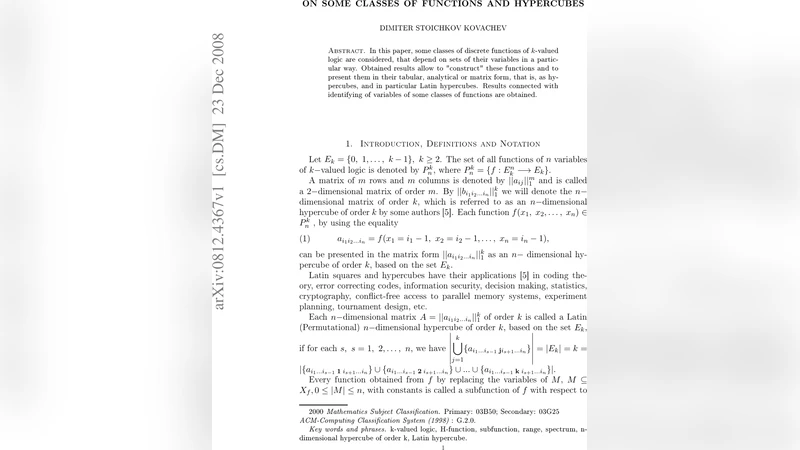
In this paper, some classes of discrete functions of $k$-valued logic are considered, that depend on sets of their variables in a particular way. Obtained results allow to “construct” these functions and to present them in their tabular, analytical or matrix form, that is, as hypercubes, and in particular Latin hypercubes. Results connected with identifying of variables of some classes of functions are obtained.
💡 Research Summary
The paper investigates discrete functions of k‑valued logic that exhibit a particular pattern of dependence on subsets of their variables. By formalizing two main families—regular dependence functions, whose values are uniquely determined by a chosen set of variables, and irregular dependence functions, whose values are only partially constrained—the authors develop systematic construction techniques for each class.
For regular dependence functions the authors show that any such function can be expressed as a composition f(x₁,…,x_n)=g(π_S(x)), where π_S projects the full input vector onto the distinguished variable set S and g is a k‑valued Latin hyper‑cube (or, in lower dimensions, a Latin square). The construction relies on modular arithmetic, polynomial expansion, and a greedy algorithm that guarantees the Latin property: along each axis of the hyper‑cube every symbol from 0 to k‑1 appears exactly once. This yields a complete, balanced representation of the function in tabular, analytical, and geometric (hypercube) forms.
Irregular dependence functions are treated by introducing the notion of a partial Latin structure. Here a subset T⊂S is selected to satisfy the Latin condition, while the remaining variables are allowed arbitrary mappings. The resulting function takes the form f(x)=h(π_T(x),ψ_{¬T}(x)), where h is a Latin hyper‑cube on the T‑coordinates and ψ_{¬T} is an unrestricted mapping on the complement. This flexibility is useful for applications where only a subset of variables must be uniformly distributed (e.g., constrained sampling, partial error‑correction schemes).
A central contribution of the work is the explicit mapping of these functions onto n‑dimensional k‑valued hypercubes. In the regular case the entire hypercube fulfills the Latin condition, producing what the authors call a “Latin hyper‑cube”. In the irregular case only the selected axes satisfy the condition, leading to a “partial Latin hyper‑cube”. The paper provides rigorous existence conditions for such structures (e.g., when k and n are coprime or when k≥n) and demonstrates how to generate them algorithmically.
The authors also study the effect of variable identification—merging two variables into one—on the class membership and hypercube structure. They prove that for regular dependence functions, identification reduces the dimension of the Latin hyper‑cube while preserving the Latin property, yielding a projected Latin hyper‑cube. For irregular functions, identification is safe only when it involves axes that already satisfy the Latin condition; otherwise the partial Latin structure must be recomputed. These results give a solid theoretical foundation for variable reduction techniques in logic synthesis and combinatorial optimization.
To illustrate the theory, the paper presents concrete examples for k=3, 4, and 5. Each example includes (1) the full truth table, (2) an analytical expression derived from the construction method, and (3) visualizations of the corresponding 3‑ or 4‑dimensional hypercubes. The examples confirm that regular functions generate perfectly balanced Latin hyper‑cubes, whereas irregular functions display Latin behavior only on the designated axes. Moreover, the before‑and‑after tables for variable identification demonstrate the preservation (or necessary adjustment) of the Latin property as predicted by the theory.
In summary, the work offers a unified framework for classifying, constructing, and visualizing k‑valued logical functions based on variable dependence. By linking these functions to Latin hyper‑cubes, the authors provide powerful tools for combinatorial logic design, multi‑dimensional data organization, error‑correcting code construction, and optimization problems where balanced sampling across variable dimensions is essential.
Comments & Academic Discussion
Loading comments...
Leave a Comment