Multi-User SISO Precoding based on Generalized Multi-Unitary Decomposition for Single-carrier Transmission in Frequency Selective Channel
In this paper, we propose to exploit the richly scattered multi-path nature of a frequency selective channel to provide additional degrees of freedom for desigining effective precoding schemes for multi-user communications. We design the precoding ma…
Authors: Wee Seng Chua, Chau Yuen, Yong Liang Guan
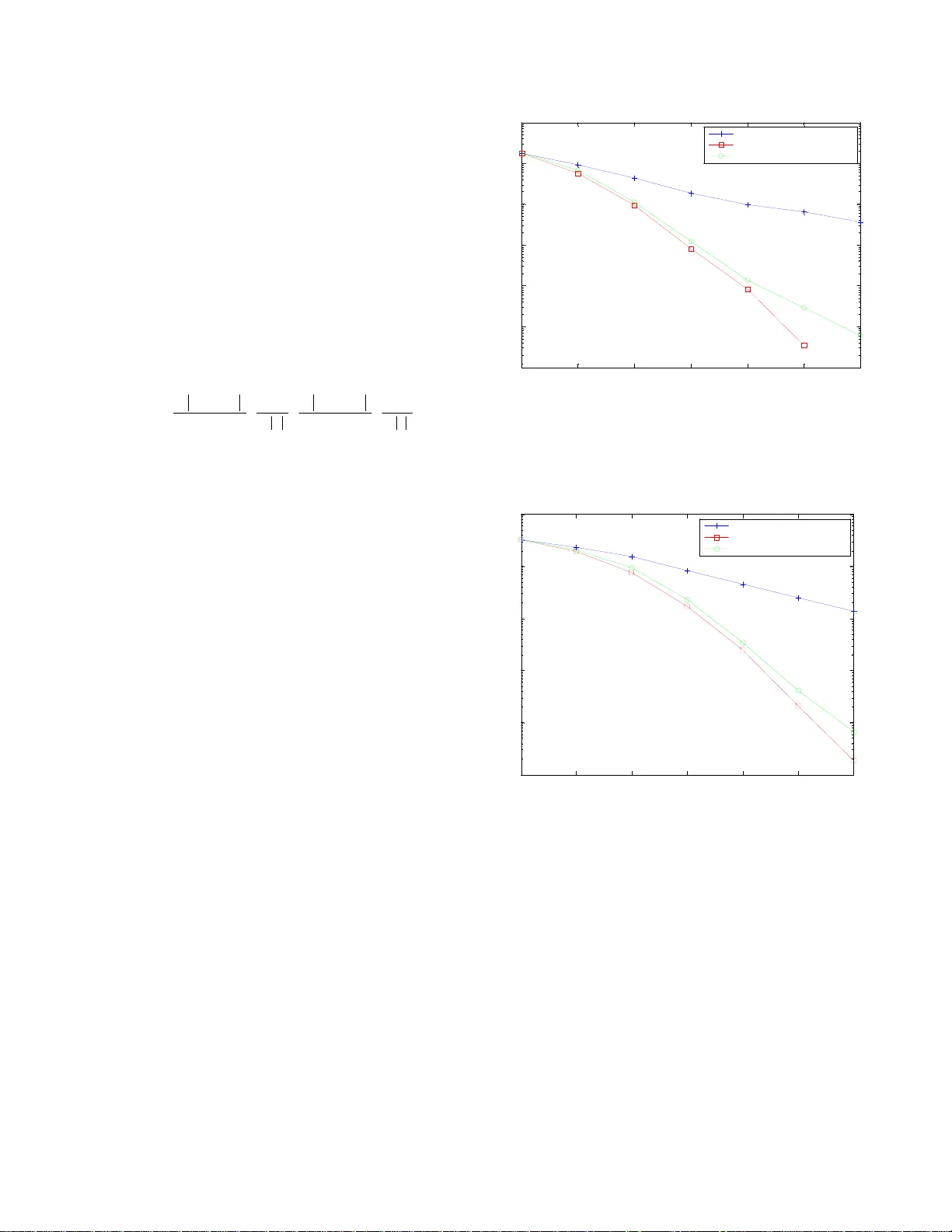
1 Multi-User SISO Precoding based on Generalized Mu lti-Unit ary Decomposition for Single-carrier T r ansmission in Frequency Selective Channel Wee Seng Chua 1 , Chau Yuen 2,3 , Yong Liang Guan 1 and Francois Chin 2 1 Nanyang Technological University, 2 Institute for Infocomm Research, Singapore, 3 Hong Kong Polytech nic University Email: chua0159@ntu.edu .sg, cyuen@i2r.a-star.edu.sg, ey lguan@ntu.edu.sg , and franc oischin@i2r.a-star.edu.sg Abstract – In this paper, we propose to exploit the richly scattered multi-path nature of a frequency selective channel to provide addition al degrees of freedom for desigining effective precoding schemes for multi-use r communications. We design the precoding matrix for multi-user communications based on the Generalized Multi-Unitary Decompos ition (GMUD), where the channel matrix H is transformed into iri H PR Q . An advantage of GMUD is that multipl e pairs of unit ary matrices i P and i Q can be obtained with one single R r . Since the column of i Q can be used as the transmission beam of a particular user, multiple solutions of i Q provide a large selection of transmission beams, which can be exploited to achie ve high degrees of orthogonality between the multipaths, as well as between the interfering users. Hence the pr oposed precoding technique based on GMUD achieves better performance than precoding based on singula r value decomposition. Key words – frequency selective channel, multi-path, multi-user, precoding. I. INTRODUCTION MIMO technol ogy has bee n widely resear ched in recent years due to its advantages of increasi ng capacity and diversity gain. With the availability o f channel state information (CSI) at the transmitter, the multi-antenna techniques can be used to serve multiple users simultaneously, this is becau se multiple antennas at the transmitter provide additional degrees of freedom in the spatial dom ain. It has bee n shown in [1, 2] that t he throughput can b e increased linearly with min imum number of transmit antennas and number of users. Since t hen, many pre-equalizati on or precodi ng techniques have been investigated to enable multi-user MIMO broadcast chann el. Dirty paper coding [3] can be applied at the transmitter to suppress interference in multi-user MIM O systems [4]. Due to the com plexity of di rty paper c oding, som e sim ple precoding techniques such as zero-fo rcing and reg ularized- inverse preco ding have be en developed in [5]. These precoders work well when combined with vector perturbation [6-8]. Unfortunatel y, most of the precodin g technique s have been designed for flat fading channel, whereas a practical broadban d channel almost al ways involves fre quency selective fading. Instead of using multi-carrier sign alling to convert a frequency selective fading channel into flat fading channels, we propose an alternative approach to exploit the multi-path nature of the frequency selective ch annel, and use the extra degrees of freedom provided by the multi-path as multiple transmit antenn as to provide simultaneous transmission to multiple users. That is, in this paper, we app ly the MIMO precoding concept to service multiple us ers with single-carrier transmission in f requency se lective channel , assuming that all the users are equipped with only single-antenna transmitter and receiver (i.e. each user cha nnel are SISO). The objective is to u se multi-path to provide the same multiplexing gain to serve multiple u ser in the same way as multiple antennas do. In multi-us er precoding communicat ion, interference between the multipaths can be enormously huge due to non-orthogonality of th e transmission beams and multipath. In order to mitigate such interference more effectively, we propos e to use a decomposition method called Generalized Multi-Unitary Decompositio n (GMUD) that has bee n previousl y propose d for multi-antenna system [9] to pre-equalize the ch annel and at the same time, maximize orthogonality among users. II. SIGNAL MODEL The system consi dered has one transm it antenna at the base station servicing one data stream to each of a pool of K users with one receive ante nn as each. The received si gnal vector at k th user whose element represents t he receive signal at different time interval is given as kk k = + yH x n (1) where x represen ts the complex envelopes of the tran smitted signal vector, k H is considered as a linear time-inva riant M paths fadin g channel, a nd n k is the additive white Gau ssian noise vector with variance σ 2 . For a linear time-varying channel with a finite memory/path, we assume M ≥ K , and we precode every PT time period, where P = (2 M -1) and T refers to the signal period. The chann el matrix H considered in (1) is a (2 M -1) × M block Toeplitz matrix: 2 [ ] [] [ ] [ ] [] 10 0 11 00 k kk k k k h hM hM h hM ⎛⎞ ⎜⎟ ⎜⎟ ⎜⎟ =− ⎜⎟ ⎜⎟ ⎜⎟ ⎝⎠ H " ## % # " ## % # " (2) where h k [ m ] represents the m -th path c hannel impul se response between the transmit an d receive antennas of user k . The transmitter signal vector x can be represented as ( ) γ = xG u (3) where G is a M × K precoding matrix, [] T 1 K uu = u " whose element u k is the intended data vector for k th user , an d 2 γ = Gu is used to normalize the transmitted signal. For this paper, we limit the in vestigation by using linear minimum mean square error (MMSE ) receiver as it is a n optimum receiver for a MIMO syst em as shown in [10, 11]. The equivalent channel at receiver is kk γ = HH G (4) and the estimated signal for u k with MMSE receiver is () () 11 H2 H H2 ˆ kk k k k k k k uu σσ −− =+ + + HH I H HH I n (5) III. GENERALIZE D MULTI-UNITARY DECOMPOSITION (GMUD) Given a comple x P × M matrix channel H , where K ≤ min( P , M ), it can transform in to various forms using different deco mpositi on techniques such as Singular Value Decomposition (SVD) [12], Geometric Mean Decompositi on (GMD) [ 13,14], Geom etric Tria ngular Decomposition (GTD) [15], and Generalized Multi-Unitary Decomposition (G MUD) [9]. All the deco mposition techniques m entioned a bove trans form H to URV H , where U and V are unitary matrices, and matrix R varies with different decom position. For Generalized Multi-Unitary Decomposition (GMUD) in [9], it transfor ms H to iri H PR Q , where R r is P × M matrix containing a block K × K lower triangular matrix or a special K × K matrix with a prescribed value at the first element and zeros for the rest of the elements in the first row, i P and i Q is a pair from a large poo l of different pairs of unitary m atrices. It is a general decom position m ethod that includes SVD, GMD, and GTD as part of the solutions. Consider a complex matrix P M × = H ^ , where K = M < P with singular values 1 K λ λ ≥≥ " . R r can be defi ned as the following form: 0 r PM × ⎡⎤ = ⎢⎥ ⎣⎦ R R (6) where 1 21 22 2 21 2 12 12 00 00 00 or R RR R R RR R MM M M r r zz z zr zz z zz r × × ⎡⎤ ⎡⎤ ⎢⎥ ⎢⎥ = ⎢⎥ ⎢⎥ ⎢⎥ ⎢⎥ ⎢⎥ ⎢⎥ ⎣⎦ ⎣⎦ R " " " ## # # ## # # " " For the first form, the non-zero positive element r at the (1,1) position can be assigned to any value between the largest and sm allest singular val ue of H . The rem aining elements at the other rows are calculated ba sed on r and th e singular values . For the second form , R is a lower triangular matrix with user pre-defined diagonal elements. This can be achieved by assigning the next remaini ng row i n the sam e way after the previous row has been assi gned and let all the entries on the right of the diagona l entries to be zero. For simplicity, we consider P = 3 and M = K = 2 from this point onwa rds, howe ver GMUD ca n be extende d to differ ent dimensions. The chan nel H is first transforms into H = HU Λ V using SVD. The matrix R r with a pre-assigne d value 1 K r λ λ < ≤ at the (1,1) position can be arranged in the form of r = HH RW Λ X , where W and X are unitary matrices assigned using Gi vens rotati ons, Λ is the same diagonal m atrix of H containi ng the singul ar values. HH HH 0 0, 00 1 ab cs ba s c ⎡⎤ ⎡⎤ ⎢⎥ =− = ⎢⎥ ⎢⎥ − ⎣⎦ ⎢⎥ ⎣⎦ WX (7) As a result, r , z 1 and z 2 can be define d in term s of a , b , c , s , 1 λ and 2 λ . H H H HH 1 HH 12 2 12 1 2 12 1 2 1 2 0 00 00 00 0 0 1 0 0 0 00 0 0 r r ab r cs zz b a s c ra c b s a s b c z z bc as bs ac λ λ λλ λ λ λλ λ λ = = ⎡⎤ ⎡⎤ ⎡ ⎤ ⎢⎥ ⎡ ⎤ ⎢⎥ ⎢ ⎥ =− ⎢⎥ ⎢ ⎥ ⎢⎥ ⎢ ⎥ − ⎢⎥ ⎣ ⎦ ⎢⎥ ⎢ ⎥ ⎣⎦ ⎣ ⎦ ⎢⎥ ⎣⎦ +− ⎡⎤ ⎡ ⎤ ⎢⎥ ⎢ ⎥ =− + ⎢⎥ ⎢ ⎥ ⎢⎥ ⎢ ⎥ ⎣⎦ ⎣ ⎦ Λ WR X RW Λ X (8) The value of a and c can be derived f rom the first row of ( 8), after substituting b and s from (7), and s ubsequent ly W and X can be determined. 12 1 2 ,0 ac bs r as bc λ λλ λ + =− = (9) The remaining values of R r can be found b y substituting the values of a and c 11 2 21 2 , z bc as z bs ac λ λλ λ = −= + (10) Subsequently , H can be decom posed into () ( ) H HH H r r rrr == = HU W R X V U W R V X P R Q (11) P r and Q r are unitary matrices due to the combinatio n of multiple unitary matrices. 3 In order to get multiple different P and Q , we include phase rotation matrices 1 θ M and 2 θ M to (11). 1 θ M and 2 θ M are diagonal matrices whose elem ents are direction parameter θ with unity gain 1 00 01 0 00 1 j e θ θ ⎡⎤ ⎢⎥ = ⎢⎥ ⎢⎥ ⎣⎦ M and 2 0 01 j e θ θ ⎡⎤ = ⎢⎥ ⎢⎥ ⎣⎦ M (12) where θ can be any value from 0 to 2 π . After the inclusion of 1 θ M and 2 θ M , H becom es () () ( ) 12 12 12 HH HH H H H ,, r r rr r θθ θθ θθ θθ = = = = HU M Λ MV UM WR X M V UM W R VM X PR Q (13) It is shown i n (13), R r is inde pendent to the value of 1 θ M and 2 θ M . From (13), it is clear that the v alues of , r θ P and , r θ Q change with t he values of θ and r in R r . Moreover, sin ce 12 , , , , a n d θ θ UWV XM M are unitary matrices, , r θ P and , r θ Q are unitary matrices. IV. PREC ODING BASED ON GMU D Consider the case where there is one transmit antenna at the base station sending one data stream to each of the K users with one receive ante nnas each. T he corresponding channel matrix k H of each user as give n in (1) can be decomposed usin g GMUD. Depen ding on the gain parameter r in R r , multiple different pairs of , r θ P and , r θ Q matrices can be gene rated with t he same R r matrix, and each user’s channel can be decom posed into H ,, kk k kk kr r r θθ = HP R Q (14) where we replace r in R from (6) and θ in 1 θ M and 2 θ M from (12) with opti mizi ng param eters r k and θ k respectively. The first column vector of , kk r θ Q is considered as an individual t ransmissi on beam for that user . Thus, by adjusting r k and θ k , multiple , kk r θ Q correspond to differ ent transmission b eams wit h different am plitude r k and different directions θ k can be obtained. The tran smitter at the base station will steer the beams of every u sers to ensure they are matched as ortho gonal as possi ble. The orth ogonality between the transmission bea ms is related to the multi-user interference, hence if all the users’ transmission beams are orthogonal to each othe r, there will be zero m ulti-users interference. The transmitter precodes the data v ector by multiplying a linear precoding matrix G containing the first column vectors of , kk r θ Q of each users. From (13) a nd (14 ), N ,1 , , 2 , , kk k kk kk k rr r θθ θ θ ⎡⎤ ⎢⎥ == ⎢⎥ ⎣⎦ 0 g QV M V q q (15) where 1, , kk r θ q and 2, , kk r θ q are the first and second column vectors respectively. We let 1, , 1, , , kk l l kr l r θ θ == gq g q (16) and the precoding matrix b ecomes [] kl = G gg (17) The unbalance chan nel gain of each use r’s transm ission beam can be com pensated by introducing different power loading factor to k g and l g and G becomes [ ] kl αβ = Ggg (18) When we combine (1), (14) a nd (17), the received signal for user k becomes () [] H ,, H 1, , , H 2, , HH 1, , 1, , , HH 2, , 2, , 1 kk k kk kk kk k kk kk kk kk k kk kk kr r r k r rr k l k r rk k rl l rr k rk k rl l uu uu θθ θ θ θ θθ θ θθ γ αβ γ αβ αβ γ =+ ⎡⎤ =+ ⎢⎥ ⎢⎥ ⎣⎦ ⎡⎤ + = + ⎢⎥ + ⎢⎥ ⎣⎦ Gu yP R Q n q u PR g g n q qg qg PR n qg qg (19) where 2 γ = Gu is used to normalized the transmitted signal. Using the matrix st ructure of k R as shown i n (6), an d 1, , 1 kk rk θ = H qg as shown in (1 6), (19) can be reduce d to HH 1, , 1, , , H 1, , , 1 0 1 0 kk kk kk kk kk kr k k r l l kr k kk r l l rk ru u ru u θθ θ θ θ αβ ε γ αβ ε γ ⎡⎤ ⎡⎤ + ⎣⎦ ⎢⎥ ⎢⎥ = + ⎢⎥ ⎢⎥ ⎣⎦ ⎡⎤ ⎡⎤ + ⎣⎦ ⎢⎥ ⎢⎥ =+ ⎢⎥ ⎢⎥ ⎣⎦ qg qg yP n qg Pn (20) where ( ) HH 21, 21, 1, , 22 , 2 , , kk kk kk k r l k r k l zu z z u θθ εα α β =+ + qg q g , and 21, k z and 22 , k z refer to the elements of R k in (6). The signal is kk ru α γ and the interference is HH 1, , 1, , 1, , kk kk ll kr l l kr r l ru r u θθ θ βγ β γ = qg qq . To detect k u , the user can either use a zer o-forcing or MMSE receiver as shown in (5), where MMSE r eceiver or Wiener filter is shown [10, 11] as the op timum receiver for a MIMO system. In order to re duce BER, 1, , kk r θ q and l g mus t be mad e as orthogonal as po ssible because the orthogon ality between them contributes to the multi-user interferen ce. However, a small dot product between these vectors m ay not lead to a 4 good precod ing matrix G because G may have a large normalization constant γ which results in a weaker receive d signal and increases the probability of bit error at the receiver. Hence it is importa nt to optimize a signal/interference power related co st function instead. Thus, in this pape r, we present the use of minimi zing the sum of per user’s in verse SINR c riteria. Thi s is becaus e optimizing this criterion has a better BER perfor mance than other criteria such as maximizing minim um SINR and maximi zing sum of pe r user’s SINR. The c ost functio n of finding G becom es () 1 i ,, 1 1 min SINR ii K ri K k θ − ∀≤≤ = = ∑ G (21) In the case of two users with two m ulti-path each, the cost function becom es 22 22 22 1, , 1, , 1, , 1, , 22 2 2 22 ,, , , , min kk ll ll kk kl k l k l lr r k r r rr kl kk l l rr θθ θ θ θθ α α αα σ γσ γ αα αα ⎛⎞ ⎜⎟ =+ + + ⎜⎟ ⎜⎟ ⎝⎠ HH qq q q G (22) IV. SIMULATION RESULTS AND DISCUSSION For simplicity, we consider one transmit antenna at th e base station and one receive antenna for each user. Eve ry user’s channel contains two equal gain m ulti-path. Since GMUD provides multiple different transmission beams from the first column vector of multiple different un itary matrix , kk r θ Q of each users, the requirement of perfect channel state information (CSI) is not stringent. It is shown in [9] that prec oding base d on GMUD is a rob ust scheme which does not suffer m uch lo ss from limited or inaccurate feedback infor mation. For comparison purposes, we also consider the precoding based on SV D. We use t he principle eigen-vector of the channel, whic h has the lar gest channel gain rep resented by the principle s ingular value. The linear precodi ng mat rix at the base station contai ns all the users’ princi ple eigenvectors, while the down link users use MMSE receivers to receive and decode t he received signal. To have m ore insight int o the behavi or of GM UD in frequency sel ective vers us frequency flat m ulti-user channels, we also compare th e proposed SISO precoding scheme with the M IMO precodi ng scheme of [9] . In the latter, there are two transmittin g antennas at the base station and two receiving antennas at the m obile terminals, the base station services one da ta stream to every user simultaneously in a flat fadin g channel [9] . 0 5 10 15 20 25 30 10 -6 10 -5 10 -4 10 -3 10 -2 10 -1 10 0 SNR (i n dB ) BER SV D P rec oding GMUD P rec odi ng (mul t i-pat h) GMUD P rec odin g (mul t i-ant enna) Figure 1: Performance of prob ab ility of bit error fo r two users using precoding matrix that send QPS K symbols based on GMUD and SVD respectivel y. The precoding matrix based on GMUD with multipath is a two path SISO frequency selective channel and GMUD with multi-antenna is a two transmit antennas and two re ceive anten nas per user MIMO multi-u ser flat fading chann el respectivel y. 0 5 10 15 20 25 30 10 -5 10 -4 10 -3 10 -2 10 -1 10 0 SNR (i n dB) BER SV D P rec odi ng GMUD P rec odi ng (m ul ti -pat h) GMUD P rec odi ng (m ul ti -ant enna) Figure 2: Performance of prob ab ility of bit error fo r two users using precoding matrix th at send 16QAM symbols bas ed on GMUD and SVD respectivel y. The precoding matrix based on GMUD with multiplath is a two path SISO frequency selective channel and GMUD with multi-antenna is a two transmit antenna and two receive ante nnas per us er MIMO multi-u ser flat fading chann el respectivel y. Figure 1 and F igure 2 sho w that unde r perfect CS I at the transmitter, pr ecoding base d on GMUD h as a significa nt gain over pre coding bas ed on SVD . This im plies that although the principal SVD tr ansm ission beam s of each user has the largest channe l gain, collectively the interferen ce between the users is extremel y high. This is because the transmission beams for different user are not or thogonal and this give rises to crosstalk bet ween differe nt users. On t he other hand, prec oding bas ed on GMUD chooses the transmission beams that are more ort hogonal, based on 5 optimi zing the cost functio n in (21) or (22) from a p ool of transmission beams centered at the pri nciple eigen-vector. For more information about the directio n of the first column vectors of diffe rent unitary m atrix , kk r θ Q , please refer to [9]. Under this condition, precod ing based on GMUD ensures that both multipath and multi-user inference and noise are taken care of sim ultaneously. Next, we compare the performance of GMUD precoding between a SISO frequency selective channel and M IMO flat fading channel . The degrees of freedom is similar for th e two scenarios where the former schem e uses one transmit antenna at the base station an d one receive antenna for every channel communicat ing in a two path fre quency selecti ve channel, whereas the latter scheme uses two transmit antennas at the base stati on and two receive antennas for every user in a flat fading channel . Figure 1 and Figure 2 show that the SISO multiple path ch annel results in a better performance than the MIM O fl at fading channel, this is because the channel matrix with a Toeplitz form in (2) has a lower condit ion number. I n other word s, the dynam ic range of r in the R matrix of (6) becomes larger, this leads to a larger pool of Q matrices generated. With a larger pool of transmission beams, the optimal transmission beams used in the precoding matri x can perform better. V. CONCLUS ION In this paper, we propose to m ake use of the degree s of freedom provided by the multi-path of a freq uency selective channel to support multi-user co mmunications by precoding . Based on the precoding techniq ue Generalized Multi-unitary Decompositi on (GMUD) previously designed for flat fading MIMO multi-user system, we have applied it to frequency selective SISO multi-user system to combat the impairments induced by freque ncy selective fadi ng and m ultiple user interference. We show t hat the degree of freedom offered by the multi-path can remove the need for multiple an tennas for a wireless comm unication l ink that em ploys preco ding. VI. REFERENCES [1] MG. Caire and S. Shamai, “On the achievable throughput of a m ultiantenna Ga ussian broa dcast channel,” IEEE Trans. on Info. The ory , vol. 49, no. 7, pp. 1691 – 1 706 , July 20 03 [2] S. Vishwanath , N. Jindal, and A. Goldsmith, “Duality, achievable rates and sum-rate capacity of Gaussian MIM O broadcast channel,” IEEE Trans. on Info. Theory , vol. 49, no. 10, pp. 2658 – 2668, Oct. 2003 [3] M. Costa, “Writing on dirty paper,” IEEE Trans. on Info. Theory, vol. 29, no. 3, pp. 439 – 441, May 1983 [ 4 ] M . S h a r i f a n d B . H a s s i bi, “A comparison of time- sharing, DPC, and beam forming f or MIMO broa dcast channels with m any users,” IEEE Trans. on Commun., vol. 55, no. 1, Jan. 2007 [5] C. Peel, B. M. Hochwald, and A. L. Swindlehust, “A vector pertur bation technique for near-ca pacity multiant enna multi user communicat ion – Part I: Channel invers ion and reg ularization , ” I E E E T r a n s . on Commu n. , vol. 51, no. 1, pp. 195 – 202 , Jan. 2005 [6] B. M. Hochwald, C. Peel, and A. L. Sw indlehust, “vector perturbat ion technique for near-capacit y multiant enna multiuser com munication – Part II: Perturbation,” IEEE Trans. on Commun., vol. 51, n o. 3, pp.537 – 544, Mar . 2005 [7] W. S. Chua, C. Yuen, and F. Chin, “A continuous vector-perturbation for multi-antenn a multi-user communicat ion,” IEEE VTC Spri ng 2007 [8] C. Yue n and B . M. Hoc hwal d, “ How t o gain 1.5dB i n vector perturbat ion,” IEEE Global Telecommunications Conference (Globecom) , 2006 [9] W. S. Chua, C. Yuen, Y. L. Guan, and F. Chin, “Limited feedback for multi-anten na ulti-user communications with generalized multi-unitary decomposition,” IEEE PIMRC 2008 [10] D. P. Palomar, J. M. Cioffi, and M . A. Lagunas, “Joint Tx-R x beamform ing design for multicarrier MIMO channels: A unifie d framewor k for convex optimization,” IEEE Trans . on Signal Processing, vol. 51, no.9, pp. 2381 – 2401, Sep. 20 03 [11] A. Scaglione, P. Stoica, S. Bar barossa, and H. Sampath, “Linear precoders and decoders designs for MIMO frequency selective channels,” IEEE ICA SSP 2002 [12] G. H. Golub and C. F. va n Loan, Matri x Computat ions, 3 rd Edition, Johns Hopk ins University Press [13] J-K. Zhang, A Kavcic, and K. M. Won g, “Equal- diagonal QR Decompositi on and it s Applicat ion to precoder design f or successive-cancellation detection,” IEEE Trans. on I nfo. Theory, vol. 51, pp. 154-172, Jan 2005 [14] Y. Jiang, W. W. Hager, an d J. Li, “The geom etric mean decompo sition,” Linear Algebra and Its Applications , vol. 396, pp. 3 73-384, Fe b 2005 [15] Y. Jiang, W. W. Hager , and J. Li, “The generalized triangular decomposit ion,” Mat hematics of Computat ion, Nov 2006
Original Paper
Loading high-quality paper...
Comments & Academic Discussion
Loading comments...
Leave a Comment