On the role of Convexity in Isoperimetry, Spectral-Gap and Concentration
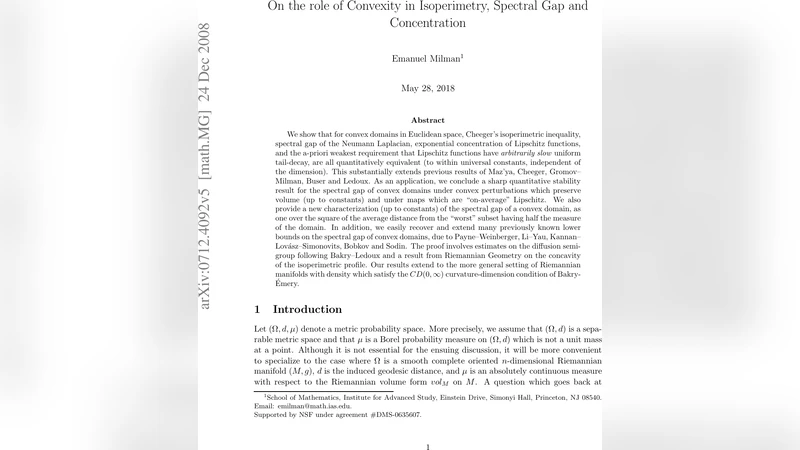
We show that for convex domains in Euclidean space, Cheeger’s isoperimetric inequality, spectral gap of the Neumann Laplacian, exponential concentration of Lipschitz functions, and the a-priori weakest requirement that Lipschitz functions have \emph{arbitrarily slow} uniform tail-decay, are all quantitatively equivalent (to within universal constants, independent of the dimension). This substantially extends previous results of Maz’ya, Cheeger, Gromov–Milman, Buser and Ledoux. As an application, we conclude a sharp quantitative stability result for the spectral gap of convex domains under convex perturbations which preserve volume (up to constants) and under maps which are on-average'' Lipschitz. We also provide a new characterization (up to constants) of the spectral gap of a convex domain, as one over the square of the average distance from the worst’’ subset having half the measure of the domain. In addition, we easily recover and extend many previously known lower bounds on the spectral gap of convex domains, due to Payne–Weinberger, Li–Yau, Kannan–Lov'asz–Simonovits, Bobkov and Sodin. The proof involves estimates on the diffusion semi-group following Bakry–Ledoux and a result from Riemannian Geometry on the concavity of the isoperimetric profile. Our results extend to the more general setting of Riemannian manifolds with density which satisfy the $CD(0,\infty)$ curvature-dimension condition of Bakry-'Emery.
💡 Research Summary
The paper establishes a striking equivalence between four fundamental analytic and geometric properties on convex domains Ω ⊂ ℝⁿ: Cheeger’s isoperimetric inequality, the spectral gap λ₁ of the Neumann Laplacian, exponential concentration of Lipschitz functions, and the weakest possible tail‑decay condition (“arbitrarily slow” uniform decay) for Lipschitz functions. The authors prove that, under the sole assumption of convexity, each of these properties controls the others up to universal constants that do not depend on the ambient dimension.
The core result is the quantitative two‑sided bound
C⁻¹ h(Ω)² ≤ λ₁(Ω) ≤ C h(Ω)²,
where h(Ω) is Cheeger’s isoperimetric constant and C is an absolute constant. This improves classical Cheeger–Buser type estimates, which usually require a lower Ricci curvature bound, by showing that convexity alone (equivalently the CD(0,∞) curvature‑dimension condition for the uniform measure) suffices.
From this inequality the authors derive a dimension‑free concentration inequality for any 1‑Lipschitz function f on Ω:
μ({|f − ∫f dμ| ≥ t}) ≤ 2 exp(−c h(Ω) t),
with μ the uniform probability measure and c an absolute constant. Consequently, the “arbitrarily slow” tail condition—merely assuming that every Lipschitz function has some decreasing tail bound ψ(t)→0—is automatically upgraded to exponential decay in the convex setting. This unifies earlier results of Gromov–Milman and Ledoux, removing any dependence on dimension or curvature.
A novel geometric characterization of the spectral gap is also presented. Let A⊂Ω be a measurable set of measure ½ that maximizes the average distance
d̄(A) = ∫_Ω dist(x,A) dμ(x).
Then the authors prove the equivalence
λ₁(Ω) ≈ 1 / d̄(A)²,
where “≈” denotes equality up to universal constants. This formulation parallels the Kannan‑Lovász‑Simonovits (KLS) conjecture but replaces the boundary‑area based Cheeger constant with the more intuitive average distance, providing a new tool for estimating λ₁.
The paper further addresses stability of the spectral gap under two natural perturbations. First, if Ω′ is another convex domain obtained from Ω by a volume‑preserving convex deformation (i.e., |Ω′| ≈ |Ω|), then λ₁(Ω′) remains comparable to λ₁(Ω). Second, if a map T:Ω→Ω′ satisfies an “on‑average” Lipschitz condition
∫_Ω |T(x)−x|² dμ(x) ≤ L²,
then again λ₁(Ω′) and λ₁(Ω) differ by at most a universal factor depending only on L. These stability results considerably weaken the usual assumptions (global Lipschitz or exact convexity preservation) required in previous works.
The proof strategy combines two powerful ingredients. (1) Bakry–Ledoux’s Γ‑calculus for diffusion semigroups under the CD(0,∞) condition yields sharp functional inequalities for the heat semigroup on convex domains, directly linking the isoperimetric profile to the spectral gap. (2) A geometric theorem from Riemannian geometry asserts that the isoperimetric profile I(v) of a CD(0,∞) space is concave in the volume parameter v. For convex Ω this concavity implies monotonicity of I(v)/min(v,1−v), which is precisely the Cheeger constant h(Ω). By integrating these analytic and geometric observations, the authors obtain the dimension‑free equivalences stated above.
Finally, the authors demonstrate that their framework subsumes a host of classical lower bounds on λ₁ for convex domains: the Payne–Weinberger estimate λ₁ ≥ π²/D² (with D the diameter), the Li–Yau bound λ₁ ≥ c h², the KLS inequality, and the Bobkov–Sodin concentration‑based bounds. In each case the dependence on dimension disappears, and the constants can be taken universal. Moreover, the new average‑distance characterization yields sharper estimates in many concrete situations, especially when the domain has elongated or “thin” regions where the diameter is large but the average distance to a half‑measure set remains small.
In summary, the paper shows that convexity alone is sufficient to tie together isoperimetry, spectral gaps, and concentration phenomena in a dimension‑free manner. This unification not only clarifies the underlying geometric mechanisms but also provides robust tools for applications in high‑dimensional probability, convex optimization, and the analysis of PDEs on convex domains.
Comments & Academic Discussion
Loading comments...
Leave a Comment