Consider the problem of determining whether there exists a spanning hypertree in a given k-uniform hypergraph. This problem is trivially in P for k=2, and is NP-complete for k>= 4, whereas for k=3, there exists a polynomial-time algorithm based on Lovasz' theory of polymatroid matching. Here we give a completely different, randomized polynomial-time algorithm in the case k=3. The main ingredients are a Pfaffian formula by Vaintrob and one of the authors (G.M.) for a polynomial that enumerates spanning hypertrees with some signs, and a lemma on the number of roots of polynomials over a finite field.
Deep Dive into A randomized polynomial-time algorithm for the Spanning Hypertree Problem on 3-uniform hypergraphs.
Consider the problem of determining whether there exists a spanning hypertree in a given k-uniform hypergraph. This problem is trivially in P for k=2, and is NP-complete for k>= 4, whereas for k=3, there exists a polynomial-time algorithm based on Lovasz’ theory of polymatroid matching. Here we give a completely different, randomized polynomial-time algorithm in the case k=3. The main ingredients are a Pfaffian formula by Vaintrob and one of the authors (G.M.) for a polynomial that enumerates spanning hypertrees with some signs, and a lemma on the number of roots of polynomials over a finite field.
A (finite) hypergraph G = (V, E) consists of a finite set V (the vertex set ) and a set E of subsets of V (the hyperedges), each of cardinality at least 2. We also write V (G) = V and E(G) = E. When all the hyperedges have the same cardinality k, we say that the hypergraph is kuniform. In the case k = 2 we are dealing with ordinary (simple) graphs. We say that H ⊆ G is a sub-hypergraph if V (H) ⊆ V (G) and E(H) ⊆ E(G); a sub-hypergraph is spanning if V (H) = V (G). A hypergraph H is a hypertree if it is connected and there are no cyclic sequences of vertices and hyperedges
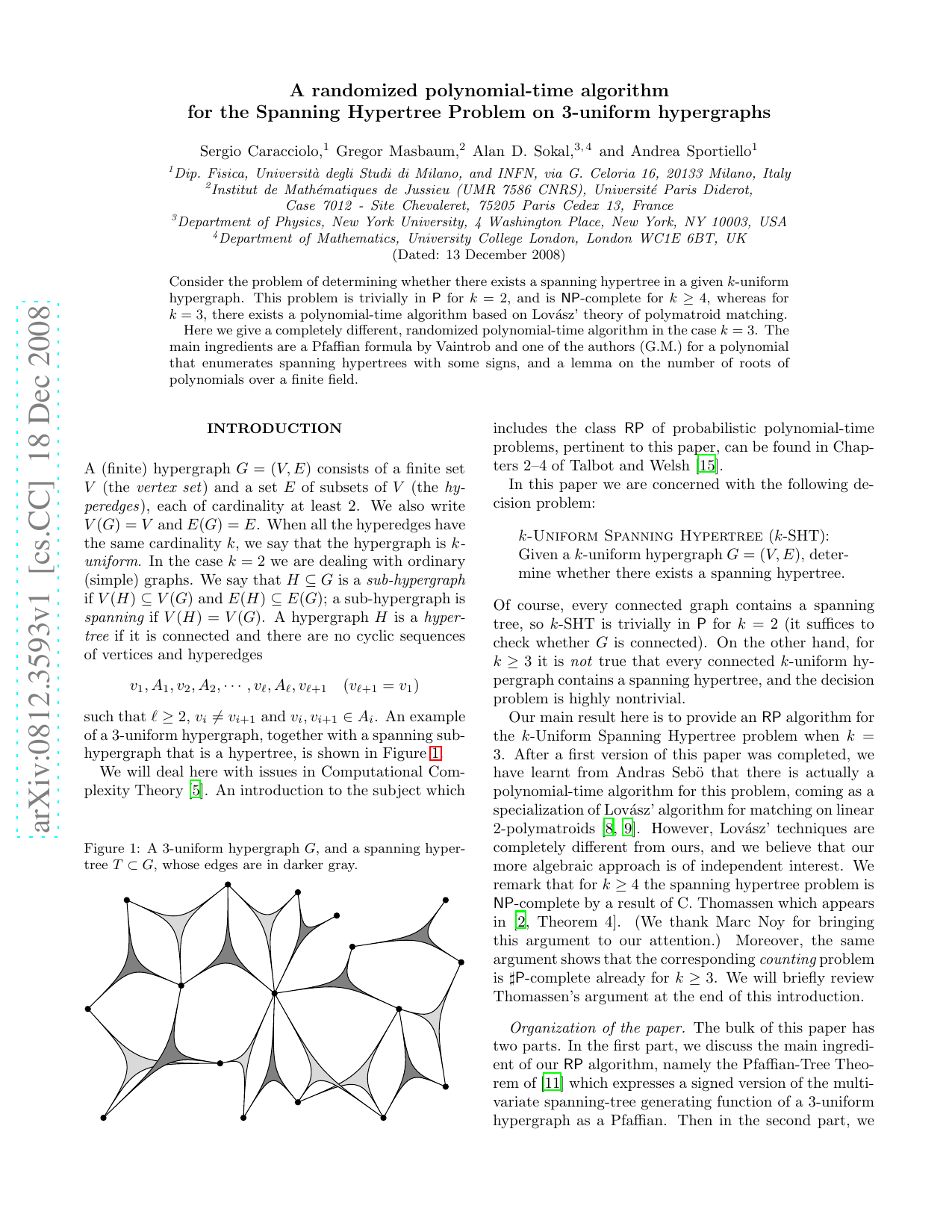
such that ℓ ≥ 2, v i = v i+1 and v i , v i+1 ∈ A i . An example of a 3-uniform hypergraph, together with a spanning subhypergraph that is a hypertree, is shown in Figure 1.
We will deal here with issues in Computational Complexity Theory [5]. An introduction to the subject which includes the class RP of probabilistic polynomial-time problems, pertinent to this paper, can be found in Chapters 2-4 of Talbot and Welsh [15].
In this paper we are concerned with the following decision problem: k-Uniform Spanning Hypertree (k-SHT): Given a k-uniform hypergraph G = (V, E), determine whether there exists a spanning hypertree.
Of course, every connected graph contains a spanning tree, so k-SHT is trivially in P for k = 2 (it suffices to check whether G is connected). On the other hand, for k ≥ 3 it is not true that every connected k-uniform hypergraph contains a spanning hypertree, and the decision problem is highly nontrivial.
Our main result here is to provide an RP algorithm for the k-Uniform Spanning Hypertree problem when k = 3. After a first version of this paper was completed, we have learnt from Andras Sebö that there is actually a polynomial-time algorithm for this problem, coming as a specialization of Lovász’ algorithm for matching on linear 2-polymatroids [8,9]. However, Lovász’ techniques are completely different from ours, and we believe that our more algebraic approach is of independent interest. We remark that for k ≥ 4 the spanning hypertree problem is NP-complete by a result of C. Thomassen which appears in [2, Theorem 4]. (We thank Marc Noy for bringing this argument to our attention.) Moreover, the same argument shows that the corresponding counting problem is ♯P-complete already for k ≥ 3. We will briefly review Thomassen’s argument at the end of this introduction.
Organization of the paper. The bulk of this paper has two parts. In the first part, we discuss the main ingredient of our RP algorithm, namely the Pfaffian-Tree Theorem of [11] which expresses a signed version of the multivariate spanning-tree generating function of a 3-uniform hypergraph as a Pfaffian. Then in the second part, we describe our algorithm, first intuitively, and then more formally, and sketch the analysis of time-and spacecomplexity. This part is fairly standard in complexity theory, but we hope that the partly expository presentation of the various concepts involved will be useful for the interdisciplinary audience (such as ourselves) we have in mind. Finally, we end the paper with some speculations and directions for further research suggested by our work.
To conclude this introduction, here is, then, Thomassen’s argument showing that k-SHT is NP-complete for k ≥ 4.
We recall that an exact cover in a hypergraph G = (V, E) is a subset E ′ ⊆ E of the hyperedges such that every vertex of G belongs to exactly one hyperedge in E ′ . (In the special case where G is an ordinary graph, an exact cover is nothing but a perfect matching.) Now consider the following decision problem:
Exact cover by k-sets (XkC): Given a k-uniform hypergraph G = (V, E), determine whether there exists an exact cover.
X3C is known to be NP-complete, and is classified as problem [[SP2]] in Garey and Johnson [5]. (It is NPcomplete even when restricted to 3-partite hypergraphs, in this case being called 3-Dimensional Matching (3DM, [[SP1]]).) Implicitly, analogous statements hold as well for any k ≥ 3. Conversely, X2C is polynomial, by matching techniques, even in its optimization variant, e.g. by Gallai-Edmonds algorithm (see [10]). On the other hand, the corresponding counting problem (equivalently: counting perfect matchings on arbitrary graphs), is known to be ♯P-complete (Valiant [16]). Now, given an arbitrary k-uniform hypergraph G, Thomassen constructs a (k + 1)-uniform hypergraph G ′ as follows: add an extra vertex ⋆, and let
The key observation is that spanning hypertrees of G ′ correspond bijectively to exact covers of G (with the obvious bijection, namely deleting ⋆ from each hyperedge). Thus, any algorithm for (k + 1)-SHT provides an algorithm for XkC. In other words, XkC is reducible to (k + 1)-SHT.
From what we said above about XkC, it follows that k-SHT is NP-complete for k ≥ 4, and counting spanning hypertrees in a 3-uniform hypergraph is ♯P-complete, as asserted.
Let G = (V, E) be a finite hypergraph on N vertices. The multivariate generating function for
…(Full text truncated)…
This content is AI-processed based on ArXiv data.