Complexity of Hybrid Logics over Transitive Frames
This paper examines the complexity of hybrid logics over transitive frames, transitive trees, and linear frames. We show that satisfiability over transitive frames for the hybrid language extended with the downarrow operator is NEXPTIME-complete. Thi…
Authors: Martin Mundhenk (1), Thomas Schneider (2), Thomas Schwentick (3)
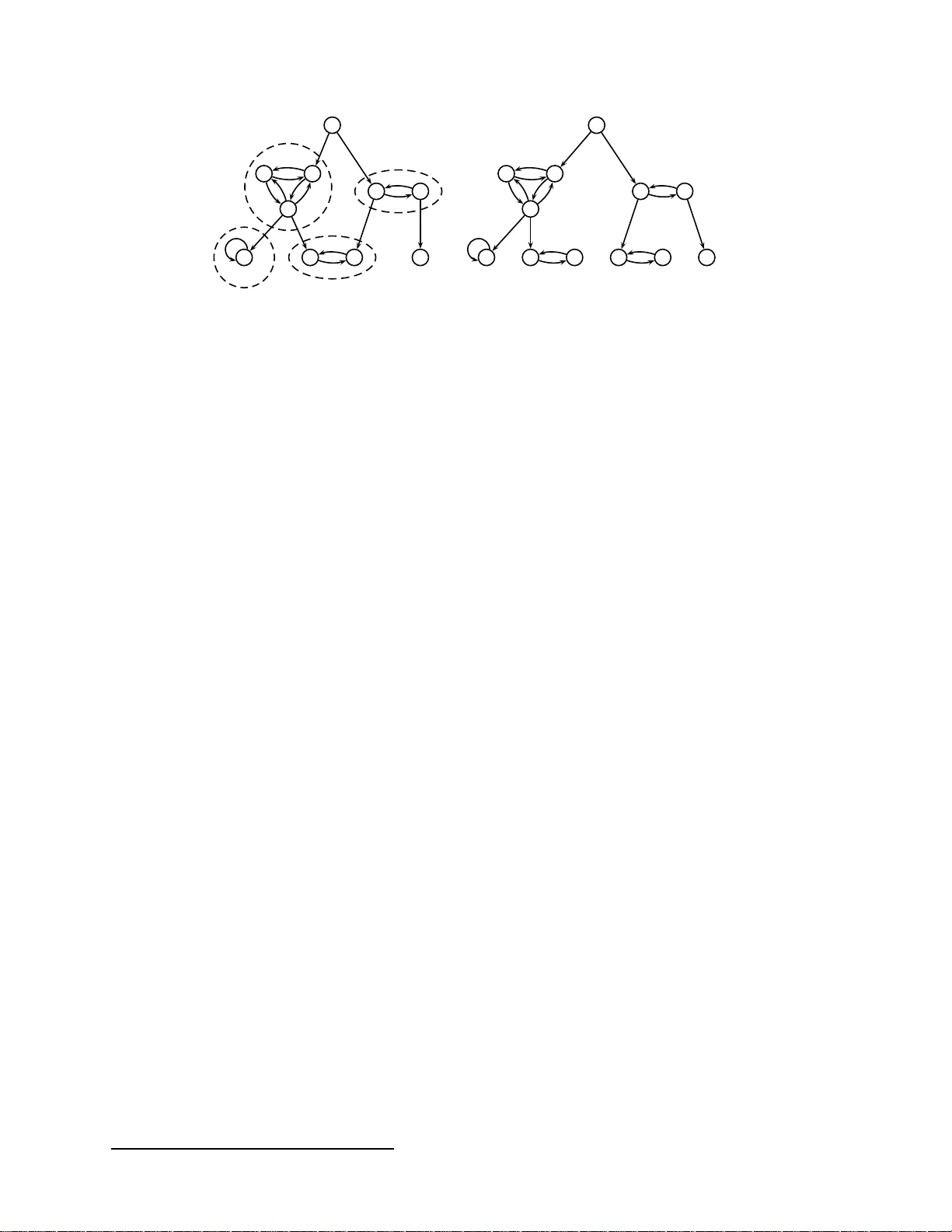
1 Complexit y of Hybrid Logics o v er T ransitive F rames ∗ Martin Mundhenk † Thomas Sc hn eider ‡ Thomas Sc h w en tick § V olk er W eb er ¶ June 24, 2008 Abstract This article examines the complexity of hybrid log ics ov er transitive fr ames, transitive trees, and linear frames. W e sho w that satisfiabil ity ov er transitive frames for the hybrid language extended with the dow narro w operator ↓ is NEXPTIME-complete. This is in con trast to undecidabilit y of s atisfiabilit y o ver arbitrary frames for this language [2]. It is also shown that adding the @ op erator or the past mod ality leads to undecidability o v er transitive frames . This is again in contrast to th e case of transitive t rees and linear frames, where w e show t hese languages to b e nonelementaril y decidable. Moreo v er, w e establish 2EXPTIME and EXPTIME upper b ounds for satisfiabilit y ov er transitive frames and transitive trees, respectively , for th e hybrid Un til / Since language. An EX PTIME lo w er b ound is show n to hold for t h e mo dal Un til language ov er b oth frame classes. 1 In tro duction Hybrid language s are extensions o f mo dal logic that allow for naming a nd a ccessing states of a mo del explicitly . This render s hybrid logic a n adequate repres e n tation formalism for many a pplications, where the ba s ic mo dal and/or temp ora l langua g es do no t suffice. Moreov er, r easoning sy s tems are e asier to devise for h ybrid than for mo dal logic. Hybrid Logi c , as well as the foundations of temp ora l lo gic, go es ba ck to Arthur Prior [2 6]. Since then, many — more or less p ow erful — langua ges hav e b een studied. Here we briefly introduce the extensions that shall concern us in this article. Nominals are sp ecial a tomic formulae that name sta tes of mo dels . They allow, for instance, for a n axiom expressing irreflexiv ity , which cannot be captured b y mo da l formulae: i → ¬ ✸ i . The at op er ator @ can b e used to dir ectly jump to states named by nominals, indep endently of the accessibility rela tion. Hence , the ab ove formula could also be written as @ i ¬ ✸ i . With the help of the downarr ow op er ator ↓ , it is p ossible to bind v a riables to states. Whenever ↓ x is encountered dur ing the ev aluation of a fo rmula, the v aria ble x is b ound to the current sta te s . All o ccurrences of x in the scop e of this ↓ are tre a ted like nominals naming s . As an example, the formula ↓ x. ¬ ✸✸ x rea ds a s: Name the cur r ent s tate x and ma ke sure that it is not p o s sible to go from x to x in exactly tw o steps. This is an axiom for asymmetry , a nother pro pe r ty no t expr essible in mo dal logic. Combined with the @ op erato r, ↓ lea ds to a very powerful language that ca n formulate many desirable prop erties and go es far b eyond the scope of the simple nomina l langua ge. T o give a more impress ive example, we consider the Until op era tor. The formula U ( ϕ, ψ ) reads as “ther e is a p oint in the future at which ϕ holds, and at all p oints b et ween now and this p oint, ψ holds”. What the basic mo dal langua ge is no t able to express, can b e achiev ed by the hybrid ↓ -@ langua ge. U ( ϕ, ψ ) ≡ ↓ x . ✸ ↓ y .ϕ ∧ @ x ✷ ( ✸ y → ψ ) . Besides more a dv anced temp ora l concepts such as “until” or “s ince”, h ybrid tempor al languages can express other desirable temp o ral notions s uch a s “now”, “yesterda y”, “to day”, or “ tomorrow”. More- ov e r , with h ybrid logic one can capture many temp ora lly r elev ant fr ame prop erties (besides the ab ove ∗ This work was presente d at Metho ds for M o dalities 4 (2005 ). † Institut f ¨ ur Informatik, F riedrich-Sc hill er-Universit¨ at Jena, Germany, mundhenk@c s.uni-je na.de ‡ Sc hool of Computer Science, University of Manche ster, UK, schneider@cs.u ni-jena. de § F ac hbereich Informatik, Uni v ersit¨ at Dor tm und, Germany , thomas.sc hwentick @udo.edu ¶ F ac hbereich Informatik, Uni v ersit¨ at Dor tm und, Germany , volker.we ber@udo. edu 1 INTR ODUCTION 2 men tioned, antisymmetry , trichotom y , directedness, . . . ). F or this r eason, hybrid tempo ral la nguages are of great in terest where basic tempo r al logic reaches its limits [9, 5, 4, 13]. T ransitiv e F rames. Hybrid logic is in terpreted ov er Kripke frames and mo dels, a s is mo dal log ic . A frame consists of a set o f states (p oints in time) and an accessibility relation R , where xRy says tha t y is reachable from x or, seen temp orally , y is in the future of x . W e examine the c omputational complexity of satisfiability for several hybrid logics over tra ns itive frames, transitive tr e es a nd linea r fra mes. Mo dal, hybrid, and fir st-order logics over transitive mo dels have b een studied r ecently in [3, 1 4, 32, 19, 20, 18, 11]. Although the complex ity of hybrid (tense) logic has b een ex tensively examined [7, 15, 2, 3, 1 3], there ar e highly expr essive h ybrid lang uages for whose satisfiability problems only r esults over arbitra ry , but not ov er restricted, temp orally relev ant frame clas ses hav e b een known. W e co ncentrate o n transitive fr ames b ecaus e tr ansitivity is a prop er t y that the re lations of many different temp oral applications ha ve in common, e ven if they differ in other prop er ties such as tree- likeness, trichotom y , irreflexiv ity , or asymmetry . T ra nsitivity c a n b e seen as the minimal req uirement in many applications, for example temp oral verification. But there are other r easons why this fra me class is of in terest, particularly in connection with com- putational complexity . In the sp ecial cas e of linear frames, nomina ls and @ can b e sim ulated using the conv e n tional mo dal o p erator and its conv er se. Hence, the basic h ybrid lang uage is as ex pressive ov er linear fra mes a s the basic mo dal la nguage. The ↓ o p e rator is useless even on tra nsitive trees, a represen- tation of bra nching time. Over transitive fra mes, in contrast, these hybrid o per ators do make a difference. In this case, there are pr op erties that c a n b e ex pressed in the hybrid, but not in the mo dal lang uage (see the ir r eflexivity example a b ove). F or this rea son, the class o f transitive fra mes can b e r egarded as a r estricted frame class that is still gener al enoug h to separ ate h ybrid from mo da l languag e s in ter ms of expressive p ow e r . Y et another r e ason for cons idering precisely transitive frames will b ecome clea r in the nex t par agra ph. Complexity of Hybrid Logics. W e use complexity classes NP, PSP A CE, EXPTIME, NE XPTIME, n EXPTIME, n ≥ 2, and coRE as k nown from [25]. A pro blem is nonelemen tarily dec ida ble if it is decidable but not contained in any n E XPTIME. It g o es without saying that rea soning tasks for r icher logics r equire mo re resources tha n those for simpler langua ges, such as the basic mo dal lang uage. W e fo cus on one reaso ning task, na mely satisfiability . The mo dal and tempor al s atisfiability problems ov er arbitrar y as well as over transitive frames are PSP A CE-complete [23, 3 0]. If the “so mewhere” mo dality E is added, satisfiability b eco mes EXP TIME- complete ov er a rbitrary frames [29]. F or many , more restricted, frame class e s , moda l and tempor al satisfiability is NP-complete [23, 24, 28]. In contrast, the known part of the complexity s pec trum of hybrid satisfiability rea ches up to undecidability . Many complexity results for h ybrid languages hav e be e n established in [2, 3]. It was prov en in [2] that the hybrid lang uage with nominals a nd @ has a PSP ACE-complete satisfiability problem and that satisfiability for the hybrid tense la nguage is EXPTIME-complete, e ven if @ or E are a dded. T he same authors show tha t these pro blems ha ve the s ame complexity (or drop to PSP ACE-complete or NP- complete, resp ectively) if the class o f fra mes is restricted to transitive fr ames (or transitive trees, or linear frames, resp ectively) [3]. Moreov er, they established EXPTIME-c o mpleteness of satisfiability for the hybrid Until / Since lan- guage. The complexity o f this langua ge ov er tra nsitive fra mes and transitive trees, res pec tively , has b een op en. PSP ACE-completeness over linear frames is known from [13]. W e wan t to find out at which ex act requirements to the frame classes the decrease from EXPTIME to PSP ACE takes pla ce. Undecidability results for language s co ntaining ↓ o riginate from [7, 15]. The strongest such r esult, namely for the pure nominal-free fragment of the ↓ languag e, is given in [2]. In recent work [3 4], it was demonstra ted that decidability of the ↓ langua ge can b e reg ained by certain restrictions o n the frame classes. T r ansitivity might b e a nother pr op erty under which the ↓ langua ge can be “tamed”, since it has alrea dy b een obs e rved that over transitive trees and linear or ders, the ↓ op erator on its own is useless. New Road-Map P ages. This ar ticle e s tablishes tw o gro ups of complexity results fo r hybrid languag es ov e r transitive frames, transitive trees , a nd linear fra mes. First, we examine satisfiability o f the hybrid ↓ la nguage. Our most sur pr ising result is the “taming” of this language ov er transitive frames : the satisfia bility pro blem is NEXPTIME-complete. This high level of complexity is reta ined even ov er complete frames. W e also show that enr iching the language by the backw ard-lo oking mo dality P or the @ op erato r leads to undecidability in the cas e o f trans itive fra mes. 2 MODA L AND HYBRID LO GIC 3 The situation is different ov e r tra nsitive tre es. Decida bility , even for the r ichest ↓ language , is easy to see, but we will show it to b e nonelementary if P or @ a re added. F or linea r frames, this is a lready known in the tempo ral case. W e pr ov e tha t adding @ suffices to obtain nonelementary co mplexity . As a seco nd step, we cons ider sa tisfiability ov er transitive frames and transitive trees for the hybrid Until / Since - E languag e. W e establish EXPTIME -hardness for the mo da l language extended with Until only . This is ma tc hed by an EXPTIME upper b ound for the full langua ge in the ca se of tr ansitive trees. As for transitive fr ames, w e give a 2 E XPTIME upp er bound. T able 1 gives an ov erview of the satisfiability problems co nsidered in this article (ma r ked bo ld) and visualizes how our results arra nge in to a c ollection o f previously known results. It makes use of the notation of hybrid languages int ro duced in Section 2 . Complexity clas s es without addition stand for completeness results; “nonel.” stands for nonele men tarily decida ble. The work fro m which the res ults originate, is cited. Conclus io ns from sur rounding r esults are abbreviated by “ c.”. hybrid complexity complexity o ver complexity o ver complexity lang. o ver arb i- transitive frames transitive trees o ver linear trary frames orders HL @ PSP ACE [2] PSP ACE [3] PSP ACE [3] NP [3] HL F , P EXPTIME [2 ] EXPTIME [3] PSP ACE [3] NP [3] HL E F , P EXPTIME [3 ] EXPTIME [3] PSP ACE [3] NP [3] HL E U , S EXPTIME [3 ] in 2EXPTIME (16), EXPTIME (14,17) PSP ACE- EXPTIME-hard (14) hard [27] HL ↓ coRE [2] NEXPTIME (1) PSP ACE [3] NP [13] HL ↓ , @ coRE [2] coRE (11) nonel. (12) nonel. ( 13) HL ↓ F , P coRE [2] coRE (11) nonel. (12) nonel. [13] HL ↓ , @ F , P coRE [2] coRE (c.) nonel. (12) nonel. [13] T able 1. A n ov erview of complexity results for hybrid logics. Num bers in round paren theses refer to the corresponding theorem. Legend. This article is org anized as follows. In Section 2, we g ive all necessary definitions and notations of mo dal a nd h ybrid logic. W e present the decidability and undecidabilit y res ults for the hybrid ↓ languages in Sections 3 and 4. The h ybrid Until / Since languag e is exa mined in Section 5. Section 6 contains some concluding remar ks. 2 Mo d al and Hybrid Logic W e define the basic conce pts a nd notations of mo dal and hybrid lo gic that are relev an t for o ur work. The fundamen tals of mo dal logic can be fo und in [6]; tho se of h ybrid logic in [2, 5]. Mo dal Logic. Let PROP b e a co unt able set of pr op ositional atoms . The languag e ML of mo da l lo gic is the s et of all formulae o f the form ϕ ::= p | ¬ ϕ | ϕ ∧ ϕ ′ | ✸ ϕ , where p ∈ PROP. W e use the well-kno wn abbreviations ∨ , → , ↔ , ⊤ (“true”), and ⊥ (“false”), as well as ✷ ϕ := ¬ ✸ ¬ ϕ . The semantics are defined via Kripke mo dels . Suc h a mo del is a triple M = ( M , R , V ), wher e M is a nonempty set of states , R ⊆ M × M is a binary rela tio n — the ac c essibility r elatio n — , and V : PROP → P ( M ) is a function — the valuation funct ion . The str ucture F = ( M , R ) is ca lled a fr ame . Given a mo del M = ( M , R, V ) and a state m ∈ M , the satisfaction r elation is defined b y M , m | = p iff m ∈ V ( p ) , p ∈ PROP , M , m | = ¬ ϕ iff M , m 6| = ϕ, M , m | = ϕ ∧ ψ iff M , m | = ϕ & M , m | = ψ , M , m | = ✸ ψ iff ∃ n ∈ M ( mRn & M , n | = ψ ) . 2 MODA L AND HYBRID LO GIC 4 A formula ϕ is satisfiable if there exist a mo del M = ( M , R, V ) and a state m ∈ M , such that M , m | = ϕ . If a ll states from M sa tisfy ϕ , we write M | = ϕ and say that ϕ is glob al ly satisfie d by M . T emp oral Log i c. The language of temp or al logic (tense logic) is the set of all formulae of the form ϕ ::= p | ¬ ϕ | ϕ ∧ ϕ ′ | F ϕ | P ϕ , where p ∈ PROP . It is common pra ctice to use the abbreviations G ϕ := ¬ F ¬ ϕ and H ϕ := ¬ P ¬ ϕ . Satisfaction for F and P formulae is defined b y M , m | = F ψ iff ∃ n ∈ M ( mR n & M , n | = ψ ) , M , m | = P ψ iff ∃ n ∈ M ( nR m & M , n | = ψ ) . Whenever one want s to sp eak not only of states accessible fro m the current state, but also of sta tes “b etw een” the curr ent and so me accessible state, one can make use of the bina ry o pe rators U (“until”) and S (“ since”), for which satisfaction is defined by M , m | = U ( ϕ, ψ ) iff ∃ n mRn & M , n | = ϕ & ∀ s ( mR sRn ⇒ M , s | = ψ ) , M , m | = S ( ϕ, ψ ) iff ∃ n nRm & M , n | = ϕ & ∀ s ( nR sRm ⇒ M , s | = ψ ) . The U / S la ng uage is strictly strong er than the basic temp ora l la nguage in the sense that F a nd P can b e expressed b y U and S e. g. F ϕ = U ( ϕ, ⊤ ) , but not vice versa. In [3], a v aria nt o f the U / S op erators , U + and S + , is int ro duced. Satisfaction for U + (analogo us ly for S + ) is defined by M , m | = U + ( ϕ, ψ ) iff ∃ n ∈ M mRn & M , n | = ϕ & ∀ s ∈ M ( mR + sR + n ⇒ M , s | = ψ ) , where R + is the transitive c losure o f R . By means of these op era tors, they “ s im ulated” tra nsitive frames syntactically [3]. W e go a step further and define another mo dification, U ++ and S ++ , with the satisfaction relatio n M , m | = U ++ ( ϕ, ψ ) iff ∃ n ∈ M m R + n & M , n | = ϕ & ∀ s ∈ M ( mR + sR + n ⇒ M , s | = ψ ) , and analo gously for S ++ . The resulting tempor al languag e is a n even closer simulation of transitivity , as we will see in Sectio n 5. Hybrid Log i c. As indica ted in the previous section, t he hybrid la ng uage do e s not exist. Rather there are s e veral extensio ns o f the mo da l langua g e allowing for explicit refer ences to states and therefore b eing called hybrid. W e introduce those hybrid lang uages that will interest us in this a rticle. The definitions and no tations are taken from [2, 3]. Let NOM b e a countable set of n ominals , SV AR be a countable se t of state variables , and A TOM = PROP ∪ NOM ∪ SV AR. It is common practice to w r ite prop ositional atoms as p, q , . . . , nominals as i, j, . . . , a nd state v ariables as x, y , . . . The ful l hybrid language H L ↓ , @ is the set of all formulae of the form ϕ ::= a | ¬ ϕ | ϕ ∧ ϕ ′ | ✸ ϕ | @ t ϕ | ↓ x.ϕ , where a ∈ A TOM, t ∈ NOM ∪ SV AR, and x ∈ SV AR. A hybrid formula is called pur e if it contains no prop o sitional atoms; nominal-fr e e if it contains no nominals; and a sentenc e if it contains no free s ta te v a riables. ( F r e e and b ound ar e defined as usual; the only binding op erator here is ↓ .) A hybrid mo del is a Kripke mo del with the v alua tion function V extended to PR OP ∪ NOM, where for all i ∈ NOM, | V ( i ) | = 1. Whenever it is cle a r from the context, we will omit the word “hybrid” when referring to mo dels. In order to ev a lua te ↓ -formulae, a n assignment g : SV AR → M for M is necessary . Given a n assignment g , a state v ar iable x a nd a state m , an x -variant g x m of g is defined by g x m ( x ′ ) = ( m if x ′ = x, g ( x ′ ) otherwise . 2 MODA L AND HYBRID LO GIC 5 F or any ato m a , let [ V , g ]( a ) = ( { g ( a ) } if a ∈ SV AR , V ( a ) otherwise . The sa tisfaction relation for hybrid formulae is defined by M , g , m | = a iff m ∈ [ V , g ]( a ) , a ∈ A TOM , M , g , m | = ¬ ϕ iff M , g , m 6| = ϕ, M , g , m | = ϕ ∧ ψ iff M , g , m | = ϕ & M , g , m | = ψ , M , g , m | = ✸ ϕ iff ∃ n ∈ M ( mR n & M , g , n | = ϕ ) , M , g , m | = @ t ϕ iff ∃ n ∈ M ( M , g , n | = ϕ & [ V , g ]( t ) = { n } ) , M , g , m | = ↓ x.ϕ iff M , g x m , m | = ϕ. A formula is satisfiable if there ex ist a mo del M = ( M , R, V ), an assignment g for M , and a state m ∈ M , s uch that M , g , m | = ϕ . W e sometimes use the “somewher e” mo dality E having the interpretation M , g , m | = E ϕ iff ∃ n ∈ M ( M , g , n | = ϕ ) . In this case, @ is nee dless, beca use @ t ϕ can b e e x pressed by E ( t ∧ ϕ ). First-Order Logi c. Mo dal a nd hybrid lo gic ca n be embedded into fra g ments o f fir st-order logic. W e will alwa ys use the standard notation of first-order logic. W e will make use of certain fragments of first-order lo g ic and denote them in the style o f [10]: [all , ( u, 1)], where u ∈ ω . This notation sta nds for the fragmen t without equalit y , without function symbols, and with no o ther relation symbols than one binary and u una ry ones 1 . W e denote the satisfia- bilit y pr oblem for such a fragment by [all , ( u, 1)]-SA T a nd [a ll , ( u, 1)]-trans- SA T, wher e the la tter r equires that the binary relation symbol is interpreted by a tra ns itive relatio n. The St andar d T r anslation ST [3 4] embeds hybrid logic int o first-order lo gic and consists of tw o func- tions ST x and ST y , defined recursively . Since ST y is o btained from ST x by exchanging x and y , we only give ST x here. ST x ( p ) = P ( x ) , ST x ( ✸ ϕ ) = ∃ y xRy ∧ ST y ( ϕ ) , ST x ( t ) = t = x, ST x (@ t ϕ ) = ∃ y y = t ∧ ST y ( ϕ ) , ST x ( ¬ ϕ ) = ¬ ST x ( ϕ ) , ST x ( ↓ v .ϕ ) = ∃ v x = v ∧ ST x ( ϕ ) , ST x ( ϕ ∧ ψ ) = ST x ( ϕ ) ∧ ST x ( ψ ) , ST x ( E ϕ ) = ∃ y ST y ( ϕ ) , where p ∈ PROP, t ∈ NOM ∪ SV AR, and v ∈ SV AR. Prop erties of Mo dels and F rames. Let M = ( M , R , V ) b e a (Kripke or hybrid) mo del with the underlying fra me F = ( M , R ). By R + we denote the tra nsitive closure of R . F or any subset M ′ ⊆ M , we write R ↾ M ′ and V ↾ M ′ for the restr ictions of R and V to M ′ . W e will re fer to t r ansitive fr ames o r line ar fr ames whenever we mean fr a mes whose accessibility relation is tra nsitive or a linea r order , r esp ectively . A line ar or der is an irre flex ive, trans itive, and trichotomous r e lation, where trichotom y is defined by ∀ xy ( xRy o r x = y or y Rx ) . A fra me F is a tr e e , if and only if it is acyclic a nd co nnected, and ev ery po in t ha s at most one R - predecessor . A tr ansitive tre e is any ( M , R + ), where ( M , R ) is a tree. Satisfiability Problems . Whenever we leave o ne or mor e op er ators out of the hybrid languag e, we omit the accor ding sup e rscript of HL . If we pro ce e d to a hybrid tense la ng uage, we a dd the s uitable temp or al op erator (s ) as subscr ipt(s) to HL . Analogously , when equipping the mo dal langua ge with additional op erator s , we add them as sub- or s uper scripts to ML . F or a ny hybrid languag e H L x y , the satisfiability pr oblem HL x y -SA T is defined as follows: Giv en a formula ϕ ∈ HL x y , do es there exis t a hybrid mo del M , an a ssignment g for M , and a state m ∈ M 1 Although constan ts are not mentioned in this notation, they are alwa ys assumed presen t, since they corresp ond to nominals in hybrid logic. 3 DECIDING HL ↓ OVER TRANSITIVE FRAMES 6 M B ( M ) Figure 1: A transitive mo del M and its block tree B ( M ). T he ma x imal co mplete subfra mes of M ar e marked by the dashed circles. Some edges caused by transitivity ar e left o ut fo r simplicity . such that M , g , m | = ϕ ? If ↓ is not in the consider ed language, the assignment g can b e left out of this formulation. If w e only ask for tr ansitive mo dels (or tr ansitive tr e es or line ar mo dels , resp ectively) satisfying ϕ , w e sp eak of HL x y -trans-SA T (or HL x y -tt-SA T, o r HL x y -lin-SA T, respectively). E.g., the satisfiability problem ov er transitive frames for the hybrid temp or al ↓ la nguage is denoted by HL ↓ F , P - trans-SA T. 3 Deciding H L ↓ o v er T ransitiv e F rames Areces, Blackburn, and Ma rx [2] prov ed that the downarrow op er ator ↓ turns the s atisfiability pro blem for h ybrid logics undecidable in general, even if no interaction with @ or P is allow ed. W e prove that undecidability v a nishes if frames are required to b e transitive. Theorem 1 The satisfiability problem for HL ↓ ov e r transitive fra mes is complete fo r NEXPTIME . Before we star t with the pr o of, we have a first lo ok a t HL ↓ ov e r tra nsitive frames. Obviously , it has no finite mo de l prop erty . E .g., the following se n tence requir es a mo del containing an infinite chain of states lab eled p . p ∧ ✸ p ∧ ✷✸ p ∧ ✷ ↓ x. ¬ ✸ x Neither is it always p oss ible to find a mo del tha t is a transitive tre e . But, in some wa y , we can get close to this. Although o ur mo dels may contain cy cles, transitivity ensures tha t all states in a cycle are pa irwise connected. I.e., the subfra me consisting of these states is complete. Therefore, we can view a mo del as consisting of ma ximal complete subframes and single states, that a re co nnected in a tr a nsitive but acy clic fashion. F or ev ery tra nsitive model M = ( M , R , V ), we define its blo ck tr e e B ( M ) = ( M ′ , R ′ , V ′ ) as the structure obtained as follows. First, we r eplace ea ch maximal complete subframe o f M , for short clique, with a s ingle vertex. Sec ond, w e unrav el the resulting structur e into a (potentially infinite) transitive tree T . Then we r e place each vertex of T by (a copy of ) the clique of M fr om which it is der ived (Figure 1). Note that a blo ck tree is not a tree, but we get a transitive tree if we view every clique a s a no de. In the following, we are often interested in this under lying tree structure o f a blo ck tr e e and refer to the cliques of a blo ck tree a s no des . F or a s tate s , we denote its no de b y u s . W e say that a no de v is b elow a no de u if the states of v a re rea chable fro m the s tates in u (but not vice versa) and a no de v is a child o f a no de u , if v is below u but there is no no de w b elow u and ab ove v . Likewise, w e use the terms tree, subtree, and le a f for blo ck tree, sub blo ck tree, and leaf clique, resp ectively . W e have to b e careful ab out how to treat nominals when unrav eling a model. If V ( i ) = { s } for a nominal i and a state s ∈ M , we define V ′ ( i ) to be the set of states from M ′ , that ar e copies via the unraveling of s . Therefore, B ( M ) is not a mo del 2 as defined in Section 2, beca use nominals may hold at mor e tha n one state, but by viewing i as a prop os itional ato m it can be trea ted a s a mo del. The satisfaction relation is not affected a nd it is therefore ea sy to see that this tra nsformation preserves 2 Note that we can alwa ys get a mo del f or ϕ from B ( M ) by joining the states lab eled with the same nominals, but this model might b e different from M . 3 DECIDING HL ↓ OVER TRANSITIVE FRAMES 7 satisfaction o f HL ↓ -sentences: The relation asso cia ting each state of M with every copy in B ( M ) is a quasi-injective bisimulation 3 [8]. Lemma 2 F o r every trans itive mo de l M , every state s of M , every co py s ′ of s in B ( M ) , and every HL ↓ -sentence ϕ : M , s | = ϕ ⇐ ⇒ B ( M ) , s ′ | = ϕ. If, for some blo ck tree B a nd some state s o f B , B , s | = ϕ holds, we refer to B as a blo ck tree mo del for ϕ . Before we show how to use this tre e-like structure to decide H L ↓ ov e r transitive fra mes, we fo cus on complete subframes and show that their size can b e b ounded. 3.1 H L ↓ o v er Complete F rames As complete subfra mes are a significant part of transitive mo de ls , we are now going to study the sa t- isfiability problem of HL ↓ ov e r complete frames 4 . The mos t imp orta nt result for o ur purpose is an exp onential-size mo del prop erty of HL ↓ ov e r complete fra mes . W e wan t to star t by giving some insight why this pro p e rty holds. In complete frames, the accessibility relation do es not distinguish differen t states. Of c o urse, states ca n b e told apart if they are lab eled differently by pr op ositions. But the num ber of different lab elings is exp onentially b ounded in the size of the for mula. T o use more states, we hav e to distinguish s tates lab eled e q ually . This can only b e done by assigning names to these states. But the num ber o f states we ca n distinguish in this w ay is b ounded by the nu mber of different state v aria bles and nomina ls use d in the sentence. While in tuition is clear, we can prove this b ound by obser ving that HL ↓ ov e r complete fra mes is equiv alent to the Monadic Class with e quality ( MC = ), the frag men t o f fir st-order logic with only unary predicates, equality , a nd no function symbols [10]. Before we prese n t this connectio n precisely , we hav e to make a note on mo dels . Every hybrid mo del can b e viewed as a relational structure for its fir st-order cor resp ondence lang uage. This first-or der language usually contains a binar y r elation to reflect the acces sibility relatio n. F or complete frames, the accessibility rela tion is trivia l and can b e ignor ed, r e sp e ctively added when g oing fro m MC = to H L ↓ . Lemma 3 There are p olynomia l time functions mapping HL ↓ formulas ϕ to MC = formulas ψ and v ice versa such that ϕ holds in a co mplete h ybrid mo del M if and only if ψ holds in the cor resp onding mona dic structure. Pro of. The mapping from H L ↓ ov e r complete frames to M C = is based on the Standard T r anslation ST as defined in Section 2. The only r ule of ST that uses the bina ry relation is the rule for the diamond op erator : ST x ( ✸ α ) = ∃ y ( xRy ∧ ST y ( α )) . B ut the right s ide ca n b e reduced to ∃ y (ST y ( α )), since xRy alwa ys holds on complete frames. F or the other directio n, we give the r ules o f a reductio n HT from M C = to HL ↓ . HT( P ( x )) = ✸ ( x ∧ p ) HT( x = y ) = ✸ ( x ∧ y ) HT( ¬ ϕ ) = ¬ HT( ϕ ) HT( ϕ ∧ ψ ) = HT( ϕ ) ∧ HT( ψ ) HT( ∃ x.ϕ ) = ✸ ( ↓ x. HT( ϕ )) Note that b oth ma ppings can b e co mputed in po lynomial time and do not blow up for mula size. ❏ This result allows us to transfer complexity results and mo del prop erties for MC = [10] to HL ↓ ov e r complete frames. Theorem 4 HL ↓ ov e r complete fra mes has the exponential-size model proper t y and its satisfia bilit y problem is complete for NEXPTIME . The lower b ound ca n b e tra nsferred directly to the case of transitive frames. Corollary 5 The satisfia bilit y problem for H L ↓ ov e r transitive frames is hard for NEXPTIME . 3 The notion of bisimulation has to b e extended by requiring states carrying the same nominal to b e related. 4 All results in this subsection hold for HL ↓ , @ F , P , too. 3 DECIDING HL ↓ OVER TRANSITIVE FRAMES 8 Pro of. W e can for ce a transitive frame, mor e precisely , the subframe gene r ated by the cur rent sta te, to b e complete by a dding ↓ x. ✷✸ x . In this wa y , we can give a reduction from the sa tis fia bilit y problem of MC = by ma pping a formula ϕ to ( ↓ x. ✷✸ x ) ∧ HT( ϕ ). ❏ 3.2 On T r ansitiv e F ram es for HL ↓ Let us s umma r ize what w e have seen so fa r. F or every HL ↓ -formula satisfia ble over tra ns itive frames, instead of a transitive mo del we ca n co nsider its blo ck tree. The size of the cliques in the blo ck tr e e ca n be expo nentially b ounded in the size of the formula by Theor em 4. The algo rithm for testing H L ↓ -satisfiability will essentially gues s a mo del a nd verify that it is corre c t. As there is no finite mo del pr op erty , all mo dels might b e infinite. Nev er theless, we will show tha t, if the formula is satisfiable, there is a lwa ys a mo del with a reg ular s tructure in which certain finite pa tterns ar e rep eated infinitely often. This will a llow us to find a finite re presentation o f such a model. T o this end, Definition 6 captures the informatio n a b out a state of a blo ck tr ee that will b e needed for the following. Intuitiv ely , the ϕ -type o f a state ca ptures the informa tio n needed ab out its subtrees in order to ev aluate a ny s ubformula of a g iven fo rmula ϕ at this s ta te. Here, ψ [ f ree / ⊥ ] is the s entence obtained from ψ by replac ing every free v a riable by ⊥ and su b ( ϕ ) is the s et of a ll subformulae of ϕ . Definition 6 Let ϕ b e a HL ↓ -sentence and B = ( M , R , V ) a blo ck tree model which is a mo de l of ϕ . The ϕ -type of a state s ∈ M is the set o f all sentences from { ψ [ f r ee / ⊥ ] | ✸ ψ ∈ sub ( ϕ ) } that ho ld at some state in the s ubtree ro oted at s . Note that states in the same clique hav e the s a me ϕ -type. Therefore, we can sp eak of the ϕ -t ype o f a no de. The type of a no de is a lwa y s a super set of the types of its children. More precisely , it is a lwa ys the union of the t ype s of the child ren together with the se t of relev ant for mulae which ho ld in the no de itself. When ev a luating a s ubformula o f a HL ↓ -sentence ϕ a t so me sta te s of a blo ck tree, all we need to know ab out s tates strictly b elow u s are the ϕ -types of the children of u s . I.e., we ca n replace subtrees below u s by subtrees o f the same ϕ -type. In the following lemma, for a blo ck tree B and tw o sta tes s 1 , s 2 , B [ u s 1 /u s 2 ] denotes the blo ck tree res ulting from B b y r eplacing the subtr e e ro oted at u s 1 by the subtree ro oted at u s 2 . The result of this substitution is ag ain a blo ck tree. Lemma 7 Let ϕ b e a HL ↓ -sentence, B = ( M , R, V ) a blo ck tree mo del of ϕ a nd s 1 and s 2 states of M such that there is a path from s 1 to s 2 but not vice versa. F or every formula ψ ∈ sub ( ϕ ) , every s ta te s 3 of M o f the s ame ϕ -type as s 2 , and every ass ig nment g that maps all free v ar iables in ψ to s 1 or states in M preceding s 1 : B , g , s 1 | = ψ ⇐ ⇒ B [ u s 2 /u s 3 ] , g , s 1 | = ψ . Pro of. The pro of is by induction on the str ucture of ψ . Most cases are trivia l since s 1 is the only state that has to b e co nsidered, e.g., if ψ = ψ 1 ∧ ψ 2 we o nly need to know whether ψ 1 and ψ 2 hold at s 1 . The interesting c a se is ψ = ✸ ξ . Here , we need to know whether ξ holds at some state s ′ reachable from s 1 . This c a n only b e affected by our substitution if s ′ is in the replaced subtr e e , a nd therefore strictly below s 1 . Thus, b y our assumption on g , all free v ariables in ψ a r e mapp ed to s tates different and no t reachable from s ′ . W e c a n conclude B , g , s ′ | = ξ ⇐ ⇒ B , g , s ′ | = ξ [ f r ee/ ⊥ ] . Hence ξ holds at some sta te in the replac ed subtree ro o ted at u s 2 , if and only if ξ [ f r ee/ ⊥ ] is in the ϕ -type of u s 2 . The lemma follows b ecause the new subtree has the same ϕ -type. ❏ Note that we restr ic ted the c hoice o f g only to those as signments that are rele v ant when ev aluating the sentence ϕ . W e can us e the previo us lemma to get so me nice restric tio ns o n the blo ck trees under considera tion. E.g., we can assume that for every sentence in the type of a no de, there is a w itnes s in the no de itself or in one of its children. Lemma 8 Let ϕ be a H L ↓ -sentence satisfiable ov er transitive fra mes. Then there is a blo ck tree mo del B for ϕ , in which 3 DECIDING HL ↓ OVER TRANSITIVE FRAMES 9 . . . . . . u v t t t u v . . . u v u t t t Figure 2: An infinite block tree, its finite representation, a nd the infinite blo ck tree obtained fro m this representation. • every no de has at mos t | ϕ | c hildren, • for every no de u with ϕ -type t a nd every H L ↓ -sentence ψ ∈ t , ψ holds a t a state in u or at a state in a c hild of u , a nd • on e very pa th from the r o ot, infinite or ending at a leaf, every ϕ -type o ccurs o nly once or infinitely often. Pro of. Let ϕ be a H L ↓ -sentence satisfiable ov er transitive fra mes a nd B ′ a blo c k tree mode l for ϕ . A blo ck tr ee satisfying the third condition ca n b e obtained fro m B ′ by applying Lemma 7. If there are t wo no de s u and v on a path, v b elow u , that have the same ϕ -t yp e , we can replace the subtree ro oted at u by the subtree r o oted at v . This allows us to cut e very finite rep etition down to a single o ccurrence of a ϕ -t yp e. The resulting structure is still a blo ck tree mo del for ϕ . Now, cons ider some no de u a nd its ϕ -t ype t . F or ev ery sentence ψ ∈ t , w e select some state in the subtree ro oted at u such that ψ holds a t this sta te. Let u 1 , . . . , u k be the no des o f those states, that are not in u . It easy to see, following s imilar tra cks as in Lemma 7, that the blo ck tree obtained by r e moving the no des b elow u a nd inserting instead u 1 , . . . , u k as children o f u is again a blo ck tree mo del of ϕ . Even more, the type of u is not changed b y this r eplacement. By applying this a rgument top-down from the ro ot, w e get a blo ck tree mo del for ϕ satisfying the first t w o c onditions. The third one is not affected by this trans fo rmation. Note that some care is needed to make this approach work for infinite mo dels. Basica lly , we must define a function that a ssigns to each no de of the origina l mo de l its set of witnes ses. The res ulting mo del is o btained by using this function in a straightforward fashion. ❏ 3.3 Deciding HL ↓ -SA T o ver T ransitiv e F rames W e will now finish the pro of of Theorem 1 b y presen ting a nondeterministic algorithm that decides HL ↓ -SA T over tr ansitive frames in ex p o nent ial time, basic ally by guessing and verifying the finite repr e- sentation of a blo ck tree mo del for a given HL ↓ -sentence ϕ . Given a blo ck tree B with the pr op erties of Lemma 8, we get a finite represe n tation as follows. F or each path of B w e consider the fir st no de v tha t has the s ame type as its pa rent no de u . W e repla ce the subtree b elow v b y a single state lab eled with a reference to u , as shown in Figure 2. W e need to keep v b ecause it might b e the only witness fo r a formula in the ϕ -type of u (cf. Lemma 8 ). Clearly , the resulting structure is finite. By Lemma 7 and Lemma 8, w e ca n g et a blo ck tree mo del fro m this r epresentation by replacing each reference with the subtree ro oted at the referenced no de, i.e., esse n tially by a n unraveling (Fig ure 2). Due to Lemma 7, the siz e o f the repres ent ation can b e r educed even further. If there are tw o no de s u and v of the same ϕ -type which are b oth the fir st no de of their type on their pa th fro m the ro ot, we can replace the subtree ro oted at v with the subtree of u . I.e., whenever tw o no des have the same ϕ -type, we can assume that their genera ted subtrees are equal. W e hav e to chec k them only once. This obser v ation can b e r eflected in our re presentation by r eplacing every duplicate with a reference, as illustrated in Figure 3. This ca uses every type to a ppea r at most t wice in the repr esentation, thus the nu m be r o f no des is at most exp onential. 3 DECIDING HL ↓ OVER TRANSITIVE FRAMES 10 . . . . . . u v t t . . . u t Figure 3: Elimina tion o f duplicates in the r epresentation of a blo ck tree. HL ↓ -SA T( ϕ ) 1: Guess the finite r epresentation ( M ˙ ∪ C, R, V , f ) of a blo ck tree mo del for ϕ . 2: Guess a ϕ -type for every sta te in C . 3: Run MCFULL’ on the sta tes in M . 4: Compute the ϕ -type for every sta te in M referenced by a state in C via f . 5: Check for every s tate s ∈ C that f ( s ) has the s ame ϕ -t ype as s . If not, reject. 6: Accept iff ϕ holds a t some state in M . Figure 4: Our alg orithm for H L ↓ -satisfiability . Such a represe ntation can b e describ ed b y a structure ( M ˙ ∪ C, R, V ) such that the states in C hav e no outgoing edges, and a function f from C to M . A state s ∈ C s tands for a r ep etition resp ectively duplication o f the subtree ro o ted at f ( s ), including states from C . This causes infinite rep etition if s is below f ( s ). Note that a state in C is a no de of its own, in fact a leaf, and canno t b e in the same complete subframe as a s tate in M . Summing up, if ϕ is satisfia ble, ther e is a repr e sentation of a blo ck tr ee mo del for ϕ of size at most exp onential in the length of ϕ . The first step of the algor ithm pr esented in Figur e 4 is to guess such a representation (step 1). In order to o bta in an algor ithm which tes ts whether the representations indeed re pr esents a mo del of ϕ , we describ e how to modify the mo del chec king a lg orithm MCFULL by F r anceschet and de Rijke [1 2] to do so. First, we deal with the states in C (step 2), simply b y gues s ing their ϕ -t ype s . Next, the model chec king algorithm MCFULL is used on the states in M (step 3). W e have to mo dify this a lgorithm in t wo res pec ts . Fir st, it has to use the informatio n guess ed for the s tates in C . Seco nd, it should compute the ϕ -types of the s tates in M . T o this end, it first ev a luates the sentences r esulting from subformulae of ϕ b y replacing free v ar iables with ⊥ . W e ca ll this mo dified algo r ithm MCFULL’. The changes are straightforward. After r unning MCFULL’ the alg orithm ha s computed for each state the set of for mulae that hold at this state. These sets depend on the guesses in Step 2. There fore, the algor ithm has to verify their consistency . This can be done b y comparing the ϕ -t y pes of the s tates in C with the ϕ -types of the referenced states (steps 4 and 5). Finally , the algo rithm checks if ϕ holds at some state in M (step 6). Theorem 9 The algo rithm H L ↓ -SA T pr esented in Figure 4 decides H L ↓ -satisfiability over transitive frames nondeterministically in exp onential time. Pro of. In Section 3 .2, we ha ve seen that for e very satisfiable sentence ϕ there is a blo ck tree mo del as descr ib e d in Lemma 8. W e have also seen how to repre sent this blo ck tr ee in a finite manner . The algorithm can guess this representation and the ϕ -types o f the states in C . The computation of the ϕ -t yp es of the states in M works corr ectly , b ecause we hav e a witness for every sentence in the type of some no de in our repr esentation. This is by Le mma 8 , which ensures tha t witnesses are in the no de of the state or in one of its children. Therefore, we cut b elow these witnesses when building the finite representation. Co nsequently , the a lg orithm will a c cept. On the other hand, if the a lgorithm accepts, it is str a ightforw ard to constr uct a blo ck tree mo del from the gues s ed repr esentation. The only cr itical p oint for soundnes s is the verification of the ϕ -t ype s guessed in Step 2, more precisely , the computation of the ϕ -type s o f the states in M . Fir st, the ϕ -type 4 DECIDA BILITY O F RICHER HYBRID ↓ LOGICS 11 ( xRy ) t = ∃ abc xRa ∧ bRa ∧ bRc ∧ y Rc ∧ 0( x ) ∧ 1( a ) ∧ 2( b ) ∧ 3( c ) ∧ 0 ( y ) , ( ¬ α ) t = ¬ ( α t ) , ( α ∧ β ) t = α t ∧ β t , ( ∃ x α ) t = ∃ x 0( x ) ∧ α t . t 0 1 t 1 1 t 2 1 t 3 1 t 0 2 Figure 5: The transla tion function a nd a zig- z a g tra nsition. of some sta te s ∈ M contains only sentences that hold at some state of the r epresented mo del b elow s . This c a n b e ass ured by lo oking only at states in M and not at states in C . That the ϕ -type of s contains all s entences that hold b elow s can b e assur ed by following the links repre s ent ed by sta tes in C . The fir st tw o s teps of the alg orithm ca n b e p erformed in exp onential time b ecause the r e presentation is of at most exp onential size. That Step 3 runs in exp o ne ntial time follows fro m Theorem 4.5 of [12], the truth of which is not affected by our mo difica tions. The time b ounds for the other steps follow ag ain from the expo nential size b ound of the representation. ❏ F rom Theor em 9 and Coro llary 5 we can conclude Theore m 1. 4 Decidabilit y of Ric her Hybrid ↓ Logics This section is concerned with satisfiability ov er tra ns itive frames, trans itive tr e e s, a nd linear fra mes fo r extensions of HL ↓ . W e investigate what happ ens if we ex tend the logic of the pr evious section with the @ -op erator and/or the past moda lity P . W e will prove undecidability ov er transitive frames. Therefore, w e will consider these lo gics ov e r more restr icted fra me classes, transitive trees a nd linear frames, where we will show them to b e no nelement arily decidable. 4.1 T ransitiv e F rames Over transitive fra mes, w e cannot sustain decidability if we enrich H L ↓ with @ or the ba ckw a r d lo oking mo dality P . W e prove undecida bilit y in b oth ca s es, making a detour v ia an undecida ble fr a gment of first-order logic. The notation of such frag ment s is given in Sectio n 2. W e pr o ceed in t w o steps. First, we show that [all , (4 , 1)]-trans- SA T is undecidable. This is do ne by a reduction from [all , (0 , 1)]-SA T. The undecidability of the la tter is a consequence of the undecidabilit y of contained traditiona l standar d classes [10]. The seco nd step consists of reductions fr o m [all , (4 , 1)]- trans-SA T to HL ↓ , @ -trans-SA T and HL ↓ F , P -trans-SA T, res pe c tively . T o be mor e precise, the r anges of these r eductions will b e the fra gments o f the resp ective h ybrid lang uages consisting of a ll no minal-free sentences. Lemma 1 0 [all , (4 , 1)]-tr ans-SA T is undecidable. Pro of. In order to obtain the requir ed reduction fro m [all , (0 , 1)]-SA T, we will transfor m a (not neces- sarily trans itive) mo del satisfying α into a transitive one. Simply taking the tra nsitive clo sure in most cases a dds new pairs to the interpretation of the rela tion and is not sufficient for keeping the informatio n which pairs were in the “old” rela tion and which pair s were not. This pro blem do es not a rise if we instead use a v a riation of the zig-zag te chnique successfully applied in [3] for a re duction betw een a mo dal and a hybrid lang uage. The cor e idea of this technique is to simulate an R -step t 1 Rt 2 in the o r iginal mo del M = ( D , I ) by a zig-zag tr ansition in a mo del M ′ = ( D ′ , I ′ ), wher e I ′ ( R ) is transitive, as shown in Figure 5. W e define a transla tion function ( · ) t using four extra predicate symbols 0 , 1 , 2 , 3 acco rding to Fig ure 5. The tr a nslation o f the xR y -a to ms ex actly refle c ts the shown zig- zag tr a nsition. It is now s traightforw ard to prov e the following c la im: F or e ach formula α , α is satisfiable iff f ( α ) is satisfiable in some mo del that interpr ets R by a tra nsitive r elation. 4 DECIDA BILITY O F RICHER HYBRID ↓ LOGICS 12 Without loss of generality , we may assume that α ha s no free v aria bles and that each v ariable is qua n- tified exa ctly once. This can always be achieved by a dditio na l existential q ua nt ification and renaming, resp ectively . “ ⇒ ”. Supp ose α is satisfied b y some mo del M = ( D , I ). W e construct a new mo de l M 4 = ( D 4 , I 4 ), where D 4 = D 0 ∪ · · · ∪ D 3 using D i = { d i | d ∈ D } , for i = 0 , 1 , 2 , 3. The interpretation I 4 is defined by I 4 ( R ) = { ( x 0 , x 1 ) , ( x 2 , x 1 ) , ( x 2 , x 3 ) , ( y 0 , x 3 ) | ( x, y ) ∈ I ( R ) } and I 4 ( P ) = D P , P = 0 , 1 , 2 , 3 . I 4 ( R ) co des a n I ( R )-transition from state x to y in M as a sequence of backward and for ward tr ansitions from x 0 to y 0 via x 1 , x 2 , x 3 as shown in Figure 5. It is eas y to s ee that I 4 ( R ) is trans itive, s inc e there is no s tate with incoming and outgoing I 4 ( R )-edges. W e now s how that fo r all subfor mulae β ( x 1 , . . . , x m ) of α a nd a ll d 1 , . . . , d m ∈ D : M | = β [ d 1 , . . . , d m ] iff M 4 | = β t [ d 0 1 , . . . , d 0 m ]. This immediately implies that M 4 satisfies α t . W e pro ceed by inductio n on β . The ba se case, β = xRy , is clear from the cons truction of I 4 ( R ). The Bo olean c ases are obvious. F or the case β = ∃ x γ , we a rgue M | = ∃ x γ [ d 1 , . . . , d m ] ⇔ ∃ d ∈ D M | = γ [ d 1 , . . . , d m , x 7→ d ] ⇔ ∃ d ∈ D M 4 | = γ t [ d 0 1 , . . . , d 0 m , x 7→ d 0 ] ⇔ ∃ d ′ ∈ D 4 M 4 | = (0( x ) ∧ γ t ) [ d 0 1 , . . . , d 0 m , x 7→ d ′ ] ⇔ M 4 | = ∃ x (0( x ) ∧ γ t ) [ d 0 1 , . . . , d 0 m ] ⇔ M 4 | = ( ∃ x γ ) t [ d 0 1 , . . . , d 0 m ] . The s econd and third line are equiv alen t due to the induction hypothesis . The e quiv alence of the third and fourth line follows from the definition of R 4 ; for the directio n fro m b elow to ab ov e, one must take into account that b ecause x is interpreted by d ′ and 0( x ) is satisfied, d ′ is indeed some d 0 . “ ⇐ ”. Le t M = ( D , I ) be a mode l sa tisfying α t , where I ( R ) is transitive. W e construct a new mo del M ′ = ( D ′ , I ′ ), where D ′ = I (0) and I ′ ( R ) = ( d, e ) ∈ ( D ′ ) 2 | ∃ ab c ∈ D ( d, a ) , ( b, a ) , ( b, c ) , ( e, c ) ∈ I ( R ) & a ∈ I (1) & b ∈ I (2 ) & c ∈ I (3) . W e now show that for all subformulae β ( x 1 , . . . , x m ) o f α and all d 1 , . . . , d m ∈ D : M ′ | = β [ d 1 , . . . , d m ] iff M | = β t [ d 1 , . . . , d m ]. This immediately implies that M ′ satisfies α . Again, the pro o f is via induction on β . The base ca se, β = xRy , is clea r from the construction of I ′ ( R ) and the fa c t that the transla tion of xRy requires 0 ( x ) and 0 ( y ). The Bo ole a n cases a re obvious. F or the cas e β = ∃ x γ , we argue M ′ | = ∃ x γ [ d 1 , . . . , d m ] ⇔ ∃ d ∈ D ′ M ′ | = γ [ d 1 , . . . , d m , x 7→ d ] ⇔ ∃ d ∈ I (0) M | = γ t [ d 1 , . . . , d m , x 7→ d ] ⇔ ∃ d ∈ D M | = (0( x ) ∧ γ t ) [ d 1 , . . . , d m , x 7→ d ] ⇔ M | = ∃ x (0( x ) ∧ γ t ) [ d 1 , . . . , d m ] ⇔ M | = ( ∃ x γ ) t [ d 1 , . . . , d m ] . The induction hypo thes is is a pplied b etw een the second and third line. It is obvious that the thir d line implies the fourth; the ba ckw a rd dire ction is due to the fact that x is interpreted by d and 0 ( x ) is satisfied, hence d ∈ I (0). This prov es the a bove claim. Since ( · ) t is an appro priate (even po lynomial-time) reductio n function, we hav e established undecidability for [all , (4 , 1 )]-trans-SA T. ❏ Theorem 11 HL ↓ , @ -trans-SA T and H L ↓ F , P -trans-SA T ar e undecida ble. 4 DECIDA BILITY O F RICHER HYBRID ↓ LOGICS 13 Pro of. W e reduce [all , (4 , 1)]-tra ns-SA T to the tw o problems H L ↓ , @ -trans-SA T and H L ↓ F , P -trans-SA T, inv ok ing a spy-p oint ar g ument (for details of the spy-point technique see [7, 2]). A spy-point is a state s of a hybrid mo del tha t sees a ll other states and is na med by a fresh no mina l i . Since our reduction will not ma ke use of any nominals, we can establish this undecidability result for the nominal-free fr a gments of the hybrid languag es in question. W e simply tr eat i as a state v ariable and bind it to s . W e fir s t tr eat the case of H L ↓ , @ and define a transla tion function ( · ) t from the first-o r der frag ment to H L ↓ , @ by ( xRy ) t = @ x ✸ y , ( ¬ α ) t = ¬ ( α t ) , P ( x ) t = @ x p, ( α ∧ β ) t = α t ∧ β t , ( ∃ x α ) t = @ i ✸ ↓ x.α t . The (po lynomial) reduction function f is defined by f ( α ) = ↓ i. ¬ ✸ i ∧ ✸ α t . In o r der to argue that each for mu la α is satisfiable iff f ( α ) is satisfia ble, we assume w. l. o. g. tha t α is a sentence (see pro of of Lemma 10). F or the “ ⇒ ” direction, supp o se α is sa tis fie d by a mo del M = ( D , I ). By adding the spy-point s to D , we o btain the h ybrid mo del M h = ( M h , R h , V h ), where M h = D ∪ { s } , R h = I ( R ) ∪ { ( s, d ) | d ∈ D } , and V h ( p ) = I ( P ). Clearly , M h satisfies f ( α ) at s — under a ny as signment, since f ( α ) is a sentence. F or the “ ⇐ ” direction, supp ose f ( α ) is sa tisfied at state s of so me h ybrid mo del M = ( M , R, V ). The comp osition of f ( α ) enforce s s to be have as the spy-point. It is easy to see that M ′ = ( M − { s } , I ), where I ( R ) = R ↾ M −{ s } and I ( P ) = V ( p ), sa tisfies α . In the case of HL ↓ F , P , we must simulate the @ op erator using P , which is po ssible in the pre sence of a spy-point and transitivity . W e simply r e -define ( · ) t by ( xRy ) t = P i ∧ F ( x ∧ F y ) , ( ¬ α ) t = ¬ ( α t ) , P ( x ) t = P i ∧ F ( x ∧ p ) , ( α ∧ β ) t = α t ∧ β t , ( ∃ x α ) t = P ( i ∧ F ↓ x.α t ) . The rest of the pr o of is the same as for HL ↓ , @ . ❏ 4.2 T ransitiv e T rees Over tra nsitive trees, where decidability of HL ↓ is trivial, even the e xtension H L ↓ , @ F , P is decidable. This is an immediate consequence of the decidability of the mona dic s e cond-order theory of the countably branching tr ee, S ω S, [10]. How ev er, we have to face a nonelementary low er bo und in b oth case s HL ↓ , @ and HL ↓ F , P . This is obtained by a reduction fro m the nonelementarily decidable H L ↓ F , P -( N , > )-SA T [1 3]. In the latter notation, ( N , > ) stands for the frame class consisting only of the frame ( N , > ). Theorem 12 HL ↓ F , P -tt-SA T , H L ↓ , @ -tt-SA T , and H L ↓ , @ F , P -tt-SA T ar e no nelement arily dec ida ble. Pro of. Decidabilit y immediately follows fro m decidability of S ω S, using the Standar d T ranslation ST. F or the nonelementary lower b ound, we reduce HL ↓ F , P -( N , > )-SA T to HL ↓ F , P -tt-SA T and HL ↓ , @ -tt-SA T, resp ectively . Let us first consider HL ↓ F , P -tt-SA T. The fra me ( N , > ) is a sp ecial case of a transitive tree. Our language is stro ng enough to enfor ce that a transitive tr ee mo del is based on ( N , > ). All we hav e to do is to require tw o prop erties: (1) Every p oint has at mos t one direct s uc c e ssor. (2) The underlying fra me is r o oted. Prop erty (2) is expressed b y PH ⊥ . Pr op erty (1) can be formulated in the following wa y : F or any p oint x , whenever x has some s uccessor, then we name one of the dir e ct successors y and ens ure that al l dir e ct successor s of x satisfy y . This translates a s λ = F ⊤ → F 1 ↓ y . P 1 G 1 y , 4 DECIDA BILITY O F RICHER HYBRID ↓ LOGICS 14 where F 1 , P 1 , and G 1 can b e expressed by means of U and S , for exa mple F 1 ϕ ≡ U ( ϕ, ⊥ ). But U ( ϕ, ψ ) can be s im ulated by ↓ x. F ϕ ∧ H ( P x → ψ ) ; analogo usly for S ( ϕ, ψ ). Hence λ is expressible in our lang uage and of constant length. An appr o priate reduction function f is g iven by f ( ϕ ) = ϕ ∧ λ ∧ H λ ∧ HG λ ∧ PH ⊥ . It is easy to o bserve that ϕ is s atisfiable in so me linear mo del iff f ( ϕ ) is satisfiable in some transitive tree. In the ca se of HL ↓ , @ -tt-SA T, we first ha v e to simulate the P operato r. This is done by a modified spy-point argument (for details of the spy-po int technique s ee [7, 2]). W e simply lab el one p oint in the transitive tree by a fresh nominal i and simulate each o ccurrence of P in ϕ using ↓ , a fresh v ariable v , and i . This is done in the following tra ns lation function ( · ) t : H L ↓ F , P → H L ↓ , @ . a t = a, a ∈ A TOM , ( F ψ ) t = ✸ ( ψ t ) , ( ¬ ψ ) t = ¬ ( ψ t ) , ( P ψ ) t = ↓ v . @ i ✸ ( ψ t ∧ ✸ v ) , ( ψ 1 ∧ ψ 2 ) t = ψ t 1 ∧ ψ t 2 , ( ↓ x.ψ ) t = ↓ x. ( ψ t ) . It is ea sy to s e e that for each mo del M based on ( N , > ), for each po int x ∈ N , and for each for mula ϕ ∈ H L ↓ F , P : whenev er i is true a t the ro ot 0 , then M , x | = ϕ ⇔ M , x | = ϕ ′ . The po int s lab elled i repres e n ts the ro ot of the fra me ( N , > ). In the languag e H L ↓ , @ , it is not p oss ible to expres s Pro p erty (2). This is in fact not neces sary if we make sure that we never refer to the past o f s in our final translation o f ϕ . Suc h a “wrong” reference can only app ear when the @ o p erator is used in connection with nominals o ccurring in ϕ . Let NOM( ϕ ) = NOM ∩ Sub( ϕ ), and let µ = V j ∈ NOM( ϕ ) @ i ✸ j. Now the fo r mula ↓ i. ( ✸ ϕ t ∧ µ ) do es not contain any r eference to any p o int befo r e s . It rema ins to ensure Prop erty (1). This is done by re pla cing λ b y λ ′ = ✸ ⊤ → ↓ x. ✸ 1 ↓ y . @ x ✷ 1 y and a gain express ing ✸ 1 and ✷ 1 by means of U , which can be simulated as shown in Section 1 . Now, a n appropria te reduction function is f ′ , wher e f ′ ( ϕ ) = ↓ i. ( ✸ ϕ t ∧ µ ∧ λ ′ ∧ ✷ λ ′ ). ❏ 4.3 Linear F r ames In the las t part of this section we co nsider linear fra mes. A frame is called linear if it is irreflexive, transitive, a nd trichotomous. An imp orta nt sp ecial case is the frame of the natural num b ers with the usual ordering relation. Hybrid ↓ languages over linear frames hav e already be e n a ddressed b y F ranceschet, de Rijke, and Schlin gloff [13]. They s howed that s atisfiability of HL ↓ , @ F , P is nonelementary , even ov er natural num b ers. This result also holds for HL ↓ F , P , b ecaus e @ i ϕ can b e s im ulated by P ( i ∧ ϕ ) ∨ ( i ∧ ϕ ) ∨ F ( i ∧ ϕ ) . While complexity dro ps down to NP fo r HL ↓ , the last cas e, i.e. HL ↓ , @ , was left o p e n. W e will answer this question in the following. Theorem 13 The satisfiability problem fo r H L ↓ , @ ov e r linea r frames a nd over natural num b ers is nonele- men tarily decidable. Pro of. Only the low er b ound ha s to be shown. W e do so by giving a r e duction from the sa tisfiability problem of first order logic ov er strings, a problem long known to hav e no nelementary complexity [31]. Strings ov er a finite a lphab et Σ ca n b e r epresented as ( { 1 , . . . , n } , <, ( P σ ) σ ∈ Σ ) , were < is the us ua l order ing a nd P σ a unary r elation for ev ery σ ∈ Σ. As b efore, these structures can also b e used for h ybrid reasoning. 5 HYBRID UNTIL/SINCE LOGIC OVER TRANSITIVE FRAMES AND TRANSITIVE TREE S 15 W e g ive a tra ns lation H T fro m first o rder logic into HL ↓ , @ , such that for every string S a nd every first order sentence ϕ , S | = ϕ ⇐ ⇒ S ′ , s | = ↓ s. ( H T ( ϕ ) ∧ ψ ) , where S ′ results from S by adding a spy-po int s preceding all other states, what is ensured by ψ . HT( P σ ( x )) = @ s ✸ ( x ∧ p σ ) HT( ¬ ϕ ) = ¬ HT( ϕ ) HT( x = y ) = @ s ✸ ( x ∧ y ) HT( ϕ ∧ ψ ) = HT( ϕ ) ∧ HT( ψ ) HT( x < y ) = @ s ✸ ( x ∧ ✸ y ) HT( ∃ x.ϕ ) = @ s ✸ ( ↓ x. HT( ϕ )) The only if directio n is obvious. F or the if direction, we hav e to sta te that S ′ is a s tring and not just a line a r frame. This is done by the formula ψ = FL ∧ DISCRETE ∧ UNIQUE . The pr ecise meaning of ψ is that the subframe genera ted by s , but witho ut the state s itself, is a string. There has to be a t leas t o ne state in the string and there has to b e a start and a n end of the string, i.e., a state o nly preceded by s and a state without successo r. FL = ( ✸ ↓ x. (@ s ✷ ¬ ✸ x )) ∧ ( ✸✷ ⊥ ) W e also hav e to ensure that the frame is not dense. DISCRETE = ✷ ( ✸ ⊤ → ( ↓ x. ✸ ↓ y . @ x ✷✷ ¬ y )) Finally , every sta te has to ca rry a unique labe l fro m the finite alphab et. UNIQUE = ✷ _ σ ∈ Σ ( σ ∧ ^ σ ′ 6 = σ ¬ σ ′ ) All other prop erties of a s tring are already ensured by linear it y . ❏ 5 Hybrid Un til/Since L ogic o v er T ransitiv e F rames and T ransi- tiv e T rees In this section, we will cons ide r HL E U , S -trans-SA T a nd HL E U , S -tt-SA T. In [3 ] it was shown that H L @ U , S -SA T is E XPTIME-complete. As for the lower b ound, w e establish a r e sult as gener al as p ossible, namely E XPTIME-hardnes s of ML U -trans-SA T and M L U -tt-SA T. Theorem 14 ML U -trans-SA T and ML U -tt-SA T ar e E XPTIME -har d. Pro of. W e will re duce the glob al sa tisfiability pro blem for ML to bo th our (lo c a l) problems ML U -trans-SA T and M L U -tt-SA T using the same reduction function. The g lobal sa tisfiability problem is defined by ML -GLOBSA T = { ϕ ∈ ML | ϕ is true in al l states of some Kr ipke mo del M} . Its EXPTIME-c ompleteness is a direct consequence of the EXP T IME -completeness of ML E -SA T [29]. It may seem difficult to try reducing this problem ov er arbitr ary frames to our satisfiability problem ov e r tr ansitive fra mes. The critical p oint lies in making a non-transitive mo de l transitive: taking the transitive closur e of its relation for ces us to add ne w access ibilities that would disturb sa tisfaction of ¬ ✸ - formulae. F or tunately though, the U op er a tor can make us distinguish the accessibilities in the origina l mo del from those that ha v e been added to make the relation transitive. Hence, a translation o f ✸ ϕ should dema nd: “Make sure that the current state sees a state in which the transla tion of ϕ holds, and that there is no state in b etw een.” This transla tes a s U ( ϕ t , ⊥ ) into the mo dal langua ge. T o construct the requir ed reduction, we define a tra nslation function ( · ) t : ML → ML U by p t = p, p ∈ PROP , ( ϕ ∧ ψ ) t = ϕ t ∧ ψ t , ( ¬ ϕ ) t = ¬ ( ϕ t ) , ( ✸ ϕ ) t = U ( ϕ t , ⊥ ) . Using ( · ) t , we constr uc t a reduction function f : ML → ML U via f ( ϕ ) = ϕ t ∧ ✷ ϕ t (whic h is clea rly computable in p olyno mia l time). It is stra ightf orward to prove the following tw o cla ims for ea ch ϕ ∈ ML . 5 HYBRID UNTIL/SINCE LOGIC OVER TRANSITIVE FRAMES AND TRANSITIVE TREE S 16 (1) If ϕ ∈ ML -GLOBSA T, then f ( ϕ ) ∈ M L U -tt-SA T. (2) If f ( ϕ ) ∈ ML U -trans-SA T, then ϕ ∈ ML -GLOB SA T. Since ea ch tr a nsitive tree is a transitive mo del, (1) a nd (2) imply the c laim o f this theorem. (1). Supp ose ϕ is satisfied in all states of some Kripke mo de l M = ( M , R, V ). B y considering the submo del genera ted by some arbitra ry state, we can assume w. l. o. g. that M has a ro ot w 0 . Due to the tr e e mo del pr op erty [6] ther e ex ists a tree- like mo del (a mo del whose under lying frame is a tree) that satisfies ϕ a t all states, to o. Hence we can supp ose M itself to b e tree-like. F r o m this mo del, we co nstruct M ′ = ( M , R + , V ), which is clearly a tra nsitive tr ee. Because of the tree-likeness of M , we o bserve that fo r each pair ( w, v ) ∈ R , there exists no u ∈ M b etwe en w a nd v in terms o f R + , i. e. no u such that w R + u and uR + v . By mea ns of this o bserv atio n, we show that for all states m ∈ M and all formulae ψ ∈ M L : M , m | = ψ iff M ′ , m | = ψ t . This cla im implies that M ′ , w 0 | = ϕ t ∧ ✷ ϕ t . It is pr ov e n by induction on the structure of ψ . The only interesting case is ψ = ✸ ϑ , and the necessar y arg ument can b e summar iz e d as follows. M , m | = ✸ ϑ ⇔ ∃ n ∈ M ( mRn & M , n | = ϑ ) ⇔ ∃ n ∈ M ( mRn & M ′ , n | = ϑ t ) ⇔ ∃ n ∈ M mR + n & M ′ , n | = ϑ t & ¬∃ u ∈ M ( mR + u & uR + n ) ⇔ M ′ , m | = U ( ϑ t , ⊥ ) In this ar gument, the equiv alence o f the first and the second line follows from the induction hypothesis . The second and third line are equiv alent due to the ab ove obser v ation. (2). Let M = ( M , R, V ) b e a transitive mo del and w 0 ∈ M s uch that M , w 0 | = f ( ϕ ). Again, we r estrict ourselves to the submo del genera ted by w 0 . Hence all states o f M are access ible fro m w 0 . Define a new Kr ipke mo del M ′ = ( M , R ′ , V ) from M , wher e R ′ = { ( w , v ) ∈ R | ¬∃ u ∈ M ( wR uRv ) } . W e show that for all sta tes m ∈ M and all for mu lae ψ ∈ ML : M ′ , m | = ψ iff M , m | = ψ t . Again, we use inductio n on the structure of ψ with the only interesting case ψ = ✸ ϑ and the fo llowing ar gument. M ′ , m | = ✸ ϑ ⇔ ∃ n ∈ M ( mR ′ n & M ′ , n | = ϑ ) ⇔ ∃ n ∈ M ( n = w 0 or w 0 Rn ) & m Rn & ¬∃ u ( mRuR n ) & M , n | = ϑ t ⇔ M , m | = U ( ϑ t , ⊥ ) The eq uiv alence of the first and the s econd line is due to the fact that M is ro oted, the definition o f R ′ as w ell a s the induction hypothesis. Now, since M , w 0 | = ϕ t ∧ ✷ ϕ t , we conclude that fo r all states x ∈ M , M , x | = ϕ t . The previo us c la im implies tha t M ′ satisfies ϕ at all states. ❏ The upp er b ounds for HL E U , S -trans-SA T and HL E U , S -tt-SA T requir e separ ate trea tment. As for HL E U , S - trans-SA T, we use an embedding into an appropriate fragment of first-o rder lo gic. In or der to eliminate transitivity , we “ simulate” this semantic prop er t y by syntactic means, namely using the op erator s U ++ and S ++ defined in Section 2. Lemma 1 5 F or any X ⊆ { @ , E } , the pr o blems HL X U , S -trans-SA T and HL X U ++ , S ++ -SA T are p olynomially reducible to each other. Pro of. Either pr oblem ca n b e reduced to the other via a simple bijection f : HL X U , S → HL X U ++ , S ++ or its inv erse, resp ectively . This function simply repla ces every o ccurr ence of U (or S , res pe c tively) in the input for mula by U ++ (or S ++ , r esp ectively). Obviously , f and f − 1 can b e computed in p olyno mial time. It is s tr aightforw ard to inductively verify the following tw o prop o s itions. (1) F or every ϕ ∈ H L X U , S : If ϕ is satisfied in a state m of some transitive mo del M , then M , m | = f ( ϕ ). (2) F or all ϕ ∈ HL X U ++ , S ++ : If ϕ is sa tisfied in a state m o f some mo del M = ( M , R, V ), then the transitive mo del M ′ = ( M , R + , V ) sa tisfies f − 1 ( ϕ ) a t m . 5 HYBRID UNTIL/SINCE LOGIC OVER TRANSITIVE FRAMES AND TRANSITIVE TREE S 17 ❏ Now it is not difficult anymore to obtain a 2EXPTIME upp er bound for HL @ U , S -trans-SA T by an em- bedding in to the lo osely µ -g uarded fragment µ LGF of first-order lo gic whose sa tisfia bility proble m is 2EXPTIME- complete [17]. O nly the E op er ator r equires a mor e c areful analysis. Theorem 16 HL E U , S -trans-SA T is in 2EXP T I ME . Pro of. W e first embed HL @ U ++ , S ++ int o the lo osely µ -g uarded fragment µ LGF of fir st-order log ic [17]. Since the satisfiability problem for µ LGF-sentences is 2E XPTIME-complete [1 7], we obtain a 2EXP TIME upper b ound for H L @ U , S -trans-SA T by Lemma 15. As a seco nd step, we will show a reductio n fro m HL E U , S - trans-SA T to HL @ U , S -trans-SA T. F or the embedding into µ LGF, we enhance the Standar d T ranslation ST (see Se c tion 2) b y the rule ST x U ++ ( ϕ, ψ ) = ∃ y xR + y ∧ ST y ( ϕ ) ∧ ∀ z ( xR + z ∧ z R + y ) → ST z ( ψ ) and a n analog o us rule for ST x S ++ ( ϕ, ψ ) . ST y and ST z are defined by exchanging x, y , z cyclically . It rema ins to take care o f the R + expressions . B ut xR + y can b e express ed by LFP W ( x, y ) . xRy ∨ ∃ z ( z R y ∧ xW z ) xy , yielding a µ LGF-se ntence with three v a riables. (If U ++ op erator s a re nes ted, v ar iables can b e “recycle d” .) The constants fr om the tra nslations of no minals can b e elimina ted intro ducing new v ar iables as shown in [16]. The whole transla tion only requir es time p oly nomial in the length o f the input formula. As for the mor e expressive languag e with E , we can embed the stro nger lang uage HL E U , S int o H L @ U , S using a spy-point argument and exploiting the fact that we ar e restricted to transitive frames. A s py-p oint is a point s that sees all o ther po ints and is named by the fresh no minal i . F or details of this technique see [7, 2]. By adding a spy-po in t to a transitive mo del, E ϕ can b e sim ulated by @ i ✸ ϕ . Hence, if we take the translation ( · ) t : H L E U , S → H L @ U , S that simply re places all o c currences o f E as shown, we obtain a reductio n function f : H L E U , S -trans-SA T → HL @ U , S -trans-SA T by setting f ( ϕ ) = i ∧ ¬ ✸ i ∧ ✸ ϕ t . Clearly , f is computable in p olynomial time. It is straightforward to verify that f is an appr opriate reduction function: If ϕ ∈ H L E U , S is satisfied a t some p oint o f so me tra nsitive mo del, add the spy-p oint s and the according accessibilities. The new mo del sa tisfies f ( ϕ ) a t s . F or the conv erse, if a tr a nsitive mo del sa tisfies f ( ϕ ) at some p oint s , then s m ust be a spy-po in t, and ϕ t is s atisfied at another po int m . Remov e s and the according accessibilities from the mo del and observe that it now satis fies ϕ at m . ❏ A note on the discrepancy b etw een the upper and lower bo und for HL E U , S -trans-SA T. Since the 2EXP- TIME r esult for µ LGF in [17] holds for sentences without constants only , cons tants — whic h ar ise from the translation of nominals — m ust b e reformulated using new v a riables. This causes an un bo unded num ber of v ar iables in the first-o rder voca bulary , b ecaus e we have no restriction on the num b er of no minals in our hybrid language . Could we as s ume that the n um be r of nominals were b ounded, then the describ ed reduction would yield guarded fixp o int s e ntences of b o unded width. In this case, sa tisfiability is EXPTIME-co mplete [1 7]. It is not known whether in the cas e of a b ounded n um be r o f v a riables, but an a rbitrary num ber of constants, satisfiability for µ LGF-sentences als o decr eases from 2EXPTIME to EXPTIME , a s it is the c a se for the fragment without the µ op erator [33]. If there were a po sitive ans wer to this question, an EXPTIME upper bo und for our satisfiability problem would follow. W e now show that H L E U , S -tt-SA T is in EXPTIME , using an embedding into P DL tree , the prop os itio nal dynamic logic for sibling- ordered trees introduced in [21, 2 2]. Finite, no de-lab elled, sibling-or dered trees are the lo gical abstractio n of XML (eXtensible Markup Language ) do cument s. In [1], it was shown that satisfiability of P DL tree formulae at the ro ot of finite trees ( P DL tree -SA T) is decida ble in E XPTIME. Since w e are going to g ive an embedding into P D L tree , we fir st in tro duce its syntax and semantics. P D L tree is the langua ge of prop os itional dynamic logic with four atomic pr ogra ms left , righ t , up , and down that a re asso cia ted with the r elations “left sis ter”, “rig h t sis ter”, “ parent”, and “daughter” in tre e s. It consists of all formulae of the form ϕ ::= p | ¬ ϕ | ϕ ∧ ϕ ′ | h π i ϕ , 5 HYBRID UNTIL/SINCE LOGIC OVER TRANSITIVE FRAMES AND TRANSITIVE TREE S 18 where p ∈ A TOM and π is a progra m. P rogra ms a re defined by π ::= left | righ t | u p | dow n | π ; π ′ | π ∪ π ′ | π ∗ | ϕ ? , where ϕ is a formula. W e abbreviate [ π ] ϕ := ¬h π i ¬ ϕ and a + := a ; a ∗ for atomic prog rams a . A P D L tree mo del is a multi-modal mo del M = ( T , R down , R right , V ), where T is a finite tree with a n order relation on a ll immediate successors of any no de, R down is the s uccessor relation and R right is the “next-sister” relatio n. The set of r elations is extended to a rbitrar y pr ograms as follows: R up = R − down , R π ∪ π ′ = R π ∪ R π ′ , R left = R − right , R π ∗ = R ∗ π , R π ; π ′ = R π ◦ R π ′ , R ϕ ? = { ( m, m ) | M , m | = ϕ } . The satisfaction relatio n for ato mic formulae and Bo olea ns is defined a s for h ybrid logic. The mo da l case is given by M , m | = h π i ϕ iff ∃ n ∈ T ( mR π n & M , n | = ϕ ) . A for m ula ϕ is satisfiable if and only if there exis ts a mo del M = ( T , R down , R right , V ), such that M , m | = ϕ , wher e m is the r o ot of T . F or any ϕ , let N ( ϕ ) b e the set of all nominals o ccurr ing in ϕ . Theorem 17 HL E U , S -tt-SA T is in E XPTIME . Pro of. W e r educe HL E U , S -trans-SA T to P DL tree -SA T and define a translation ( · ) t : HL E U , S → P DL tree by p t = p, p ∈ A TOM , ( E ϕ ) t = h up ∗ ; down ∗ i ϕ t , ( ¬ ϕ ) t = ¬ ( ϕ t ) , U ( ϕ, ψ ) t = ( down ; ψ t ?) ∗ ; down ϕ t , ( ϕ ∧ ψ ) t = ϕ t ∧ ψ t , S ( ϕ, ψ ) t = ( up ; ψ t ?) ∗ ; up ϕ t . (nominals are translated into atomic prop ositio ns); Since P DL tree has no nominals, we m ust enforce that (the translation of ) each nominal is true a t exactly one po int by requiring ν ( i ) = h do wn ∗ i i ∧ [ do wn ∗ ] i → [ down + ] ¬ i ∧ [ up + ] ¬ i ∧ [ up ∗ ; left + ; down ∗ ] ¬ i ∧ [ up ∗ ; right + ; down ∗ ] ¬ i to ho ld for each nominal i . As a reductio n function, we hav e f ( ϕ ) = h do wn ∗ i ϕ t ∧ V i ∈ N ( ϕ ) ν ( i ) . It is clear that f is co mputable in p oly no mial time a nd straightforward to show that f is an appr o priate reduction function: Suppos e, ϕ is satisfiable in some finite trans itive tree mo del M = ( M , R, V ) based on the tree ( M , R ′ ) with ro ot w . Then f ( ϕ ) is s a tisfiable in w of the P DL tree mo del based on the tree ( M , R ′ ), equipp ed with the v alua tion V . F or the converse, if f ( ϕ ) is sa tisfied a t the ro ot of some P DL tree mo del M = ( M , R down , R right , V ), then ϕ t is true at so me po int w , and each nominal is true at exactly one po int of M . Hence ( M , R + down , V ) — wher e R + down is the transitive closur e o f R down — is a hybrid tr a nsitive tree mo de l satisfying ϕ at w . Now there is one dr awbac k in the reduction via f . According to our definition of a tr ee, it is not necessary that a (transitive) tree is finite or has a r o ot. A no de can hav e infinitely many successor s, or there may be an infinitely long forward o r backw a rd path fro m some p oint. F or most pra ctical applicatio ns these cases are certainly hardly of in terest, but we strive for a more gener al res ult. If w e do allow for infinite depth or width, the ab ov e translation into P DL tree — which is interpreted over finite, ro oted trees — is not sufficient . T o ov ercome finitenes s , it suffices to r e-examine the pro of for the EXP TIME upp er b ound of P DL tree - satisfiability in [1]. This proo f in fact cov ers a more general result, too , namely that satisfiability of P D L tree formulae over (no t nec e ssarily finite) trees is in EXPTIME. 6 CONCLUSION 19 w w ♭ ♭ ♭ Figure 6: Making predecess ors successo rs. T o cater for the fact that “o ur” tr ees do not need to hav e ro ots, we fir st o bserve that sa tisfiability ov e r r o ote d transitive trees is reducible to sa tisfiability over (arbitr ary) transitive trees, b ecause a ro o t is e x pressible by PH ⊥ in our language. Since the low er b o und fro m Theorem 14 holds with res pe ct to ro oted transitive trees, it also holds for arbitrar y ones. In order to o btain the upp er bo und with resp ect to a r bitrary transitive trees , w e prop ose a mo dification of the ab ov e reduction via f . The basic idea is to turn the backward path from the no de w (that is to satisfy ϕ ) into a forward path, s uch that w b ecomes the ro ot of the transformed mo del. Th us all predecessor s of w (and their predecessor s) bec o me s uccessors a nd must b e marked by a fresh prop ositio n ♭ . (See Figure 6.) As a fir st step, we co nstruct a new tr anslation ( · ) t♭ from ( · ) t retaining a ll but the U / S -cas es. F or U / S , we r eplace all o ccurrences of the pro grams dow n and up by prog rams tha t incor p o rate the new structure and the fact that fo r ♭ -no des, their pr e de c essors used to b e their success ors, and their ♭ - successor s used to b e their predecessor s. W e define U ( ϕ, ψ ) t♭ = ( dn ′ ; ψ t♭ ?) ∗ ; dn ′ ϕ t♭ and S ( ϕ, ψ ) t♭ = ( up ′ ; ψ t♭ ?) ∗ ; up ′ ϕ t♭ , where dn ′ = down ; ¬ ♭ ? ∪ ( ♭ ?; u p ) and up ′ = ( ¬ ♭ ?; u p ) ∪ ( ♭ ?; down ; ♭ ?) . Note that we do not c hange the tr anslation of E ϕ . The only thing that rema ins to do is to enforce that there is exactly one path at whose every no de ♭ is tr ue. This means that ♭ must b e true at the ro ot no de and at exactly one successor of each no de satisfying ♭ . This can b e express ed by β = ♭ ∧ [ d own ∗ ] ♭ → [ left + ] ¬ ♭ ∧ [ right + ] ¬ ♭ ∧ h down i ♭ ∧ [ down ∗ ] ¬ ♭ → [ d own ] ¬ ♭ . It is now stra ightf orward to show that f ♭ , given by f ♭ ( ϕ ) = ϕ t♭ ∧ β ∧ V i ∈ N ( ϕ ) ν ( i ) , is indeed an appropr iate reduction function. (Note that ϕ t♭ replaces h down ∗ i ϕ t♭ , b e c ause we have turned w in to the new r o ot no de.) ❏ 6 Conclusion W e hav e established tw o gro ups of complexity results for hybrid logics over three temp or ally re lev ant frame classes: tra ns itive frames, transitive tr e e s, a nd linear fra mes. First, w e have “tamed” H L ↓ ov e r transitive frames showing that H L ↓ -trans-SA T is NEXPTIME- complete. The key step o f our pro o f was to find a finite repr esentation o f transitive mo dels for this lo gic. In co nt rast, we proved that H L ↓ , @ -trans-SA T and H L ↓ F , P -trans-SA T are undecidable. In this context, the question arises whether the multi-mo dal v ariant o f H L ↓ ov e r transitive frames is still decidable. Over tra nsitive tre e s, we show e d three enrichm ent s of HL ↓ to b e decidable, alb eit nonelementarily , namely H L ↓ , @ -tt-SA T, H L ↓ F , P -tt-SA T, a nd HL ↓ , @ F , P -tt-SA T. Co ncerning linear fr ames, w e obtained the same result for H L ↓ , @ -lin-SA T, a n issue le ft o p en in [1 3]. In the third part of our work, we establishe d an EXPTIME low er b ound for ML U -trans-SA T and ML U -tt-SA T and matched the latter with an EXPTIME upp er b ound for H L E U , S -tt-SA T. This is the same REFERENCES 20 complexity as for satisfiability ov er arbitr ary frames for the sa me langua g e. As for H L E U , S -trans-SA T, we hav e given a 2EXPTIME upp e r b ound. W e conjecture EXPTIME - completeness. Over linear frames, the co mplexity of hybrid U / S lo gic is still o pe n. As a sp ecial case, s atisfiability of HL @ U , S ov e r ( N , > ) is known to b e PSP A CE-complete [13]. Moreover, in [2 7] it was shown that ML U is PSP A CE-complete with resp ect to general linear time. Over this frame class — which do es not prop erly contain that of linear or ders — the temp or al hybrid languages from this pape r could b e re-examined in future work. Ac kn o wledgmen ts W e thank Balder ten Cate, Massimo F ranceschet, a nd Maa rten Marx for helpful sugge stions, discuss ions, and co mment s. References [1] L. Afanasiev, P . Bla ckburn, I. Dimitriou, B. Gaiffe, E.Goris, M. Marx, and M. de Rijke. P DL for ordered trees. Journal of A pplie d Non-Classic al L o gics , 15(2):115 –135 , 200 5 . [2] Ca r los Are ces, Patrick Blackburn, and Maa rten Marx. A road- map o n complexity for hybrid logics. In Pr o c. of the 13th CSL, 1999 , volume 168 3 of LNCS , page s 307– 321. Springe r , 199 9. [3] Ca r los Areces, Patric k Bla ckburn, and Ma arten Marx. The computatio nal complexity of hybrid tempo ral logics. L o gic J ou r n al of the IGPL , 8(5):653– 679, 2000. [4] Ca r los Arece s , Patrick Blackburn, and Maarten Marx. Hybrid log ics: Characterizatio n, interpo lation and co mplexity . Journal of Symb olic L o gic , 66(3):97 7–101 0, 2001 . [5] Patrick Blackburn. Repres ent ation, rea soning, and relational structures : a h ybrid logic ma nifesto. L o gic Journal of the IGPL , 8(3):339– 365, 2000 . [6] Patrick Blackburn, Maa rten de Rijke, a nd Yde V enema. Mo dal L o gic , volume 53 of Cambridge T r acts in The or etic al Computer Scienc e . Cam bridge University Pr ess, 20 01. [7] Patrick Blackburn and Jerry Selig man. Hybr id languag es. Journ al of L o gic, L anguage and Informa- tion , 4(3):251 – 272, 1995 . [8] Patrick Bla ckburn and Jerr y Seligman. What a re h ybrid languages? In M. Krach t, M. de Rijke, H. W ansing , and M. Zakha ryasc hev, editor s , A dvanc es in Mo dal L o gic , volume 1 of CSLI Public ations , pages 4 1–62 . Stanfor d Universit y , 19 9 8. [9] Patrick Blackburn and Miroslav a Tzako v a. Hybrid langua ges and tempo ral logic. L o gic Journal of the IGPL , 7 (1):27–54 , 1 999. [10] E . B¨ orger , E. Gr ¨ adel, and Y. Gurevich. The Classic al De cision Pr oblem . Persp ectives o f Mathemat- ical Logic. Spring er, 1997. [11] Anuj Daw ar and Martin O tto. Mo dal characteris a tion theorems over sp ecia l classes of fr ames. In Pr o c. of the 20th LICS, 2005 , pag es 2 1–30 . IE EE Co mputer So ciety , 20 05. [12] Ma ssimo F rances chet a nd Maa rten de Rijk e. Mode l chec king hybrid lo g ics (with a n application to semistructured data). Journal of Applie d L o gic , 20 06. T o a ppea r. [13] Ma ssimo F ra nceschet, Maarten de Rijke, and Be rnd-Holger Schlingloff. Hybrid lo gics on linear structures: Expre s sivity and co mplexit y . In Pr o c. of the 10th TIME, 2003 , pages 166– 173. IEEE Computer So ciety , 200 3. [14] Ha rald Ganzinger, Chr istoph Meyer, and Margus V eanes. The tw o -v aria ble guar ded frag ment with transitive r elations. In Pr o c. of the 14th LICS, 1999 , pa ges 24–3 4 . IE EE Co mputer So ciet y , 199 9. [15] V alentin Gor a nko. Hierarchies of moda l a nd tempor al logics with reference pointers. Jou r n al of L o gic, L anguage and Information , 5(1):1– 24, 199 6. REFERENCES 21 [16] E . Gr ¨ adel. On the res training p ow er of g uards. Journal of Symb olic L o gic , 64 :1719– 1742 , 1 999. [17] E rich Gr¨ adel a nd Igor W alukie wic z. Guar ded fixed po int logic. In Pr o c. of the 14th LICS, 1999 , pages 4 5–54 . IE EE Computer So ciety , 19 99. [18] Neil Immerma n, Alexander Moshe Rabinovich, T ho mas W. Reps, Shmuel Sagiv, and Greta Y orsh. The bo undary betw een decidability and undecidability for tra nsitive-closure lo gics. In Pr o c. of the 13th CSL, 2004 , volume 32 10 of LNCS , pag es 160 –174 . Spring er, 20 04. [19] E manuel Kiero nski. EXPSP ACE-complete v ar iant of gua rded fragment with transitivity . In Pr o c. of the 19th ST AC S, 2002 , volume 2 285 of LNCS , pa ges 6 0 8–61 9. Springer , 2 002. [20] E manuel Kierons ki. The tw o -v aria ble guar ded fra gment with tra nsitive guards is 2EXPTIME-ha rd. In Pr o c. of the 6th F oSSaCS, 2003 , volume 2 620 of LNCS , pa ges 299– 3 12. Spr inger, 2003 . [21] Ma rcus Kra ch t. Syntactic co des and grammar refinement. Journal of L o gic, L anguage and Informa- tion , 4(1):41– 6 0, 19 95. [22] Ma rcus Krach t. Inessen tial featur es. In Sele cte d Pap ers of 1st LAC L, 1996 , volume 1328 o f LNCS , pages 4 3–62 . Spring er, 1997. [23] Richard E . Ladner . The computational c o mplexity of prov ability in systems of mo dal prop ositiona l logic. SIAM Journal on Computing , 6 (3):467–4 80, 1 977. [24] H. Ono and A. Nak a mura. O n the size o f refutation K ripke mo dels for some linea r mo dal and tense logics. Studia L o gic a , 34:325 –333 , 1 980. [25] C . H. Papadimitriou. Computational Complexity . Addison-W esley , 199 4. [26] A. P rior. Past, Pr esent and F utur e . Oxford Universit y Pres s, 196 7. [27] Ma rk Reyno lds. The complexity of the temp o ral lo gic with ” unt il” ov er genera l linear time. Journal of Computer and System Scienc es , 66 (2):393–4 26, 200 3. [28] A. P rasad Sistla a nd Edmun d M. Clarke. The complexity of pro p o sitional linea r temp ora l logics. Journal of the ACM , 32(3 ):733–7 49, 1985 . [29] E dith Spaa n. Complexity of mo dal lo gics . PhD thesis, ILLC, Universit y o f Amsterdam, 1 993. [30] E dith Spaan. The complexity of prop ositiona l tense log ics. In Maarten de Rijke, editor, D iamonds and Defaults , pa ges 2 87–30 7. Kluw er, 1993. [31] L a rry Sto ckmey er. The Complexity of De cision Pr oblems in Automata and L o gic . PhD thesis, MIT, 1974. [32] Wies law Szwast and Lidia T ender a. On the decisio n pr oblem fo r the guar ded fragment with transi- tivit y . In Pr o c. of t he 16th LICS, 2001 , pages 1 47–15 6. IEEE Computer So ciety , 2001. [33] B alder ten Cate a nd Mas simo F rances chet. Guarded frag ments with cons tants. Journal of L o gic, L anguage and In formation , 14(3):28 1–288 , 2 005. [34] B alder ten Cate and Ma ssimo F r anceschet. O n the complexity of hybrid log ics with binders. In Pr o c. of the 19th CSL, 2005 , volume 3 634 o f LNCS , pa ges 339–3 54. Spr inger, 2005 .
Original Paper
Loading high-quality paper...
Comments & Academic Discussion
Loading comments...
Leave a Comment