Posets and Permutations in the Duplication-Loss Model: Minimal Permutations with d Descents
In this paper, we are interested in the combinatorial analysis of the whole genome duplication - random loss model of genome rearrangement initiated in a paper of Chaudhuri, Chen, Mihaescu, and Rao in SODA 2006 and continued by Bouvel and Rossin in 2…
Authors: Mathilde Bouvel (LIAFA), Elisa Pergola (DSI)
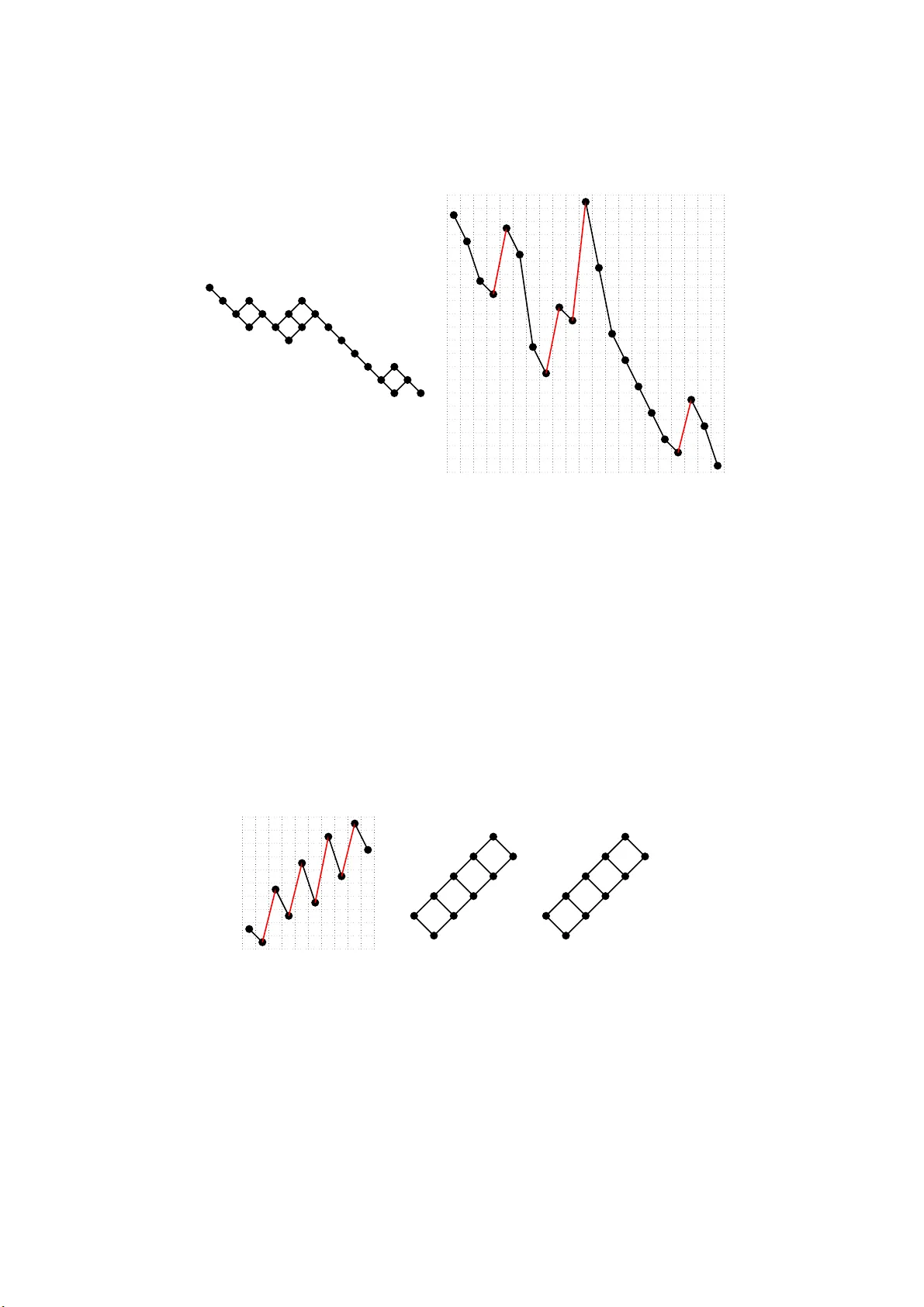
P osets and P erm utations in the Duplication-Loss Mo del: Minimal P erm utations with d Descen ts. Mathilde Bouv el ∗ Elisa P ergola † Octob er 22, 2021 Abstract In this pap er, we are interested in th e co mbinatorial analysis of th e whole genome duplication - random loss mo del of genome rearrangemen t initiated in [8] and [7]. In this model, genomes composed of n genes are mod elled by permutations of the set of integers [1 ..n ], that can evolv e through du pli cation-loss step s. It w as previously shown that the class of p e rmutations obtained in this mo d el after a given num b er p of steps is a class of p a tt ern -a voiding p erm utations of finite basis. The exclud e d pat- terns w ere d escribed as the minimal p ermutations with d = 2 p descents, minimal b eing intended in the sense of the pattern- inv olvemen t relation on p ermutations. Here, w e give a local and simpler characterizatio n of the set B d of minimal p ermutations with d descents. W e also provide a more detailed analysis - c h aracterization, bijection and enumeration - of tw o particular sub sets of B d , namely th e patterns in B d of size d + 2 and 2 d . 1 P attern-a v oidance in the d uplication-loss mo del The study of genome evolution has b een the so ur ce of extensive research in computational biology in the la st decades . Many mo dels for genome evolution were defined, taking int o a ccount v ario us bio logical phenomema (see [4], [9], [10] for recent examples in literatur e). Among them, the tandem duplic atio n - r an- dom loss mo del represents g enomes with p ermutations, that can evolv e throug h duplic ation-loss steps representing the biologica l phenomenon that duplicates fragments of genomes, and then loses one copy of ev e r y duplica ted gene. F or the origina l biologica l motiv ations, w e refer to [8]. In this first section, we de- scrib e the duplica tion-loss mo del, and recall some prev ious results obtained by other a uthors. W e recall some definitio ns and pr op erties on pattern- av oidance that a re necessar y to int r o duce the per mut a tions that will aris e from this mo de l and on which we will fo cus in the rest of the pap er. ∗ LIAF A, Uni v er s it´ e Paris Diderot - Paris 7, Case 7014, 75205 P aris Cedex 13, F rance, mbouvel@ liafa.jussieu.fr † Unive r sit` a degli Studi di Firenze, Dipartimen to di Sistemi e Informatica, v.le Morgagni 65, 50134 Firenze, Italy , elisa@dsi .unifi.it 1 1.1 The tandem duplication - random loss mo del for genome evolution A p ermutation of size n is a bijectiv e map from [1 ..n ] to itself. W e denote by S n the set of p ermutations o f size n . W e consider a p ermutation σ ∈ S n as the word σ 1 σ 2 . . . σ n of n letters on the alphab et { 1 , 2 , . . . , n } , containing exactly once each letter (w e often prefer the word element instead of le tter ). F or example, 34625 1 re pr esents the per mutation σ ∈ S 6 such tha t σ 1 = 3 , σ 2 = 4 , . . . , σ 6 = 1. In our mo del, p er m uta tio ns can be mo dified by duplic a t ion-loss steps . Each of these steps is c o mp o sed of t wo elementary op erations . Firstly , a fragment of consecutive elements of the p er mu ta tion is duplicated, and the duplicated fragment is inserted immediately after the original co py: this is the tandem duplic ation . After this first op eration, any duplicated element app e ars twice in the sequence of in teger s (that is no more a pe r mutation at this stag e). Then the r andom loss o ccur s: one copy of every duplicated element is lost, so that we g et a p er mut a tion at the end of the s tep. F o r any duplication-lo ss step, w e call its width the num b er of elements that are duplicated. 1 2 z }| { 3 4 5 6 7 1 2 z }| { 3 4 5 6 z }| { 3 4 5 6 7 (tandem duplication) 1 2 3 4 5 6 3 4 5 6 7 (random lo ss) 1 2 4 5 3 6 7 Figure 1 : Example of one step of tandem duplication - r andom lo ss of width 4 Notice that the duplication-loss mo del is a particular case of the very gen- eral fra mework fo r trans forming p ermutations defined in [1]: the p ermuting machines . A permuting mac hine takes a permutation in input and per forms on it a trans fo rmation that satisfies the t wo prop er ties of indep endance with resp ect to the v alues and of stability with resp ect to patter n-inv olvemen t (see [1] for more details). These t wo prop er ties are sa tisfied by the duplica tion-loss transformatio n. W e will consider per mutations that are obtained from an identit y p er mut a - tion 12 . . . n after a given num b er p of duplica tion-loss steps, that is to say that are the o utput of a com bina tio n in series of p p ermuting mac hines with input 12 . . . n . The reaso n is that these per m ua tions are the o nes obtainable at a cost of at most p in the duplication-loss mo del with a particular c ost fu nction . Indeed, v arious duplication-lo ss models can b e defined dep ending on the cost function c ∈ R N that is chosen. W e will always a ssume that the cost c ( k ) of a duplicatio n-loss step is dep endant o nly on the width k of this step. In the original mo del of Chaudhuri, Chen, Mihaescu a nd Rao [8], the c ost of a duplication-loss step of width k is c ( k ) = α k , for a pa r ameter α ≥ 1. In [7], w e consider the cost function defined by c ( k ) = 1 if k ≤ K , c ( k ) = ∞ other w is e, for a pa r ameter K ∈ N r { 0 , 1 } . The mo del we will focus o n in what follows has a v er y s imple cost function, namely c ( k ) = 1 , ∀ k . It is a specia l case of both the 2 mo del of [8] (with α = 1) a nd the mo del o f [7] (with K = ∞ ). This particular mo del is called the whole genome duplic ation - r andom loss mo del : indeed, since any step has co st 1 no matter its width, we can assume w.l.o.g that the who le per mutation is duplicated at any step. As said befor e, we are now going to focus on permutations obtained from an identit y p ermutation 12 . . . n after a certain num b er p of duplication-loss steps in the whole genome duplication - rando m loss mo del, that is to say on per mutations o btainable at a cost of at mos t p in this mo del. W e will describ e combinatorial pro p e rties of those p er mu ta tions in Subsection 1.3, in terms of pattern-av o idance. 1.2 Previous results on the duplication-loss mo del The per m uta tio ns obtainable in at most p duplica tion-loss steps in the whole genome duplication - random lo ss model were implicitely character iz ed in [8], through Theorem 1: Theorem 1. L et σ ∈ S n . In the whole genome duplic ation - r andom loss mo del, ⌈ log 2 ( numb er of maximal incr e asing substrings of σ ) ⌉ steps ar e ne c essary and sufficient to obtain σ fr om 12 . . . n . An incr e asing substring of σ is just a sequence of co ns ecutive elements of σ tha t ar e in increasing o rder. An increa sing substring is ma ximal if it can b e extended neither on the left nor on the right. Example 1. F or example, 69 84137 25 c ontains 5 maximal incr e asing substrings that ar e 69 , 8 , 4 , 137 and 25 . In [7], we r e fo rmulated Theorem 1 int o Theo rem 2, introducing , instead of the num b er of maximal increa sing substring s, the num b er of desce n ts which is a v e r y w ell- known statistics on p er m uta tions. Definition 1. Given a p ermutation σ of s ize n , we say that ther e is a des cent (r esp. ascent ) at p osition i , 1 ≤ i ≤ n − 1 , if σ i > σ i +1 (r esp. σ i < σ i +1 ). We indic ate t he n u mb er of desc ents of t he p ermutation σ by de sc ( σ ) . Example 2. F or ex ample, σ = 698413 725 has 4 desc ents, namely at p ositions 2 , 3 , 4 , 7 . It is often conv enient to see permutations through their grid r eprensentation defined in [5] and desc r ib ed in Figur e 2, especia lly b ecause it gives a b etter view of descents and ascents. Obviously , we have: Remark 1. The numb er of maximal incr e asing substrings of a p ermutation σ is de s c ( σ ) + 1 . More pr ecisely , the p ositions of the desce nts a nd n indicate the po sitions of the last element s of the maxima l incr easing substrings of σ . These definitions allow us to state Theorem 2: Theorem 2. The p ermutations that c an b e obtaine d in at most p steps in the whole genome duplic ation - r andom loss mo del ar e exactly those whose numb er of desc ents is at most 2 p − 1 . 3 1 2 3 4 5 6 7 8 9 1 2 3 4 5 6 7 8 9 Figure 2: The grid represe ntation of the p ermutation σ = 69841 3725 Pr o of. B y Theorem 1, the p ermutations o btainable in a t most p steps a re exactly those having their num b er of maximal incr e asing s ubstrings a t most 2 p , that is to s ay having at most 2 p − 1 desc ent s by Remar k 1. Generalizing a little, we will fo cus in the r emaining of the pap er o n the set of per mutations with at mos t d descents, without assuming that d is of the form d = 2 p − 1. W e ca n notice that this corresp onds to the set of per m uta tions compos ed of d + 1 increa sing sequences , se parated either by ascents or b y descents (a per mutation may hav e more than one such de c omp osition). In [2] this set is denoted W ( e 1 , . . . , e d +1 ) with ∀ i, e i = +. In this pap er , and a s an application of their re sults, the a uthors are concerned with pro pe rties of W ( e 1 , . . . , e d +1 ) in terms of pattern-av o idance, and they prov e that this s et is a finitely based pattern-av o iding per mutation class. O ur work can b e seen as a more detailled analysis of this particular result. 1.3 P att ern-a v oidance in the duplication-loss mo del W e need to recall a few definitions on pattern-avoidance in permutations to pro ceed. Definition 2. A p ermutation π ∈ S k is a pattern of a p ermut ation σ ∈ S n if ther e is a subse quenc e of σ which is or der-isomorph ic to π ; i.e., if ther e is a subse quenc e σ i 1 σ i 2 . . . σ i k of σ (with 1 ≤ i 1 < i 2 < . . . < i k ≤ n ) such that σ i ℓ < σ i m whenever π ℓ < π m . We also say that π is in volved in σ and c al l σ i 1 σ i 2 . . . σ i k an occ ur rence of π in σ . Example 3. F or example σ = 142 563 c ontains the p attern π = 1342 ; and 15 63 , 1463 , 256 3 and 1453 ar e the o c curr enc es of this p attern in σ . But σ do es not c ontain the p attern 321 as no subse quenc e of size 3 of σ is isomorphic to 3 2 1 , i.e. , is de cr e asing. W e write π ≺ σ to denote that π is a pa ttern of σ . W e say that a set C of per mutations is stable for ≺ if, for any σ ∈ C , for any π ≺ σ , then we a lso hav e π ∈ C . A per mut a tion σ that do e s not co nt a in π as a pattern is said to avoid π . The class of all p ermutations av oiding the pa tterns π 1 , π 2 . . . π k is denoted S ( π 1 , π 2 , . . . , π k ). W e say that S ( π 1 , π 2 , . . . , π k ) is a c la ss of pa ttern-av oiding per mutations o f b asis { π 1 , π 2 , . . . , π k } . The basis o f a class of pattern-av oiding 4 per mutations may be finite or infinite. Pattern-av oiding p ermutation classes considered in the literature (see for example [6], [12] a nd their references) a re often of finite basis. Although it ma y sound a p ow erful sta temen t, it is s imple to understand that: Prop ositi o n 1. A set C of p ermutations that is stable for ≺ is a class of p attern- avoidi n g p ermutations. However, its b asis might b e infinite. Pr o of. Co nsider C a set of p er mutations that is stable for ≺ . Define B to be the set of minimal p ermutations that do no t b elong to C , minimal b eing in tended in the sense o f ≺ . More formally , B = { σ / ∈ C : ∀ π ≺ σ with π 6 = σ, π ∈ C } . W e claim that C = S ( B ). Indeed, take σ / ∈ S ( B ). Then there exis ts π ∈ B such that π ≺ σ . Since π ∈ B , π / ∈ C and considering that C is stable for ≺ , we deduce from π ≺ σ that σ / ∈ C either. Con versely , if σ / ∈ C , then either σ ∈ B (and consequently σ / ∈ S ( B )) or ther e exists π ≺ σ with π 6 = σ such that π / ∈ C . In this second case, by induction we obtain that σ / ∈ S ( B ). W e conclude that the set C is a class of pattern-avoiding p er m uta tio ns whose basis B = { σ / ∈ C : ∀ π ≺ σ with π 6 = σ, π ∈ C } has no reaso n a priori to b e finite. In [7], we prov ed that c lasses o f per mutations defined in duplication- loss mo dels, as the per mut a tions obtained in at mos t a given num b er p of steps, are classes of pattern- av oiding p ermutations. W e hav e not a lwa ys be e n able to find the basis, even thoug h we hav e prov ed in an y case we co nsidered that this basis is finite. In this paper , we ta ke into consideration in par ticular the following result: Theorem 3. The class of p ermutations obtainable in at most p steps in the whole genome duplic atio n - r andom loss mo del is a class of p attern-avoiding p ermutations whose b asis B d is finite and is c omp ose d of the minimal p ermuta- tions with d = 2 p desc ents, minimal b eing intente d in the sense of ≺ . The pr o of of Theorem 3 we gave in [7] is implicite, and for sake of clarity we give b elow an explicit pro of of it. Pr o of. Le t us deno te by C p the class o f p ermutations obta inable in at most p steps in the whole genome duplication - random loss mo del. W e first prove that C p is stable for ≺ . Co ns ider σ ∈ C p of s iz e n and π of size k ≤ n such that π ≺ σ . The r e is a sequence o f at most p duplication-loss steps that transforms 12 . . . n into σ . By definition, π has an o ccurr ence in σ . In the duplication-loss s c enario for σ , if you keep tr ack only of the elements that form an occur rence o f π , you obtain a se q uence o f duplicatio n-loss steps moving from 12 . . . k to π , of no more than p steps. This shows that π ∈ C p , a nd consequently that C p is stable for ≺ . According to Prop o sition 1, C p is a class of pattern-avoiding p ermutations whose basis is { σ / ∈ C p : ∀ π ≺ σ with π 6 = σ, π ∈ C p } . F ollowing Theorem 2, we deduce that this basis B d of exc luded patterns is made of the minimal per mutations with d = 2 p descents, that is to say the p ermutations w ith 2 p descents that contain no pa ttern with 2 p descents, exce pt themselves. What is left to prov e is tha t this basis is finite. It is sufficient to establish a n upp er b ound on the size of the p ermutations in B d to s how that B d is finite. W e p ostp one this part of the pro of to P rop osition 5 2, where we show in par ticular tha t the p er mut a tions of B d are of siz e at most 2 d . A consequence is that the basis B d of excluded patterns of C p is finite. In this pap er, w e fo cus o n the ba sis B d of excluded patterns app ear ing in Theorem 3. More g enerally , we do not assume that d is a p ow er of 2 but ra ther wish to c ha racterize and enumerate the s e t B d of p ermutations that ar e the minimal ones in the sense of ≺ for the prop erty of having d descents. 1.4 Outline of the pap er In this pap er, we focus o n the sets B d of per mut a tions that are the minimal ones in the sense o f ≺ for the prop erty of having d descents. F or the cases d = 2 p , B d is the basis of excluded patterns of the class of per m uta tions obtainable in at mo st p steps in the whole genome duplication - rando m loss mo del. The work that is pre sented her eafter is org anized as follows. First, we give a lo cal characterizatio n of the p ermutations o f B d . Indeed, the definition of these p ermutations as the minimal ones with res p ect to ≺ for the prop e r ty of having d descents is not very easy to use. W e will prove in Section 2 that the p e rmutations of B d are the p er mutations σ whose asc ent s sa tisfy a simple and lo cal prope r ty: there is an asc ent in σ ∈ S n at po s ition i if and only if 2 ≤ i ≤ n − 2 and σ i − 1 σ i σ i +1 σ i +2 forms an o ccur rence of either the pattern 2143 or the pa ttern 3142 . This characterization is used to tr y and c o unt the p er mutations in B d . De- spite our effort, w e did not succeed in this dir ection, and focused o n simpler cases that ca n b e seen as a firs t step in the en umer ation of B d . First, as explained at the beg inning of Section 2, Prop osition 2, the size of the p er mutations in B d is at least d + 1 and a t most 2 d . Obviously ther e is only one p ermutation of B d of size d + 1, that is the reverse iden tity permutation ( d + 1) d ( d − 1) . . . 321. F or any other size, ther e is no immediate result. Using a repres entation of p ermutations of B d as p osets (partially ordered sets), w e could en umera te the p ermutations in B d having size 2 d and d + 2 resp ectively . In Sectio n 3, we prove tha t the p ermutations o f B d having size 2 d ( i.e. max - imal size) are en umer ated by the Ca talan num b ers: there ar e C d = 1 d +1 2 d d of them. W e give tw o p ossible pro ofs of this result. W e descr ib e an “ECO” gener- ation (see [3]) of the p ermutations of B d of size 2 d whose asso ciated successio n rule is known to cor resp ond to the Cata lan num b ers. More directly , w e could provide a simple bijection b etw een Dyc k pa ths of length 2 d and an adequate representation of the p ermutations of size 2 d in B d . In Section 4 , we consider p er mutations of size d + 2 (minimal non-trivial case ) in B d . After a combinatorial analy s is and some co mputations, we obtain that there are s d = 2 d +2 − ( d + 1)( d + 2) − 2 such p ermutations. The sequence ( s d ) do es not appea r in the Online Encyclo pe dia of Int e g er Sequences [11]. How ever, we realized that the sequence ( s d 2 ) do es. This sequence co unt s the num b er of non-interv al subsets of the set { 1 , 2 , . . . , d + 1 } . Section 4 als o gives a bijectiv e pro of of the fact that there are twice a s many p ermutations of size d + 2 in B d as non-interv al subsets of { 1 , 2 , . . . , d + 1 } . Section 5 s umma rizes some op en problems in the study of the sets B d ’s. F rom here o n, by minimal per mut a tion with d descents, we mean a p ermu- tation that is minimal in the sense o f the pattern-inv olvemen t relation ≺ for the 6 prop erty of having d descents. Example 4, which is illustra ted on Figure 3, should cla rify the notion of minimal p ermutation with d descents. Example 4. Permutation σ = 861 3 241195107 has 6 desc ents but is not minimal with 6 desc ents . Inde e d, the elements 1 and 4 (that ar e cir cle d on Figur e 3) c an b e re move d fr om σ without changing the numb er of desc ents. Doing this, we obtain p ermutation π = 6421 9738 5 which is minimal with 6 desc ents: it is imp ossible t o remo ve an element fr om it while pr eserving the numb er of desc ents e qual t o 6 . However, π is not of minimal siz e among the p ermutation with 6 desc ents: π has size 9 wher e as p ermut ation 765 4321 has 6 desc ents but size 7 . 1 2 3 4 5 6 7 8 9 10 11 1 2 3 4 5 6 7 8 9 10 11 σ = 8 6 1324 11 951 07 1 2 3 4 5 6 7 8 9 1 2 3 4 5 6 7 8 9 π = 6 42197 385 Figure 3: Permut a tions σ and π of Ex a mple 4. 2 A c haracterization for minimal p erm utations with d descen ts The aim o f this section is to pr ovide a mor e practical characteriza tion o f minimal per mutations with d descents, by finding necessary a nd sufficient conditions on per mutations for being minimal with d descents. First, we provide a necessary condition on the size of those p ermutations with Pro p osition 2. Prop ositi o n 2. L et σ b e a minimal p ermut ation with d desc ents. Then every asc ent of σ is imme diately pr e c e de d and imme diately fol lowe d by a desc ent, and the s ize n of σ satisfies d + 1 ≤ n ≤ 2 d . Pr o of. Co nsider a p ermutation σ ∈ B d , a nd denote by n the size of σ . By minimalit y in the sense o f ≺ , σ has exac tly d descent s . T o crea te a p ermutation with d desce n ts, you need at least d + 1 elements, and with d + 1 elements, the only p ermutation with d descent s you can cr eate is ( d + 1) d ( d − 1) . . . 2 1, which is minimal. Therefor e, n ≥ d + 1. It is also easily seen that σ do es neither start no r end with an ascent, oth- erwise the per mutation obtained by removing the first or the last element of σ would hav e the same num b er d of descents, contradicting that σ is minimal with d descents. In the same wa y , σ cannot have t wo consecutive a scents σ i − 1 σ i and σ i σ i +1 , otherwise we would get the s a me contradiction removing σ i , since this remov al doe s not ch a nge the n umber of descents. 7 This prov es that a minimal permutation with d descents is compos ed of non- empt y seque nc e s of descents, separated by isola ted ascents. A longes t p ossible per mutation with d des cents so obta ine d has d isolated des cents, separa ted by d − 1 isolated a scents, and consequently has 2 d ele ments. W e then get that the size of σ is at most 2 d : n ≤ 2 d . Figure 4: Decomp o s ition o f a minimal per mu ta tion with d descents int o non- empt y sequences of des c ent s sepa rated by isolated ascents The decomp osition of a minimal p ermutation with d descents in to non-e mpty sequences of des c ent s separ ated b y isolated ascents that is describ ed in the pro o f of Pr op osition 2 is illustr a ted in Figure 4. This decomp osition can b e carried further to g ive a necessa ry and sufficient condition on p ermutations for b eing minimal with d descents. This characteriza tion is describ ed in Theore m 4. Theorem 4 . A p ermutation σ is minimal with d desc ents if and only if it has exactly d desc ents and its asc ents σ i σ i +1 ar e such that 2 ≤ i ≤ n − 2 and σ i − 1 σ i σ i +1 σ i +2 forms an o c curr enc e of either t he p attern 2 143 or the p attern 3142 . Pr o of. Le t σ b e a minimal p er mut a tion with d descents. In the decomp osition of σ in to non- e mpty sequences o f descents separ ated by is olated a scents – illus- trated in Figure 4 – it app ear s clear ly that an ascent σ i σ i +1 is necessarily such that 2 ≤ i ≤ n − 2 , with σ i − 1 σ i and σ i +1 σ i +2 being descents. Now, consider an ascent σ i σ i +1 . The previous remarks le ad to σ i − 1 > σ i , σ i < σ i +1 and σ i +1 > σ i +2 . Let us assume tha t σ i − 1 > σ i +1 . Then the p ermutation obtained from σ by the r e mov al of σ i has as many descents as σ (and one ascent less), contradicting the minimality of σ . Consequen tly , σ i − 1 < σ i +1 . Similarly , if σ i > σ i +2 , the remov al o f σ i +1 from σ do e s not change the num b er of descent s , contradicting the minimalit y of σ . So σ i < σ i +2 (see Figure 5). A t this p oint, we hav e the five following inequalities: σ i − 1 > σ i , σ i < σ i +1 , σ i +1 > σ i +2 , σ i − 1 < σ i +1 and σ i < σ i +2 . Thanks to them it is po s sible to c heck that the sequence σ i − 1 σ i σ i +1 σ i +2 is an o ccurrence of either the pattern 2143 or the pattern 3142. 8 Removing leads to the descent F orbidden configur ations The o nly p ossible configura tions Figure 5: The elements σ i − 1 σ i σ i +1 σ i +2 around an ascent σ i σ i +1 in a per mu ta - tion σ which is minimal with d descents Conv ersely , consider a p ermutation σ with d de s cents whose ascents σ i σ i +1 are suc h that 2 ≤ i ≤ n − 2 a nd σ i − 1 σ i σ i +1 σ i +2 forms a n oc currence o f either the pattern 21 43 or the pattern 3142 . This implies that σ has the shap e of non-empty sequences of descents s e parated b y isola ted a s cents. And it is a simple matter to prove that the remov a l of any elemen t of σ makes the num b er of desc e n ts decreas e by one – there are thr e e cases to consider : the remov ed element may b e either the first element of an ascent, or the second element of an ascent, or it ma y b e betw een tw o desce nts. This pr ov es that σ is a minimal per mutation with d descents. W e thoug ht this characterization could help us to enu mer ate the minimal per mutations with d descents. Although we did not reach this goa l, we still obtain partial results when we studied minimal p ermutation with d descents and of a given size n . F or n = d + 1 , we already prov ed that there is only one such p ermutation. F or n = d + 2 and n = 2 d , the next tw o s e ctions describ e the enumeration we obtained. In bo th cas e s, w e will us e a p artial ly or der e d set (or p oset ) repres entation of p ermutations, that comes directly from the characterization of minimal p ermutations with d descents in Theor em 4. Representa ti on of m inimal p ermutations with d descent s with p osets Consider a set of all the p ermutations of a g iven size n , that a re minimal with d descents, and having their descents and ascents in the s a me po sitions. In all these p ermutations, the elements a re loca lly o r dered in the same wa y , even around the ascents, beca use of Theorem 4. W e can give a representation of this whole set of p ermutations b y a p artial ly or der e d set (or p oset ) indicating the necessary c o nditions on the r elative order of the elements b etw een them. F or a descent, we just hav e a link from the first and gre a test elemen t to the second and sma llest one. F or any a scent σ i σ i +1 , the elements σ i − 1 σ i σ i +1 σ i +2 form a diamond-shap ed structure with σ i +1 on the top, σ i on the b o ttom, σ i − 1 on the left a nd σ i +2 on the rig ht. See Figure 6 for an exa mple. By Theorem 4, any lab elling of the elements of the pos et resp ecting its or dering constraints is a minimal p ermutation with d descents. W e will say that a p ermutation σ satisfies the diamond prop erty when ea ch of its ascent σ i σ i +1 is such that σ i − 1 σ i σ i +1 σ i +2 forms a diamond, that is to say is an o ccurrence of either 2143 or 3142 . 9 Figure 6: A po set repres e nting a set of minimal p ermutations with 16 desce nts and 4 ascents (consequently o f size 2 1) containing, among others the per mut a - tion 20 18 15 1 4 19 17 1 0 8 13 12 21 16 11 9 7 5 3 2 6 4 1 whose grid r epresentation is also given 3 En umeration of minimal p erm u tations with d descen ts and of size 2 d The minimal permutations with d descents that hav e s ize 2 d a r e, b ecause of minimalit y , o f a very par ticular shap e. Indeed, they ca nno t hav e tw o consecutive ascents a s usual, but neither can they hav e tw o consecutive des cents, o therwise it w ould b e imp ossible to reach s ize 2 d . Consequently , they all result from of an alternation of isolated descents and isola ted ascents, of cour se sta rting and ending with a descent. An ex ample is g iven in Figure 7(a). (a) (b) 1 2 3 5 4 7 6 9 8 10 (c) Figure 7: (a) A minimal permutation σ = 2 1 5 3 7 4 9 6 1 0 8 with d = 5 descents and of size 2 d = 10 , (b) the pos et representing the set of all minimal per mutations with d = 5 descents and of siz e 2 d = 10 and (c) the authorized lab elling of the subsequent p oset ass o ciated with σ A conseq uence is that all minimal permutations of size 2 d w ith d descents 10 hav e their descents and ascent s in the same p osition, so that a unique po set represents the set of all minimal p ermutations with d descents having size 2 d . This po s et has the shap e of a ladder with d steps: it is a sequence of d − 1 diamonds, tw o consecutive diamonds b eing linked by an edg e. These diamonds corres p o nd to the ascent s in the permutations, tha t ar e separated by one descent only in this case. See Figure 7(b) for an example. The parag r aph on p o s et repr esentation at the end of Section 2 justifies Prop ositio n 3: Prop ositi o n 3. The m inimal p ermutations with d desc ents and of size 2 d c or- r esp ond exactly to the lab el lings of the ladder p oset with d steps with t he inte gers { 1 , 2 , . . . , 2 d } that r esp e ct its or dering c onstr aints. An example of this co rresp onda nce is given in Figur e 7(c). The p oset representation a llows to s ee at once some pro p erties of minimal per mutations with d descents having size 2 d . F or example, such a p ermutation alwa ys has 1 a s its second element and 2 d as its next to last elemen t. The ma in result of this section is : Theorem 5. The minimal p ermutations with d desc ents and of size 2 d ar e enumer ate d by the Catalan nu mb ers C d = 1 d +1 2 d d . Pro of of Theorem 5 b y an analytical metho d A p ossible wa y to prov e Theorem 5 is to use the ECO metho d, pr esented in details in [3]. In our case, the idea develop ed by this metho d is to build all the authorized lab ellings of the ladder p o set with d steps from all the a uthorized lab ellings of the la dder p os et with d − 1 steps without crea ting twice the s ame labe lling. In its orig inal fo rm, the ECO method builds combinatorial ob jects of size d from those of s ize d − 1, through a pro cess of lo c al exp ansion , w her eby the ob jects are mo dified only by the addition of a n elementary blo ck of o b ject. In our case, in order to get a lab elling of size d , the lo c al exp ansions might mo dify many lab els in the lab elling of size d − 1, but the relative order of these lab els betw e e n them will remain the sa me. In this sense, we can consider that the expansion is still lo cal. In the ECO metho d, the combinatorial ob jects (lab elling s o f the ladder p oset with d steps in our c a se) receive lab els . The lab e l of an o b ject is the num b er of its childr en , that is to say the num b e r of ob jects that are obtained from it in the lo cal expansion pro ces s. Those children can aga in rece ive a lab e l b y the same metho d. The infinite tre e in which any p ermutation is the fa ther of its children is called the gener ating tr e e o f the combinatorial class. With the E CO labelling of the combinatorial ob jects, we der ive a suc c ession rule or r ewriting ru le that describ es the pro duction (in terms of labels ) of the po ssible lab els of these o b jects, toge ther w ith a starting po in t. There is a simple succession r ule that is asso ciated with s ome combinatorial classes en umer a ted by the Catalan num b e rs (for example with Dyck paths [3]): (2) ( k ) (2)(3) · · · ( k )( k + 1) A p ossible wa y of proving that authorized lab ellings of the ladder p os et with d steps are en umer ated by the Catala n num b ers is to find an ECO constructio n for this class whose asso cia ted success io n rule is the one ab ov e . 11 The E CO la b els that ar e given to author ized lab ellings of the ladder p osets with d steps for this purp ose are (2 d − σ 2 d + 1), σ 2 d being the lab el of the rightmost element of the po set. Notice a lso that 2 d is the lab el of the uppermo s t element of the po set, and that this element is also the seco nd r ightmost one. Consider an author ized labelling σ of the ladder p oset with d steps that ha s ECO lab el ( k ). Its c hildren are the lab ellings of the la dder po set with d + 1 steps obtained by adding a new step on the right, this new step of the la dder being lab elled with 2 d + 2 for the top elemen t, and i for the rightmost one, for 2 d + 2 − k ≤ i ≤ 2 d + 1. The elements j in σ with j ≥ i ar e tur ned into to j + 1 to maintain bo th the relative or der of the elements o f σ and the pro pe rty that these new lab e llings use all the int eg ers of [1 .. 2 d + 2] exactly once. Since k = 2 d − σ 2 d + 1, it is eas y to chec k tha t a ll the la be lling s obtaine d in this w ay are authorized, and that all of them a re obtained. W e can now fo cus on the ECO lab els o f the children (of size d + 1) o f an authorize d lab elling of s ize d with ECO lab el ( k ). There are of co ur se k of them whose ECO labels are, b y the ab ov e formula, (2( d + 1) − i + 1) with 2 d + 2 − k ≤ i ≤ 2 d + 1, that is to s ay the children o f a lab elling with ECO label ( k ) hav e lab els (2) , (3) , . . . ( k ) , ( k + 1). The star ting p oint for this E CO constr uc tio n is the ladder p oset with o ne step pr ovided with its only authorized lab elling 21, and who se ECO lab el is (2). T o sum up, the succession rule obtained for this ECO constructio n of a u- thorized lab elling of the ladder p osets is (2) ( k ) (2)(3) · · · ( k )( k + 1) and this succes sion rule co rresp onds to combinatorial cla sses enumerated by Catalan num b e rs. Figure 8 s hows the b eginning of the genera ting tree as so ciated with this E CO construction. T o improv e the unders ta nding o f this tree , w e do not represent lab ellings of ladder p ose ts in its no des, but ra ther the minimal p ermutations with d descents of size 2 d asso ciated with them. Pro of of Theorem 5 by bijectio n It is well known that Dyck paths of length 2 d are enumerated by the Ca talan num ber s C d = 1 d +1 2 d d . Let us reca ll the definition of Dyck paths. Definition 3. A Dyck p ath of length 2 d is a p ath in N × N starting at (0 , 0 ) and ending at (2 d, 0 ) , with steps going up (of c o or dinate (1 , 1) ) and steps going down (of c o or dinate (1 , − 1) ). As it is a path in N × N , a Dyck path never go es under the x -axis. W e can also notice that a Dyck path ha s as many steps going up as those going down, and that any prefix of a Dyck path contains at lea st a s many steps going up as those going down. This is actually a characterizatio n o f Dyc k paths. W e provide a bijection betw een Dyck paths of length 2 d and authorized lab ellings of the ladder p oset with d steps with the in teg ers { 1 , 2 , . . . , 2 d } . The bijection is simple. Starting from a Dyc k pa th D o f length 2 d , we n umber its steps with the in teger s from 1 to 2 d , fr o m left to right. Then, w e label the low er line of the ladder with the num b e rs of the steps o f D going up and its upper line with the num b ers o f the steps of D go ing down. An example is s hown in Figure 9. 12 21 2143 21436 5 21436 587 21437 586 21536 4 21536 487 21537 486 21637 485 3142 31426 5 31426 587 31427 586 31526 4 31526 487 31527 486 31627 485 41526 3 41526 387 41527 386 41627 385 51627 384 Figure 8: The first four levels of the generating tree asso cia ted with the ECO construction of authorized lab ellings of the ladder p osets descr ib ed ab ov e 1 2 3 4 5 6 7 8 9 10 1 3 2 6 4 7 5 8 9 10 Figure 9: An example of the bijection be tw e e n minimal p er mu ta tions with d descents of siz e 2 d (seen as author iz ed lab ellings of the ladder po set with d steps) and Dyck paths with 2 d steps The application we describ ed is actually a bijection b etw een Dyc k paths and the authorized lab ellings of the la dder pose ts , corr esp onding to the permutations we are in tere s ted in. The reason is simple. It is sufficient to no tice that a lab elling of the ladder p oset with d steps is authorized if and o nly if any i -th element x on the upp er line has at lea st i sma ller elements o n the lower line (the elemen t y on the lower line that is linked to x by a s tep on the ladder, and all the ele ments b elow y ). See Figure 10 for a b etter understanding of this statement. In the same wa y , a path with d steps going up and d step going down is a Dyck path if and only if any i -th step g o ing down has at lea st i steps going up befor e it. 4 En umeration of minimal p erm u tations with d descen ts and of size d + 2 In Section 3, we enumerated the minimal p ermutations with d descents a nd of size 2 d , that is to s ay of maximal pos s ible size. W e have already proved that the 13 y x < x | {z } Figure 10: A condition for a lab elling of the ladder p oset to b e authorized minimal p ossible size for a minimal per m uta tion with d descents is d + 1 and shown tha t there is o nly one such per m uta tio n, namely the reversed iden tity ( d + 1) d . . . 21. In this s e c tion, we will fo cus on the minimal per mutations with d descents and of size d + 2, i.e. the minimal no n-trivial cas e, and give a close d formula for their enumeration throug h Theo rem 6. Theorem 6. The minimal p ermutations with d desc ents and of size d + 2 ar e enumer ate d by the se quenc e ( s d ) define d as fol lows: s d = 2 d +2 − ( d + 1)( d + 2) − 2 . W e provide t wo p oss ible pro ofs for Theore m 6. Bo th of them are based on the p oset representation of minimal p ermutations with d desc ent s and of size d + 2, that consequently have a unique ascent. The first one is str aightforw ar d with this decompo sition, but implies r ather co mplex co mputations. The s econd pro of is more complicated but it does no t in volve such technicalities: it consists in a corresp onda nce b e t ween no n-interv al subsets of { 1 , 2 , . . . , d + 1 } and mini- mal p ermutations with d desc ent s of s ize d + 2, each non-interv al subset b eing asso ciated with exactly tw o distinct per mu ta tions. Pro of o f Theorem 6 b y a computational metho d Let us recall that a minimal p ermutation σ with d descents and of size d + 2 has a unique ascent, betw e e n tw o sequences of desce n ts, and that the e lement s s ur rounding the ascent are orga nized in a diamond in the p oset representation of the p ermutation. Let us deno te by i and k the elements of the a scent, i < k , b y j the element preceeding i in σ , a nd by h the e lement following k . In the p ermutation σ , the subsequence j ik h forms an o c curence of either the pattern 2143 (if j < h ) or the pattern 31 42 (if j > h ). This defines tw o types o f minimal p ermutations with d descents of size d + 2. W e denote by N 1 the num b er of those p ermutations for which j < h and by N 2 the nu mber of tho s e having j > h . W e firs t compute N 1 . In order to character iz e a minimal p ermutation σ with d descent s , of size d + 2, and having its diamond o f the type 2143, y o u first need to establish the v alues o f j , i , k and h satisfying the constraints 1 ≤ i < j < h < k ≤ d + 2. Then (see left part of Figur e 11), the element s g reater than h (exc e pt k ) are nece ssarily pla ced befor e j , in decr e a sing or der, for ming the sequence o f descents B . Similarily , the e le ments sma lle r than j (except i ) hav e to co me after h in σ , again in decr easing o rder, to form the sequence of descents A . The set C o f elements betw een j a nd h must b e partitioned int o t wo parts C 1 and C 2 , p oss ibly empt y , the elements of C 1 being placed in decreasing or der b etw een B and j , those of C 2 betw e e n h a nd A . There ar e 2 car d ( C ) = 2 h − j − 1 such partitions of C int o C 1 ⊎ C 2 . 14 T o sum up, a minimal per mutation with d descent s , of size d + 2, and ha v ing its diamond of the t yp e 21 43 is determined by the v alues of its i , j , h , a nd k , with 1 ≤ i < j < h < k ≤ d + 2, a nd a partition of the set C of element s b etw een j and h into C 1 ⊎ C 2 . This characterization a llows us to c ompute N 1 : N 1 = d − 1 X i =1 d X j = i +1 d +1 X h = j +1 d +2 X k = h +1 2 h − j − 1 = d − 1 X i =1 d X j = i +1 d +1 X h = j +1 ( d + 2 − h )2 h − j − 1 = d − 1 X i =1 d X j = i +1 d − j X m =0 ( d + 1 − m − j )2 m = d − 1 X i =1 d X j = i +1 h d − j X m =0 ( d + 1 − j )2 m − d − j X m =0 m 2 m i = d − 1 X i =1 d X j = i +1 h ( d + 1 − j )(2 d − j +1 − 1 ) − 2 d − j +1 ( d − j − 1) − 2 i = d − 1 X i =1 d X j = i +1 2 d − j +2 − ( d − j + 2) − 1 = d − 1 X i =1 d − i +1 X n =2 2 n − n − 1 = d − 1 X i =1 2 d − i +2 − ( d − i + 1)( d − i + 2) 2 − ( d − i ) − 3 = d +1 X p =3 2 p − p ( p − 1) 2 − ( p − 2) − 3 = d +1 X p =3 2 p − 1 2 p 2 − 1 2 p − 1 = 2 d +2 − 1 2 ( d + 1)( d + 2 )(2 d + 3 ) 6 − 1 2 ( d + 1)( d + 2) 2 − d − 3 = 2 d +2 − ( d + 1)( d + 2)( d + 3 ) 6 − d − 3 F or the minimal permutations σ with d desce nts and of size d + 2, who se diamond is of type 3142 , the analysis is simpler (this case is illustra ted o n the right side of Figur e 11). Indeed, following the previo us notations, to c har acterize such a p ermutation, you must again choose i , j , h and k with the co nstraint that 1 ≤ i < h < j < k , but not every such choice is acc e ptable. Namely , consider the set of elements b etw een h and j . Tho se elements canno t b e befor e j in σ , since they ar e s ma ller than j . B ut neither can they go after h sinc e they a re greater tha n h . Co nsequently , there cannot b e any elemen t b etw een h and j , and h = j − 1. Now, once i , j and k ar e established, the p ermutation σ is completly characterized. The elements grea ter than j (except k ) necessarily 15 if j < h 1 d + 2 i j h k A B C C = C 1 ⊎ C 2 ⇓ B C 1 j i k h C 2 A if j > h 1 d + 2 i h j k A B C C = ∅ ⇓ B j i k h A Figure 11 : The tw o t yp es of minimal p er mut a tions with d descents and of size d + 2, with the decomp os ition us ed for their en umer ation form a sequence B of descents befo re j , and those smaller than j − 1 (except i ) form a sequence A of des cents after h = j − 1. The computatio n of N 2 is then straigthforward: N 2 = d − 1 X i =1 d +1 X j = i +2 d +2 X k = j +1 1 = d − 1 X i =1 d +1 X j = i +2 d + 2 − j = d − 1 X i =1 d − i X m =1 m = d − 1 X i =1 ( d − i )( d − i + 1) 2 = d − 1 X n =1 n ( n + 1 ) 2 = 1 2 h d ( d − 1)(2 d − 1) 6 + d ( d + 1) 2 i = d ( d − 1)( d + 1) 6 The total n umber of minimal p ermutations with d desce nt s of size d + 2 is 16 now simply obtained by the final computation: N = N 1 + N 2 = 2 d +2 − ( d + 1)( d + 2)( d + 3 ) 6 − d − 3 + d ( d − 1)( d + 1 ) 6 = 2 d +2 − ( d + 1) 2 − d − 3 = 2 d +2 − ( d + 1)( d + 2) − 2 This achiev es the computationa l pro of of Theorem 6. W e no w turn to a bijectiv e pro of of it. Pro of of Theorem 6 b y bijection A non- int erval subset of { 1 , 2 , . . . , d + 1 } is a non-empt y subset of { 1 , 2 , . . . , d + 1 } that is not an interv al. F or example, the non-interv a l subsets of { 1 , . . . , 4 } are: { 1 , 3 } , { 1 , 4 } , { 2 , 4 } , { 1 , 2 , 4 } and { 1 , 3 , 4 } . Non-interv a l subs e ts of { 1 , 2 , . . . , d + 1 } are easy to enu mer ate, as shown in Pro p o sition 4. Prop ositi o n 4. The n umb er of non-interval subsets of the set { 1 , 2 , . . . , d + 1 } is 2 d +1 − ( d +1)( d +2) 2 − 1 . Pr o of. The r e are 2 d +1 subsets of { 1 , 2 , . . . , d + 1 } , o ne being the empty set. So we o nly need to prov e that there are ( d +1)( d +2) 2 subsets of { 1 , 2 , . . . , d + 1 } that ar e (non-empty) interv als. It is simple to see that there a re i in terv al s ubsets of { 1 , 2 , . . . , d + 1 } whose gr eatest element is i , namely the in ter v als [ j..i ] for 1 ≤ j ≤ i . And since P d +1 i =1 i = ( d +1)( d +2) 2 , the pro o f of Pr op osition 4 is completed. Notice that the sequence (2 d +1 − ( d +1)( d +2) 2 − 1) d is reg istered in the Online Encyclop edia of In teg e r Sequences [11] as [A00 2662]. T o prove Theor em 6, we need to s how that there are t wice as many minimal p ermutations with d descents and of s ize d + 2 as non-interv al subsets of { 1 , 2 , . . . , d + 1 } . F or this purp ose, we partition the set of minima l p ermutations with d descents a nd of size d + 2 int o tw o subsets S 1 and S 2 , a nd show bijections betw een S 1 (resp. S 2 ) and the set of non-interv al subsets of { 1 , 2 , . . . , d + 1 } , denoted N I . The set S 1 contains the minimal per m uta tions σ with d descents and o f size d + 2 such that (1) d + 2 is the elemen t at the to p of the ascent of σ , and (2) the first sequence o f desc e n ts of σ is not comp osed of elemen ts that are consecutive. The s et S 2 contains all the other minimal per mut a tions with d descents a nd o f size d + 2. Figure 12 shows the shap es of the p er mutations in S 1 and in S 2 . W e firs t describ e the simple bijection Φ 1 betw e e n N I and S 1 . Co ns ider a non-interv a l subset s of { 1 , 2 , . . . , d + 1 } . Let us denote by w the set of “wholes” asso cia ted with s : w = { 1 , 2 , . . . , d + 1 } \ s . Now we s et Φ 1 ( s ) to be the permutation consisting of the elements of s in decreasing o rder, follow ed by d + 2 and then b y the elements of w in dec r easing o rder. This definition is illustrated in Figure 13. Prop ositi o n 5. The applic ation Φ 1 defines a bije ction b etwe en N I and S 1 . Pr o of. Le t s be a no n-interv al subset of { 1 , 2 , . . . , d + 1 } , and let w b e the asso ciated set of wholes w = { 1 , 2 , . . . , d + 1 } \ s . W e start by proving that Φ 1 ( s ) ∈ S 1 . Since s ∈ N I , s contains at least tw o elements, a nd w at leas t one. Consequently , Φ 1 ( s ) consists o f tw o non-empty 17 d + 2 | {z } non - consecutive Perm utations in S 1 d + 2 | {z } consecutive d + 2 Perm utations in S 2 Figure 12: The shap es of the p e r mutations in the sets S 1 and S 2 d = 7 s = { 3 , 4 , 5 , 8 } w = { 1 , 2 , 6 , 7 } Φ 1 ( s ) = 8 5 4 s min = 3 9 = d + 2 7 = w max 6 2 1 Figure 13: Definition of the bijection Φ 1 on an ex ample sequences o f descents separated by one ascent, a nd we just need to c heck the di- amond pro pe r ty ar o und its ascent to prove that Φ 1 ( s ) is a minimal p ermutation with d descents and o f size d + 2. In our case, pr oving this diamond prop er ty is the same as showing that the smallest element s min of s is smaller than the bigger e le ment w max of w . Since s is not an interv a l, there is at least one el- ement of w that is bigg er than s min , and conseq uent ly s min < w max . Finally , considering again that s is not an interv al, we get that Φ 1 ( s ) ∈ S 1 . Now – given tha t among the minimal p ermutations with d descents and of size d + 2, the p ermutations of S 1 are defined as those whose elemen ts in the first sequence of descents do not for m a n interv al – it s ho uld now be clea r that Φ 1 is a bijection b etw een N I and S 1 . The bijection b etw een N I and S 2 is le s s simple, and we will need to c la ssify the p ermutations of S 2 by dividing them into types, from A to E . Those types are illustrated in Figure 14. The p ermutations σ of t yp e A are tho se o f S 2 such that (1) d + 2 is the second element of the ascent of σ , and (2 ) the first sequence of descents of σ contains only tw o elements, that are consecutive. The p ermutations σ of t yp e B a re those o f S 2 such that (1) d + 2 is the second element of the a scent of σ , (2) the fir s t s equence of desc e n ts of σ is comp osed of consecutive elements, and co nt a ins at least 3 elements, and (3) the seco nd sequence o f descent s o f σ ha s the for m ( d + 2)( d + 1) r , with r b eing either empt y or a sequence of consecutive elements in decrea sing order and whose smallest element is 1. 18 Type A d + 2 d + 1 | {z } consecutive Type B d d + 2 d + 1 1 | {z } consecutive | {z } consecutive or empt y Type C d + 2 d + 1 d 1 | {z } consecutive | {z } consecutive and not empt y | {z } consecutive or empt y Type D d + 2 z }| { consecutive Type E d + 2 z }| { non-consecutive Figure 14: The classific a tion of the p ermutations in S 2 int o 5 t yp es A to E The p ermutations σ of type C are tho s e o f S 2 such that (1) d + 2 is the second element of the ascent of σ , (2) the fir st s equence of descents of σ is made of consecutive elements, and co nt a ins at least 3 elements, and (3) the seco nd sequence of desce nts of σ is of the form ( d + 2)( d + 1) r 1 r 2 with r 1 being a seque nc e of consecutive elements in decreasing order and whose greatest element is d , and r 2 being either empty o r a sequence of consecutive elements in decreas ing or der and whose smallest element is 1. Notice that r 1 cannot be empt y . The p ermutations of type D a re those of S 2 such tha t (1) d + 2 is the first element of σ , and (2) the elemen ts of the se cond seq uence of descents of σ ar e consecutive. The p ermutations of t yp e E are those of S 2 such tha t (1 ) d + 2 is the first element of σ , and (2) the elemen ts of the se cond seq uence of descents of σ ar e not consecutive. Given this classificatio n, it is now eas y to pr ove that: Prop ositi o n 6. L et σ b e a p ermutation of S 2 . Then σ is of one typ e exactly, among the typ es A t o E . Pr o of. W e distinguish tw o cases, according to the p osition o f d + 2 in σ : d + 2 is either the first element of σ or the second ele men t of the as cent of σ . In the first cas e, it is clear that σ is either o f type D or of type E . Let us now assume that d + 2 is the second element o f the asc e n t o f σ . Then, beca use σ ∈ S 2 , the 19 elements of the first sequence of descents of σ ar e necessa rily co nsecutive. Let us consider the p ositio n of d + 1 in σ . If it is the first element of σ , and s ince the e le ments in the first sequence of descents of σ are co nsecutive, then the diamond prop erty a round the a s cent of σ is not s atisfied. Indeed, in such a situation, it is imp ossible for the r ightmost elemen t of the diamond to b e greater than the low est one. Conseq uent ly , the only p ossible p o sition for d + 1 in σ is just after d + 2 . If there ar e only tw o elemen ts in the first sequence of desce nts of σ , then σ is o f type A . If there ar e at least three e le ments in the first sequence of descents of σ , then it is of t yp e C if d + 1 is followed by d , of type B otherwise. Because the elemen ts in the first sequence o f descent s of σ ar e consecutive, the r e ader will ea sily understand that the second sequence of descents o f σ is co mpo sed of consecutive element for σ of type B , and splits into t wo seq uences of consecutive elements in case σ is of type C . W e ar e now able to define the applica tio n Φ 2 from N I to S 2 , and to prov e that it is a bijection. Consider a non-interv al subset s of { 1 , 2 , . . . , d + 1 } , a nd call w the asso ciated set of wholes w = { 1 , 2 , . . . , d + 1 } \ s . 1. If w contains only one e le ment x , then necessa rily x 6 = 1 and x 6 = d + 1 , or s would b e an interv al. In this case, we s et Φ 2 ( s ) to the p ermutation of type A with x ( x − 1 ) on its firs t descent. This p ermutation obviously satisfies the dia mond prop erty (see Figure 15). s = { 1 , 2 , . . . , d + 1 } \ { x } w = { x } Φ 2 ( s ) = x x − 1 d + 2 d + 1 | {z } all elemen ts but x and x − 1 Figure 15: Definition of the bijection Φ 2 for s such that | w | = 1 If w c ontains at lea st t wo elemen ts, le t us denote by n the cardinality of s and by m the ca rdinality of w increased by 1. Notice tha t m ≥ 3 and n ≥ 2. W e will als o call w 1 and w 2 the sma llest and second sma llest e le ments of w , and s n and s n − 1 the g reatest and second greatest element s of s . W e will as so ciate to s a p ermutation o f S 2 with m elements on its first sequence of desc e n ts and n on its second, according to the relative order of w 1 , w 2 , s n and s n − 1 . Actually , there are few wa ys to order thos e 4 elements, since they must satisfy the co nditio ns w 1 < w 2 , s n − 1 < s n , and w 1 < s n (or s would b e an int er v al). Namely there are five po ssible such or derings. 2. If w 1 < w 2 < s n − 1 < s n or w 1 < s n − 1 < w 2 < s n , then Φ 2 ( s ) is the per mutation of t yp e E obtained as fo llows: we start from d + 2, then wr ite the elements o f w in decrea sing order, and finally the element s of s in 20 decreasing order. Because of the conditions satisfie d by w 1 , w 2 , s n and s n − 1 , this p er mu ta tion satisfies the diamond prop erty (see Figure 16). s = { s 1 , s 2 , . . . , s n } with s 1 < s 2 < . . . < s n w = { w 1 , w 2 , . . . , w m − 1 } with w 1 < w 2 < . . . < w m − 1 w 1 < w 2 < s n − 1 < s n or w 1 < s n − 1 < w 2 < s n Φ 2 ( s ) = d + 2 w m − 1 w 2 w 1 s n s n − 1 s 1 | {z } non-consecutive Figure 16 : Definition of the bijection Φ 2 for s such that w 1 < w 2 < s n − 1 < s n or w 1 < s n − 1 < w 2 < s n 3. If s n − 1 < w 1 < w 2 < s n , then the non-interv al s ubset s is completly determined by knowing the cardinality n of s and the grestest element s n of s . Indeed, it is necessa ry that s = { 1 , 2 , . . . , n − 1 } ⊎ { s n } to satisfy the condition s n − 1 < w 1 < w 2 < s n . In this ca se, we as so ciate to s a per mutation of type D as follows. The first element of Φ 2 ( s ) is d + 2, the second sequence of descents of Φ 2 ( s ) is made of n conse c utive elements in decreasing order, the gre atest of which is s n , and the remaining elements are pla ced after d + 2 in decrea s ing or der to co mplete the first seq uence o f descents of Φ 2 ( s ). T o prov e that this p er mut a tion is of type D , w e m us t chec k that it b elo ngs to S 2 , that is to say that it satisfies the diamo nd prop erty . It is simple to see that s n has at least n + 1 elements smaller than itself: the remaining n − 1 elements of s , w 1 and w 2 . Consequently , 1 and 2 cannot b e in the second sequence of descents of Φ 2 ( s ). Therefore, the first sequence of des cents of Φ 2 ( s ) ends with 2 1, a nd this is enoug h to pr ov e the diamond pr op erty (see Figure 17). 4. If w 1 < s n − 1 < s n < w 2 , the elemen ts of { 1 , 2 , . . . , d + 1 } are pa rtitioned int o s ⊎ w in the following w ay : s = { 1 , . . . , w 1 − 1 } ⊎ { w 1 + 1 , . . . , n + 1 } and w = { w 1 } ⊎ { w 2 = n + 2 , . . . , d + 1 } . The non-interv al s is then completly deter mined by knowing the cardina lit y n o f s and the num b e r p = n + 1 − w 1 of elements of s b etw een w 1 and w 2 . Let us notice that p ≥ 2 (since s n − 1 and s n are betw een w 1 and w 2 ) a nd p ≤ n − 1 ( p = n would imply that s is an interv al). In this case, we asso ciate to s the per mutation Φ 2 ( s ) of type C as follows. The seco nd sequence of descents of Φ 2 ( s ) s plits in to t wo par ts (the sec o nd one p ossibly empty). The first part contains p + 1 elements (we can c heck that 3 ≤ p + 1 ≤ n ) that are c o nsecutive, and whose greates t element is d + 2 , o f course written in decreasing order. The second part is comp ose d of n − p − 1 consecutive elements in decreasing o rder, with 1 as minimal element. This construction leav es m co ns ecutive elemen ts unused so far: written in decreasing order, they will constitute the first seq uence of descents of Φ 2 ( s ). No w, it is ea sy 21 s n − 1 < w 1 < w 2 < s n s = { 1 , 2 , . . . , n − 1 } ⊎ { s n } w = { n , n + 1 , . . . , s n − 1 } ⊎ { s n + 1 , . . . , d + 1 } Φ 2 ( s ) = d + 2 d + 1 s n + 1 s n − n 2 1 s n s n − 1 s n − ( n − 1) | {z } consecutive | {z } consecutive | {z } consecutive Figure 17: Definition of the bijection Φ 2 for s such that s n − 1 < w 1 < w 2 < s n to prov e the diamond prop erty , since the second sequence of descents o f Φ 2 ( s ) necessarily starts with ( d + 2)( d + 1). This remark completes the pro of that the p ermutation Φ 2 ( s ) we just defined is in S 2 , and of type C (see Figure 18). w 1 < s n − 1 < s n < w 2 s = { 1 , . . . , w 1 − 1 } ⊎ { w 1 + 1 , . . . , n + 1 } w = { w 1 } ⊎ { n + 2 , . . . , d + 1 } W e set p = n + 1 − w 1 Φ 2 ( s ) = d + 1 − p n − p + 1 n − p d + 2 d + 1 d + 2 − p n − p − 1 1 | {z } p + 1 co nsecutive elements | {z } n − p − 1 consecutive elements | {z } m consecutive elements Figure 18: Definition of the bijection Φ 2 for s such that w 1 < s n − 1 < s n < w 2 5. The last p o ssible relative order of w 1 , w 2 , s n and s n − 1 is s n − 1 < w 1 < s n < w 2 . This cas e is pa rticularly simple since the cardinality n of s deter- mines s completly . Indeed, it is necessary that s = { 1 , . . . , n − 1 } ⊎ { n + 1 } to satisfy the conditions s n − 1 < w 1 < s n < w 2 . The p ermutation Φ 2 ( s ) is of type B , with the n elements on the second s e quence o f descents star t- ing with ( d + 2)( d + 1) and then e ither nothing or consecutive n umber s 22 in decreasing o rder a nd ending with 1. This leav es m c o nsecutive n um- ber s, with greates t element d , to fill in the first sequence of desc ent s o f Φ 2 ( s ). Because the second sequence of descent s s tarts with ( d + 2)( d + 1), Φ 2 ( s ) clearly satisfies the diamond pr op erty , justifying that Φ 2 ( s ) is a per mutation of S 2 and of t yp e B (see Figure 19). s n − 1 < w 1 < s n < w 2 s = { 1 , . . . , n − 1 } ⊎ { n + 1 } w = { n } ⊎ { n + 2 , . . . , d + 1 } Φ 2 ( s ) = d d − 1 n n − 1 d + 2 d + 1 n − 2 1 | {z } n − 2 consecutive elements | {z } m consecutive elements Figure 19: Definition of the bijection Φ 2 for s such that s n − 1 < w 1 < s n < w 2 These different cases to define Φ 2 ( s ) are ex emplified in Figure 20. This ends the definition of the application Φ 2 : N I → S 2 . Mo reov er , we hav e: Prop ositi o n 7. The applic ation Φ 2 defines a bije ction b etwe en N I and S 2 . Pr o of. The in verse application of Φ 2 , fro m S 2 to N I , ca n easily b e defined fr o m the previous para graphs, distinguishing ca ses according to the type (from A to E ) of a p ermutation of S 2 . The details are left to the reader. Putting things all tog ether, we hav e a pa rtition o f the set of minimal per- m uta tio ns with d desc ent s and of size d + 2 int o S 1 ⊎ S 2 , and tw o bijections Φ 1 (resp. Φ 2 ) b etw een S 1 (resp. S 2 ) and N I . Combining this with the en umer- ation of non- int er v al subsets of { 1 , 2 , . . . , d + 1 } obtaine d in Pro po sition 4 , we get another pro of of Theorem 6, by a bijective appro ach. 5 Conclusion and op en problems The goal pursued in this paper is the analysis (characteriza tion, en umer ation, . . . ) of the pe rmutations that are minimal for the prop erty of having d des cents, minimal b eing intended in the sense of the patter n- inv olvemen t relation. F o r d = 2 p , those p e r mutations a rise from the w ho le genome duplica tio n - random loss mo de l, defined in computational biology , wher e they a pp ea r as the excluded patterns defining the pattern-av oiding classes of p ermutations obtained in at most p steps in this mo del. W e fir st provided a loc a l characterizatio n of the minimal p ermutations with d descents, focusing only on the elements of the p ermutation surro unding its ascents. This c ha racteriza tion is e a sy to check: indeed, it provides a linear-time 23 Case for s Example of s Φ 2 ( s ) Type (1) with s = { 1 , 2 , 4 , 5 , 6 } 3 2 7 6 5 4 1 A w = { x } w = { 3 } x = 3 (2) with s = { 1 , 5 , 6 } 7 4 3 2 6 5 1 E w 1 < w 2 < s n − 1 < s n w = { 2 , 3 , 4 } (2) with s = { 1 , 3 , 4 , 6 } 7 5 2 6 4 3 1 E w 1 < s n − 1 < w 2 < s n w = { 2 , 5 } (3) with s = { 1 , 2 , 5 } 7 6 2 1 5 4 3 D s n − 1 < w 1 < w 2 < s n w = { 3 , 4 , 6 } | s | = 3 , s n = 5 (4) with s = { 1 , 3 , 4 , 5 } 3 2 1 7 6 5 4 C w 1 < s n − 1 < s n < w 2 w = { 2 , 6 } | s | = 4 , p = 3 (4) with s = { 1 , 2 , 4 , 5 } 4 3 2 7 6 5 1 C w 1 < s n − 1 < s n < w 2 w = { 3 , 6 } | s | = 4 , p = 2 (5) with s = { 1 , 2 , 3 , 5 } 5 4 3 7 6 2 1 B s n − 1 < w 1 < s n < w 2 w = { 4 , 6 } | s | = 4 Figure 20: Definition o f Φ 2 ( s ) for so me non- in ter v al subsets s of { 1 , 2 , . . . , 6 } ( d = 5), illus trating all the po ssible cases in the construction of Φ 2 pro cedure for deciding whether a per mut a tion is minimal with d descent s or not. The second step of our study was more ab out en umer ating these p ermuta- tions. W e prov ed that a minimal p ermutation with d descents has size a t least d + 1 and at mo st 2 d . W e could not find the en umer a tion of all minimal per - m uta tio ns with d descen ts, but we w ere able to enumerate such per mut a tions of size d + 1, d + 2 and 2 d . Mo re precisely , ther e is o nly one o f size d + 1 (which is the reversed identit y), ther e are 2 d +2 − ( d + 1)( d + 2 ) − 2 minimal p ermutations with d des cents of s ize d + 2, and those of size 2 d a re enumerated by the Cata la n nu mber s. The enumeration of the minimal per m uta tio ns with d des cents and of size n ∈ [( d + 3) .. (2 d − 1 )] remains an op e n question. F o r n = d + 3, w e co mputed the fir st few terms o f the en umera ting sequence, and it seems not to appea r in the Online Encyclop edia of Integer Sequences [11]. Notice how ever tha t the analytical techn iq ue used to enumerate the minimal p ermutations with d descents of size d + 2 co uld theoretically b e a pplied to any other size n ∈ [( d + 3) .. (2 d − 1)], but there would b e ma n y more case s to consider. Indeed, only fo r n = d + 3, there are more tha n eigh ty of them, instead of the tw o cases for n = d + 2. This combinatorial complexity suggests that to so lve this enumerating pr oblem, either other techniques or an automated ex amination of the numerous cases ar e needed. 24 References [1] M.H. Albert, R.E.L. Aldred, M.D. Atkinson, H.P . V a n Ditmarsch, C.C. Handley , D.A. Hotlon, and D.J. McCa ughan. Compositio ns of pa ttern restricted sets of permutations. T ec hnical rep ort, 2004 . [2] M. Atkinson, M. Murph y , a nd N. Ruskuc. Partially well-order ed closed sets of per mutations. Or der , 2(1 9):101– 113, 2002. [3] E. Bar c uc c i, A. Del Lungo, E. Pergola , and R. Pinzani. ECO : A metho dol- ogy for the enum er ation of co m bina torial ob jects. J. Differ enc e Equ. Appl. , 5:435– 490, 1999 . [4] S. B´ erard, A. Bergero n, C. Chauve, and C. Paul. Perfect sorting by reversals is not alwa ys difficult. IEEE/ACM T r ans. Comput. Biol. Bioinformatics , 4(1):4–16 , 2007. [5] A. B ernini, L. F errari, and R. Pinzani. Enumerating permutations avoiding three Babson-Steingr ´ ımsson patterns. A n nals of Combinatorics , 9 :137–1 62, 2005. [6] M. Bo usquet-M´ elou. F our classes of pattern-av o iding p ermutations under one ro of: Generating trees with tw o lab els. Ele ctr. J. Comb. , o n(2), 2 002. [7] M. Bouvel and D. Rossin. A v ariant of the tandem duplication - r andom loss mo del of genome rearr angement. a rXiv:080 1.2524 v1. [8] K. Chaudh ur i, K. Chen, R. Miha escu, and S. Rao. On the tandem duplication-rando m loss mo del of genome rear rangement. SOD A, pag es 564 – 5 70, 2 006. [9] M.C. Che n and R.C.T. Lee. Sorting by trans po sitions bas e d on the first increasing substring concept. In BIBE ’04: Pr o c e e dings of the 4th IEEE Symp osium on Bioinformatics and Bio engine ering , pa g e 553, W ashing ton, DC, USA, 2 004. IEEE Computer So c ie t y . [10] A. La ba rre. New b ounds and tractable instances for the tra nsp o sition distance. IEEE/A CM T r a n s. Comput. Biolo gy Bioinfo rm , 3(4):3 8 0–39 4, 2006. [11] N. J. A. Sloane. The O n-Line E ncyclop edia of Integer Sequences, 2007 . published electronically at www.resear ch.att.com/ ∼ njas/ sequences/. [12] V. V atter. Enumeration schemes for restricted p er mut a tions. Comb. Pr ob ab. Comput. , 17 (1 ):137–1 59, 2008. 25
Original Paper
Loading high-quality paper...
Comments & Academic Discussion
Loading comments...
Leave a Comment