Telex: Principled System Support for Write-Sharing in Collaborative Applications
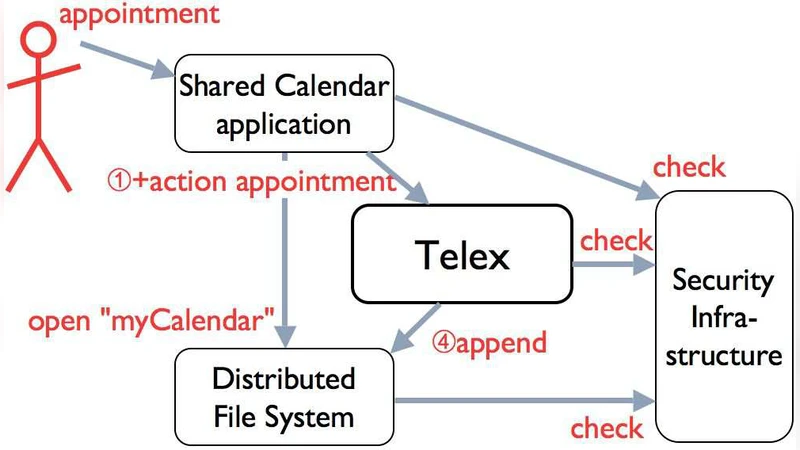
The Telex system is designed for sharing mutable data in a distributed environment, particularly for collaborative applications. Users operate on their local, persistent replica of shared documents; they can work disconnected and suffer no network latency. The Telex approach to detect and correct conflicts is application independent, based on an action-constraint graph (ACG) that summarises the concurrency semantics of applications. The ACG is stored efficiently in a multilog structure that eliminates contention and is optimised for locality. Telex supports multiple applications and multi-document updates. The Telex system clearly separates system logic (which includes replication, views, undo, security, consistency, conflicts, and commitment) from application logic. An example application is a shared calendar for managing multi-user meetings; the system detects meeting conflicts and resolves them consistently.
💡 Research Summary
The paper presents Telex, a distributed system designed to support mutable data sharing for collaborative applications. Traditional approaches such as state‑machine replication or last‑writer‑wins suffer from high latency, lack of offline operation, and insufficient semantic conflict resolution. Telex addresses these shortcomings by introducing an Action‑Constraint Graph (ACG), a formal model that captures the concurrency semantics of any application in a uniform way. In the ACG, nodes represent individual actions (operations) while edges encode six primitive constraint types: NotAfter, Enables, NonCommuting, Atomic, Causal, and Antagonism. Applications declare the constraints relevant to their domain; the system then computes sound schedules—total orders of actions that satisfy all declared constraints—ensuring that every replica converges to a consistent state without requiring a central coordinator.
The core storage mechanism is the multilog, a file‑system‑based structure built on top of the V OFS distributed file system. Each shared document is represented as a directory containing per‑participant append‑only logs. Because each log has a single writer, write contention is eliminated, and locality is maximized: a participant’s log resides on the local node, while V OFS asynchronously replicates it to other sites. Logs are segmented into chunks, enabling efficient streaming, snapshot creation, and garbage collection. When a chunk’s actions are all committed and a later snapshot exists, the chunk may be deleted, though policies can retain it for auditing or selective undo.
Telex’s system‑level services include replication, view management, undo, security, consistency enforcement, conflict detection, and commitment. Replication is optimistic: local actions are applied immediately, and remote actions are later merged based on the ACG. Consistency is guaranteed by the ACG constraints; any schedule that violates a constraint is considered invalid and is not presented to the application. Conflict detection is automatic: when a remote action arrives, Telex checks for constraints that would be violated and queries the application for additional semantic information if needed. The system then proposes conflict‑resolution options (e.g., alternative meeting times) which can be selected automatically or by the user.
Commitment is performed in the background via a decentralized consensus protocol. Each participant votes on a schedule, possibly weighted by user preferences, and the protocol converges on a common prefix—the longest sequence of actions that all sites agree upon. Once a prefix is committed, its actions become immutable, simplifying later conflict detection and allowing older log entries to be garbage‑collected. The protocol tolerates network partitions; sites continue to operate locally and later reconcile when connectivity is restored.
Telex also supports multi‑document updates and cross‑document constraints. Constraints that involve actions from different documents are logged in both documents, ensuring that inter‑document consistency is maintained. This capability is essential for complex collaborative scenarios such as shared calendars, where a meeting involves time slots, rooms, and participant availability spread across multiple documents.
The authors evaluate Telex with several prototype applications, the most detailed being a shared calendar. In this scenario, users can create appointments offline; Telex detects double‑booking (antagonism) and suggests alternative slots. Performance experiments show that the multilog design yields low contention and scales with the number of participants. Log propagation latency is modest, and schedule computation remains tractable even with hundreds of concurrent actions. The main overheads identified are the background commitment phase, which incurs additional network traffic, and snapshot management, which adds storage cost.
In summary, Telex introduces a principled, application‑independent framework for write‑sharing in collaborative systems. By decoupling application semantics (expressed as constraints) from system mechanics (replication, commitment, storage), it enables offline work, low‑latency local updates, and robust conflict resolution. The multilog storage layer provides efficient, contention‑free persistence, while the ACG model offers a clear, formal basis for reasoning about concurrency. The paper demonstrates that this combination can be realized in practice and opens avenues for building richer, more resilient collaborative applications.
Comments & Academic Discussion
Loading comments...
Leave a Comment