Coupling Component Systems towards Systems of Systems
Systems of systems (SoS) are a hot topic in our “fully connected global world”. Our aim is not to provide another definition of what SoS are, but rather to focus on the adequacy of reusing standard system architecting techniques within this approach in order to improve performance, fault detection and safety issues in large-scale coupled systems that definitely qualify as SoS, whatever the definition is. A key issue will be to secure the availability of the services provided by the SoS despite the evolution of the various systems composing the SoS. We will also tackle contracting issues and responsibility transfers, as they should be addressed to ensure the expected behavior of the SoS whilst the various independently contracted systems evolve asynchronously.
💡 Research Summary
**
The paper “Coupling Component Systems towards Systems of Systems” does not attempt to redefine what a System‑of‑Systems (SoS) is; instead, it investigates whether conventional system‑architecting techniques can be reused to address the practical challenges that arise when many independently managed systems are coupled into a large‑scale SoS. The authors argue that the key to successful SoS engineering lies in treating the constituent systems as providers and consumers of services rather than as producers of physical products. By adopting a service‑oriented perspective, emergent capabilities—services that do not exist in any single component—can be systematically identified, specified, and verified.
The central methodological tool presented is the N² dependence coupling matrix (also called the N² matrix). In this representation each system occupies a diagonal cell; the off‑diagonal cell (i, j) records any functional flow, resource requirement, safety constraint, contractual clause, or other dependency from system i (the source) to system j (the target). The matrix can be enriched with multiple layers of information: physical interfaces, procedural protocols, and operational semantics. By visualising the entire dependency network in a single tabular form, architects can quickly spot tight couplings, cyclic dependencies, and potential single points of failure. Moreover, because the matrix is extensible, it can capture not only data flows but also legal agreements and service‑level agreements (SLAs), thereby supporting contract management and responsibility transfer when individual systems evolve asynchronously.
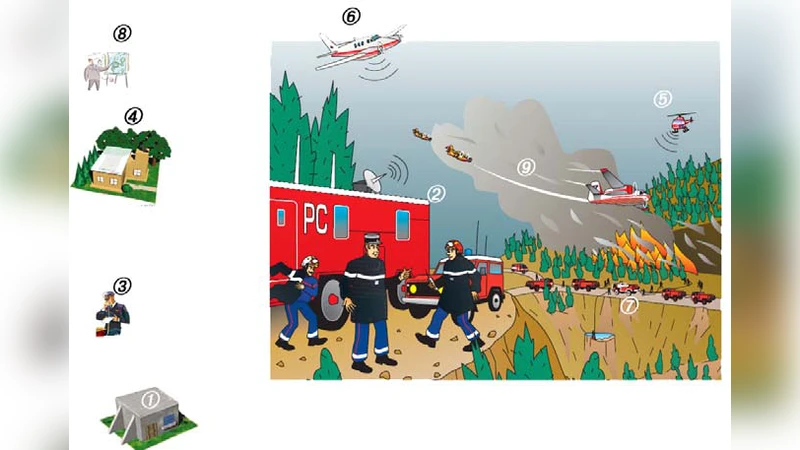
The authors illustrate the approach with a detailed case study of a forest‑fire emergency response SoS. The scenario involves nine distinct systems: an emergency operation command centre, a mobile headquarters, an air officer, a departmental operation centre, a command helicopter, a coordination plane, ground fire‑fighter squads, a weather team, and water bombers. Each system’s functional responsibilities (e.g., risk assessment, resource allocation, situational reporting) are enumerated, and the information exchanges among them are mapped onto the N² matrix. The matrix makes explicit the flow of fire‑status updates, resource requests, weather data, and coordination commands. When multinational fire‑fighting forces are added, the matrix size grows quadratically (n² for n participating nations), highlighting scalability concerns.
To mitigate the explosion of interfaces, the paper advocates a common technical infrastructure for physical interoperability (e.g., shared communication links) and a service‑oriented middleware (a “service repository”) for procedural interoperability. The repository stores neutral service descriptions (endpoint, parameters, QoS) that both providers and consumers can discover and invoke, thereby decoupling systems and enhancing security by masking the identity of service providers. Semantic interoperability is addressed by recommending shared ontologies and situation‑awareness models, ensuring that all participants interpret data consistently.
Contractual and responsibility issues are integrated directly into the matrix: each cell can contain SLA terms, performance guarantees, and liability clauses. When a component system is upgraded or replaced, the matrix can be re‑evaluated to verify that all dependent services remain compliant, and any breach of contract can be traced to the responsible party. This approach supports the “evolutionary development” property of SoS, where components change over time without jeopardising overall system functionality.
The paper also discusses three NATO‑defined levels of interoperability—physical, procedural, and operational—and maps them onto the matrix layers. Physical interoperability is achieved through the shared infrastructure; procedural interoperability through standardized service contracts and protocols; operational interoperability through semantic alignment and shared situational awareness. By treating these layers as orthogonal but interrelated, the authors provide a comprehensive framework for designing, analysing, and managing complex SoS.
In conclusion, the N² dependence coupling matrix, enriched with service‑oriented, contractual, and semantic information, offers a unified, scalable method for engineering large‑scale Systems of Systems. It enables architects to preserve loose coupling, ensure service availability despite asynchronous evolution of components, and manage the legal and safety aspects that are critical in high‑stakes domains such as emergency response. The case study demonstrates the practicality of the approach, while the discussion of interoperability standards and middleware solutions points toward concrete implementation pathways for real‑world SoS projects.
Comments & Academic Discussion
Loading comments...
Leave a Comment