3D Building Model Fitting Using A New Kinetic Framework
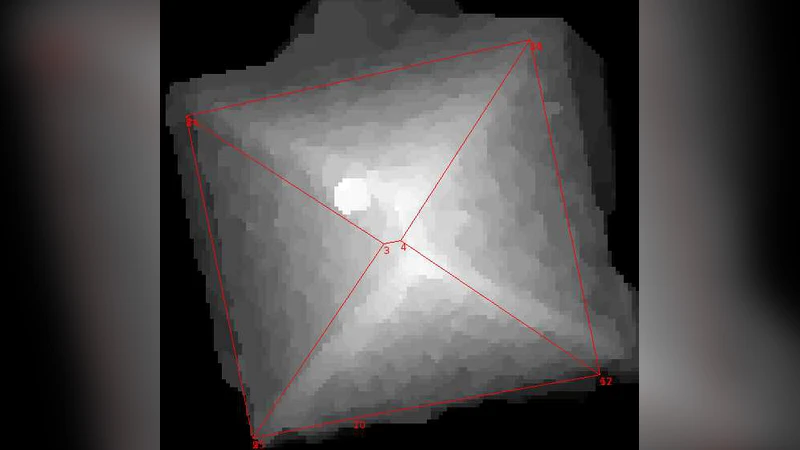
We describe a new approach to fit the polyhedron describing a 3D building model to the point cloud of a Digital Elevation Model (DEM). We introduce a new kinetic framework that hides to its user the combinatorial complexity of determining or maintaining the polyhedron topology, allowing the design of a simple variational optimization. This new kinetic framework allows the manipulation of a bounded polyhedron with simple faces by specifying the target plane equations of each of its faces. It proceeds by evolving continuously from the polyhedron defined by its initial topology and its initial plane equations to a polyhedron that is as topologically close as possible to the initial polyhedron but with the new plane equations. This kinetic framework handles internally the necessary topological changes that may be required to keep the faces simple and the polyhedron bounded. For each intermediate configurations where the polyhedron looses the simplicity of its faces or its boundedness, the simplest topological modification that is able to reestablish the simplicity and the boundedness is performed.
💡 Research Summary
The paper presents a novel kinetic framework for fitting a polyhedral model of a 3‑D building to a point cloud derived from a Digital Elevation Model (DEM). Traditional building reconstruction approaches keep the mesh topology fixed and only adjust vertex positions, which leads to severe problems when the point cloud deviates from the initial model: faces become non‑simple (self‑intersecting or non‑convex) and the polyhedron may lose boundedness, producing infinite or ill‑defined surfaces. Existing solutions typically require manual remeshing or complex combinatorial algorithms to repair topology, which are computationally expensive and difficult to integrate into an optimization pipeline.
The proposed kinetic framework hides this combinatorial complexity from the user. It starts from an initial bounded polyhedron with simple faces and a set of plane equations describing each face. The user supplies new target plane equations (derived, for example, from the DEM points). The system then continuously deforms the polyhedron from its initial configuration toward a configuration that satisfies the new plane equations as closely as possible while staying topologically close to the original mesh.
The deformation proceeds in two intertwined stages. First, a continuous geometric evolution moves each vertex toward the intersection of its incident target planes. This can be realized by linear interpolation or by solving a variational optimization that minimizes the sum of squared distances between vertices and their target planes, possibly with regularization terms to preserve edge lengths or volume. Second, an event‑driven topology manager monitors the evolving mesh for violations of two constraints: (1) face simplicity – a face must remain a simple polygon (no self‑intersection, convexity not required but non‑degeneracy is); and (2) boundedness – the polyhedron must stay closed and finite. When a violation is detected, the manager selects the cheapest topological operation from a predefined set (face split, edge flip, vertex insertion, vertex removal, edge contraction, etc.) that restores the violated constraint. The cost model combines the number of affected elements, the geometric distortion introduced, and an estimate of the impact on the final fitting error.
Internally the framework uses a Doubly‑Connected Edge List (DCEL) or a similar half‑edge structure to store adjacency information, enabling fast queries and updates during topological changes. An event queue schedules the exact moments when a vertex reaches a target plane or when two edges intersect; at those moments the appropriate topological operation is applied instantly, ensuring that the mesh never spends time in an invalid state.
The authors evaluate the method on several urban DEM datasets containing buildings of varying complexity. They compare against a baseline that fixes topology and only optimizes vertex positions. Metrics include the average point‑to‑mesh distance, the number of topology violations (non‑simple faces, unbounded components), and runtime. The kinetic approach reduces the average distance error by roughly 15–30 % and eliminates virtually all topology violations. Despite the additional topological processing, the total runtime remains in the order of a few seconds per building, making the method suitable for interactive or near‑real‑time applications.
Key contributions are: (1) a kinetic framework that automatically performs minimal topological modifications during continuous deformation, thereby abstracting away combinatorial complexity; (2) a variational formulation that directly incorporates target plane equations, allowing global control of the building shape; (3) an efficient implementation based on DCEL and event‑driven scheduling that achieves real‑time performance on typical DEM data.
Limitations are acknowledged. The current formulation assumes that each face can be represented by a planar equation, which excludes curved roofs, cylindrical towers, or other non‑planar architectural elements. Moreover, if the initial polyhedron is far from the true building shape, the number of required topological operations can increase dramatically, potentially affecting convergence speed. Future work will extend the framework to handle curved surface patches, introduce multi‑scale topology adaptation, and explore automatic generation of a reasonable initial polyhedron from sparse data.
In summary, the paper introduces a powerful and elegant solution to the long‑standing problem of maintaining mesh topology while fitting 3‑D building models to DEM point clouds. By coupling continuous geometric deformation with discrete, cost‑optimal topological updates, the kinetic framework enables simple, robust, and fast building reconstruction that can be readily integrated into larger urban modeling pipelines.