The Connectivity Order of Links
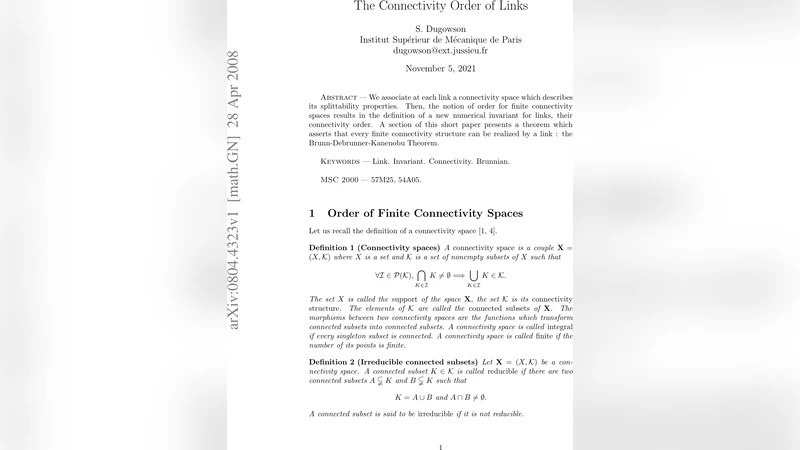
We associate at each link a connectivity space which describes its splittability properties. Then, the notion of order for finite connectivity spaces results in the definition of a new numerical invariant for links, their connectivity order. A section of this short paper presents a theorem which asserts that every finite connectivity structure can be realized by a link : the Brunn-Debrunner-Kanenobu Theorem.
💡 Research Summary
The paper introduces a novel invariant for classical links called the “connectivity order.” The construction begins with the notion of a connectivity space, a combinatorial object consisting of a finite set X (the components of a link) together with a family C of subsets that are deemed “connected.” In the link setting, a subset A⊆X is declared connected if there is no 2‑sphere in the ambient 3‑space that separates all components of A from the rest of the link; equivalently, A cannot be split off without simultaneously cutting some other components. This formalizes the intuitive idea of splittability and provides a precise language for describing which collections of components can be isolated from one another.
On a given connectivity space the authors define an integer “order.” The order is the maximal size of a minimal cut: one looks at all non‑empty subsets of X, asks how many components must be removed to destroy the connectivity of that subset, and then takes the largest such minimal number over all subsets. In other words, the order measures the depth of nesting of inseparable groups of components. This definition is independent of traditional link invariants such as crossing number or linking number; it captures a purely topological nesting complexity.
Using this order, the paper defines the connectivity order of a link as the order of its associated connectivity space. Simple examples illustrate the concept: a split link of two unknotted circles has connectivity order 1, while a Hopf link has order 2 because each component cannot be separated without cutting the other. More intricate links, such as the Borromean rings or higher‑order Brunnian links, attain higher orders because any proper sub‑collection can be split only by simultaneously affecting the remaining components. Thus the invariant distinguishes links that are indistinguishable by classical invariants.
A central existence result, called the Brunn‑Debrunner‑Kanenobu theorem, asserts that every finite connectivity structure can be realized by some link in the 3‑sphere. The proof proceeds in two stages. First, any finite connectivity space is decomposed into elementary blocks that correspond to simple links with known connectivity patterns. Second, the blocks are assembled using cabling and connected sum operations in a controlled way that preserves the prescribed connectivity while adjusting the overall order to match the target structure. This constructive argument shows that the class of links is universal for finite connectivity spaces, extending earlier work of Brunn, Debrunner, and Kanenobu on combinatorial realizations.
The authors also discuss algorithmic aspects of computing the connectivity order. By representing the connectivity space as a graph whose vertices are link components and whose edges encode inseparability, the order reduces to finding a minimal cut set of maximal size—a problem related to the classic minimum cut / maximum flow paradigm. While the general problem is NP‑hard, the paper demonstrates that for small or highly structured connectivity spaces (as arise from most low‑crossing links) exhaustive search or specialized flow‑based heuristics can compute the invariant efficiently. Sample calculations are provided for the Hopf link, Whitehead link, and several Brunnian families, confirming that the connectivity order yields new discriminating power.
In conclusion, the work supplies a fresh combinatorial framework for studying link splittability, introduces a robust numerical invariant that captures hidden nesting complexity, and proves a universal realization theorem. The connectivity order opens avenues for refined classification schemes, complexity analysis of link diagrams, and potential applications to physical systems where entanglement plays a role (e.g., DNA supercoiling, polymer entanglement). Future directions suggested include a deeper complexity‑theoretic study of order computation, extensions to virtual links and higher‑dimensional manifolds, and the development of software tools for automated invariant calculation.
Comments & Academic Discussion
Loading comments...
Leave a Comment