Statistical analysis of an archeological find
In 1980, a burial tomb was unearthed in Jerusalem containing ossuaries (limestone coffins) bearing such inscriptions as Yeshua son of Yehosef, Marya, Yoseh--names which match those of New Testament (NT) figures, but were otherwise in common use. This…
Authors: Andrey Feuerverger
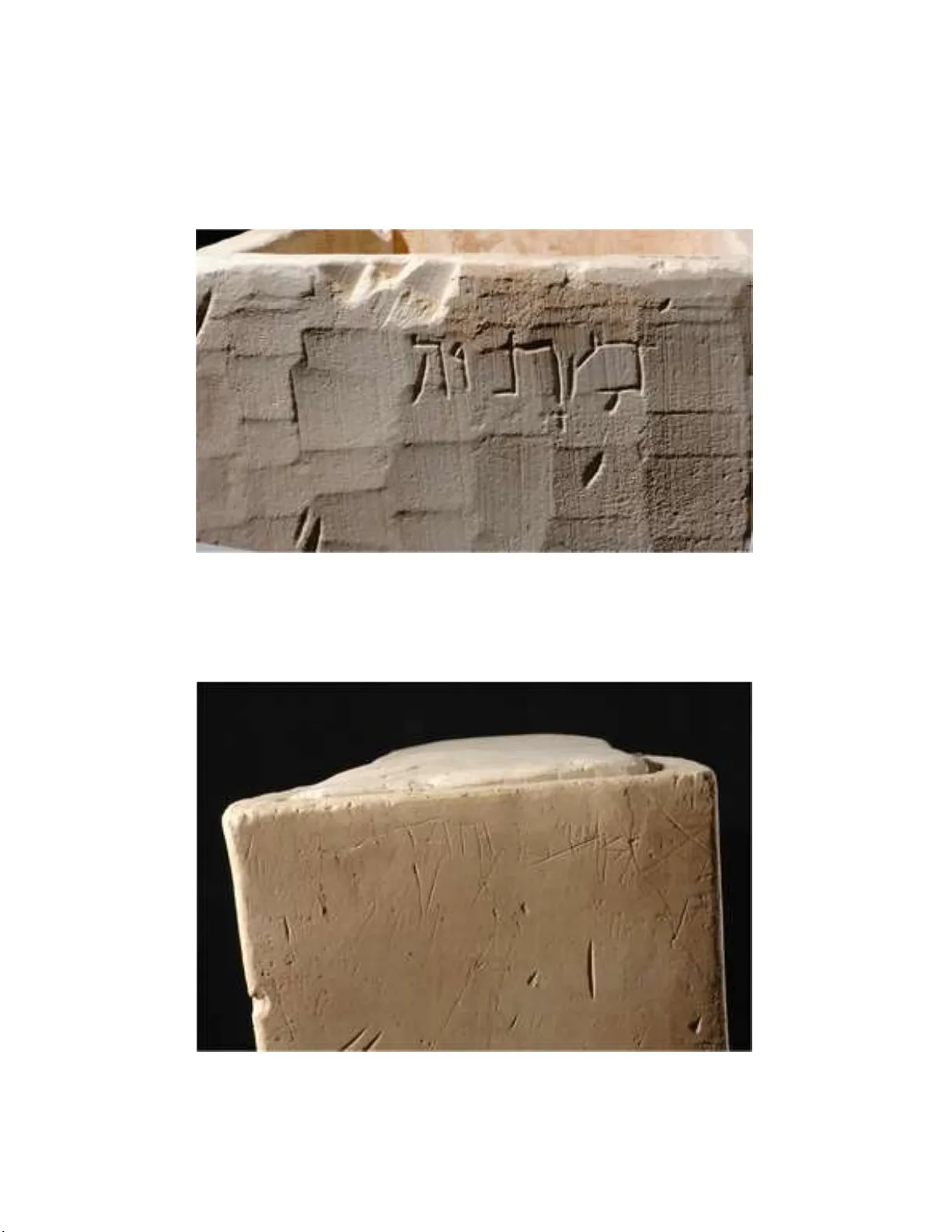
The Annals of Applie d Statistics 2008, V ol. 2, No. 1, 3–54 DOI: 10.1214 /08-A O AS99 c Institute of Mathematical Statistics , 2008 ST A TISTICAL ANAL YSIS OF AN AR CHEOLOGICAL FIND 1 By Andrey Feuer verger University of T or onto In 1980, a bu rial tom b was unearthed in Jerusalem con taining ossuaries (limestone coffins) b earing such inscri ptions as Y eshua s on of Y ehosef, Mary a, Y oseh—names whic h matc h those of New T esta- ment (NT) figures, but w ere otherwise in common use. This pap er discusses certain statistical aspects of authenticating or repudiating links b etw een this find and the NT family . The av ailable data are laid o ut, and w e examine the distribution of names (onomasticon) of the era. An approac h is prop osed for measuring the “surprisingness” of the obse rved outcome relative to a “hypothesis” th at the tombsite b elonged to the N T family . On the basis of a particular—but far from uncontested—set of assumptions, our measure of “surprisingness” is significan tly h igh. 1. In tro du ction a nd summary . In Marc h 1980, the S olel Boneh Con- struction Compan y inte rrupted exca v ation work at an apartmen t site com- plex in the East T alpiy ot neigh b ourh o o d of Jeru salem, and rep orted to Is- rael’s Departmen t of An tiquities and Museums that it had acciden tally un- earthed a previously u n kno wn entrance to a bu rial cav e. This tom b is lo cated appro ximately 2.5 kilometers south of the site of the Second T emple in the Old Cit y of Jerusalem, destro y ed by the Romans in 70 CE. 2 Shortly after its disco v ery , this bur ial site w as examined and surv eye d and salv age exca v ations were carried out. Within this ca ve a n umb er of ossuaries 3 w ere foun d, s ome b earing inscriptions, and these w ere published Received A p ril 2007; revised December 2007. 1 Discussed in 10.121 4/08-A OAS99A , 10.1214/08-A OAS99B , 10.1214/08 -AO A S99C , 10.121 4/08-A OAS99D , 10.1214/ 08-A OAS99E , 10.1214/08 -AO A S 99F , 10.121 4/08-A OAS99G and 10.1214 /08-A OAS99H ; rejoinder at 10.1214/08 -AO A S 99REJ . Key wor ds and phr ases. Jesus of Nazareth, distribution of names, onomastico n, data, statistical inference, conditioning, coincidence, “relev ance,” “rareness” and “surprising- ness,” tail areas, historical assumptions, a priori, hyp otheses and p ost ho c inference. This is an electronic reprint of the original ar ticle published b y the Institute of Mathematical Statistics in The Annals of Applie d Statistics , 2008, V ol. 2, No. 1, 3– 54 . This r eprint differs from the original in pagination and t ypo graphic detail. 2 CE and BCE are abbreviations for “common era” and “before the common era”— secular versions of the abbreviations AD and BC. 3 Ossuaries are rep ositories for b ones; see Section 3 . 1 2 A. FEUER VERGER b y Rahmani ( 1 994 ), pages 22 2–224 , Nos. 701–709 an d b y Kloner ( 199 6 ). Among these ossuaries were fou n d su c h inscriptions as “Mary a,” “Y oseh,” “Y esh ua son of Y ehosef,” and other inscriptions of related in terest. Since the pr actice of ossuary bur ial was prev alen t among J ews at th e time Jesus of Nazareth wa s crucified in Jeru salem at th e b ehest of the Romans, arc heological questions arise in resp ect of the iden tit y of the individu als buried in this tom b . S ince names suc h as Y ehosef, Mary a, Y eshua, etc. , w ere not uncommon during the era in w hic h suc h burials to ok plac e, the task of assessing w hether or n ot th ese ossuaries might b e those of the New T estamen t (NT) family is not straightfo rw ard. Sev eral disciplines b ear on assessing the authen ticit y of suc h fin d ings, including c hemical sp ectroscop y for analyzing and dating patinas, epigraphic and p aleographic examination b y sp ecialists in ancien t semitic script, and DNA analysis of an y remains, not to men tion historical sc holarship of early Christianit y . An y tamp ering with the tom bsite or other p ossibilities for fraud m u st also b e wei ghed and take n in to accoun t. One p urp ose of this article is to cont ribute to ward suc h efforts b y dev elop- ing statistical metho d s for assessing evidence for and against a “h yp othesis” that this tom b b elonged to the family of the historical Jesus. In doing so we consider su c h data as are a v aila ble on the distribution of names during the era in question, and we compute (on the basis of n umerous assump tions de- tailed explicitly) p r obabilities and estimates related to such questions as the exp ected pr op ortion of times that a similarly “surprising” sample of names could b e exp ected to arise by pur e chance when sampling fr om a p opulation ha vin g simila r c haracteristics to the one whic h existed at that time. Our computations w ere carried out under a sp ecific set of assumptions which are b y n o means univ ersally accepted. Of course, ultimately , the authen ticit y of an y suc h fin d cannot b e determined thr ough purely statisti cal reasoning alone, and it can certa inly turn out th at this tom b site is n ot that of the NT family; in that eve n tualit y the v alidit y of our metho ds should remain unaffected. A fu rther purp ose of this pap er is to la y out th is highly int er- esting d ata set—toget her with the no vel inferent ial c hallenges it p oses—for the b enefit of the statistical comm u nit y . In Secti on 2 below we describ e the unearthed tom b and the ossuaries disco vered inside. Bac kground on the practice of ossuary inte rmen t is giv en in S ection 3 . Th e genealog y of the NT family—cen tral to our analysis—is discussed b riefly in Section 4 . Section 5 discusses a v ailable data sour ces and pro vides some statistic al summaries of the J ewish onomasticon, that is, of the distribution of names of the men and wo men who liv ed during that era, and Sectio n 6 follo ws up in further detail f or the particular n ames foun d in the East T alpiyo t tom b. S ome statist ical “judgemen t cal ls” are discussed in Section 7 . Because the T alpiy ot tom b m u st b e regarded as ha ving b een “b est” out of many p ossible observ ations, in Section 8 we review w hat is ST A TISTICAL AN AL YSIS OF AN ARCHEOLOGICAL FIND 3 kno w n ab out the size of the r elev ant p opulation within w h ic h these burials to ok place. S ection 9 addresses some inferen tial issu es which arise in d ata of this type. F or statistical inference to b e v alid, one may not tai lor an alternativ e h yp othesis to data that has already b een seen. In Section 10 w e address suc h matters and on a b est efforts basis we carefully formulate a priori h yp otheses for this p roblem. A paradigm for the in ference problem at hand is th en dev elop ed in Sections 11 and 12 . Ou r m etho d is based on d efining an a p r iori measure of the “surprisingness” of an observ ation u sing the “relev ance and rareness” of certain name renditions, and an assu m ed complex of NT familial relations among them. “Relev ance” will refer essen tially to mem b ership in an a pr iori list of c andidates f or inclusion in a NT tom bsite, and “rareness” w ill b e defined relativ e to an a priori list of n ested p ossible name rend itions for eac h suc h candidate; features of familia l inte rrelations figure prominently in the form ulation. Our analysis, implemen ted for a v ariet y of parameter c hoices, is rep orted in Sectio n 13 which first provides a d etailed summary of the assumptions un derlying our analysis. I n Section 14 we pr o vide a d etailed discussion of our r esults, and some concluding r emarks. The R computing co d e on whic h our r esults are based ma y b e do wnloaded fr om the “statlib” w ebsite [F euerv erger ( 2008 )]. W e remark that, in assessing the evidence in an y w ay , it is essenti al to adopt a strictly historic al viewp oint, and thus to set aside considerations that a NT tom bs ite cannot exist. In fact, Jewish r itual observ ances prev alen t at the time are en tirely consisten t w ith the p ossible existence of such a tom b. W e caution the r eader to note, ho we v er, that the analysis w e pr esen t is based on one sp ecific “tradition” of history . T hese assumptions represent the author’s b est understanding as at the time the analysis w as carried out but they are far f r om un iv ersally agreed up on and they en ter in to the analysis in a cumulativ e w a y . It is antici pated that such p oin ts will b e r evisited in the discussion to this pap er. 2. Description of the find. The vesti bule of the tomb w as damaged b y the blasting op erations that led to its disco very . The tom b had otherwise b een co vered by earth, apparen tly u ndisturb ed since ant iquit y . On the exte- rior facade ab o ve the tom b ’s en trancew a y there was carv ed in relief a circle b eneath an upw ard p ointing gable—a rare feature. Within the 2 . 3 × 2 . 3 m tom b w ere six kokhim 4 —t wo on eac h of the other th r ee w alls—eac h just o ver 1.6 m in length, and u nder 0.5 m in w idth, deep enough to store tw o or three ossuaries in eac h. Within these kokhim a total of ten ossuaries were 4 Kokhim (singular kokh ) are small h orizon t al tunn els chiseled into the wall s of a tomb within which ossuaries could b e p laced. The Latin terms are lo culus and lo culi . 4 A. FEUER VERGER found, 5 some of them b rok en. Two ossu ary lids, discarded in antiquit y , were found b eneath the soil fi ll in the ro om. Early Roman (Hero d ian) sherds (i.e., brok en pieces of p ottery) were also found on the fl o or which date the site to the late Second T emple p erio d, that is, from the end of the first century BCE or the b eginning of the fir st cen tury C E to appro ximately 70 CE. Such b ones as were within the ossuaries w ere in an adv anced state of disin tegra- tion. Two arcosolia (shallo w shelv es intended for la ying out b o d ies) had b een carv ed in the tom b w alls and con tained broken and p o wd ered b one remains. Disturb ed b ones, presum ably swe pt off the arcosolia , were also found on the flo or. The golal (blo cking stone) to th e tomb’s ent rance was not found at the site indicating that the tom b had b een accessed by robb ers in ant iquit y . The ossuaries found within this burial cav e are typica l of Jewish ossuaries of the fi rst cen tury CE. Six of the ten ossuaries b ore inscriptions, five in Jewish script (i.e., Hebrew or Aramaic) and one in Greek. This prop ortion of inscrib ed ossuaries (i.e., 6 out of 10) and this pr op ortion of Hebrew to Greek (5 out of 6) are b oth higher than typica l of other tom b s previously found in this area. Th e six inscrib ed ossuaries and the four uninscrib ed ones are describ ed b elo w in th e ord er they app ear in Kloner ( 1996 ); their Israel Antiquiti es Authorit y (IAA) ident ification num b ers and d imen s ions are indicated as we ll. Ossuar y #1. IAA 80–500 . 68 . 5 × 26 × 32 . 5 cm. Inscrib ed in Greek: M αριαµη ν o υ [ η ] M αρα This elegan tly rendered ossu ary (see Figure 1 ) has multiple p ossible read- ings. Mara, an (absolute) contrac ted form of (the emphatic) Martha, is a rare name, these b eing feminine v ersions deriv ed from the Aramaic dominan t masculine form mar meaning “lord,” “master,” or “honorable p erson.” The question of whether Mara w as int ended h ere as a title, su c h as “honorable lady ,” or whether it w as in tended only as an alternate (i.e., second) name is disputed. If this inscription were understo o d as in Hebrew, then Mariame- nou w ould b e a diminutiv e (i.e., end earing) form of Mariamne or Mariamene and the inscription would read “Mariamene [diminutiv e] the lord/master” pro vided w e also assume also that M αρα (or ) is in tended as “lord” or “master” and that “ η ” is m ean t as the feminine article “the.” An alternate reading requires that one interpret the stroke b et ween “Mariamenou” and “Mara” as representing not an η , but only a scratc h m ark; in that case one in terp retation is that this ossuary cont ains the remains of tw o p ersons— one called Mariame, and the other called Mara. Ho wev er, the manner in 5 No information is av ailable regarding the placement of the vari ous ossuaries among the kokhim . ST A TISTICAL AN AL YSIS OF AN ARCHEOLOGICAL FIND 5 whic h these t wo w ords run closely together, and on th e same line, seems more su ggestiv e of th eir referring to a single p erson. Rahmani ( 1994 ), pages 14 and 222, reads the inscription as follo ws: “The strok e b et w een the υ of the fir st and the µ of the second name p robably represent s an η , stand- ing here for the usual η και . . . u sed in the case of double n ames . . . ” and he p osits that the second name is a con tracted form [not a cont raction] of “Martha” leading to the reading “Mariamene [d imin utiv e] who is also called Mara.” According to Greek usage of the time, the fir st w ord of the inscrip- tion is a genitiv e/p ossessiv e form for Mariamene, r endered in a p articular dimin utiv e form understo o d to b e an end earmen t, so that the inscription then translates as “[the ossuary] of Mariamene [dimin u tiv e] also known as Mara.” Rahmani’s reading, wh ic h is the one we adopt, was accepted by Kloner ( 1996 ) and has b een corrob orated by others in the field. Ossuar y #2. IAA 80–50 1. 55 × 23 × 27 cm. I n scrib ed in Hebrew let- tering: The lettering is executed clearly—see Figure 2 . It translates as “Y eh ud a son of Y eshua, ” Y eh ud a b eing Hebrew for J udah. Note that “bar” (i.e., “son of ”) is Aramaic, not Hebrew. Fig. 1. 6 A. FEUER VERGER Ossuar y #3. IAA 80–502 . 55 × 28 × 34 cm. In scrib ed in Hebrew: This translates as Mat y a, a sh ortened form of Mattit yah u, that is, Matthew; see Figure 3 . Ossuar y #4. IAA 80–50 3. 65 × 26 × 30 cm. I n scrib ed in Hebrew let- tering: This translates as Y esh ua son of Y ehose f, that is, Jesus son of Joseph. Unlik e the other inscrib ed ossuaries f oun d in this tom b, the incisions here are “messy ,” “inform al,” and sup erficially carved, and eac h of the four let- ters of is faint; see Figure 4 . How ev er this reading of the inscription w as authentic ated (b y Rahmani and also Kloner) by comparison with the inscription on Ossu ary #2 and is corrob orated by others. Also relev an t is that n o other Hebr ew name ends in the letters vov and ayin . A large, crudely carv ed righ tw ard-leaning cross, whose pu r p ose or sym b olic meaning (if any) is unkno wn, app ears at the head of th e in scription. Cross-marks on ossuaries w ere sometimes carv ed by masons, most lik ely to indicate alignmen t of lid- tops; in this instance the marking do es n ot hav e the app earance of b eing an obvious scratc h mark of this nature. It h as b een suggested that the “cross” on this ossuary ma y hav e b een purp oseful. Fig. 2. ST A TISTICAL AN AL YSIS OF AN ARCHEOLOGICAL FIND 7 Fig. 3. Fig. 4. 8 A. FEUER VERGER Fig. 5. Ossuar y #5. IAA 80–504 . 54 . 5 × 26 × 34 . 5 cm. Inscrib ed in Hebrew: This translat es as Y oseh or Y osa, a relativ ely rare v ariant of Y ose f or Y ehosef (i.e., Joseph). In Hellenized form, this inscription would b e read as Y ose, Y oses, or Joses. See Figure 5 . Ossuar y #6. IAA 80–505 . 52 × 27 × 33 cm. In scrib ed in Hebrew: This translates as Marya , that is, Maria, a Hellenized form of Miriam or Mariam. See Figure 6 . Ossuar y #7–10. These four ossuaries, the first three of whic h corre- sp ond to IAA n umb ers 80–506 to 80–508, b ear no inscriptions and ha v e dimensions 67 × 31 . 5 × 38 . 5 cm, 51 × 27 × 31 . 5 cm, 61 × 26 . 5 × 31 . 5 cm, and (the rep orted dimensions) 60 × 26 × 30 cm, resp ectiv ely . In ge neral app earance, the six inscriptions corresp ond to four distinct st yles. Th at of Y esh u a is unprofessional. Th e ossuaries of Mary a, Y oseh, and ST A TISTICAL AN AL YSIS OF AN ARCHEOLOGICAL FIND 9 Fig. 6. Mat y a are executed in similar plain b ut neat hands. That of Mariamenou is executed in an “elegan t” Greek hand. And finally , the ossuary of Y ehuda app ears rendered “professionally .” Rahmani surmised that the similarities b et w een Ossu aries #5 and #6 and their inscriptions, b oth coming from the same tom b, ma y indicate that Y oseh and Mary a were the paren ts of Y esh ua and the grandparen ts of Y eh u da. 6 Although the dimensions of the ossuaries differ, eac h is consisten t w ith the measurement s of an adult. Among the inscrib ed ossuaries, n um b ers 1 and 4 (Mariamenou and Y esh ua) are the longest, p ossibly corresp onding to taller than a v erage p ersons, and num b ers 1 and 2 b ore orn amen tal carvings (rosettes, etc.) as did also the first th r ee of the four un in scrib ed ossuaries listed; all of the other ossuaries w ere ornamen t-free, except for suc h inscrip- tions as ha ve b een noted. Finally , we note that th e ten th ossuary—that is, the uninscrib ed, un or- namen ted one with dimensions 60 × 26 × 30 cm—is “missing.” The original arc heological drawings made at the time of the exca v ation indicate that ten ossuaries were found at the site, but IAA records sho w that only nin e we re retained in its p ermanent collections. No w, it is not en tirely unusual that an ossuary—particularly an un in teresting one—would get “lost” in the com- ings and goings of suc h archeo logica l wo rk. Ho wev er, suggestions ha ve b een 6 If this in terpretation is correct, t h e tombsite cannot b e that of the NT family . How ever Rahmani do es not follo w up with any explanation for the messy nature of t he inscription on O ssuary #4 . 10 A. FEUER VERGER raised [e.g., T ab or ( 2006 ), among others] that the d imensions of the missing ossuary seemingly matc h those of the disputed ossuary of James. 7 W ere this so, statistical dimension matc hing 8 could easily b e used to pr ove that the James ossuary must surely b e the one m issing from our tom b , with attending consequences that w ould b e startling, particularly if the ful l inscription on the James ossuary were authen ticated. Our inv estigat ions along these lines, ho wev er, did n ot p ro ve fru itfu l. In Secti ons 5 and 6 we sh all discuss the distribution of Jewish names in late an tiquity and pro vide some fur ther details concerning the n ames found on the Ossuaries # 1 through #6 . The next t w o secti ons provide some bac kground on the pr actice of ossuary burial, and on th e genealogy of the NT family . 3. Ossuaries and re-in termen t. An ossuary is an app ro ximately rectan- gular c hest, t yp ically quarried in the soft limesto nes common near Jerusalem, con taining the b ones of one (and sometimes more) deceased p ersons. Th e custom of rep ositing b ones of the dead in suc h b one b oxe s is not mandated b y halacha , that is, Jewish ritual la w; it was practiced by Jews in and around Jerusalem only from the end of the fir s t century BCE, or from the start of the fi r st cen tury CE, until the year 70 CE. Instead of burial in coffins as had b een an earlier custom, b o dies w ere apparen tly first placed in a pit or a cav e and left to decomp ose for ab out a ye ar un til only b ones remained. These b ones w ere then gathered by the deceased’s family , d ep osited into an ossuary , and interred in a tom b. O ssuaries (and tom bs in p articular) w ere a more costly form of bu rial that n ot all p ersons could afford. F urther informa- tion and sp eculation regarding the religious and p olitico-histo rical asp ects of this p r actice, ma y b e found in Hac hlili ( 1994 ), K loner ( 1996 ) and Rahmani ( 1994 ). The approxi mate dimensions of ossuaries are usually recorded in cen- timeters in the ord er length × width × h eigh t. Typica l ossu ary b o xes are somewhat tapered so th at the length × wid th dimensions at the top will b e sligh tly larger than at th e b ottom. Being qu arried and c h iseled artifacts, the shap e, and hence the dimensions, of ossuary b oxes are not en tirely precise. The length of an ossuary had to b e s u fficien t to hous e the femur (thigh b one) 7 An ossuary inscrib ed “James son of Joseph brother of Jesus” is in the p ossessi on of Oded Golan, a priv ate Israeli an tiquities collecto r, u nder prosecution for alleged forgery at the time this article wa s written; see, for example, Shanks and Witherington ( 2003 ). Israeli prosecutors apparen tly accept the auth enticit y of t h e fi rst component of this inscription but allege that th e second comp onent had b een forged, although (as of the time of writing) no evidence to that effect has been p rodu ced. The statistical asp ects of the “James son of Joseph brother of Jesus” inscription w ere studied by F uchs ( 2004 ). 8 Rahmani ( 1994 ) giv es the dimensions of a sample of 897 ossuaries from whic h th e multi v ariate d istribution of dimensions can, for this purp ose, b e quite reliably inferred. ST A TISTICAL AN AL YSIS OF AN ARCHEOLOGICAL FIND 11 whic h is the human b o dy’s longest b one, and the t wo other d imensions h ad to b e sufficien t to house the skull, p elvis, and other b ones. Ossuaries w ere frequently carve d with ornamen tal motifs suc h as latti ces, friezes, triglyphs, or rosettes. Such markings would t ypically ha v e help ed iden tify the p ersons lying within, esp ecially for ossuaries that were unin- scrib ed (as migh t o ccur, e.g., in families lac king literacy ). Rahmani ( 1994 ) notes that 233 of the 897 ossuaries in the State of Israel collec tions as of 1989 b ear in s crip tions 9 mean t to iden tify the in dividuals within, with these inscriptions b eing in one or more of the language s in common use at the time—primarily Aramaic, Hebr ew and Greek. Ab out t wo thirds of these inscriptions are in Hebrew/Aramaic, while ab out one third are in Greek, or a com bination of Greek and Hebrew. The us e of in- scriptions evidence some degree of literacy on the p art of the family to w hom the tom b complex b elonged. In virtually all cases, s u c h inscriptions consist only of the ind ividual’s fi rst name, 10 or of their first name together with the name of their father. Inscriptions for w omen o ccasionally included the name of the husband in lieu of th e father. Only a single case among the ossuar- ies catalogued b y Rahmani includes the name of a b rother, and only one men tions the n ame of a son; su c h rare mentio ns pr esumably o ccurred only when the other menti oned p ersons we re individuals of particular distinction. Con tractio ns of names app ear also to ha v e b een used, and we re lik ely in- tended as end earmen ts. Note that the use of inscrip tions wa s int ended solely to assist members of the immediate family to ident ify the remains within; they served no pub lic or other fun ction. Ossuary b u rial was practiced primarily w ithin the environs of Jerusalem in part, no doubt, b ecause of the a v ailabilit y of suitable stone there. In fact [ Ilan ( 2002 ), page 52], of the 712 names in Ilan d eriv ed from ossuaries sources, only 66 were foun d outside of the Jeru salem region, with 24 of th ese ha vin g come from a single burial ca v e in Jeric h o. Rahmani ( 1994 ), page 21, notes that ossu aries quarried at Jerusalem w ere also used by Jews living as far a w ay as 25 km f r om Jerusalem (including J ericho). 4. A brief NT genealogy . The names in the genealo gy of the NT family b ear on the statistical analysis; ho w ev er, our discussion here will b e b rief. W e caution the reader that our analysis relies on a sp ecific “tradition” for 9 Because plain ossuaries are of lesser interest and often b ecome “discarded,” these figures significantly ov erstate the inscription rate. 10 According to halachah the name marke d on a gra ve m ust correspond to the actual name by which that p erson w as known during t h eir lifetime. In particular, if an individual had b een k now n by a nickname, that form of their name m ust b e us ed on their coffin. Note that although halachah p ostdates the era of Jesus we are assuming here that this basic tenet was already essen tially b eing observed at that time. 12 A. FEUER VERGER this geneolog y but that suc h historical details cannot b e regarded as b eing certain. Jesus wa s b orn a few yea rs b efore the turn of the millennium and was crucified in (most like ly) April of 30 C E. The earliest kno wn h istorical record of the names of Jesu s ’ siblings is provided by Mark 6:3 (written around 70 CE) w ho lists the names of Jesus’ brothers in the order James, Joses, Judah, and Simon. Since it w as customary to name the eldest first, it is reasonable to assume that J ames wa s Jesus’ eldest brother, and Joses w as next eldest. Mat thew 13:54 –56, u sually b eliev ed to b e a historically late r source, records the names in the order James, Joseph, Simon, and Ju dah— using J oseph in place of Joses for the second brother, and rev ersing the ord er of the last t w o names. It seems lik ely that Judah was actually the y oungest, for up on Jesus’ d eath James to ok o ve r the ministry , and up on James’ death Simon (and not Judah) did—Joses th us ha vin g lik ely n o longer b een aliv e at the time. These sour ces also refer to sisters of Jesus in the plural bu t do not name them. The earliest extan t v ersions of Mark and Matthew w ere originally written in Greek, with Mark b eing considered here to b e the earlier and therefore more authoritativ e source. Hence the earliest kno wn written record refers to the second br other as Joses, and not as Joseph. W e s hall tak e Joses as ha vin g b een th e actual name of that br other. It is commonly b eliev ed that Jesus h ad tw o sisters and that they w ere called Mariam and Salome. A single (and later) source whose reliabilit y seems less certain suggests there may hav e b een a third s ister named Joanna. Joseph w as the son of Jacob (i.e., Y aak ov, or James), and 2nd cen tury sources name the paren ts of Mary as Joac him and Anna of Sepp horis 11 — the largest cit y in the vicinit y of Nazareth at the time. Concerning further ancestry , at the start of the NT there is a lengthy series of “b egats” (i.e., geneolog ical lists) wh ose purp ose is to trace the lineages of Mary and Joseph bac k to King Da vid; these can arguably b e used to study their genealog ies. In particular, the name Mat ya app ears sev eral times in the lineage of Jesus (as recorded in Luk e) and some sc h olars attribute this name to the lineage of Mary . The traci ng of ancestries bac k to the h ouse of Davi d relates to the theme of the NT since it ma y ha v e b een commonly held that the lineage of the Messiah w ould trace back along a “Da vidic line.” Concerning the ultimate fate of the siblings of Jesus, only a small amount is kno wn . Paul 1, Cor. 9:1 ff refers to the brothers as tra v eling with their wiv es wh ic h suggests that they we re married an d lik ely h ad c hildren. Th e names of these women and an y children are n ot known, although a reference is known to grandsons of Y eh ud a named Zok er and James. 11 Sepphoris wa s sa v agely destroy ed by the Romans in 4 BCE and later rebuilt by Hero d Antipas. ST A TISTICAL AN AL YSIS OF AN ARCHEOLOGICAL FIND 13 Joseph us Fla vius ( 1943 ) records the execution of James in 62 CE in the vicinit y of the T emple, stating that this James w as “the brother of the man kno w n as Jesus wh o is called the Messiah.” Consequent ly , James ma y b e regarded as an a priori candidate whom one migh t not b e su rprised to find in a NT family tom b, if one suc h existed (although early historical records app ear to indicate that James was buried at the p lace of execution). Th e t wo y oungest brothers S imon and Judah are b oth sur mised to ha ve liv ed b ey ond th e yea r 70 CE, into the reign of T ra jan (ten th emp eror of Rome who ru led b et ween 98–117 CE) and are therefore not a priori candidates for suc h a tom b . T he fate of J oses is un kn o wn ; after he is men tioned by n ame in the gosp els he is n ev er heard of again. Ho we v er, b ecause it was Simon who succeeded as leader wh en James died, it is generally assumed that Joses wa s no longer aliv e at the time. Joses is therefore an a priori candidate for a NT tom b. As f or Judah, the manner of his death is n ot kn o wn . Concerning any p ossible “wife” of Jesus, nothing is kno wn except that had one existed she w ould lik ely hav e b een in terred in the family tom b if there we re one. 12 Jesus to o is, of cours e, a candidate for a NT tombsite, and w e also kno w—from the NT passages concerning Joseph of Arimathea—that p ersons who p re-deceased Jesu s are n ot candidates for suc h a tombsite since the family eviden tly did not p ossess one p rior to Jesus’ d eath. 5. Statistics of the Jewish onomasticon. A t least th r ee resources are a v ailable for studying the distribution of names durin g the era relev an t to this stu dy . The fi rst is the catalog ue of Jewish ossuaries in the col lections of the State of Israel compiled b y Rahmani ( 1994 ) who details all ornamen ted and inscrib ed ossuaries held by the Israel Anti quities Authorities (IAA) and b y the Isr ael Museum as of 1989—a total of 897 sp ecimens in all. O f these, 233 b ear inscriptions ident ifying the names of a total of 241 male p ersons and a substant ially lesser (but undetermined) num b er of female p ersons. Of the 233 inscrib ed ossuaries, 143 are in Jewish script (i.e., Hebrew or Aramaic), 73 in Greek script, and the remainder in a mix of b oth scripts or in other languages (suc h as Latin). A total of 147 unique names (male and female) o ccur among them. The compilation in Rahmani is not arranged by either tom b groups or b y gender, and only limited summary information is pro- vided on the distribution of names. Although it is, in principle, p ossible to do so b y working with an ind ex of names pro vided , it is not straigh tforw ard to abstract statistic al information from this source. The second resource, and b y far the most compr ehensiv e one curren tly a v ailable, is the lexico n of Jewish names of late antiquit y compiled by T al 12 The only “viable” c andidate for a “wife,” assuming one existed, app ears to b e Mary Magdalene although we shall make n o such assumption. Mary Magdal ene d o es, how ever, turn out to b e an a p riori candidate for inclusion in a NT tom bsite based on other ground s. 14 A. FEUER VERGER Ilan ( 200 2 ). It co v ers the p eriod b et wee n 330 BCE (marking the Helle nistic conquest of Pale stine) and 200 CE (whic h marks the closing of the Mish- naic p erio d and of the early Roman Empire). I lan’s compilatio n includes the names of 2509 m ales and 317 females tak en from all a v ailable sou r ces, including not only ossuaries from b oth within as we ll as outside the S tate of Isr ael col lectio ns, but also from literary sour ces, epigraphic and papy- rologica l do cuments, and man y other sources. Detailed source information and some statisti cal compilatio ns are also pro vided. Although Ilan includes all recorded names used by Jews of Pal estine du r ing the stat ed p eriod , it also includ es a furth er 86 names of women and 685 n ames of men regarded as fictitious, that is, n ot corresp ond ing to p ersons who h ad actually liv ed. Fictiti ous names will b e excluded from our analysis. A third resource is Hac hlili ( 2005 ); in particular, T ables V-2, (a) and (b) of Hac hlili (page 200) p r o vide frequencies for the most common p ersonal names among Jews, b y gender and by sour ce, in the late Second T emple p erio d . These tabulations are b ased only on the most common n ames—for a total of 1091 males and 192 f emales—tak en from ossu aries, Masada ostraca, and other sour ces. The sample sizes of wh ic h these common names constitute subsets are not pr o vided. These tables essent ially coincide with subsets of names in Ilan ( 2002 ) bu t dating to the late Second T emp le p erio d . Ilan’s more extensiv e compilation allo ws less v ariable estimatio n of the incidence of n ames, although estimates meant to p ertain only to the p opula- tion of ossu aries, but based on all of Ilan, may b e somewhat biased n ot only b ecause nonossuary sources are thereb y included, b ut also b ecause Ilan’s compilatio n includes p erio d s some 300 y ears p r ior to w hen ossuary burials b ecame p rev alen t as w ell as 130 y ears after that practice h ad ceased. Es- timates based on the samples of Rahmani or Hac h lili will b e m u ch more v ariable, but presumably less biased, based as they are, in the first instance, on names app earing on actual ossuaries only , and in the second, on names from the late Second T emple p erio d only . I t is p ossible to extract from Ilan’s lexicon n ames obtained only from ossuaries, and these constitute a sup erset of the sample in Rahmani. Of course, one could argue that no p opulation assem bled fr om such sources can b e regarded as v alid for the inference at hand, ho w ever, we regard that viewpoint as n ihilistic and shall not adopt it. Although the inf ormation in Ilan ( 2002 ) is not arranged sp ecifically for our pur p oses, the compilations there include names ta k en from ossuaries as wel l as from many other sources, and further, many more names tak en from ossuaries app ear in I lan than in Rahmani since Rahmani cat alogues only ossuaries in the State of Israel collections while Ilan includes names on ossuaries from all av ailable sources. As already men tioned, I lan con tains the names of 2509 male p ersons and 317 female p ersons. Th ese comprise 721 unique male names and 110 u nique female names. F urthermore, Ilan states that, of these, the names of 519 male and 193 female p ersons (712 p ersons ST A TISTICAL AN AL YSIS OF AN ARCHEOLOGICAL FIND 15 in all) had b een derived from ossuary inscriptions (num b ers substanti ally higher than Rahmani). F rom this it app e ars that ab out 27% of inscrib ed ossuaries b ear f emale names, w hile 73% b ear the names only of males; ho w - ev er the relati v e fr equ en cy of ossuaries of females is und errepresen ted in these num b ers due to the custom of sometimes n aming fathers on b oth male as well as female ossuaries, and of o ccasionally naming h usbands on female ossuaries. Note also that 61% of the female names in I lan are d eriv ed fr om ossuary sources wh ile only 21% of the m ale names are so deriv ed, num b ers that reflect the patriarc h al nature of so ciet y at the time. Our pr esen tation of these distributions of names is laid out in T ables 1 through 5 . T able 1 giv es the total n um b er of unique male and female p er- sons in eac h of Ilan and Rahmani, as well as the corresp onding num b er of unique male and f emale names . The fourth column giv es Ilan’s coun ts wh en restricted to names obtained only from ossuary in s criptions. In this table, as in some of the others b elo w, not all tabulations or computations were com- pleted, eit her for reasons of feasibilit y or for constrain ts of time; th is w ill b e indicated throughout by dashed lines at the affected table ent ry p ositions. It will b e imp ortan t to b ear in mind that dashes in the tables do not r epr esent zer os . T able 2 giv es the ten most common f emale names acco rding to Ilan, to- gether with their frequencies in Ilan, Rahmani, and among Ilan’s ossuary sources only . Th ere are (v ery) sligh t v ariations b et wee n the num b ers in our table and a similar one in Ilan, ours ha ving b een corrected for a small n um- b er of add itional entries Ilan had later added to her lexicon. Fictitious name coun ts are shown separately , with “F ” lab els atta c hed; for exa mple, Ilan lists 63 Salomes, b ut t w o were fi ctitious. Note that names obtained f rom os- suaries are nev er fictitious. Here again dashed lines represen t undetermined en tries (not zeros). T able 3 give s the 21 most common male names app earing in Ilan, together with their frequencies in Ilan, Rahmani, and among Ilan’s ossuary sources T able 1 Onomastic gender distribution Gender Ilan Rahmani Ilan ossuaries Male p ersons 2509 241 519 F emale p ersons 317 – 193 T otal p ersons 2826 – 712 Male names 721 – – F emale names 110 – – T otal names 831 147 – 16 A. FEUER VERGER T able 2 Jewish female names of late antiquity Generic name Ilan Rahmani Ilan ossuaries Mariam/M ary 74 + 6F 18 44 Salome 61 + 2F – 41 Shelamzion 25 + 0F – 19 Martha 21 + 0F – 17 Joanna 12 + 0F – 7 Shiphra 12 + 0F – 9 Berenice 9 + 1F – 2 Sarah 8 + 1F – 5 Imma 8 + 0F – 6 Mara 7 + 0F 2 5 No. females 317 + 86F – 193 No. female names 110 – – only , with sligh t up dates having aga in b een made to a similar table of Ilan. There are also minor differences b et ween th e Rahmani column of our ta- ble, as determined by us, and a table based on Rahmani giv en b y F uc hs ( 2004 ). The fictitious name counts in the “Ilan” column again occur only on nonossuary sources; in one instance (an Eleaza r) the fictional status is uncertain. A num b er of difficulties o ccur in p ro ducing such tables. In Rahmani ( 1994 ), the gender of seve ral of the names is ambiguous. (Presu mably one could try to resolve these by cross-referencing to Ilan w here most names are catego rized b y gender.) F urthermore, some ins criptions are u ncertain d ue to problems of legibilit y . The r esulting tables th erefore dep end somewhat on what conv en tions one adopts to ward the v arious problems of this nature. Ilan ( 2002 ) and Hac hlili ( 2005 ) giv e considerable furth er information con- cerning the customs of naming as w ell as ab out the distribu tion of names in that era. By wa y of general comment , one can sa y th at the p o ol of n ames in u s e wa s not unlimited. F or that reason differen t renditions of a generic name category often acted as distinct names so as to help distinguish among individuals. Names asso ciated with the Hasmonean d ynast y were esp ecially p opular. F or men, these includ e the names Mattathias, Y o chanan, Simon, Judah, Eleazar, and Y onathan. As for Hasmonean wo men, only t w o of their Hebrew names are kn o wn —one called Mariam, and the other S helamzion. It is p ossible that the name Salome w as p opu lar for th e same reason, but its origin is uncertain. Biblical names, particularly of the secondary c h aracters, w ere also p opu lar, with the n ames of primary biblical c haracters b eing less prev alen t than m ight ha ve b een exp ected. ST A TISTICAL AN AL YSIS OF AN ARCHEOLOGICAL FIND 17 T able 3 Jewish male names of late antiquity Generic name Ilan Rahmani Ilan ossuaries Shimon/Simon/P eter 249 + 8F 24 62 Y eh osef/Y osef/Jo seph 221 + 10F 19 45 Y ehudah/Judah/Judas 171 + 8F 20 45 Eleazar/ Lazarus 169 + 7F + 1? 14 30 Y o chanan/John 124 + 5F 8 26 Y eh osh ua/Y eshua/Jesus 101 + 2F 10 or 11 23 Hananiah/Ananias 83 + 3F 11 19 Y onathan/John 72 + 3F 6 14 Mattathias/M atthew 62 + 1F 7 17 Menac h em 44 + 2F 0 4 Y aako v/Jacob/J ames 43 + 2F 5 6 Hanan 36 + 3F 4 7 Alexander 30 + 1F 4 – Dositheus 30 + 1F 6 – Zac hariah 25 + 6F 1 – Ishmael 31 + 0F 2 – Levi 25 + 4F 1 – Saul 29 + 0F 10 – Choni/Onias 27 + 0F 0 – Shmuel/Sam uel 21 + 5F 0 – Hezekiah 23 + 3F 0 – No. of males 2509 + 685F 241 519 No. of male names 721 – – The counts sho wn for eac h of the generic names in T ables 2 and 3 include all r enditions or v arian ts of that name. Ho wev er, we shall require more de- tailed statistical information regarding the r enditions within the generic catego ries for certain names relev an t to this study . Three v arian ts will int er- est us particularly , namely the v arian ts Mariamenou and Mary a f or Mariam, and the v arian t Y oseh for Y osef. Suc h breakdo wns are pro vided in T ables 4 and 5 . W e see f rom T able 4 that there are (in all) 16 v arian ts for Mariam, and from T able 5 that there are 22 v arian ts for Joseph if language differ- ences are also allo wed for. In T able 4 , horizon tal lines d emark t wo groups of Mariam renditions relev an t for us, with Mariamenou and Mariamne iso- lated at the top of the table and v ersions “equiv alen t” to Mary a isolated at the b ottom; close-sounding v ersions are placed close to, b ut on the opp osite sides, of these lines. Lik ewise, in T able 5 , the renditions considered relev ant to the biblical brother Joses app ear in the fiv e ro ws isolated at the b ottom. W e note the f ollo wing imp ortan t differences b etw een ossuary and n onos- suary sources. F or Mariam, the rendition apparen tly o ccurs only on 18 A. FEUER VERGER T able 4 Mariam r enditions Rendition Ossuary Nonossuary Combined of name sources sources sources M αριαµην o υ 1 0 1 M αριαµν η 0 0 + 1F 0 + 1F M αριαµην 0 1 1 M αριαµ 2 2 4 M αριαµη 10 8 18 M αραµη 0 1 1 M αριαµης 0 1 1 M αριαδ o ς 1 0 1 M αριǫαµη 1 0 1 12 10 + 4F 22 + 4F 3 0 3 0 1 1 M α [ ρ ] ιας 1 0 1 M αρια 4 6 + 1F 10 + 1F 8 0 8 1 0 1 T otal of above 44 30 + 6F 74 + 6F ossuaries. F or rend itions of Joseph, the f orm nev er app ears on ossuaries, while the Greek f orm I ω σ η π o ς and the Hebrew form are also greatly underrepr esen ted on ossuaries. The rend ition is the most common one app earing on ossuaries, although it is w ell represent ed among nonossuary sources as wel l. I n the five renditions (at the b ottom of T able 5 ) consistent with the biblical brother, their “free use” on ossuaries, and relativ e rareness on n onossuaries, app ears consisten t with the notion that they act m uch lik e a separate name catego ry . Of these fi v e, the Hebrew rend ition has nev er b een foun d on an y ossuary other than at T alpiy ot. 6. More ab out the T alpiyo t inscriptions. In this section we pro vide some further details for the particular names o ccurring on the Ossuaries #1 –6 describ ed in Section 2 . Our p r imary resource here, again, is Ilan ( 2002 ). Mariam & Mary a: The name Mariam or Miriam, and its v ariant s, wa s the most common female n ame of the Second T emple era. 13 W e note also that starting with the earliest gosp els of Mark, Mary a is the p r incipal form by 13 W e are follo wing the statis tics of Ilan’s onomasticon here; some sources put Salome as the most common female name, with Mariam as th e second most common. ST A TISTICAL AN AL YSIS OF AN ARCHEOLOGICAL FIND 19 T able 5 Joseph r enditions Rendition Ossuary Nonossuary Combined of name sources sources sources I ω σ η ϕ o ς 0 0 + 5F 0 + 5F I ω σ η π o ς 4 38 42 I ω σ ιπ o ς 0 1 1 I ω σ η π o υ 1 6 7 I ω σ η ϕ 2 6 8 I ω σ η π 0 3 3 I ω σ ιας 0 1 1 I ω σ ι o υ 0 1 1 Ioseph 0 0 + 1F 0 + 1F Iosepu 0 1 1 2 17 + 2F 19 + 2F 27 61 88 1 0 1 2 1 3 0 29 + 2F 29 + 2F 0 6 6 0 1 1 I ω σ η 1 1 2 I ω σ ǫ 2 0 2 I ω σ η ς 2 0 2 1 0 1 1 2 3 T otal of above 46 175 + 10F 221 + 10F whic h the name of the historical Mary h as b een handed d o wn ; it is therefore lik ely that this is the form of the name b y w hic h she was kno wn . (W e remark that this con tent ion is not un iv ersally accepte d.) Mariamenou [ η ] Mara: Of the o ccurrences of the generic Mariam in Ilan ( 2002 ) only one instance consists of the “full” and highly unusual form M αριαµη ν o υ ; it corresp onds to our Ossuary #1 on whic h the additional de- tail “[ η ] M αρα ” is inscrib ed. The form M αριαµν η also o ccurred only once but do es not corresp ond to a p erson who actually liv ed, while M αριαµη ν also occurred once, although not on an ossuary . W e remark that Maria- menou and Mara are eac h in dividually quite rare names so that either of these s hould hav e sufficed f or pur p oses of identificat ion by family members if referr in g to a single in dividual. An argum ent can b e pu t forth that the actual name of Mary Magda lene w as Mariamne. F or some b ac kground , w e refer to Bo vo n ( 2002 ) and refer- ences th erein. In a 4th cen tury v ers ion of the Acts of Philip, a woman who 20 A. FEUER VERGER is though t to b e Mary Magdalene is referred to throughout as Mariamne, and Bo v on sur mises that Ph ilip w as her brother. 14 This versio n of these Acts is the earliest and most complete one kno wn and is also one of the earliest kno wn h istorical sources explicitly citing Mary Magdalene’s n ame. These Acts also indicate that she died in Pale stine, th us p oten tially allo wing that an ossuary of hers migh t b e found in Jerusalem. James T ab or [priv ate comm un ication] has recen tly found a still earlier reference. Hipp olytus, a second cen tury Christian writer, wrote in R efutations 5.2: “Th ese are the heads of v ery numerous discourses whic h the Nassenes assert that James the brother of the Lord h anded d o wn to Maria mne.” Th is reference dates to appro ximately 175 CE, some 100 yea rs after the destruction of Jerusalem, and fur thermore suggests that “Mariamne” w as, at one time, the head of a ministry thereb y en titling her to b e addressed as “lord” or “honorable lady .” The family b uried at T alpiyot app ears to ha ve understo o d Aramaic o ve r a p erio d of some t wo generations (in view of their use of ) and is therefore lik ely to hav e kno wn the Aramaic meaning of “mara.” As her name in dicates, Mary Magdalene came from Magdala (or Migdal); she herself like ly sp ok e Greek and is b eliev ed by some to ha v e preac hed ex- tensiv ely among Gr eek-sp eaking Jews. It has b een sp eculated that she w as also an ap ostle and a k ey con tributor to the early C hristian mo v ement, and explanations ha ve b een adv an ced (rev olving around patriarc hal intrigues) as to why she ma y ha ve later b een p ortra y ed as a “sinner.” Ossu ary #1 is the only one in the T alpiy ot tomb in Greek script. Since Mary Magdalene w as not a descendent of the same b lo o dlines as the family of Jesus, it is at least plausible—if this really w ere her ossu ary— th at it m ight h a ve b een rendered in Greek script ev en wh ile the others ma y n ot hav e b een. Th e in- scription on Ossuary #1 will b e regarded in our analysis as an appropriate rendering of her n ame. As an inscription, Mariamenou [ η ] Mara is extraordi- nary , and—all pr evious considerations aside—among the 74 Mariams wh ose names are currently kno wn to u s, it pro vid es arguably the “closest fit” to Mary Magdalene. Our an alysis will b e b ased on the f ollo wing sp ecific assump tions concern- ing the inscription on Ossuary #1 : First, we w ill assu m e that it refers to only one p erson and that it represen ts an appropriate app ellation for Mary Magdalene. S econd, we will assume that this rare rendition is not ap p licable to m an y other “Ma riams.” F urther—inferring from the remark able d etail of this inscription—w e will assume that ev en if a larger sample of Mariams could someho w b e obtained, it is unlikel y that so sp e cific al ly appr opriate a name (for Mary Magdalene) w ould arise with frequency greater than o ccurs 14 The mentioned “argument” th en only requires us to assume that a b rother w ould know his own sister’s name. ST A TISTICAL AN AL YSIS OF AN ARCHEOLOGICAL FIND 21 in Ilan’s sample. Th e r eader should n ote that these assumptions are far from univ ersally accepted. W e shall revisit this matter in S ection 14 . Y esh u a: Th e name Y eshua is a deriv ativ e of Y ehosh ua and is the sixth most common Jewish m ale name of the Hellenistic and Roman p erio ds. Its p opularit y deriv es f rom the fact that Y ehosh ua was the successo r to Moses. Note that the shortened form Y esh u a is the one by wh ic h the name of Jesus is kno w n, and all literary records—wh ether based on the NT or on its Hebrew v ersions—u se that form for the n ame. Jesus quite lik ely pr eac hed in Aramaic and is, in any case, kno wn to hav e b een able to sp eak it; in this resp ect, the use of Aramaic on Oss uary #4 is therefore not implausible. Y ehosef & Y oseh: The name Y ehosef was the second m ost common male name in the Second temple p erio d. The form Y oseh whic h app ears on Os- suary #5 , ho wev er, is an uncommon v ersion f or this name. Among the 46 ossuaries b earing some ve rsion of the name Y ehosef, on ly one (corresp ond ing to our O ssuary #5 ) b ears the Hebr ew form ; furthermore, this version of the name is one that corresp onds to that used in the gosp el of Mark. 15 In our analysis, w e will assume that the (father) Y ehosef named on Ossu ary #4 is not the same individu al as the Y oseh named on Os suary #5 , and that the t wo name v ersions were int ended for delib erate distinction. The rationale b ehind this lies, first, in the seemingly sp ecial charac teristics of the name , and second, in the fact that halacha (although a later tradition) man- dates that the name by whic h a p erson was actually kno wn in life is the form that m ust app ear on their grav esite. Third , the use of the somewhat informal Y eshua (instead of the more formal Y ehosh ua) in the p atron ym of the Y ehuda ossuary suggests that the T alpiy ot tom b family ma y hav e r e- sp ected “nic kn ames.” W e note again, ho w eve r, that these assumptions are not un iv ersally accepte d. Mat y a: This is a shortened form of Matit ya h u (Matthew), a common name ha ving Maccab ean and Hasmonean origins. According to Lu k e and Matthew, this name o ccurs in the genea logy of Jesus sev eral times, through Mary’s lineage in particular. Y eh u da: This translates as Jud ah, a strong Maccabean name, and the third most common Jewish n ame in the Hellenistic and Roman p erio ds. It is also th e name of a y ounger br other (or half-brother) of Jesus. 7. Some statisti cal “ju d gemen t calls.” In this sectio n we indicate some statistic al “judgemen t calls” and app ro ximations w hic h we prop ose to app ly . The fir st is a sp ecialized assum p tion concerning the ind ep endence of assign- men t of names. In particular, w e shall assume that fathers called Y ehosef 15 In the earliest extant (Greek) versi on of Mark, the name of th e brother Joses is written only as I ω σ ǫ or as I ω σ η σ . It translates into Hebrew pronounced as Y oseh (rather than Y osa). 22 A. FEUER VERGER w ould n ame a son Y esh ua with fr equency comparable to that in the general p opulation (although sub ject to the p ro viso that the n ames of f athers and sons ough t normally to differ); lik ewise, w e shall assume that men call ed Y ehosef would marry w omen called Mariam in the same frequency as that name o ccurs generally; and s o on. Assignmen t of names within f amilies is w ell known to b e dep endent time-longitudinal ly, with c hildren frequen tly named after earlier “no des” on their family tree. How ev er in the present con text this assu mption is app lied p rimarily on a time-c r oss-se ctional basis. Although this assumption is unlikel y to b e accurate with resp ect to v ery rare and/or v ery unusual names, f or the t yp es of n ames whic h concern us th e di- mension of the und erlying distribution here seems small enough that mo dest time-cross-sec tional d ep endencies sh ould not ha v e excessive impact. Muc h as we would p refer to av oid suc h an assump tion, an incisiv e anal ysis without it do es not seem f easible. W e shall, h o wev er, revisit this in Section 14 . W e shall also o ccasionally ignore certain sm all (and generally negligible ) corrections to join t frequencies for suc h facts as that brothers ought nor- mally to b ear d ifferent names, and so on. In cont exts where these could matter more substantiv ely (as in our computing co de [F euerv erger ( 2008 )], for example) appropriate corrections will b e tak en into acc oun t. W e next addr ess the qu estion of b iases in the samples a v ailable for as- sessing the name frequencies. W e first consider the situation for the generic name cat egories and afterw ard for the renditions o ccurring within them. There are seve ral p oten tial sources of b ias if Ilan’s complete lexicon is u sed. One is the usual selection bias r elating to representa tiv eness of the sources. Difficulties of this t yp e affect man y surveys and here little can b e done to correct them. Another sou r ce of b ias arises if nonossuary listings are included in the frequencies. One may attempt to add ress this (for the generic n ames) by comparing their frequen cies by ossuary and n onossuary sources; these ma y b e determined from the second and fourth columns of T ables 2 and 3 . Suc h comparisons do not suggest biases of great consequence; tests for the equalit y of prop ortions b et ween ossu ary and nonossuary sources p ro ved to b e non- significan t, although among generic names not relev an t to this study there are one or t w o instances among the more u n usual names where the relativ e frequencies b et w een ossuary and n onossuary sources app ear to differ more substant iv ely . As it seems preferable to allo w some element of bias in return for reduced v ariabilit y (in h op e of obtaining estimates with smaller o v erall error) w e shall use Ilan’s f ull lexico n to estimat e the relativ e frequencies for the generic n ame catego ries relev an t to our w ork. As w ill b e eviden t later, smal ler frequencies for r elevant n ames in-sample are “a dv an tageous” for driving tests to w ard “significance, ” while smal ler frequencies for r elevant names out-of- sample will driv e tests a w ay from significance. In these resp ects, the frequencies for suc h names as Simon, ST A TISTICAL AN AL YSIS OF AN ARCHEOLOGICAL FIND 23 Y eh ud ah, and Matthew will ultimately not matter for us, and those for the names Joanna and Martha will m atter rather little . F or Mariam, Salome, and Joseph, the combined v ersus the ossuaries-only relativ e frequ en cies are essen tially iden tical. F or Y esh ua and Y aak o v the frequency differences eac h fall in their nonconserv ativ e directions although not significan tly s o, and the effects of this can b e studied in exp erimen tatio n. A third source of bias stems from the fact that Ilan’s lexicon co vers a broader r ange of dates than relev ant for us, this b eing the case (although v ery muc h less so) ev en if Ilan’s data were restricted to ossuary sources alone. One could, in p rinciple, study this effect b y lab oriously catego rizing the in- dividual en tr ies in Ilan, ho w ev er the ossuary versus nonossuary comparisons do already largely address this concern. F or the r enditions of names within the generic cat egories the situati on is, ho w ever, altoget her different as T ables 4 and 5 ha v e shown, presum- ably r efl ecting v ariations in the p opularit y of sp ecific renditions ov er time. Allo wa nces for this are n ecessary . T o obtain estimates for name r endition frequencies we prop ose to u se the o verall p rop ortion (i.e., including n onos- suaries) for the generic categories—these b eing jud ged the most stable in terms of b ias-v ariance tradeoff—bu t to correct “in ternally” for differences in the ossuary versus nonossuary rendition frequencies. Thus for th e rend i- tion Y oseh, w e estimate its fr equ en cy as (7 / 46 ) × 221 2509 = 33 . 63 2509 , since there are 221 (nonfi ctitious) Josephs among Ilan’s 2509 males, w hile among th e 46 Josephs whose names are deriv ed from ossuaries, 7 were v er- sions deemed consisten t with Y oseh. Note that the frequency deriv ed ab o ve is considerably higher (hence more conserv ativ e) than the v alue 10 / 2509 obtained “directly .” Lik ewise the frequency for Mary a will b e estimated as (13 / 4 4) × 74 317 = 21 . 86 317 , and not as 19 / 317, and so on. Needless to sa y , it is the fraction f rom within the generic categorie s that will primarily d riv e th e v ariabilit y of such esti- mates. 8. Size of the relev an t p opulation. W e require estimates of the size of the relev an t p opulation of Jerusalem and of the n u m b er of ossuary buri- als that took place o verall. The estima tes in this section d ra w on v arious sources. In particular, in a pap er on the James ossuary , C amil F uc hs ( 2004 ) carefully estimated the p opulation of Jeru s alem in a sequence of steps w hic h w e summarize here. 24 A. FEUER VERGER First, citing s tu dies b y Hac h lili ( 1994 ) and Kloner (1980), F uc hs notes that the maxim u m range of dates during w hic h J ews practiced ossuary burial w as b et we en 20 BCE and 70 CE, an in terv al of app ro ximately 90 y ears. These, ho w ev er, are outside limits, and since the practice of ossuary burial w as undou b tedly introdu ced gradu ally , a reasonable, bu t still conserv ativ e estimate, is to assum e that the custom was prev alen t b et ween 6 CE and 70 CE, an in terv al of some 65 y ears. Second, citing studies by Broshi ( 1977 , 1978 ) and Levine ( 2002 ) who es- timate the habitable areas of Jerusalem and their p opulation densities, and the stud y by Wilkinson ( 1974 ) on the capacit y of water sup ply systems, F uc hs argued (follo wing Broshi) that around 20 BCE, the p opulation of Jerusalem was ab out 38,500, while around 70 CE th e p opulation wa s ab out 82,500 (corresp ondin g to a gro wth rate of ab ou t 1% p er an num). Levine’s estimate for around 70 CE w as b et ween 60,0 00 to 70,000, while Wil kin- son’s estimates for aroun d 70 CE wa s ab out 75,00 0 p ersons. These are all in reasonably go o d agreement ; to b e conserv ativ e, F uc h s adopted Broshi’s estimates. Third, citing v arious sources, F uc h s estimated the birth rate to ha v e b een b et w een 4% and 4.5% p er yea r—corresp onding to an a ve rage fertilit y rate of ab out 6 to 7 c h ildren p er woman—and he estimated juvenile mortalit y to ha ve b een b et wee n 35% and 50%. F uc h s used the midranges in his compu ta- tions, and a tru ncated P oisson distribu tion to mo del the n um b er of c hildren p er w oman estimating that app ro ximately 132,200 Jeru s alemites died in the p erio d b et ween 6 CE and 70 CE. Of these, appr o ximately 66,100 w ere male and 66,100 w ere female, count s whic h include infan ts, juv eniles, adults, and n on-Jews. Conserv ativ e esti- mates are that 5% of the p opu lation were non-Jews and that 42% of the deceased w ere juv eniles, lea ving 36,4 20 male and an appro ximately equal n um b er of female deceased Jewish adults during this p erio d. Next, to afford a tom b-site and other costs asso ciated with ossuary bu rial required some degree of affluence. As w ell, ossuaries b earing ins criptions ev- idence some degree of literacy on the part of th e family inv olv ed. Literacy and affluence w ere no doubt correlated attributes, and F uchs concluded, us- ing a sequence of relativ ely conserv ativ e estimates, that at most 12% of the p opulation satisfied these dual criteria. This led him to a “relev ant p opula- tion size” of around 4,370 males at most buried in inscrib ed ossuaries in the Jerusalem area d uring the relev an t era. T o place F uc hs’ estimat e in con text, recall that the State of Isr ael collections (as itemize d b y Rahm ani) con- tained only 233 ossuaries b earing inscriptions (with some b eing of women) and that in Ilan the names of 519 male p ersons w ere deriv ed from ossuaries (with some only b eing fathers on mens’ as we ll as on womens’ ossuaries). F uc hs’ estimates thus app ear to b e b oth reasonable and conserv ativ e. ST A TISTICAL AN AL YSIS OF AN ARCHEOLOGICAL FIND 25 F uc hs d id not require n or did he estimat e the n um b er of ossuaries of females b earing inscriptions. Since among I lan’s ossu ary sources 519 male and 193 female names were found, it app ears that 27% of inscrib ed ossuaries b ear female names—a male to female ratio of ab out 2.7 to 1. Of course, this underestimates the pr op ortion of inscrib ed female ossuaries. While one could more accuratel y estimate this p rop ortion b y pur s uing fine detail in Ilan w e prop ose instead to u s e a crude estimate based on a ratio of 2 to 1, namely that 2,185 females were b uried in inscrib ed ossu aries. This estimate app ears adequate for our pur p oses and (co n v enientl y) corresp ond s with the ratio found in the T alpiy ot tom b . Relativ e to qu estions of wh ether or not the T alpiy ot tombsite could b e that of the NT f amily , the data f rom that site must b e view ed as the “b est” of man y trials. S o far, ab out 100 tom bsites ha v e already b een explored, but the mere existence of others that ha ve not b een m u s t someho w also b e accoun ted for. Th e T alpiy ot site consists of 4 male and 2 female inscrip tions. When divided int o F uc hs’ estimates for the total num b er of inscrib ed adu lt ossuaries, we obtain appr o ximately 1,100; this app ears to b e an app ropriate n um b er of trials out of whic h th e T alpiy ot observ ation could b e considered as b eing the “b est.” 9. Inferentia l issues. This section concerns wh ether or not statistical reasoning applies to th is problem, and whether the a v ailabl e data p ermit meaningful an alysis of an archeo logica l find su c h as this. Remarks regarding the inte rpretation of “tail areas” are p ostp oned to Section 14 . Sev eral issu es need to b e addressed. First is the “fear-factor” connected with prop osing an analysis on a con tr ov ersial topic; it seems fair to sa y (and certainly in hindsight) that the inte nsit y with which an y analysis of this data set will b e scrutinized constitutes an arguably u npreceden ted feature of this problem. F aced w ith this one may b e tempted to adopt so highly conserv a- tiv e a stance that all evidence b ecomes maske d. W e side-step this and try to analyze the d ata as in an ordinary statistical pr oblem; the resulting com- putations must then to b e inte rpreted b y eac h “consumer” for themselv es. Second are “theologi cal” considerations w hic h if rigorously adhered to v oid an y p ossibilities for analysis. The approac h w e adopt is to analyze the data from a p urely “ historic al ” viewp oint , by whic h w e also mean that all p ersons referred to are assumed to ha ve b een real and sub ject to all considerations real p ersons are su b ject to. Third, there is the question of wh ether the a v ail- able data b ear adequately on the p r oblem at hand . On e could argue that the a v ailable onomastic a cannot b e authentic ated (i.e., matc hed to the actual p opulations) and so on. W e b ypass such viewp oin ts and adopt the p osition that considerable and relev an t data are av ailable for the problem at hand . Harder to dismiss is the role of “coincidence” [see Diaconis and Mosteller ( 1989 )], the issue b eing that this data did not originate in a planned ex- p eriment; coincidences o ccur all the time, an d their a priori p robabilities 26 A. FEUER VERGER can b e extremely small, ev en though the pr obabilit y is n ot small that some coincidence will h app en to some one , somewher e , sometime . It could b e ar- gued th at such data cannot b e analyzed, or that extremely min ute lev els of “significance” are required to carry eviden tiary v alue. A kind of “relativ- it y” op erates here to w ard which the analyst must adopt a stance. F or our problem, to an “observ er on the ground” in Jerusalem interest ed only in results from digs, th ese data originate in a stand ard w ay . It is tempting to argue that b ecause this find concerns the most well- kno wn family that ev er liv ed it actually might exempt us— pur ely on te chnic al g r ounds —from the limitatio ns of coincidence . In an y case, our analysis will b e carried out from the v ant age of the aforemen tioned “observe r on the ground” in Jerusalem. There are also certain sub conscious and/or widely held misp erceptions that “interfere” in our attempts to assess the evidence in these data. In particular, one needs to face the fact that it do es seem extraordinary , at first, to con template that an ossuary that ma y h av e b een in tended for Jesus of Nazareth could ev er p ossibly b e foun d. T he follo wing historic al p oin t therefore needs to b e made: Jesus was a Jew—a dev out man who follo wed the letter and the spirit of the J ewish la ws, as did other members of the NT family . Unless p rev en ted by for c e majeur e , th e family (and follo wers) of Jesus would ha v e certainly seen to a q u ic k and pr op er burial in accordance with the Jewish ritual customs prev alen t at the time. Roman authorities sa w to Y eshua’s crucifixion b ecause they deemed it against their int erests to allo w a man pro claimed as b eing “King of the Jews” to liv e, and for the same reason wo uld hav e certainly executed an y son(s) of su c h a “King.” But th ere is little r eason for Roman authorities to h av e sto o d in the w a y of families of crucified p ersons fr om su bsequent ly condu cting prop er burials, and there are in an y case acc oun ts of ho w release of the b o dy was secured thr ough the infl uence of Joseph of Arimathea. In fact, Joseph of Arimathea offered a burial site, in J erusalem, for that purp ose (as evidently the NT family did not y et ha v e one of its o wn) and the single most like ly ev entual it y , from a purely historical stance, is that the remains of Jesus were int ended for in terment in an ossuary—although p ossibly as muc h out of the sight and kno w ledge of Roman authorities as p ossible. Mo ving the r emains to (sa y) Nazareth—a trek of some thr ee or four d a ys—may hardly hav e b een feasible considering logistics at th e time; indeed the T alpiy ot lo cation is among the man y where one might reasonably exp ect such a tom b—if on e existed—to b e foun d. Next, the ossuary inscrib ed “Y eh uda son of Y esh ua” pla ys an un solicite d role in the inference b ecause at least this m uc h is true: If this tom bsite really w ere that of the NT family , then there did liv e a p erson named Y ehuda whose father happ ened also to b ear th e name Y eshua. In that eve n tualit y , the p ossibilit y arises that the tw o Y eshuas ma y h av e b een the same p erson. It would not hav e b een considered unusual for a Jewish man to hav e a c hild, ST A TISTICAL AN AL YSIS OF AN ARCHEOLOGICAL FIND 27 and if that child wa s b eliev ed to b e a target of the Romans, it would not ha ve b een un usual to try to p r otect it. Ho wev er, other p ossibilities exist as w ell, with the time elapsed b et w een the cru cifixion and the d estruction of Jerusalem allo wing other s cenarios to hav e play ed out. If, on the other hand, an ossuary inscrib ed “Y eh uda son of Y esh ua” ma y (for whatev er reason) not b e lo cated in a NT family tom bsite, then the T alpiy ot site cannot b e that of the NT family and the names found there must b e pu r ely coinciden tal. In our analysis, this ossu ary will initially b e “set aside,” but we revisit this in Section 14 . Exp erimenta l design issu es (as wel l as their absence) also play a role as there are s ev eral h yp othetical scenarios un der wh ic h our data could, in principle , hav e b een collec ted. F urthermore, w e do not kno w a pr iori w hether or not a NT tom b s ite actually exists, the ind ividuals w ho migh t hav e b een within it, or the rend itions of their names—considerations whic h eac h subtly affects the c haracter of our inf eren ces. Conditioning and/or ancillarit y , w hic h are stand ard statistical pr actice, pla y an esp ecially imp ortan t role in our analysis. It seems reasonable, and p erhaps ev en a practical n ecessit y , in analyzing these data, to condition on the n um b er of inscrib ed ossuaries found in this tom b , and also to condition on the fact that t w o were female and four we re m ale. In some resp ects, these v alues carry little “information” relev an t to the questions of int erest h ere. W e also cond ition on the fact th at t wo of th e inscrib ed m ale ossuaries are aligned in the generational sequence “C son of B” and “B son of A.” The fact that there we re a total of ten ossuaries in the tom b ma y or ma y not b e view ed as ancillary , but not the ratio 6 / 10 of inscrip tions, for that r atio carries information concerning the “literacy” of the f amily that o wn ed the tom b. Like wise, the sp ecific languag es used on th e inscriptions cannot b e regarded as ent irely ancillary b ecause some information is a v ailable ab out the languages used b y NT family members . Conditioning will thus pla y a significan t role in our an alysis, w ith eve n our “test statistic s” p ermitted to dep end on certain observed configurational asp ects of the find. A further inferen tial issu e is that m ore than one reasonable analysis may b e pr op osed (ev en b y the same statistician) leading to somewhat differing “ p -v alues.” C. R. Rao rece n tly r eferr ed (2007, at Cochin) to a 1992 Lei- den Ph.D. thesis by V an den Berg whic h consisted of sendin g the ident ical data set to ten reno wn ed statisticians, resulting in ten differen t analyses. Andrews and F euerverge r ( 2005 ) h a ve argued that examining a collectio n of mo dels allo ws the v ariations among their r esu lts to sp eak for the true inheren t un certain ties without trivializing a problem. As a final p oin t, we mentio n that NT genealogica l d ata is sub j ect to con- siderable ambig uit y , w ith names ha ving frequently c hanged in form across sources, across time, and across translations. Care must therefore b e exer- cised to assure that an y prop osed analysis is not influenced unduly by p rior 28 A. FEUER VERGER examination of the data, a principle well enough u ndersto o d, b u t difficult to incorp orate in practice. 10. Ou r “a p r iori” h yp otheses. In Sections 11 and 12 we dev elop a sta- tistical approac h based on “relev ance” and “rareness,” or “sur prisingness,” for addressing questions suc h as those raised b y the T alpiy ot site. Here— on a b est efforts b asis —w e attempt to formula te a reasonable set of a pr iori alternativ e h yp otheses. Our approac h is strictl y “ historic al ” and with no claim made, of course, that the data has not b een seen. W e prop ose eigh t a priori hypotheses (APH) in all. • APH 1: An ossu ary in tend ed for Jesus w as lik ely to ha ve b een pro d u ced in the Jeru salem area. He was first laid to rest near th e site of the cru- cifixion und er the initiativ e of Joseph of Arimathea, 16 and it is unlike ly that follo wers would ha ve dishonour ed the b o d y in an y wa y . • APH 2: It is lik ely that one or more among the more affluent follo w ers of this Messianic mov emen t w ould ha v e seen to a tom bs ite for th e NT family and/or for some of its k ey leaders. • APH 3: Inf erring from biblical accoun ts, if there w ere a NT tom bsite, no one who predeceased Jesus ma y b e in it. One suc h p erson is Joseph, the father. (This do es not p reclude the name Joseph from o ccurrin g in the tom b.) Another su c h p erson is John the Baptist. 17 • APH 4: No one wh o died after 70 CE ma y b e foun d in s uc h a tomb. Hence Simon and Y eh uda will b e excluded (although their names are not) . This also excludes most—although not all—of the ap ostles, man y of whom liv ed b eyo nd 70 CE. • APH 5: Closest relations, p articularly closest blo o d relativ es, are among those who migh t b e exp ected to b e in the tom b. Among those whose names are essen tially kn o wn , are the mother Mary , brothers James and Joses, siste rs 18 Mariam and Salome, and as a more remote p ossibilit y , a third sister J oanna. P otenti al bloo d relations or others very close to the family can also b e iden tified from among those present at the bu r ial ritual. This includes a Mary a (referred to as the mother of James and Joses); it includes Mary Magdalene 19 whose p resence at the bu rial ritual 16 This NT account suggests, incidental ly—and it is an important point for us—that the NT family did not yet h a ve a tombsite of its ow n. 17 According to Josephus, John the Baptist died [wa s b eheaded] at Mac haerus b efore Jesus. H e wa s thus most likely buried at Qumran, or in the v icinity th e D ead Sea. 18 The likel ihoo d of a sister being in a N T tomb dep ends in p art up on wheth er or not she was married. 19 Although Mary Magdalene is sometimes cited as a p ossible c andidate for a “sp ouse” on the basis of her presence at the bu rial (confirmed in Mark 15 and Luke 8), and on th e basis of later gnostic sources whic h refer to her as a companion of Jesus, our analysis d oes ST A TISTICAL AN AL YSIS OF AN ARCHEOLOGICAL FIND 29 is consisten t across all gosp el accoun ts; and it includes a Salome w ho might b e a sister of Jesus. 20 , 21 The list of family int imates migh t also include a sister of Mary and/or p ossibly her sp ouse Cleopas (generally assumed to b e the brother of Joseph ). • APH 6: Th e tom b migh t include close asso ciates and/or others ment ioned prominent ly or strategically in the NT (e.g., some ap ostles, esp ecially if related through blo o d and/or m arriage), close friends, and/or sligh tly more d istant relations of the family . It would exclude an yone whose tom b has already b een found elsewhere, or who is kno wn to ha v e liv ed and /or died elsewhere. A br ief discus s ion of p otent ial such p ersons is giv en b elo w. The a priori p robabilit y of inclusion for in dividuals in this group is less than for those in APH 5, and their n um b er wo uld b e related to the size of the tom b complex. Because the genealog y of the NT family is n ot kno w n fully , suc h a tom b migh t also con tain individuals whose names are unknown (or w ould not h a ve o ccurred) to u s. • APH 7: It would b e exp ected that if a NT tom b existed it might be unusual or d istinctiv e in some w a y , reflecting the prominence or other c haracteristics of the family via some feature(s) of the site; exactly how, one cannot sa y . As the NT family d o es not app ear to ha ve b een large it is plausib le th at their tom b site m ight also not b e large. • APH 8: There is no a priori hypothesis as to the num b er of ossuaries that migh t b e found in suc h a tom b , as to their configuration, or as to the renditions of names th at migh t app ear on them, 22 but it might b e exp ected that these ossuaries wo uld in some resp ects b e unusual, with some b earing d istinctiv e or un usual in scriptions and /or ornamenta tion, and p erhaps more detail in the rendering of names than typica l. Let us n ext consider, in a little further d etail, the p ersons (or names) that migh t b e viewe d as candidates for inclusion und er APH 6. Th ose present at the funeral hav e already b een discussed. Among others men tioned pr omi- nen tly in the NT are individu als n amed Joanna and Suzana menti oned in Luk e 24:10 as providers of fi n ancial supp ort. The n ame Martha also app ears in the NT as a close friend but she came from Bethan y and would lik ely ha v e not assume th is; it only assumes that she is on a “short list” of p ersons close enough to the family to b e a candidate for inclusion in a NT tomb, an assumption which is b y no means un iversally accepted. 20 The brothers are not named as having been at the burial and most likely fled (as did the other ap ostles) for fear of their lives; none w as present at t he crucifixion. 21 A woman called Martha (whose brother wa s Lazarus) may also hav e b een presen t at the burial, how ever her ossuary is b elieved to hav e b een found at Dominus Flevit. 22 On the other hand , an ossuary inscrib ed “Shimon bar Y onah” found at Dominus Flevit and b elieved to correspond to one of the ap ostles helps us to infer what a NT inscription should lo ok like. 30 A. FEUER VERGER b een interred in her o wn family’s tom b site there. As concerns the ap ostles— man y of whom are b eliev ed to hav e survived b eyond 70 CE—there are no substant iv e a p riori reasons for an y of them to b e found in a NT family tom bsite—esp ecially if it were a small one—unless related by b lo o d to the family; this would b e the case if the ap ostle happ ened also to b e a brother. As eviden t from the discussion, the a priori candidates for a NT tom b site are not unlimited. O f course, fr om this inf ormation, more than one plausible a p riori list can b e constru cted. Ho wev er, we will work with differen t p ossible lists as w ell as with d ifferen t n um b ers of (and frequencies for) candidates. W e can now write do wn our a pr iori list of candidates for a NT tom bsite. In alphab etical order, for the wo men, this list in cludes, initially , the p ersons 23 Mariam, Mary , M ary Magdalene and Salome. F or the men, it includes James, Jesus and Joses. In expanded v ersions, the lists may include Cleopas, Joanna and Martha, although these p ersons are considered to b e more remote p ossibilities. The list of p ersons (but not necessarily names ) that w ould disqualify the tom bsite as b elonging to the NT family includes Joseph, Simon and Y eh u d a, as well as man y r ather sp ecific and/or unusual names 24 though t not to b e asso ciated with the NT family in any wa y . The consequences of n ot sp eci- fying a disqualifier list more fully will b e statistica lly conserv ativ e. Finally , the list of names that d o not disqu alify the find, b u t that otherwise offer little or no “evident iary v alue” is length y; for our pu rp oses, it will suffi ce for this list to consist of all names other than those already includ ed here. Next, w e need to deal with the f act that ev en if the ossuary for a candid ate on our lists w ere found, we h a ve no wa y of kn o wing a priori by w hic h r endi- tion their name would app ear. O ur paradigm for m easur ing “surp risingness” will allo w us to handle this problem in an effectiv e wa y , but will r equire an a priori assignment of a measure of “su rprisingness” to an y name rendition that might o ccur. It will b e more conv enien t to deal with a recipro cal form of “surpr isingness”; this will b e a measure of “relev ance and rareness” which 23 The four lists give n here, are not lists of names , but of NT p ersons; here Maria m, Sa- lome and Joanna refer to (p ossible) sisters, James, Joses, S imon and Y ehudah to brothers, etc. 24 Certain specific r enditions , even for generic names associated with t h e NT family , could also b e included in this disqualifier list. ST A TISTICAL AN AL YSIS OF AN ARCHEOLOGICAL FIND 31 w e w ill call the “RR v alue.” “Relev ance” will refer to mem b ership in an a priori list of tom b candidate name renditions. The RR v alue of a datum, or of a subset of data, will often b e the same as the frequency of o ccurrence of its “relev ant” comp onen ts under indep end en t random sampling from the onomasticon, but there w ill b e essenti al exceptions to this. (The complete definition is somewhat inv olv ed and will b e d etailed further b elo w.) F or the sak e of defin iteness, we defin e “surprisingness” as − log(RR v alue) , or alte r- nately as 1 / (RR v alue). The w a y in whic h we sh all assign “RR v alues” to n ame renditions of NT p ersons on our a priori candid ates lists is via pr esp e cifie d n ested classes of sets of name renditions in whic h the innermost class(es) represen t the most “relev ant” bu t “rarest” (i.e., the most s p ecific but appr opriate) renditions of that p erson’s n ame, and the outermost classes includ e the less rare ren- ditions still considered relev an t for that p erson. These classes are compiled in conjunction with th e totalit y of the information in Ilan (whic h includ es the T alpiy ot names). Collectio ns of outermost sets of such n ested classes ma y themselv es constitute a part of a p artition of the generic name cate- gory from whic h they derive , as ma y happ en when the generic name applies to more than one NT individual. This o ccurs in particular with the generic name Mariam whic h here can r efer to three differen t “intima tes” of the NT family , and with the generic name Joseph which can refer to t w o such in- dividuals. Nothing here is inte nded to preven t the same rendition category from applying to more than one p erson. T o now b ecome sp ecific, for Mary Magdalene, w e initially allo w a nested class of renditions consisting of the follo wing thr ee “appropriate” and de- creasingly r are sets: (a) the set consisting only of the rendition Mariamenou [ η ] Mara; (b) the set consisting of all v ersions of Mariamne, including the one in (a); and (c) the set consisting of all Mariams, 25 including those in (b). Up on consulting T able 4 , we observ e that no (nonfictitious) r endition of Mariam app earing in category (b) and n ot also in category (a) o ccurs among sources restricted to ossuaries. Since only ossuary-based sources ultimately figure in the analysis, our categories (a) and (b) here actually b ecome id en- tical; we are thus left with only t wo nested r endition categorie s for Mary Magdalene. Now, eac h such r enditions set will ha v e an a priori RR v alue asso ciated with it, and when an observed rendition of a relev ant name is encoun tered, the RR v alue asso ciated w ith it will b e that of the rarest set to whic h it b elongs. The sp ecific measure of “rareness and relev ance” asso- ciated with such a set will b e defin ed b elow; typical ly it will b e the relativ e 25 It is p ossible that for Mary Magdalene only th e renditions in (a) and (b) are relev an t and that t h e remaining Mariams in (c) are not. Ho w eve r, the results of our analysis will not dep end up on whether or not we include (c) here since it b ecomes included up on considering Mary . 32 A. FEUER VERGER frequency of that set within the onomasticon, but certain excepti ons to this will b e p ermitted. Con tin uing in this wa y , for (the mother) Mary we allo w t w o classes, namely (a) all v ersions of Marya ; and (b) all Mariams, 26 including those in (a). F or the (p ossible) sisters Mariam, S alome, and Joanna w e hav e only the generic name sets for eac h since n one is known b y an y rarer rendition; this app lies to Martha as w ell. F or the men, w e m ust be mindful that the name of the father on the generational ossu ary pla ys a differen t role than the other m ale names. In an y case, for Jesus, 27 as well as for James and C leopas, w e hav e again b a- sically only their generic name categ ories, while for Joses w e ha v e (a) all renditions consisten t with Joses (as at the b ottom of T able 5 ); and also (b) the generic Joseph set. As for the father on the generational ossuary t w o additional p ersons are relev ant for us, one b eing Joseph, the father of Jesus, and the other b eing Jacob, the father of this Joseph — b ut the lat ter rele- v an t pr imarily b ecause he is also the p ossible father of Cleopas, and r elev ant only if the generational ossu ary were to read “Cleopas son of Jacob.” F or Joseph and Jacob w e again ha v e only their generic name classes asso ciated with them, as neither app ears to ha v e b een kno wn by rarer renditions. The RR v alues assigned to these r enditions will b e con text-dep endent owing to configurational considerations induced by the pr esence of the generational ossuary . 11. A prop osed metho d for analysis: pream ble. W e turn no w to deve lop our approac h for the inference problem at hand. Because application of a classical hyp othesis testing framew ork in th e present con text is n ot straigh t- forw ard, w e consider an appr oac h cen tering generally on the “sur prisingness” of observ ations, and of ho w frequently—under a random samp ling proto col from the onomasticon—a cluster of obs erv ations of equal or greater “sur- prisingness” would arise. T he idea is to try to circum ven t sp ecifying asp ects of an alternativ e h yp othesis “inessen tial” to the p roblem. Broadly put, “sur- prisingness” is related (inv ersely) to ‘relev ance and rareness” in observ ations (referred to as “RR” v alues), with “relev ance” referring generally to asso ci- ation of the data with wh at migh t b e exp ected to o ccur in a tom b of the NT family , and “rareness” connected with, b ut not identica l to, a relativ e frequency asso ciated with those data. 26 Conceiv ably , one could argue here to omit the broader clas s (b) and all o w only (a). How ever, o wing to th e presence on our list of a sister whose name might b e Mariam, this decision again is inconsequential. 27 Strictly sp eaking, Jesus w as known only by the v ersion Y eshua of the generic Y eh osh ua. How ever, the full and formal Y ehoshua is never u sed in Second T emple d o c- umentary texts [T. Ilan, priv ate comm unication] and for this reason we allo w only the generic n ame category here. ST A TISTICAL AN AL YSIS OF AN ARCHEOLOGICAL FIND 33 An approac h based on “surp risingness”—or “RR” v alue—p ossesses some useful features: First, it pro vid es a more “natural” metho d for sp ecifying relativ e probabilities f or clusters of names u nder the alternativ e. It also p er- mits us to deal effectiv ely w ith the fact that names of “relev an t” p ersons can presen t in more or less rare renditions; such renditions ma y b e nested and differen t “RR” v alues assigned to them. F urthermore, it leads us, in a n atu- ral w a y , to r ecognize that u nder the alternative hypothesis, the probabilities asso ciated with an y give n set of n ames are not in v arian t u nder configura- tional rearrangemen ts of those names; it also pro vides an in tuitiv ely natural w a y to enco de sub tle features of the p robabilit y stru cture arising out of the complex of family interrela tionships. The metho d is also useful in helping distinguish b et ween those asp ects of the alternativ e that are of an a p riori nature from those that are a p osteriori; in particular, it allo ws us to more easily recognize that the test pro cedur es can themselv es b e allo wed to de- p end up on certain asp ects of the observed tom b c onfigur ation . Last, b u t not least, the metho d affords us the conv enience to ignore names wh ose eviden- tiary v alues are regarded as negligible, ev en though many suc h names would b e view ed as not in consisten t with a NT tom bsite. S uc h features make the metho d easier to imp lement than a carefully crafted lik elihoo d r atio test whic h requires a precise sp ecificatio n of an H 1 -probabilit y structure. An y seemingly “incorrect” sp ecifications of the alternativ e hyp othesis will only result in s ome mo dest losses of p ow er. 28 W e see it as not disadv anta geous to mak e that sacrifice, viewing it as p artial paymen t to ward any inadve rten t p ost ho c in d ebtedness in the inference. Returning to our discussion on measuring su rprisingness, if we we re to mirror a standard hyp othesis testing setup, H 0 migh t b e the assertion that the observed configuration of n ames arose by purely r andom draws from the onomasticon; an alternativ e “ H 1 ” would b e an opp osite of H 0 relev ant to the “NT hyp othesis” that the tom b site is that of the NT family . A “sample space” would consist of all p ossible drawings from the onomasticon, sub ject to the conditioning of there b eing t wo w omen, and four men, t w o of whom are in father-son generational alignmen t. Some mo dest “realism” r estrictions on p oin ts in the sample space ma y also b e required; sp ecifically , within a small tom b, the exact name renditions of deceased p ersons ough t to differ. W e next need to order the p oin ts in the sample space “along an H 0 — H 1 con tinuum.” (This o ccurs n aturally in the classical setup once H 1 is sp ec- ified fully .) It cannot b e en tirely unambiguous as to h o w suc h an ordering should b e defined; lo osely put, we wan t to order p oint s on the basis of how “con vincingly” they reflect what one migh t exp ect to find in a NT family 28 This o ccurs b ecause the presence in th e sample of nonrelev ant names, and the absence of relev ant ones is not fully “optimized” for, although such “mathematic al” optimality here is more apparent than real. 34 A. FEUER VERGER tom bsite. Among name clusters not inconsisten t with “ H 1 ” this ordering could b e on the basis of the probabilit y , u nder pu rely random sampling, of presp ecified asp ects of the cluster th at most con vincingly “allude” to “ H 1 .” Th us, for example, the p resence of a name such as Mat y a shou ld not d is- qualify a cluster (since it is not inconsisten t with the genealogy) although its probabilit y cont ribution might b e d iscoun ted (e.g., set to unit y)—for we ha ve, after all, n o idea wh o this ma y b e—while a more “rare but relev an t” name suc h as Y oseh should hav e its probabilit y accoun ted for in the com- putation. The “probability ,” or “RR v alue,” resulting from a computation of this t yp e (with th e familial and other adju stmen ts to b e d iscussed b elo w) will b e used to measure “surp rise”; smaller RR v alues ⇒ greater su rprise. A “tail area” for assessing “evidence” against H 0 w ould then b e based on the o vera ll probabilit y , un d er the H 0 -sampling, of the set of p oints in the samp le space whose RR v alues are less than or equal to that of the observe d out- come (i.e. , which are as or more “surprising”). If this “tail area” is sufficien tly small, w e ma y then consider to inv ok e the standard logic and conclude that either we hav e witnessed an ev en t of rare chance , or the null h yp othesis must b e u n true. W e are b eing cautious not to u se the term “ p -v alue” here; a more careful d iscussion of the interpretat ion of a small tail area w ill b e u ndertak en in S ection 14 . F or an appropriate d efi n ition of “surprise”—which must b e sp ecified a priori—a k ey computati onal question then b ecomes: What is the pr ob ability that a ( p ermissible ) r andom sampl e of two female and thr e e 29 male ossuaries, c onfigur e d as at T alpiyot, c ontains a cluster of names which ( r e lative to this H 0 and “ H 1 ” setup ) is as or mor e “ surprising ” than the cluster found? It is p erhaps worth remarking that if we pr o ceeded classicall y and carried out a LR test on the basis of a priori hypotheses suc h as APH 1–APH 8, then if a W ald’s χ 2 t yp e of approxima tion were applicable w e wo uld need the prob- abilities (under H 0 and H 1 ) only for the observe d data p oin t, that is, only for the n ames and confi gu r ation observ ed. But w hether suc h a test is carried out exactly via enumeration, or only appr o ximately via a W ald’s appr o xima- tion, th e out-of-sample names will matter only as to their n um b er and their probabilities, the actual names themselv es will not matter; and in tur n, their n um b er and their probabilities are required only for determining the distri- bution of th e LR test statistic u nder H 0 . The imp recision in this assertion p ertains primarily to matters concerning the tom b configuration and famil- ial in terrelatio nships among the names. But if one already includes w ithin the alternativ e those names that are “configurationally activ e,” thereby ac- coun ting for their con tribution to the ov erall “ H 1 ” probabilit y structure, the inclusion of additional names b ecomes essentia lly straigh tforwa rd, and our 29 The Y ehuda ossuary is initially b eing excluded in our analysis. ST A TISTICAL AN AL YSIS OF AN ARCHEOLOGICAL FIND 35 assertion then holds more precisely . This op ens the p ossibilit y that s eem- ingly qu ite differen t v ersions of “ H 1 ” could lead to essen tially similar test results. As long as t w o v ersions of “ H 1 ” were not particularly opp osed to an y of the names in-samp le, but otherwise had (p ossib ly quite) different sets of out-of-sample candidates, although appro ximately the same in num- b er and with comparable “ H 1 ” probabilities, then the results of the tests should b e similar. T he robu stness of any pro cedur e—sp ecifically to the “ H 1 ” sp ecification—could then presumably b e c hec ke d by allo wing for different n um b ers of out-of-sample names, and differen t p robabilities for them, with the actual n ames themselv es not mattering. Robustness to mo der ate v aria- tions in the “ H 1 ”-probabilities of in-sample (as well as out-of-sample) n ames could presumably also b e chec k ed in this w a y , although the same cannot b e said for c ontentious “ H 1 ”-disagreemen ts concerning an y of the in-sample names. 30 It is to b e understo o d, throughout our discussions, that all ver- sions of “ H 1 ” require a broad categ ory of “Other” for all of the essen tial ly “uninformativ e” n ames that could o ccur but are not otherwise considered to b e inconsisten t with “ H 1 .” One fin al p oint arises from the fact that even if a “p erson” in the tomb is on our “ H 1 ” a priori list, we do n ot kno w what r endering of their name will o ccur, and in p articular ho w “relev an t and rare” that r endering will b e. If a name version is rare, this w ould b e evident from Ilan’s lexicon. Ho we v er r ar e names ar e not r ar e and there ma y well b e more than one p ossib le rare rendering for an y particular individual. In the end, how ev er, th e ossuary of suc h an individual wo uld ha ve b een rendered in (at most) one suc h w a y . Hence the “rare n ames are n ot rare” concern do es not app ly so muc h to an y particular individual’s many p oten tial rare renderings, as it d o es to the case that to o man y p ersons, eac h having rare name f orms, are all considered to b e lik ely candidates und er “ H 1 .” Accoun ting for this requires that we carry out the analysis allo wing for more rather than few er p ossible candid ates ha ving rare names. 12. A prop osed metho d for analysis: the RR metho d. Wit h the bac k- ground of the p r evious section b ehind u s, w e ma y no w describ e in f urther detail our prop osed paradigm based on “surprisingness.” 30 In the present context, one of the more conten tious “ H 1 ”-disagreemen ts cen ters around the inclusion of Mary Magdalene as an “ H 1 ”-candidate. W e note that— on pur ely te chnic al gr ounds —this conten tiousness mak es her an ideal “ H 1 ”-candidate for some “hy- p othesis test.” In any case, it may b e th at th e con ten tiousness of Mary Magdalene as an “ H 1 ”-candidate has arisen b ecause some interpret this as intending to imply th at she w as a spouse to Jesus although no suc h assumption is made h ere. S ensitivities to this issue app ear to h a ve been heigh tened due to a recen t fictional account; see Ehrman ( 2004 ). An- other source for this con tentio usness p ossibly arises from the tradition t h at regards Mary Magdalene as a “sinner”; the earliest historical accoun ts, ho w ever, do not corrob orate that view. 36 A. FEUER VERGER Because our inference is cond itional on the observ ed configuration, our pro cedure may dep end on that asp ect of the observ ed data (although not on any other). F or the sample of the t wo women, we (initially) consider the case that “ H 1 ” allo ws selecti on f r om a list of p ersons whic h consists of Mary Magdalene, Mary , Mariam, Salome, and “Other,” together with their corresp onding name rendition classes as defined in S ection 10 . In numerical exp eriment ation, this list may b e r educed, and/or augmen ted b y Joanna, Martha, W oman(1), W oman(2), etc., w here “W oman(i)” is considered to b e a “relev ant” (out-of sample) p erson whose name is left unstated. 31 This list is int ended to reflect APH 1–APH 8. The category “Other” group s toget her all other female names, in particular those considered not to b e informativ e. An y selectio n of a female name from the ab ov e list is “relev an t,” except for “Other.” The “RR” v alue for eac h of the names on this list is t ypically , but not inv ariably , the probabilit y of the rarest rendition catego ry (among our pre-defined catego ries) of the observed version of that name und er r and om sampling from the onomasticon; the name category “Other” is discounted b y b eing assigned an RR v alue of 1. The RR measure (relev ance and rareness) for a set of tw o w omens’ names is defined as the pro duct of their individual RR v alues. Th e samp ling of these w omens’ names is carried out b y d ra w ing indep end en tly from the onomasticon, except that we do not allo w an y name r endition to o ccur t w ice. T urning n ext to the men , the list of p ersons und er “ H 1 ” is tak en initially to consist of Joseph (as a father), Jesus, Joses, James, and “Other,” to b e augmen ted in numerical exp erimen tation b y Cleopas, Male(1), Male(2), etc., with corresp onding rendition classes again as given in Section 10 . T h e RR v alues for eac h of these name renditions are computed from their onomas- ticon frequencies, except for the un informativ e category “Other” whic h is assigned an RR v alue of 1 and is otherwise treated as b efore. With these con ven tions, male names are selected under random sampling f rom the ono- masticon, and assigned to the t w o singleto n male ossuary slot s, and th e t wo slots on the generational ossu ary . This rand om samp ling for the men is r estricted by realism requiremen ts to ensur e that “no man dies t wice,” and that a father and son h a ve differen t n ames. Th e RR v alue (relev ance and rareness) for the sample of the four male names is then d efin ed as the pro du ct of the RR v alues of the in dividual names, except for adjustmen ts deriving from NT familial relations detail ed b elo w. The RR v alue for the com bined male and female sample has y et to b e defined; for the momen t 31 The actual names will b e unimp ortan t except for those in-sample; only the number of such name categories and th eir probabilities or RR va lues will actually matter. This will also be the case for some of t h e configurational aspects op erative in the case of the men. ST A TISTICAL AN AL YSIS OF AN ARCHEOLOGICAL FIND 37 ma y we tak e it to b e the pro duct of the RR v alue for the f emales and the RR v alue for the males. The exceptions to the H 0 -sampling m a y b e sum marized as follo ws. F or the wo men, we do not p ermit an y name rendition to o ccur t wice. Lik ewise for the men, for an y configured set of four male names w e d o not p ermit the name renditions of the tw o singleton m ales to b e id entica l (u n less b oth are “Other”) as one wo uld (again) not exp ect tw o inscrib ed ossuaries to ha ve b een left indistinguishable in a sm all tom bsite. F urthermore, we do not p ermit the father and son n ame rend itions to b e the same (unless b oth are “Other”). And finally , we do not p ermit the name rendition of the son to also b e that of one of a s in gleton m ale (unless “Other”), the idea b eing again that “a p erson cannot d ie t wice.” W e next indicate the nature of some of the definitional adjustmen ts to the RR v alue imp osed by “ H 1 .” As it happ ens, these inv olv e only the n ames for the males, and often in v olve the father in the generational ossuary . T ypical among suc h restrictions and adjustment s are the follo wing. If the father is “Other,” then the RR v alue for the generational ossuary is set to 1 r egardless of the son’s name, f or we then do not kn o w who that son may h av e b een and therefore discoun t it. Next, the father of that p airing is not p ermitted to b e Y eshua 32 ; in that case we set the RR v alue for th e pairing to 1, or eve n to ∞ , the net effec t b eing ab out the same. If Y osef is the father and the son is “Other,” and if that Y osef cannot b e the b iblical brother by virtue of th ere also b eing a Y osef in the tom b , the RR for the generational ossuary is set to 1, since w e again do not kno w who this Y osef is. These considerations are far from complete ; a complete set of restrictions and adjustmen ts of this t yp e will b e detailed in the follo wing section. Finally , the RR v alue f or the entire samp le is defin ed as the pro duct of the RR v alue for the females and the RR v alue for the males but p ossibly with exceptions of the follo wing t yp e: W e ma y consider requirin g the name Y eshua to app ear as either the s on in the generational p airing or as one of the singleton males; the idea h ere is that n othing b eats the “surprisin gness” of the ne plus ultr a n ame Y eshua—app earing in a consisten t manner—in a tom bsite b eing gauged for ha ving b elonged to the NT f amily . Nev ertheless, the inferences do need to b e c hec k ed for robus tness to r equ irements of this nature. As long as the definition of “surprise” (or “RR” v alue) is sp ecified fully and a priori, the resulting appr oximat e “tail area” will essen tially b e “v alid”; all that is still required would b e to d etermine the distribution of the “RR” v alues under the null h yp othesis. 32 Having one Y esh ua in the tomb as a father is “problematical” enough; a second is not b eing p ermitted. 38 A. FEUER VERGER 13. A statistical analysis. In this section we summarize a statistica l anal- ysis of the T alpiyot tom b d ata based on the paradigm d ev elop ed in the pre- vious tw o sections. Ou r analysis, ho wev er, is predicated up on a particular set of assumptions. Statistic al analysis often follo w s fr om factual direction b y sub ject matter exp ertise—in this instance from sp ecialists in the history of early Ch ristianit y , in ancient scripts and carvings, and so on. Th e assump - tions A.1–A.9 under wh ic h w e carried out our analysis 33 are by no means univ ersally agreed u p on. F u rthermore, the failure of any one of them can b e exp ected to impact significan tly u p on the r esults of the analysis. W e b egin b y itemizing these nine assumptions. • A.1: W e assu me the “physical facts” to b e correct: that the T alpiy ot b urial ca ve wa s foun d and p ro venanced prop erly , that it had remained essen tially undisturb ed since anti quit y , and that no ossuaries we re mo v ed in to or out of the tom b b et wee n the time the bur ials to ok place and the time in 1980 when the tomb w as exca v ated. • A.2: W e assume that if an y ossuaries b earing inscriptions w ere remo ved from the tom b they were remo ved haph azar d ly and with n o in ten t to mislead “in the direction” of “ H 1 ”—that is, w ithout regard to inscriptions that ma y hav e b een inconsisten t with “ H 1 .” • A.3: W e assu me that the historical and genealogi cal information relied up on here is adequately acc urate. In particular, we assume that th e most appropriate r en d ition of the name for the mother is Mary a, for the father is either Y ehosef or Y osef, and that those for the siblings are as giv en in the NT, with the second brother’s (Y oseh’s) most appr opriate name rendition b eing as in Mark 6:3 of the NT. • A.4: W e assu m e that the ossuary inscrib ed “Y ehuda son of Y esh ua” can b e explained and ma y b e disregarded in our analysis. (W e shall revisit this p oin t in Section 14 .) • A.5: W e assume the app r o ximate v alidit y of the demographic estimate s for Jerusalem, in particular for the n um b er of Jewish adults d ecease d w ithin the relev an t time spans , for the num b er of ossuary b urials that to ok place, and for their inscription rates. • A.6: W e assume that the lexicon of Ilan ( 2002 ) p ro vides a sample of n ames of p ersons f rom the relev an t era sufficien tly represen tativ e for our pur- p oses, and that our implementa tion f or their f requencies is appropriate. • A.7: W e assume that the fu ll inscription Mariamenou [ η ] Mara refers to a single individual and represent s the most appropriate sp ecific app ellation for Mary Magdale ne from among those kno wn; we fur ther assu me th at this inscription is suffi cientl y distinctiv e that it could only ha v e applied to v ery 33 These assumptions were p roposed by S. Jacob ovici, except for A.6 and A.9 which are due to the author. ST A TISTICAL AN AL YSIS OF AN ARCHEOLOGICAL FIND 39 few and/or very particular individu als within the generic Mariam name catego ry . Our sp ecific implementat ion of this assumption will b e of the t yp e to assume that essen tially at most one out of ev ery 74 Mariams could legitima tely ha ve b een rendered in this w ay , and that Mary Magdalene w as among those who could. • A.8: W e assu m e that th e inscription of the father “Y ehosef ” on the “Y eshua ossuary” and the in scription “Y oseh” on that individu al’s ossuary we re mean t to d istinguish among t w o different p ersons. • A.9: W e assume that on a time cr oss-se ctional b asis, th e assignment of names is adequately appro ximated by indep endent sampling; th u s , for instance, that fathers called Y ehosef wo uld name a son Y esh ua with ab out the same in cidence as o ccurs in the general p opu lation, and so on. (See also Section 14 .) W e tu rn no w to our analysis, stressing again that it is predicated u p on al l of the hypotheses APH 1–APH 8 and the assu mptions A.1–A.9. W e compare “surprisingness” (or rather “RR” v alues) for T alpiy ot-lik e configurations of names, when sampled rand omly from Ilan’s onomastico n, with the corre- sp ondin g v alues for the arrangement actually observed; these computatio ns w ere based on complete en umeration o v er the onomasticon. Our b aseline c omputation in v olve s sampling from the wo mens’ name ren- dition categories MM, Mary a, Mariam, Salome and Other , with relativ e fr equencies 74 × (1 / 44) 317 = 1 . 68 317 , 74 × (13 / 44) 317 = 21 . 86 317 , (74 − 1 . 68 − 21 . 86 ) 317 , 61 317 and 317 − 74 − 61 317 , and assigning to these rend itions the “RR” v alues 1 . 68 317 , 21 . 86 317 , 74 317 , 61 317 and 1 , resp ectiv ely; here MM stands for “Mariamenou [ η ] Mara” (or equiv alen tly for our d ata, just Mariamne). The frequencies for MM and Mary a were dis- cussed in Section 7 ; the frequency for Mariam is based on the complement in the set of generic Mariams 34 after the MMs and the Maryas are remo v ed. The RR v alues assigned to the n ame categ ories are the same as their cor- resp ondin g assigned f requencies, but with sev eral exceptions: T he RR v alue 34 “Mariam” is b eing used in tw o senses here: as the generic name category , and as the “other” Mariams after the specialized ones are remo ved. This will also occur with the name Joseph. The intended meanings should b e clear from the context. 40 A. FEUER VERGER for a Mariam w h o is not an MM or a Mary a, is based on the frequency of the en tire generic class; the rationale for th is is that this is no w a v ery common rendition of a v ery common n ame, and while it is consisten t with the NT genealogy , it carries reduced evidenti ary v alue. Also, the name cat- egory “Other” is assigned an RR v alue of 1; higher RR v alues still could b e assigned to any w omens’ names thought to inv alidate the find although w e d id not imp lement such an in v alidation set—the impact of this b eing, of course, conserv ativ e. The mens’ n ame rendition categories for our b aseline c omputat ion are Y osef, Y eshua, Joses, James and Other , with relativ e fr equencies (221 − 33 . 63) 2509 , 101 2509 , 221 × (7 / 46) 2509 = 33 . 63 2509 , 43 2509 and 2509 − 221 − 101 − 43 2509 , and RR v alues 221 2509 , 101 2509 , 33 . 63 2509 , 43 2509 and 1 , resp ectiv ely . The category O th er is again assigned an RR v alue of 1. The frequency (as we ll as the RR v alue) for Joses was discussed in S ection 7 . The RR v alue for Y osef is based (initially at least), on the full generic Joseph coun t—again on the groun ds that it is n o w a most ord inary rendition, al- though for the renditions of Y osef the situation will actually b e more inv olv ed since they could refer to either the br other or to the father; we shall need to revisit su c h issues b elo w. If, in numerical exp erimenta tion, an y of our b aseline n ame renditions are remo ved from our a p riori lists, the adju stmen ts required to th e frequencies and RR v alues of the remaining ones are the natural ones. And if any names suc h as Joanna, Martha, Cleopas are added to that list, the frequencies and RR v alues asso ciated w ith them will b e based on I lan’s (nonfictitious p ersons) coun ts, namely 12 / 317, 21 / 317, 7 / 2509 (and s o on), resp ectiv ely . Up dates to the frequ en cies for the categories of “Other” women and/or “Other” men are also the ob vious ones. T o further appr eciate the nature of th e complica tions that ma y arise con- sider, for example, fi nding a Cleopas son of J ames ossu ary . Should s u c h a James b e viewe d as b eing the biblical b r other with a hitherto unknown son? Or should this James b e view ed as b eing the biblical grandfather? W e are obliged to establish rules for d ifferen tiating among such p ossibilities. ST A TISTICAL AN AL YSIS OF AN ARCHEOLOGICAL FIND 41 The reader will hardly fail to notice—as our definition of “surprisingness” and “RR” v alue take s sh ap e—the man y judgement calls inv olv ed in their definition. Ou r c hoices are meant to m irror the inten t that R R should es- sen tially measure the probab ilit y con tribu tion only for those asp ects of the find that are considered r elevant and knowable for th e NT family; ho w ev er what is imp ortan t is that these judgemen t calls all b e of an a pr iori nature and this we are attempting to d o on a b est efforts basis. Exp erimen tation app ears to confir m that “sensible” v ariations in the definitions do not mak e a great difference to the r esults of our computations—as long as one is op- erating within the same set of a pr iori hyp otheses and assumptions, namely APH 1–APH 8 and A.1–A.9. In addition to the “realism”-base d sampling r estrictions outlined in the last section, the computations in our b aseline case in v olv e a s eries of 14 configuration-relate d familial adjustments to the RR v alues whose inte rac- tions with eac h other can b e a bit complicated. These w ere devised on the basis of what is b eliev ed known of the genealogy of the NT family and of our relativ e exp ectations of ho w one may hav e though t su c h n ames migh t or ough t to b e configur ed in a NT tom b. The parameters pr op osed b elo w w ere all selecte d on the basis of app earing to b e reasonable a p r iori choice s, b u t the sensitivit y of the computations to these choi ces was n everthele ss c hec ked to gauge their influence. F or the b aseline c ase , w e now itemize the complete set of adjustments to the R R v alues as implemen ted in ou r “R” compu ting co d e [F euerv erger ( 2008 )]: • If the father is Y esh u a, the RR v alue for the generational ossuary is set to 1. • If the father is Other, the s on ’s RR v alue do es not count (i.e., is set to 1). • If the father also app ears as one of the singletons, his name is n ot count ed t wice to ward the RR v alue. • If the t wo s ingleton males are Y osef and Y oseh, 35 then under “ H 1 ” w e do not know who Y osef is and therefore set his RR v alue to 1. • If Y oseh is the f ather then the RR v alue for the son is set to 1 since the biblical brother Y oseh did n ot ha v e a son whose n ame w e know. Ho w ever, since it w as n ot uncommon for sons to b e named after close b lo o d relativ es w e shall allo w the p articular names Y esh ua, Y osef, James, and Cleopas for the son, 36 but in those cases we discount the RR v alue for those son’s names by m u ltiplying by 5. 35 Note that the case where Y oseh is the son and Y osef is a singleton will get handled ( q.v. ) b y t he fact that if Y oseh is the son of an yo ne other than Y osef then he cannot b e the biblical b rother. The reverse case where Y osef is the son and Y oseh is a singleton will get hand led ( q.v. ) by the fact that Y osef will th en b e an unkn o wn p erson. 36 These four names correspond to p ersons b elieved to ha ve died p rior to the year 70 CE. 42 A. FEUER VERGER • Likewise, if Cleopas is the father then the RR v alue for the son is set to 1, ho w ever, we shall allo w the p articular names Y osef, James, and Y osa for the son b ut in those cases w e d iscoun t the RR v alue for those s on’s names by m u ltiplying by 5. • If Y oseh is the father, and a Y osef app ears as a singleton, then w e do not kno w who that Y osef is (eve n though this name is not considered to b e in v alidating) and so w e assign to that Y osef an RR v alue of 1. In resp ect of the next four p oints (with Y osef b eing the father in eac h), w e b ear in mind th at th e name Y osef can refer to either the biblical br other or to the biblical father, un less Y oseh is the n ame of the son or a singleton male, in whic h case Y osef can only refer to the b iblical father or to someone w e don’t kno w; w e m u st therefore mak e RR v alue adjustments to account for the r esulting scenarios: • If Y osef is the father but is not also a singleton male, and if Y oseh is either the son or a singleton—thereb y ru ling out that Y osef is referring to the biblical brother—then the RR v alue f or the generational ossuary is set to 1, u nless the son is either Y eshua, Y oseh or James, in whic h case the generational ossuary receiv es its “full” RR v alue. • If the father is Y osef and is n ot also a singlet on male, and if a Y oseh do es not also app ear in th e tom b—thereby making it p ossible that Y osef refers to either the biblical father, the biblical brother, or to someone we don’t kno w —then the RR v alue for the generatio nal ossuary is set to 1, u nless the son is either Y esh ua or James, in whic h case the generational ossuary receiv es its “full” RR v alue. • If the father is Y osef and he is also a singleton male, and a Y oseh do es not app ear in the tom b then he can only r efer to the biblical b rother or to someone w e don’t kn o w. In either case w e do not know the n ame of the son. F or our baseline case w e allo w the son to b e either Y eshua or James but m ultiply that son’s RR v alue by 5, and apply the usual RR v alue for the name Y osef. • If the father is Y osef, and Cleopas is the son, and if a Y oseh is no wh ere in the tom b, then regardless of wh ether or not Y osef is also a sin gleton, w e treat him as r eferring to the b ib lical b rother. The RR v alue for the generational ossu ary is then the pro du ct of the RR v alues f or Y osef and Cleopas except multiplied b y 5 since that son’s name w as not known. In resp ect of the next t w o p oint s (James b eing the father in b oth), we b ear in min d that the name James can refer to either the biblical brother or to the b ib lical father of Y osef and Cleopas; w e m u st therefore make RR v alue adjustments to accoun t for the resulting scenarios: • If J ames is the father and is also one of the singletons, then und er “ H 1 ” he can only refer to th e biblical brother or to someone w e d on’t kno w and ST A TISTICAL AN AL YSIS OF AN ARCHEOLOGICAL FIND 43 cannot refer to the biblical grandfather Jacob. In this case we p ermit the son to b e either Y oseh, Y eshua, or Y osef, or ev en Cleopas, b ut w e m ultiply the son’s RR v alue by 5. • If James is the father and not also one of the singletons, then he can b e referring to either the bib lical grandfather or to the biblical brother. In that case, if Cleopas is the son the generational ossuary is giv en its full RR v alue, but if the son is Y oseh, Y osef or Y eshua, the son’s rarit y is m u ltiplied by 5. And one fi n al adjustment : • If Y eshua is the son, and Y osef is the father, then in the baseline case w e apply a “b on u s” factor to this “prize” case by dividin g the RR v alue by 1.2. In n umerical exp erimen tation, the “do wnw eigh ting” f actor of 5 for “un - kno w n sons” w as v aried and w e also could en tirely disallo w RR con tributions for the n ames of such sons. W e also could omit the 1.2 b onus factor for the Je- sus son of Joseph combinati on. F urther, w e could also require that a Y eshua m u st app ear in the tomb b efore it could b e considered to b e as “surprising” as that at T alpiyot . Exp erimentati on confirms, how ev er, that the results of the computations are not undu ly influenced by mo dest v ariati ons in suc h sp ecifications f or the definition of the RR v alues as long as suc h rules are selected in a generally reasonable w ay . W e turn finally to the results of our computatio ns whic h are based on exact enumeratio n o ver Ilan’s onomasticon. T h ere are, firstly , a total of 317 2 × 2509 4 = 3 . 982 × 10 18 p ossible samples (of p erson s ) that can b e d ra w n from th e onomasticon (if order is allo w ed to matter); of these, 3 . 608 × 10 18 pass our “realit y” requirements—t hat is, appr o ximately 90 . 6% of dr a wn samples are “v alid.” F or the T alpiy ot tom bsite, the RR v alues are computed as 74 × (1 / 44) 317 × 74 × (13 / 44) 317 for the women, 221 × (7 / 46) 2509 × 1 for the s ingleton men, and 101 2509 × 221 2509 . 1 . 2 for the generational ossu ary , w ith the RR v alue for the ov erall fi n d then b eing the pr o duct (1 . 451 × 10 − 8 ) of these thr ee RR v alues; this computation tak es in to account all of our baseline ru les includ ing the 1.2 b on us factor f or 44 A. FEUER VERGER the prized Jesus son of Joseph pairing. Next, f or our baseline con text, w e found that 1 . 981 × 10 12 of the “v alid” samples hav e an RR v alue less than or equal to that of the T alpiy ot tom b— th at is, are considered to b e as or more “surprising” than the T alpiy ot fi nd; the prop ortion of these is 5 . 491 × 10 − 7 , or ab out 1 / 1,821, 000. Multiplying this prop ortion by 1,100, that is, by the estimated maxim um n um b er of T alpiyot -lik e tombsites that can b e formed from all inscrib ed ossu aries that had b een p ro duced in that region an d in that era—giv es 0.00 06041 , or ab out 1 / 1,655. Th e interpretat ion of suc h a “tail area” is discussed in Section 14 . One in tuitive explanation for this (baseline) result is as follo ws. The n ames of the four males can b e arranged in 12 differen t configurations—4 c hoices for father, then 3 for son, the other tw o b eing singletons whose order d o es not matter. In T alpiy ot the 4 male names whic h o ccur there w ere found in their u nique “b est” configuration. L o osely put, this contri butes a factor of ab out 1 / 12 to the tail probabilit y . When combined with the “rareness and relev ance” of the Mariamenou inscription these largely counte ract that we are looking at the b est of 1,100 tom b s ites. Th e r emaining names are n ot equally rare b ut they are nev ertheless relev an t ones and random sampling o ver the onomasticon do es not b eat them too easily , particularly when NT familial relationships are prop erly account ed for. W e next examine the s en s itivit y of this computation to the v arious p aram- eter c hoices, restrictions, candidate lists, and so on, u nderlying the b aseline case. (W e d o not, h o wev er, deviate here from an y of the assum p tions A.1– A.6.) The questions at issu e h ere concern how far we can pu sh the “ H 1 ” sp ec- ification b efore th e results b ecome meaningless. This “stress testing” work in volv es: (1) Adding additional candidate names to “ H 1 ,” and/or remo ving names; (2) Changing the probabilities or R R v alues for names in “ H 1 ”; (3) Changing the numerical v alues of parameters; (4) Adding or dropping v ari- ous “ H 1 ” restrictions and/or configurational b on u ses; and (5) Com bin ations of the ab o ve . T o preve n t this high-dimensional task fr om b ecoming unwieldy , w e carry out su ch steps one at a time, as w ell as in jud icious combinatio ns. The follo wing tail areas are obtained under the ind icated “single condi- tion” change s fr om the baseline case: • Require that Y esh ua b e in the tom b b efore it can b e considered to b e more sur prising than that at T alpiy ot: 0.0005 52. • Remov e the b onus factor of 1.2 for the Y esh ua/Y ehosef generational p air- ing: 0.000726 . • Redu ce the rarit y adjustment factor (of 5) for un kno w n sons b y half: 0.0006 96. • Double the rarity adjustmen t factor for un kn o wn sons: 0.00060 4. • Do not count unkno wn sons (set their RR v alue to 1): 0.0005 97. • Remov e S alome: 0.000367 . ST A TISTICAL AN AL YSIS OF AN ARCHEOLOGICAL FIND 45 • Add Joanna: 0.00111 . • Add Martha: 0.00103. • Add Cleopas: 0.00267 [worst case 37 ]. • Redu ce the frequency and RR-v alue for MM b y half: 0.000181. • Double the frequency and RR-v alue for MM: 0.0009 53. • Redu ce the frequency and RR-v alue for Y oseh b y half: 0.000323. • Double the frequency and RR-v alue for Y oseh: 0.0013 1. • Allo w the father on the generational ossu ary to b e named Y esh ua: 0.0 00697 . The follo wing results are obtained u nder the indicated “m ultiple condi- tion” change s fr om the baseline case: • Add Joanna and Martha: 0.001 59. • Add Joanna and C leopas: 0.00463 . • Add Martha and Cleopas: 0.0042 9. • Add Joanna, Martha and Cleopas: 0.00669 [w orst case]. • Double the frequency and RR-v alues for MM and Y oseh: 0.00220 . In the next group of results, Joanna, Martha, and Cleopas are all included, this b eing the “w orst” of the cases computed ab o ve. • Remov e b on us factor for the Y esh ua/Y ehosef generatio nal p air: 0.00752 [w orst case]. • Require that Y esh ua b e in the tom b b efore it can b e considered to b e more sur prising than T alpiy ot: 0.00380. • Remov e b on us factor f or Y eshua/ Y ehosef generational pair but require that Y esh ua b e in the tom b: 0.0041 5. In the next group of results, Joanna, Martha, and Cleopas are all included, and no b on us factor is used for the Y eshua/Y osef pairing; this is again the “w orst” of the cases considered ab o ve. • Do not allo w the RR v alue for unkno wn sons to coun t: 0.006 35. • Redu ce the rarit y adjustment factor (of 5) for un kno w n sons b y half: 0.0087 1 [wo rst case]. • Double the rarity adjustmen t factor for un kn o wn sons: 0.00678 . In the next group of results, Joanna, Martha, and Cleopas are all included, no b onus factor is used for the Y eshua/ Y osef pairing and the RR adjustment factor for unkno wn sons is reduced by half. (This is the “wo rst” of the cases considered ab o ve. ) 37 Adding Cleopas results in the greatest deterioration in “tail area” among “single condition” cha nges. Here, as wel l as in each blo ck of results b elow , we indicate the “worst case” within the b lock. Shortly , we pursue “steepest ascen t” based on such “w orst case” results. 46 A. FEUER VERGER • Redu ce MM (frequ en cy and) RR-v alue by half: 0.0041 0. • Double MM RR-v alue: 0.0193. • Redu ce Y oseh RR-v alue b y half: 0.00414. • Double Y oseh RR-v alue: 0.0173. • Double MM and Y oseh RR-v alues: 0.0353 [worst case]. In the next group of r esults, Joanna and Cleopas are included, b ut Martha is excluded; n o b onus factor is used for the Y esh ua/Y osef pairing, an d the RR adjustment factor for un kn o wn sons is reduced b y half. • F or the case ju st stated: 0.00594. • Redu ce MM (frequ en cy and) RR-v alue by half: 0.0027 4. • Double MM RR-v alue: 0.0132. • Redu ce Y oseh RR-v alue b y half: 0.00281. • Double Y oseh RR-v alue: 0.0116. • Double MM and Y oseh RR-v alues: 0.0238 [worst case]. In our last group of results, J oanna and Cleopas are in clud ed, b ut Martha is excluded; no b onus factor is used for the Y eshua/Y osef pairing, and u n- kno w n sons are not counted to w ard the RR v alue. • F or the case ju st stated: 0.00423. • Redu ce MM RR-v alue b y half: 0.0019 9. • Double MM RR-v alue: 0.00944. • Redu ce Y oseh RR-v alue b y half: 0.00190. • Double Y oseh RR-v alue: 0.00836 . • Double MM and Y oseh RR-v alues: 0.0169 [worst case]. 14. D iscus sion an d concluding remarks. W e b egin with some r emarks on our computations. In some resp ects, the results are d riv en b y the condi- tioning on th e observed configuration of the inscrib ed ossuaries in the tom b , and their n um b er is fortuitously close to b eing “optimal” f or “allo wing de- tectio n.” With more inscriptions the combinato rial gro wth of p ossibilities dilutes p o w er and with fewe r in scriptions th e pr emium on “rareness” dimin- ishes. (F ortuitous “relev ant” rarenesses among the ren d itions w hic h o ccurred also pla y a critical r ole.) How ev er, ev en with this seemingly ideal n um b er of inscrib ed ossuaries our “tail areas” b ecome “not s ignifican t” if the set of a p r iori candidates for a NT tombsite and their sets of name r enditions (rare ones, in p articular) b ecome to o large. This also o ccurs if these lists exclude certain in-sample names and r en d itions, in particular the rare (and con trov ersial) “MM.” A n um b er of simplifications w ere us ed to b ound computatio nal lab our. W e ha ve, fi r st, not implemen ted a list of names wh ic h inv alidate a fi nd. Ho w ever, doing so wo uld only in v alidate some of the samples under H 0 hence further reducing our “ta il areas” since the T alpiyo t site con tains no suc h names; ST A TISTICAL AN AL YSIS OF AN ARCHEOLOGICAL FIND 47 therefore the effect of that simplification is conserv ativ e. In fact, ev en within the generic names among our candidates, there o ccur renditions for them that also b elong on our list of in v alid n ames, or should at least b e treated as “Other” so far as their con tribution to RR v alue is concerned. Th e effects of our not ha ving done so are again conserv ativ e since (1) the frequencies for the relev ant n ames are then h igher than they really should b e, (2) b ecause some of these renditions do not then w ind up on an “inv alid candidate s” list, and (3) b ecause these renditions are wr ongly assigned “legit imate” RR v alues in cases when they should ha v e b een treated as “Other.” A second lab our-sa ving appr o ximation in vo lv ed not concerning ourselv es unduly with the p ossibilit y of dr a wing iden tical name rend itions (for the t w o women, or the t wo singleton men, or the father and son) when those n ames arose from the “Other” names cat egories; needless to sa y this should hardly impact on the results. Certain additional items of “evidence” or “data” that may carry “infor- mation” relev an t (in v arying degrees) to our problem h a ve not b een incorp o- rated in to our analysis b ecause suc h observ atio ns do not t yp ically corresp ond to a pr iori h yp otheses; the question of if, and precisely ho w, such in formation can b e quan tified in a formal statistical analysis is therefore problematical. The items of this type of whic h w e are a ware are: (1) The unt ypical carving of the circle and upw ard p oin ting gable on the entrance wal l of the tom b ; (2) The righ t ward leaning “cross” at the head of the Y esh ua ossu ary inscrip tion whic h might b e though t more distinctiv e than a mason’s mark (although its meaning, if any , is not kno wn); (3) Th e pr oximit y of the tom bsite to the T emple; (4) The unusually high pr op ortion (6 / 10) of ossuaries b earing inscriptions; (5) The languages used on the inscrip tions, and in particular the u s e of Greek script on O ssuary #1 ; (6) The fact that these ossuaries are all of adu lt size; (7) Pu rp orted mito chondrial DNA evidence suggest- ing that Y esh ua and Maria menou were n ot “mat ernally” r elated; (8) The alignmen t of the three names Y ehosef, Y esh ua, and Y eh uda wh ic h app ear on th e t w o generationally sequ enced father-son ossuaries (“A son of B son of C”) b eing the only one among the six p ossible arrangement s for those names th at d o es not imme diately in v alidate the fin d; (9) Pur p orted electron microscop y tests whic h suggest that the sp ectral elemen t signature of the patina of the James ossuary matc hes to the T alpiyo t tom b; and finally , (10) The relativ e absence of arc heologi cal features which could b e u sed to h elp further rule out th e p ossibilit y of this b eing the NT tom bsite. Tw o fu rther p oint s also b ear noting h ere. The first is that on a priori grounds, the s isters (Mariam and S alome, say) are p erhaps less lik ely to o ccur in a NT tombsite due to the p ossibilit y that they may ha v e b een married and hence b een with families of their o wn. The second is that if the d isputed James ossu ary were to p ro v e authen tic, then J ames could no longer b e an a priori candidate. (A 48 A. FEUER VERGER related consideration arises if James w as b u ried at the place of his execu- tion.) Needless to sa y , if any of th ese out-of-sample n ames w ere “remo v ed” from our a priori lists, or otherwise “do wnw eight ed,” our “t ail areas” would all d ecrease. Let us next consider the impact of some of the assumptions. First, as concerns assump tion A.8 (that Y oseh and Y ehosef do not refer to the same p erson), the situatio n is somewhat sub tle. While reasonable arguments may b e adv anced in f a vo r of this assumption, if w e were to c ho ose to carry out an analysis w ithout it, the p robabilit y structure und er H 0 could then n o longer b e approximat ed by indep endence. Sp ecifically , the dra win gs of the father and of the singletons wo uld then b ecome dep enden t in a wa y wh ic h cannot b e sp ecified in an obvio us manner so that the com bined RR v alue for Y oseh and the father Y ehosef could then n ot b e approxima ted b y or- dinary m ultiplication. One could, ho wev er, carry out analyses un der tw o ev entuali ties—the first (as we h av e d one) under the assump tion that these p ersons d iffer, and the second un der the assumption that they are in fact the same. In the latter case, the father Y ehosef in the generational ossuary w ould then b ecome regarded as b eing the biblical brother (with only Y oseh, and not Y ehosef, contributing tow ard the RR v alue), and the son Y eshua w ould then n ot coun t to ward the RR v alue (or m ight coun t but in only a diminished w ay). Thus o v erall, without assumption A.8, the computations w ould not resu lt in “significance.” Curiously , assu m ption A.4—regarding the Y eh uda son of Y eshua ossuary— in volv es less computational complexit y than at firs t seems since our analyses ma y in fact b e carried out allo wing for the pr esence of a full “generationally aligned” sequence “A son of B son of C.” Because the NT genealogy has no known father-and-son pair with b oth dying b et we en 30 CE and 70 CE, the y oun gest of this aligned trio—namely “A”—w ould never con tribute to ward the RR v alue. Hence the results of suc h analyses would actually b e identi cal to those already carried out. A qu ite d ifferen t conclusion would b e r eac hed, ho wev er, if the presence of th is ossuary in the tomb was p ermitted to coun t “negativ ely ,” that is, in the d ir ection of inv alidating the find. Concerning our sp ecialized ind ep endence assumption A.9, a referee has argued that if the p opulation of Jerusalem consisted of a small num b er of large clans, eac h sharing only a few ancestors, it could lead to name cluster- ing, and the longitudinal dep en d ences w ould then result in cross-sectional dep endence as well. Of course, the cross-sectional appro ximate indep endence is ultimately a judgement call which we would ha ve pr eferred to av oid, ex- cept that doing so wo uld then limit th e p o wer of statistica l p r o cedures that can b e devised. T he data base for “assessing” this assumption more broadly (for the era in question) is limited, but it is not null. The series of “b egats” in the NT are one p oten tial data source wh ic h could b e studied. More u sefully , Ilan’s ( 2002 ) compilation allo w s u s to reconstruct some name matc hings. ST A TISTICAL AN AL YSIS OF AN ARCHEOLOGICAL FIND 49 Th us, of the 23 entries of (ge neric) Y eshua derived from ossuaries, 13 are matc hed with the n ame of either a son or a father, with t wo of these b eing matc hed with b oth a father as well as a son. (One further ent ry is matc hed with a S alome, presumably a wife or sister.) F rom that data a sligh t ten- dency ma y b e discerned f or fathers called Y esh ua to also name th eir sons Y eshua, bu t little else of significance is in evidence. Of the 45 en tries of (generic) Y osef deriv ed from ossuaries, 32 are matc h ed with the name of either a son or a father, with one of these b eing matc hed with b oth a father and a son. [In t wo cases a daugh ter is men tioned (b oth times Martha). In another case a twin is mentio ned (Eleaze r), and in a related case t wo sons are mentio ned (Eleazar and Joseph).] Two of these 32 cases indicate a s on to b e Y eshua (one corresp onding to T alpiyot ); none sho w Joseph as b eing a son of Y eshua. Th ere app ears to b e a significan t tendency for the sons and the fathers of (these ossuary-deriv ed) Y osefs to ha v e su c h rather unusual names as Shabi, Y o ezer, Kallon, Agra, Benaiah, and so on. The impact of this on our analysis is conserv ativ e since the d irection of the dep en d ence implied only r enders the T alpiyot observ ations more rare. The last assu mption w e discuss here is A.7 concerning the n ame of Mary Magdalene. Th is assu m ption w as suggested to us und er the rationale out- lined in Section 6 and it is the case that without the “rareness and r elev ance” of the Mariamenou [ η ] Mara inscription our test pr o cedures would not pr o ve “significan t.” Having no germane h istorical exp ertise, the auth or work ed u n- der this assumption, but the question may fairly b e pu t as to wh ether or not it arose under the infl uence of the data. F or inferences to b e v alid, the rendi- tions for Mary Magdalene (particularly the most s p ecialized ones) m ust, of course, b e sp ecified a priori. As this p oin t will no doubt b e argued by others it is unnecessary for us to b elab our it h ere; ho w ever we offer tw o commen ts. First, our analysis d o es indeed assum e the name of Mary Magdalene to hav e b een either Mariamne or Mariamen (or a closely r elated rendition), a p oin t legitima tely sub ject to corrob oration—or otherwise—b y h istorical sc holars. Should suc h sc h olarship ultimately pro ve inconclusiv e, an approac h alo ng the follo wing lines ma y p erhaps b e considered: W e ha v e at our disp osal a list of some 80 Mariams of the era whose act ual name renditions are kn o wn to us ; this includes the t wo Mariams from the T alpiy ot fin d . If no w we sough t to categorize these 80 renditions according to the degree to whic h they ap- p ear to b e appropriate ones for Mary Magdalene then it might well b e that the rendition Mariamenou [ η ] Mara wo uld b e th e one selected as b eing the most so. Here aga in, it would b e the remark able charac ter of that rendition that w ould lead us to offer it that consideration. A separate issue is w hether or not Mary Magdalene’s cand idature is legitimately a priori; wh ile the logic b ehind the hypothesis APH 5 of S ection 10 is “b est efforts”-based, it is not incon testable. 50 A. FEUER VERGER The issues arising from the remaining assum p tions, as w ell as their im- pacts on the analysis are more straigh tforward. W e only remark, y et again, that all of the assumptions must b e met for our “tail areas” to b e meaningful. Finally , concerning the (disputed) ossuary of James, it has b een sp ecu- lated that it m igh t actually pro v enance to the T alpiy ot site. On the basis of the curren tly a v ailable evidence the author do es not b eliev e any suc h claim to ha ve b een established, b ut its impact on the computations can nev ertheless b e describ ed. First, with that ossuary included the statisti cal “significance” of the find wo uld strengthen sub stan tially eve n though the num b er of os- suaries conditioned u p on w ould also ha ve increased. No additio nal “RR” v alue would accrue for the common father, although some mod est cont ribu- tion might accrue on accoun t of t wo patron ym ic ossuaries then lik ely b eing brothers. As for the (disp uted) “br other of Jesus” comp onent of the inscrip - tion, no f u rther “RR” v alue w ould acc rue from the rep eated menti on of Jesus. Of course, the mere mentio n of that particular name, and in this way , w ould obviously b e considered to b e sufficien tly remark able that any fu rther statistic al efforts would b e rendered unnecessary . Let us finally turn to the question of ho w one ma y interpret the “tail areas” computed in the preceding section, that is, the prop ortions (“under H 0 ”) of obtaining “su r prisingness” v alues as great as at T alpiy ot. Th e issues here are not straigh tforw ard. Supp ose, for the sak e of this discussion, that agreemen t has b een reac h ed with resp ect to al l of the hyp otheses, assump- tions, and co nditions up on whic h our computations w ere carried out; w e shall h ereafter collectiv ely r efer to th ese as our pr ovisos . Using our “base- line” case for purp oses of illustration, our computations suggest that a clus- tering of names as “sur p rising”—that is, “as r elev ant and as rare”—as those at T alpiy ot o ccurs (app r o ximately) once p er 1,821,000 tombs u n der random sampling from the onomasticon. This n um b er is considerab ly greater than the num b er of p ersons— let alone famili es—that d ied during the relev an t span. 38 W e are, in fact, no w in a p osition to carry out a particular hyp othesis test : Here H 0 is the hyp othesis that al l 1,100 tombs in the vicinit y of Jerus alem arose under random assignment of names, and H 1 is the h yp othesis that one unsp e cifie d one among these 1,100 tombs is that of the NT family. The test statistic we shall use for this purp ose is the lo west H 0 -tail area for the RR v alues of th e 1,100 tom b s. A p -v alue for this test is b ounde d ab ove 39 b y 38 Hence if, for example, the entire p opulation could b e divided into 10,000 T alpiyot- size tombs, the probabilit y is 1 / 182 (und er random assignmen t) that another family w ould hav e matched this tail area, and 1 / 1,655 that such a family would hav e occurred among the 1,100 existing tombs. Of course, larger families could hav e b etter o dds th at some delib er ately sele cte d subset of their names migh t b e deemed to b e as “surprising.” 39 It is b ounde d ab ove b ecause n ot all existing tombs h a ve as yet b een “measured,” and one or more among them could conceiv ably provide a still low er tail areas. The fact ST A TISTICAL AN AL YSIS OF AN ARCHEOLOGICAL FIND 51 the pr obabilit y that one among these 1,100 tombs w ould ha v e an RR v alue corresp onding to an H 0 - tail ar e a less th an or equal to 1 / 1,821,0 00; this probabilit y b oun d is 1 / 1,655. We ther efor e c onclude , subje ct to the state d pr ovisos , that ther e exists a NT tombsite , and furthermor e that it is one of the 1,100 tombs in the vicinity of Jerusalem. This is the first step in our inference, al though it ma y b e bypassed if we are prepared to accept the stated conclusion. In terestingly—if count erin tuitive ly—w e cannot as an imme diate next step conclude from this that the tom b at East T alpiyot must b e that one. Our finding do es, ho w ever, p ermit us to obje ctiv e ly assign a probabilit y of 1 / 1,100 of b eing that of the NT family to an y r andomly selected one among these existing 1,100 tom b s. Constructing a formal h yp othesis test for whether or not the East T alpiyot tom b is actuall y that one is ho wev er not straight- forw ard 40 —a price we p a y for the absence of a pr obabilit y mo del (for RR v alues) und er the “NT hyp othesis.” W e are thus faced with the situation that w e kno w (with p = 1 / 1 , 655) that one of the 1,100 tom bs in the vicinit y of Jerusalem is the NT family tom bsite, and furthermore kno w that this kno w ledge wa s deriv ed from an (extreme) RR tail area measuremen t whic h o ccurred at a single tombsite . An d y et w e cannot imme diately conclude from this that this one tom bsite m ust b e that of the NT family . W e d o ho wev er kno w that the NT tom bsite is either the one at East T alpiy ot or one of the others among the 1,100 tom b s in the vicinit y of Jeru salem; un less a “t yp e 1” error has o ccurred in our “first step,” n o other options are a v ailable . 41 The second step in our inference in volv es the Ba yes formula P ( A | B ) P ( A | B ) = P ( A ) P ( A ) × P ( B | A ) P ( B | A ) for up dating prior o d ds by a lik eliho o d ratio. Here A is the ev en t that the T alpiy ot tom b is that of the NT family , an d A is the ev ent that it is not. The conditioning even t B ca n b e c h osen in more than one w ay here. The that not all tom bs we re configured identica lly complicates our arguments, h o w eve r suc h conditioning is accepted statistical p ractice. 40 There are analogies b etw een our problem and one arising in “DN A matching” where a probabilit y P ( A | B ) is computed, although P ( B | A ) is the one desired. In our application, what has b een computed is the probabilit y of obtaining an equally “surprising” cluster of names given that the tomb is not that of th e NT family while what is desired is the probabilit y that this is the NT family tomb given that the cluster of names is so surprising. Some considerations that apply in such DN A studies therefore carry ov er to our problem. How ever our problem differs from th e DNA one in that the DNA profile of th e “accused party” is fully known, while th e a priori profile for the NT tombsi te is not. 41 W e shall not consider here the p ossibilit y that th e foregoing arguments (as well as some others b elo w) may b e rep eated using the 100 tombs already exca v ated in lieu of the 1,100 “in existence.” 52 A. FEUER VERGER “natural” c h oice—where B is the even t of obtaining the sp ecific cluster of names found at T alpiyo t—is a wkw ard to w ork with. W e shall condition instead on th e ev en t that the H 0 -tail area of the tom b b eing examined is less than or equal to that wh ic h o ccurred at T alpiy ot. In p ro ceeding, the follo wing notation will b e useful. Let n 1 b e the n um b er of tom b s in the vicinit y of Jerusalem that ha ve already b een exca v ated; that num b er 42 is appro ximately 100. Let n 2 b e the num b er of tombs—appro ximately 1,100— that exist in the v icinity of Jerusalem. Let n 3 b e the num b er of tom bs (of “T alpiyot size”) that could ha ve b een formed had the entir e p opu lation of Jewish adults b een b uried in tom bs with inscrib ed ossuaries; that num b er is somewhat less than 10,000. Let q b e the H 0 -tail area of the RR statistic for the T alpiyo t tomb acco rding our baseline, or to any other “case” b eing considered; the order of magnitude of q is ab out 10 − 6 . In this notation, the p -v alue for our test at step one is p = n 2 q , while our o dds-up dating formula b ecomes P ( A | B ) P ( A | B ) = 1 ( n 2 − 1) × θ q = θ ( n 2 − 1) q , where θ ≡ P ( B | A ) is the pr obabilit y that a NT family tom b wo uld consist of a cluster of names as sur prising (based on our RR approac h) as that at T alpiy ot. Some readers ma y b eliev e that θ = 1, or in that order of magnitude; for them the inference pro cess will no w b e co mpleted. A similar remark applies to readers prepared to at least b eliev e that θ is not terribly small. Readers who prefer not to assume that θ is not very small ma y consider, as a thir d step, to obtain a lo wer confidence b ound for θ . Among the n 2 existing tom bs, that of the NT family has probabilit y θ of “attaining q ” while the probabilit y that one among the n 2 − 1 others do es is giv en by ( n 2 − 1) q since their tail areas are uniformly d istributed. Hence the probabilit y that the tail area v alue of q will b e attained in the group of all n 2 existing tombs is giv en b y τ ≡ θ + ( n 2 − 1) q − ( n 2 − 1) q θ = θ [1 − ( n 2 − 1) q ] + ( n 2 − 1) q . This in fact is the probabilit y of a Bernoulli even t. A decidedly conserv ativ e 100(1 − α )% lo w er confidence b ound for τ is giv en by 0 if the “ q -eve n t” is not attained, and by α if (as in our case) it is. Solving τ ≥ α then giv es the 100(1 − α )% lo wer confiden ce b ound θ ≥ α 1 − ( n 2 − 1) q − ( n 2 − 1) q 1 − ( n 2 − 1) q 42 The ossuary-sourced listings in Ilan also divide up into approximately 100 T alpiyot- lik e configurations. ST A TISTICAL AN AL YSIS OF AN ARCHEOLOGICAL FIND 53 for θ , fr om whic h we obtain the confidence b ound P ( A | B ) P ( A | B ) ≥ α − β β (1 − β ) , where β ≡ ( n 2 − 1) q , for the o dd s ratio; for small β , this b ound is app ro ximately ( α/β ) − 1. F or illustration, in our baseline case, n 2 = 1 , 100, and q = 1 / 1 , 821 , 000; if α = 0 . 05 or 0.01, the lo w er confidence b ound for θ is 0 . 0494 or 0 . 0094, and in turn the lo w er confidence b ound f or P ( A | B ) /P ( A | B ) will b e 81 . 90 or 15 . 58, resp ectiv ely . If w e had assumed instead th at θ = 1, 0 . 5, or 0 . 1, then using the v alue θ /β we w ould hav e obtained od ds ratios of 1657, 828 and 167, resp ectiv ely . Th ese results are, of course, all dep endent up on our provisos. T o su mmarize now, in this pap er w e h a ve conv ey ed an interesti ng data set and hav e provided some backg round essent ial for its int erpretation. W e ha ve also prop osed a paradigm intended to deal with the p urely statisti- cal questions suc h data p ose—that based on “surp risingness,” or the “RR” (relev ance and r areness) measure. Although r elated to classical m etho ds, this p aradigm differs from them in a n um b er of w ays. In practice , there are probably few real-data-base d analyses of consequence on con trov ersial issues wh ic h do not lend themselv es to coun terargumenta tion. The results of our analysis could b e c hallenged on the basis of the metho dology applied or the assumptions on w hic h it w as based. W e hop e that the statist ical metho dology itself will not b e foun d unduly con trov ersial. As concerns the assumptions, the situation is differen t; while w e ha v e provided a rationale for eac h, they are not u nassailable. F urthermore, argumen ts could b e moun ted to th e effect that no a priori lists of p ersons and name rend itions could eve r b e legitimat ely assem b led after the fact. Th e influence of the Mariamenou [ η ] Mara in scription in the analysis particularly fl ags it as a “target.” If the assumptions A.1–A.9 un der which our computations hav e b een carried out are accepted, and if an a priori list of NT tomb candidates, together with an a priori set of name renditions for them were accepted as w ell, and further, if the list of candidates con tained at least those key p ersons whic h the T alpiyo t inscriptions seemingly allude to, then our computations strongly suggest that the p ossibilit y that the T alpiy ot tom b is that of the NT family merits serious consideration. Su b ject to th e stated pr o visos, our n u- merical exp erimen ts also suggest that this conclusion is robust to mo der ate v ariations in the sp ecifications of the lists of candidates and name rend ition catego ries. It is also reasonably robust with resp ect to v ariations in the rela- tiv e frequencies for these n ame renditions and with resp ect to “reasonable ” v ariations in the comp onen ts of our defin ition of “surprise” (or “RR” v alue). Ev en if statistical significance of the “RR” v alue of the T alpiy ot tom b w ere accepted as fact, nothing in the pu rely statistical asp ects of our anal- ysis dir e ctly addresses su c h questions as whether or n ot Jesus and Mary Magdalene migh t ha v e b een married, or wh ether or not they ma y ha ve had 54 A. FEUER VERGER a son; certainly other p ossible explanations exist as w ell. F urther, statist ical significance only establishes that either the null hyp othesis must b e false, or w e ha v e observed an ev en t of rare chance; either of th ese are p ossibilities. Among the v arious assumptions made, p erhaps the one that most “driv es” our analysis in the dir ection of “significance” is the extraordinary inscription Mariamenou [ η ] Mara. It has b een sp eculated that Mary Magdalene was a principal driving force in the m o vemen t founded by Jesus but was later vili- fied in the course of patriarc h al p o wer struggles. While we are in no p osition to w eigh in on any su c h theories, what we can sa y is that from a purely statistic al p oin t of view, this muc h is true: It is the pr esence in this burial ca ve of the ossuary of Mariamenou [ η ] Mara, and the m ysteries concerning the iden tit y of the w oman kno wn as Mary Magdalene, that h old the k ey for the degree to wh ic h statistica l analysis will ultimately p la y a substant iv e role in determining whether or not the bu rial ca v e at East T alpiy ot happ ens to b e that of the family of J esus of Nazareth. Ac kn o wledgments. F or helpful discussions and other assistance the au- thor is indebted to Da vid An drews, Nicole Austin, James Charlesw orth, Radu Craiu, T om DiCiccio, Laur el Duquette, Grace F euerv erger, Steve Fien- b erg, Camil F uchs, Don F raser, Shimon Gibson, F elix Golub ev, Ita y Heled, T yler Ho ward, T al Ilan, Simc ha Jacob o vici, Marek Kanter, Georges Mon- ette, Hadas Moshono v, Radford Neal, Nancy Reid, Ben Reiser, J ames T a- b or, Rob ert Tibshirani, the staff at Asso ciated Pro ducers Ltd., the editors of this Journal and the referees, and certain others who pr efer to remain anon ym ou s . Due to confi d en tialit y agreemen ts the author w as obliged to resp ect, not all those n amed w ere a ware of the nature of this work; it go es without sa ying that the author alone is resp onsible for the con ten ts of this pap er. I particularly wish to reiterate my in debtedness to Simc h a Jacob o vici for bringing this extraordinary d ata set to my att en tion, f or sharing his ex- tensiv e kno wledge base regarding this archeol ogical find, and for facilit ating sc holarly conta cts; the assumptions under whic h our analysis w as carried out were prop osed by h im. I also thank Asso ciated Pro d ucers for p erm is- sion to repro du ce the images of the six inscrib ed ossuaries. Sp ecial thanks to Tyle r Ho w ard for his astute suggestions and h ighly conscien tious w ork in c hec king my original S-PLUS cod e and con ve rting it into R co de. I also tak e this opp ortunit y to reaffirm my indebtedness to Da vid Andr ews for the many incisiv e in sigh ts he has generously shared with me ov er the ye ars on the subtleties of statistically significan t applications; no finer statist ician ha ve I ev er kno wn . Lik ewise, S . Fienberg and G. Monette were most gra- cious in supplying inv aluable commen ts and suggestions on an earli er draft. Last, bu t not least, I wish to thank P r ofessor James T ab or for h aving so generously shared with me his we alth of kno wledge concerning h istorical matters of the New T estamen t era, and f or tirelessly resp ond ing to man y ST A TISTICAL AN AL YSIS OF AN ARCHEOLOGICAL FIND 55 queries, particularly during the pro cess in whic h the a priori h yp otheses of Section 10 we re b eing form ulated. SUPPLEMENT AR Y MA TERIAL Computing co de for “Statistic al analysis of an arc heologic al find” (doi: 10.121 4/08 -A OAS99supp ; .txt). This file con tains the R computing co de used to pro duce the results in this pap er. The co de is self-explanatory and is easily mo dified to generate the rep orted results. It ma y also b e mo dified to accoun t for different assum ption sets to ent er in to the ”RR” (relev ance and rareness) computations. REFERENCES Andrews D. F. A. and Feuer ver ger, A. (2005). The statistical significance of Pa lm Beac h Count y . In Statistic al Mo deling and Analysis f or Complex Data Pr oblems (P . Du c hesne and B. R´ emillard, eds.) 17–40. GERAD 25th Aniv. SER. 1 . Springer, New Y ork. MR218952 9 Bov on, F. (2002). Mary Magdalene in t h e Ac ts of Philip. In W hich Mary?—The Marys of Early Christian T r adition (F. Stanley Jones, ed.) 77–89. So ciety of Biblic al Liter atur e Symp osium Series 19 . S ociety of Biblical Literature, Atlan ta. Bro shi, M. (1977). How man y people lived in Jerusalem (from the t ime of Herod until the destruction of the Second T emple)? ETMOL 14 . (In H ebrew.) Bro shi, M. (1978). Estimating the population of ancient Jerusalem. Biblic al Ar che olo gy R eview June 4 10–15. Diaconis, P. a nd Mo steller, F. (1989). Method s for stud ying coincidences. J. A mer. Statist. Asso c. 84 853–861. MR113448 5 Ehrman, B. D. (2004). T ruth and Fiction in The Da Vinci Co de. Oxford Univ. Press, Oxford. Fla vius, J. (19 43). Antiquities of th e Jews. (A. Wikgren, transl.) Harv ard Univ. Press. Feuer verger, A. (2008). Su p plement to “Statistical analysis of an archeol ogical find.” DOI: 10.1214/07 -AO A S 99SUPP . Fuchs, C. (2004). Demograph y , literacy and names distribution in ancient Jerusal em— How man y James/J acob son of Jose ph, brother of Jesus w ere there? Polish J. of Biblic al R ese ar ch 1–30. Hachlili, R. (1994). The change in burial customs in th e late Second T emple p eriod. In T ombs and Burial Customs i n the Ancient L and of Isr ael Yitzhak Ben Tzvi Memorial and the So ciety for R ese ar ch of the L and of I sr ael and its Antiquities 173–189. Hachlili, R . (2005) Jewish F uner ary Customs , Pr actic es and Rites in the Se c ond T emple Perio d. Brill , Boston. Ilan, T. (2002). L exic on of Jewish Names in L ate A ntiquity, Part 1 : Palestine 3 30 BCE– 200 CE . Mohr Sieb eck, T u bingen. Kloner, A. (1996). A tom b with inscribed ossuaries in east T alpiyo t, Jerusalem. Atiquo t XXIX 15–22. Levine, L. I. (2002). Jerusalem : Portr ait of the City in the Se c ond T emple Perio d (538 BCE–70 CE) . Jewish Publication So ciet y , Philadelphia. Rahmani, L. Y. (1994). A Catalo gue of Jewish Ossuaries in the Col le ctions of the State of Isr ael . Israel Antiquities Au thority , Israel Academy of Sciences and Humanities, Jerusalem. 56 A. FEUER VERGER Shanks, H. and Witherington, B. (2003). The Br other of Jesus: The Dr amatic Story and M e aning of the Fi rst Ar che olo gic al Link to Jesus and His F amily. Harp erCollins, New Y ork. T abor, J. D. (200 6). The Jesus Dynasty. Simon & Sch uster, N ew Y ork. Wilkinson, J. (1974). A ncient Jerusalem: Its w ater supply and p opu lation. Palest. Explor. Q. 1 06 33–51. Dep ar tmen t of St a tistics Rm. 6009, Sidney Smith Bldg. 100 St. George Street University of Toronto Toronto, Ont ario Canada M5S 3G3 E-mail: andrey@utstat .toron to.edu
Original Paper
Loading high-quality paper...
Comments & Academic Discussion
Loading comments...
Leave a Comment