Letter to the editor. NAA and JFK: Can revisionism take us home?
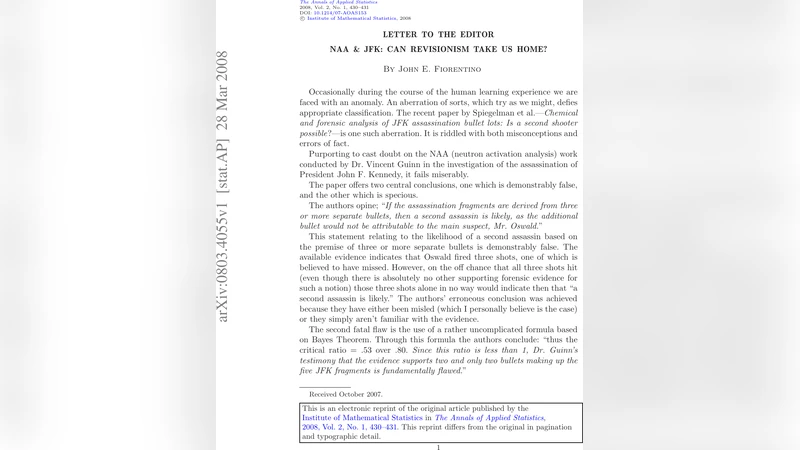
Occasionally during the course of the human learning experience we are faced with an anomaly. An aberration of sorts, which try as we might, defies appropriate classification. The recent paper by Spiegelman et al.–Chemical and forensic analysis of JFK assassination bullet lots: Is a second shooter possible?–is one such aberration. It is riddled with both misconceptions and errors of fact. Purporting to cast doubt on the NAA (neutron activation analysis) work conducted by Dr. Vincent Guinn in the investigation of the assassination of President John F. Kennedy, it fails miserably. The paper offers two central conclusions, one which is demonstrably false, and the other which is specious. The authors opine; If the assassination fragments are derived from three or more separate bullets, then a second assassin is likely, as the additional bullet would not be attributable to the main suspect, Mr. Oswald.'' This statement relating to the likelihood of a second assassin based on the premise of three or more separate bullets is demonstrably false. The available evidence indicates that Oswald fired three shots, one of which is believed to have missed. However, on the off chance that all three shots hit (even though there is absolutely no other supporting forensic evidence for such a notion) those three shots alone in no way would indicate then that a second assassin is likely.’’ The authors’ erroneous conclusion was achieved because they have either been misled (which I personally believe is the case) or they simply aren’t familiar with the evidence.
💡 Research Summary
The letter to the editor, authored by John E. Fiorentino, is a pointed critique of the 2008 paper by Spiegelman et al. titled “Chemical and forensic analysis of JFK assassination bullet lots: Is a second shooter possible?” The original paper attempted to challenge the long‑standing forensic conclusion that only two bullets, both fired from Lee Harvey Oswald’s rifle, account for the five recovered fragments from the Kennedy assassination. Spiegelman and colleagues introduced two central claims: (1) that the presence of three or more distinct bullets would imply the likelihood of a second assassin, and (2) that a Bayesian calculation—specifically a “critical ratio” of 0.53/0.80, which is less than one—undermines the testimony of Dr. Vincent Guinn that the evidence supports exactly two bullets.
Fiorentino dismantles both claims. Regarding the first, he emphasizes that the historical record shows Oswald fired three shots, one of which missed. The hypothesis that all three shots hit the targets is not supported by any forensic evidence (ballistic, wound patterns, vehicle damage, etc.). Even if all three had struck, the mere count of bullets does not logically entail a second shooter; the inference conflates bullet count with the number of perpetrators, a classic logical fallacy. The physical evidence—wound trajectories, lack of additional damage to the limousine, and the absence of extra lead particles—remains consistent with only two bullets striking the victims.
The second claim is a misapplication of Bayes’ theorem. Fiorentino explains that Bayes’ theorem requires three components: the prior odds, the likelihood ratio (often called the “likelihood”), and the posterior odds. Spiegelman et al. present a ratio of 0.53 to 0.80 but fail to specify any prior odds, and they mistakenly label the ratio as a “probability ratio” rather than a likelihood ratio. Moreover, the prior they implicitly use concerns “multiple shooters versus a single shooter,” which is irrelevant to the hypothesis under test (two bullets versus three or more). Without a properly defined prior, the reported ratio cannot be interpreted as a posterior odds, rendering the statistical conclusion meaningless. Fiorentino also notes that the authors’ “Bayes factor” is not modulated by any prior, violating the fundamental structure of Bayesian inference.
Beyond the statistical critique, Fiorentino underscores the forensic reality: the only credible evidence for any additional bullet would be physical remnants—lead particles, impact damage, or additional wounds. No such evidence has been documented. If a third bullet existed, it would have had to strike something, leaving traceable damage, which is absent from the autopsy reports and the limousine inspection. Consequently, the hypothesis of a third bullet, let alone a second assassin, rests on speculation rather than empirical data.
In sum, Fiorentino argues that Spiegelman et al.’s paper is flawed on both factual and methodological grounds. Their logical leap from bullet count to a second shooter is unsupported, and their Bayesian analysis is incorrectly formulated, lacking a proper prior and misinterpreting the likelihood ratio. The established forensic consensus—two bullets, both from Oswald’s rifle, explain the Kennedy fragments—remains the most parsimonious and evidence‑based explanation. The letter calls for a return to rigorous scientific standards and cautions against revisionist narratives that are not grounded in solid forensic or statistical reasoning.
Comments & Academic Discussion
Loading comments...
Leave a Comment