Editorial: Statistics and "The lost tomb of Jesus"
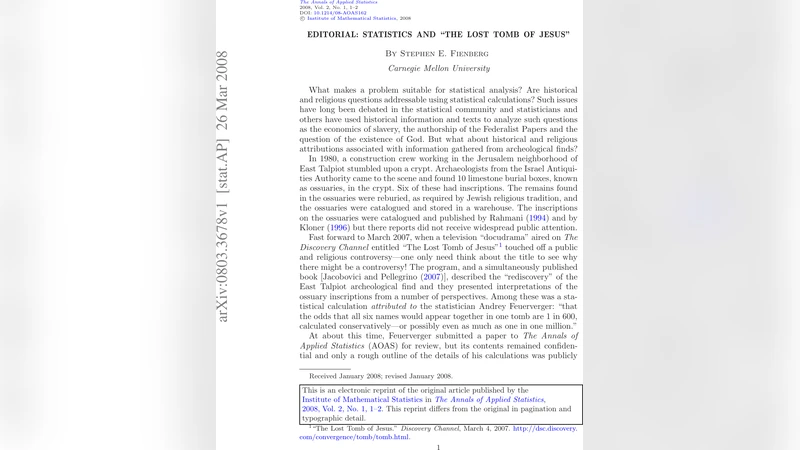
What makes a problem suitable for statistical analysis? Are historical and religious questions addressable using statistical calculations? Such issues have long been debated in the statistical community and statisticians and others have used historical information and texts to analyze such questions as the economics of slavery, the authorship of the Federalist Papers and the question of the existence of God. But what about historical and religious attributions associated with information gathered from archeological finds? In 1980, a construction crew working in the Jerusalem neighborhood of East Talpiot stumbled upon a crypt. Archaeologists from the Israel Antiquities Authority came to the scene and found 10 limestone burial boxes, known as ossuaries, in the crypt. Six of these had inscriptions. The remains found in the ossuaries were reburied, as required by Jewish religious tradition, and the ossuaries were catalogued and stored in a warehouse. The inscriptions on the ossuaries were catalogued and published by Rahmani (1994) and by Kloner (1996) but there reports did not receive widespread public attention. Fast forward to March 2007, when a television docudrama'' aired on The Discovery Channel entitled The Lost Tomb of Jesus’’ touched off a public and religious controversy–one only need think about the title to see why there might be a controversy! The program, and a simultaneously published book [Jacobovici and Pellegrino (2007)], described the rediscovery'' of the East Talpiot archeological find and they presented interpretations of the ossuary inscriptions from a number of perspectives. Among these was a statistical calculation attributed to the statistician Andrey Feuerverger: that the odds that all six names would appear together in one tomb are 1 in 600, calculated conservatively–or possibly even as much as one in one million.''
💡 Research Summary
The editorial in the Annals of Applied Statistics uses the controversy surrounding the 2007 Discovery Channel documentary “The Lost Tomb of Jesus” as a case study to examine whether historical and religious questions can be meaningfully addressed with statistical methods. The documentary popularized a striking claim made by statistician Andrey Feuerverger: that the probability of finding the six names “Jesus, Mary, Joseph, Joseph, Mary, Joseph” together in a single tomb is somewhere between 1 in 600 (a conservative estimate) and 1 in one million (a more extreme estimate). This figure was presented as a dramatic piece of evidence that the East Talpiot tomb might be the family tomb of Jesus of Nazareth.
Feuerverger’s original paper, submitted confidentially to AOAS and later published with extensive discussion, employed a Bayesian framework. He derived prior probabilities for each name from ancient literary sources (the Mishnah, Josephus, the New Testament, etc.) and combined these with the observed six inscriptions to compute a posterior probability (or p‑value) for the hypothesis that the tomb belonged to the New Testament family. The editorial summarizes the methodological steps, notes that the paper includes photographs, a detailed discussion of name frequencies, the assumptions underlying the analysis, and a novel p‑value calculation.
The editorial’s primary contribution is a critical appraisal of Feuerverger’s approach. It highlights several methodological concerns:
-
Data quality and representativeness – The name frequency data are drawn from a limited set of textual sources and may not reflect the true distribution of names in first‑century Jerusalem. Moreover, only six of the ten ossuaries bore legible inscriptions, and some inscriptions are partially damaged, introducing observation error.
-
Subjectivity of priors – Bayesian analysis requires the specification of prior probabilities, which in this case were chosen to make the combination of names appear unusually rare. Since “Joseph” and “Mary” were among the most common names of the period, assigning them low prior probabilities inflates the posterior odds dramatically.
-
Independence assumptions – The calculation treats the appearance of each name as independent, ignoring familial or regional naming conventions that could increase the likelihood of repeated names within a single family tomb.
-
Selection bias and multiple testing – The hypothesis that the East Talpiot tomb might be “Jesus’s tomb” was formulated after the tomb was discovered. This post‑selection bias means that the probability of finding a rare name combination somewhere among the many tombs in Jerusalem is far higher than the conditional probability computed for this particular tomb.
-
Interpretation of Bayesian results – The public presentation of the result as a simple “probability” misrepresents what a Bayesian posterior actually conveys. It does not give the probability that the tomb is authentic; it measures how surprising the data are under the specified priors and model.
-
Transparency and peer review – The original analysis was initially kept confidential, with only a rough outline released to the media. The editorial stresses that such secrecy undermines scientific scrutiny and can fuel sensationalism.
The editorial also notes that at the Joint Statistical Meetings in 2007, Feuerverger presented his work publicly, and three discussants offered alternative perspectives, many reframing the problem from a Bayesian standpoint. The editors encourage readers to evaluate the persuasiveness of the assumptions, data, and calculations themselves, especially in light of the extensive non‑statistical discussion that has proliferated online and in the popular press.
In sum, the editorial acknowledges that statistical modeling can provide intriguing insights into archaeological questions but warns that the reliability of such insights hinges on the quality of the underlying data, the objectivity of the modeling assumptions, and the care with which results are communicated to a non‑technical audience. It calls for a cautious, transparent approach when applying statistical methods to historically and religiously sensitive topics, and invites scholars to read the full paper and its accompanying discussion before drawing any definitive conclusions about the identity of the East Talpiot tomb.
Comments & Academic Discussion
Loading comments...
Leave a Comment