Geotechnical problems related with loess deposits in Northern France
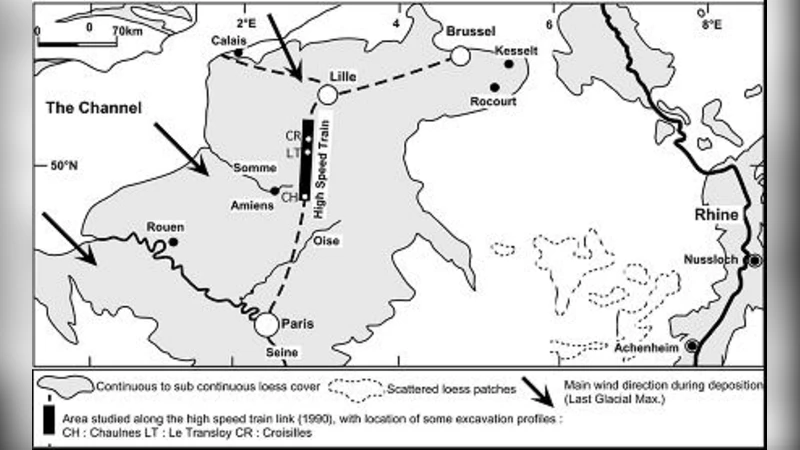
Special problems were encountered in some areas in Northern France where the high speed railways (TGV Nord) crossed some loess deposits that appeared to be specially sensitive to change in water content and susceptible to collapse. Numerous sinkholes appeared along some sections of the line following wet climatic periods. After a general geological and geotechnical presentation of loess deposits and collapse susceptibility, in which some tools of the mechanics of unsaturated soils are reconsidered with special application to loess collapsibility, this paper describes the results of a geotechnical study carried out on block samples of intact loess. Collapse susceptibility is examined in the light of microstructure observation. The dependence of collapse to water content changes is examined and the validity of various existing collapse criteria is investigated.
💡 Research Summary
The paper addresses a critical geotechnical issue that emerged along the TGV Nord high‑speed railway in northern France, where the line traverses extensive loess deposits that are highly sensitive to changes in water content and prone to collapse. Over a 50 km section, more than forty sinkholes have been documented, some triggered naturally by wet climatic periods and others by anthropogenic disturbances such as World‑I trenches. The authors begin with a comprehensive geological overview of loess, describing its aeolian origin during periglacial conditions, its worldwide distribution, and the specific characteristics of the northern French loess: a calcareous, low‑plasticity, highly porous silty material with calcium carbonate contents up to 18 % and occasional clay minerals (smectite, vermiculite, kaolinite).
Microstructural investigations using scanning electron microscopy (SEM) and laser scanning reveal a fabric dominated by angular quartz‑silt grains, random orientation, and a network of clay bridges and carbonate cementation that provides inter‑particle bonding. However, this bonding is largely governed by capillary suction; when the suction is reduced by rapid wetting, the bonds weaken and the structure collapses.
To quantify collapse susceptibility, the authors apply the classic double‑oedometer test (Jennings & Knight, 1957) and complement it with modern suction‑controlled compression tests. Two parallel loading paths are executed: one at constant initial water content representing the natural unsaturated state, and another in which the specimen is wetted under a modest load and then compressed under near‑zero suction. The difference in void‑ratio curves yields the collapse strain as a function of applied stress. Results show that even under modest stresses (≈100 kPa), loess samples with initial water contents below 12 % can experience collapse strains exceeding 15 % when subjected to rapid wetting, highlighting the extreme sensitivity of these soils.
The paper critically evaluates existing empirical collapse criteria, such as the Gibbs‑Bara density‑liquid‑limit relationship, and demonstrates that they underestimate the collapse potential of northern French loess because they do not account for the combined effects of low plasticity, high porosity, and carbonate cementation. By integrating the state‑surface concept of unsaturated soil mechanics (Matyas & Radhakrisna, 1968), the authors illustrate how suction reduction and loading interact on a three‑dimensional e‑(p‑ua)‑(ua‑uw) space, providing a more rigorous framework for predicting collapse.
Field observations are correlated with laboratory findings. The 43 recorded sinkholes are classified as 19 natural (linked to intense autumn‑winter precipitation and groundwater rise) and 21 artificial (associated with historic trenching). Additional sinkholes appeared after the unusually wet winters of 2001 and 2002, confirming that climatic wetting events can trigger rapid collapse in the exposed loess layers, especially where protective vegetal cover has been removed during construction.
Based on these insights, the authors propose a multi‑criteria assessment protocol that combines: (1) initial moisture content and suction measurements, (2) collapse strain obtained from double‑oedometer or suction‑controlled tests, (3) microstructural indicators such as the presence and continuity of clay bridges and carbonate bonds, and (4) site‑specific hydraulic loading scenarios (rainfall intensity, groundwater fluctuations, and potential water line leaks). This protocol aims to identify high‑risk loess sections before construction and to guide mitigation measures such as pre‑loading, drainage, or in‑situ stabilization.
In conclusion, the study demonstrates that the loess deposits of northern France constitute a highly collapse‑prone, unsaturated soil whose behavior cannot be reliably predicted by traditional, simplistic criteria. A rigorous application of unsaturated soil mechanics, coupled with detailed microstructural analysis, is essential for accurate risk assessment. Implementing the proposed comprehensive evaluation framework will enhance the safety and durability of high‑speed railways and other critical infrastructure built on or near loess terrains.
Comments & Academic Discussion
Loading comments...
Leave a Comment