Linear programming bounds for unitary space time codes
The linear programming method is applied to the space $\U_n(\C)$ of unitary matrices in order to obtain bounds for codes relative to the diversity sum and the diversity product. Theoretical and numerical results improving previously known bounds are …
Authors: Jean Creignou (IMB), Herve Diet (IMB)
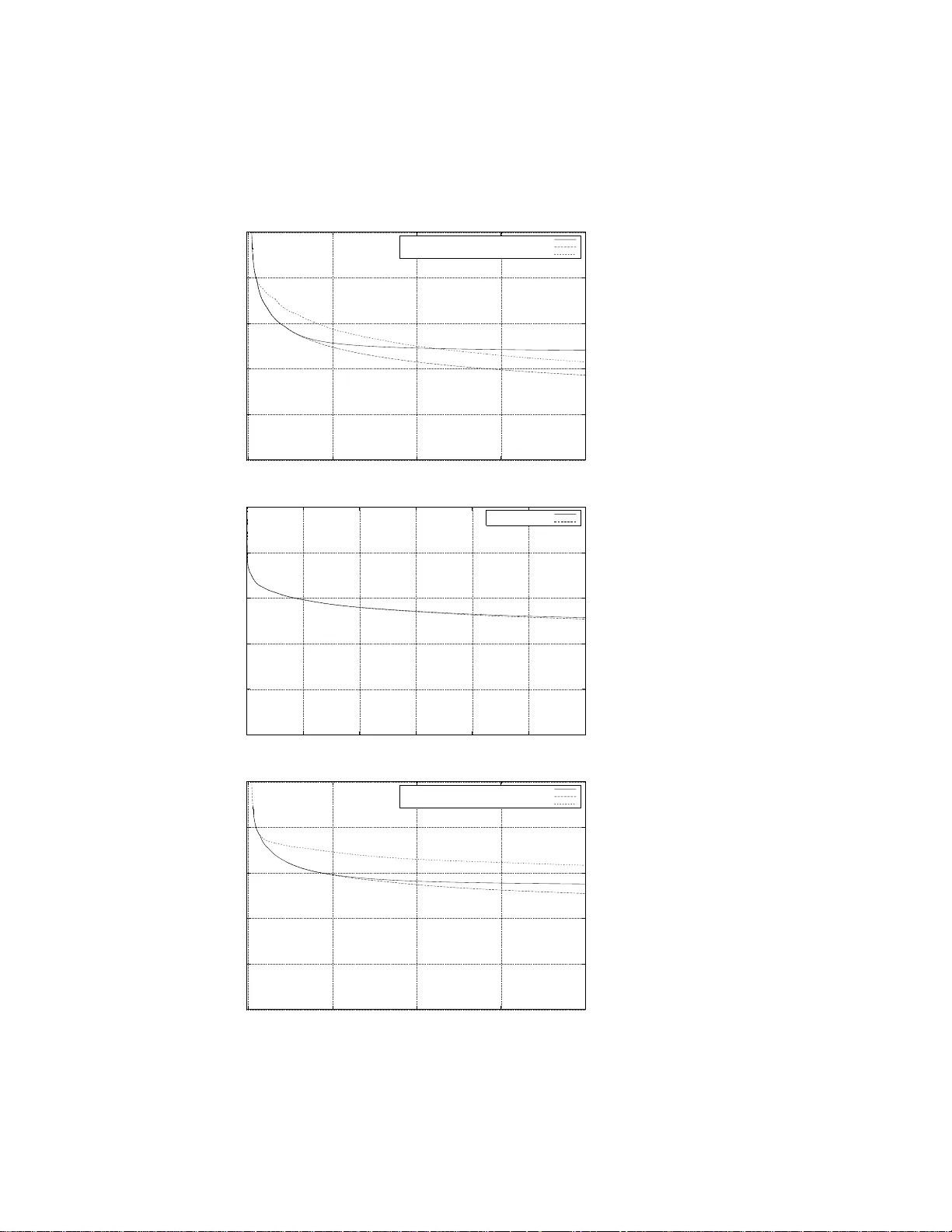
Linear programming b ounds for unitary space time co des Jean Creignou Herv ´ e Diet Octob er 25, 2018 Abstract The linear programming method is applied to the space U n ( C ) of uni- tary matrices in order to obtain b ounds fo r co des relative to the diversi ty sum and the diver sity product . Theoretical and numerica l results improv- ing p reviously known b ounds are derive d. 1 In tro duction Now adays break through o f wireless co mm unications ha s provided new and nice problems to the field o f coding theory . Indeed stra tegic issues of MIMO commu- nications has lead to consider co ding in Gra ssmann and Stiefel manifolds, and also in unitary groups [13]. Co des in unita r y groups are useful in the co ntext of non-coherent flat Rayleigh c hannel a s shown in [6]. The per formance of a unitary space-time co de V is meas ured (see [7 ]) by t wo functions namely the diversit y sum Σ V and the diversit y pro duct Π V : Σ V := 1 2 √ n min {|| x − y || : x 6 = y ∈ V } , Π V := 1 2 min n | det( x − y ) | 1 n : x 6 = y ∈ V o . Here || A || denotes the standa r d Euclidea n no r m of complex matrices: || A || 2 = T race( AA ∗ ) = P | A i,j | 2 . A standard problem is , given a nu mber N of p o in ts in U n ( C ), to maximize the v alue of Σ V or of Π V . Many author s hav e address ed this questio n, na rro wing ga ps b et ween bounds and explicit co nstructions (see [7], [8], [10], [11]). The linear progra mming method, whic h was initially devel- op ed by Philipp e Delsarte in the framework of asso ciation schemes [4 ], and is a powerful method to deal with suc h questio ns, has not b een applied to unitary co des b efore. Delsarte metho d was successfully adapted to the compact tw o- po in t homo geneous spa ces b y Kabatiansky and Lev enshtein [9] a nd recently to more genera l situations like the Grassma nn co de s [1], the p ermutation c o des [12], the or dered codes [2], [3]. Most of the situations mentioned a bov e fit into a 1 common framework, namely a compact g roup G a cts homog eneously on the un- derlying space X , and the representation theor y o f G c onstructs a certain family of orthogonal polynomia ls natura lly attached to X . Standard metho ds of har - monic a nalysis show that these p olynomials hold the desired p ositivit y prop erty that allows for Delsar te linear progra mming method. This general framework is recalled in Sectio n I I, and w e show in Section I II that unitary co des can b e treated likewise, the Schu r p olynomials b eing the asso ciated family of o rthog- onal po ly nomials. Section IV and V present the results, b oth numerical a nd analytic, obtained by the implemen tatio n of this metho d. It turns out that we improv e all previously known b o unds concerning the div ersity sum and the di- versit y product. Moreov er it is worth pointing out that the matho d can easily be ex tended to more complex situations, for exa mple a div er sit y function in- volving b oth Σ V and Π V . 2 The linear programming metho d on homoge- neous spaces W e br ie fly desc r ibe the linea r progra mming method on homogeneo us spaces. F or more details w e refer to [9], [14, Chapter 9] for a treatment of 2-p oint homogeneous spa ces, and to [1] for the prominent case of Grassmann co des. Let G b e a compact group acting tra nsitiv ely and contin uously on a compact space X , a nd τ : X × X → Y such that τ characterizes the orbits of G acting on X × X . W e mean here that, for a ll x 1 , x 2 , x ′ 1 , x ′ 2 ∈ X , τ ( x 1 , x 2 ) = τ ( x ′ 1 , x ′ 2 ) ⇔ ∃ g ∈ G : g ( x 1 , x 2 ) = ( x ′ 1 , x ′ 2 ) . Let S b e an y subs e t of Y , we c a ll a finite subset V ⊂ X a S -co de if for all c 1 6 = c 2 ∈ V , τ ( c 1 , c 2 ) ∈ S . A contin uous function P : Y → C is said to p ossess the p ositivity pro p erty if for an y finite subset V ⊂ X and any complex function α : X → C , X x,y ∈V α ( x ) α ( y ) P ( τ ( x, y )) is r eal non-negative. A canonical example is the constant function P 0 = 1; non-trivia l examples are given by the so called zona l functions that we int ro duce now. Let L 2 ( X ) = u : X → C : R X | u ( x ) | 2 dx < ∞ where dx is the unique G - inv ariant Ha a r mea s ure on X such that R X dx = 1 . This vector space is given the standard G -action defined b y g .u ( x ) = u ( g − 1 ( x )) and is endow ed with the canonical G -in v ariant hermitia n pro duct : ( u 1 , u 2 ) = R X u 1 ( x ) u 2 ( x ) dx. The Peter-W eil theor em shows that L 2 ( X ) ca n b e decomp osed as a direct sum of G -irreducible subspac e s V i . The next step is to as sociate to ea ch irreducible subspace V i a so-called zonal function P V i . A standard construction is the 2 following: given an orthonormal basis ( u 1 ( x ) , ..., u d ( x )) of V i , one can define ˜ P V i ( x, y ) = 1 d i d i X i =1 u i ( x ) u i ( y ) . (1) where d i = dim( V i ). Since these functions a r e constant on G -or bits we ca n rewrite ˜ P V i ( x, y ) = P V i ( τ ( x, y )). F rom this prop erty comes the term zonal functions used to qualify them. F rom eq ua tion (1) it is easy to pr o ve that these zonal functions v erify the positivity proper t y and do not dep end of the chosen orthonor mal basis. It turns o ut that, when the irreducible subs paces V i are pairwise non isomorphic, the cone o f contin uous positive G -in v ariant functions is exa ctly the s et of linea r combinations with no n negative co efficien ts o f the P V i (see [5]). In the remaining of this pap er we assume that this co ndition is satisfied. W e moreov er let V 0 denote the one-dimensio na l subspace asso ciated to the trivial represe ntation of G . The so-called linear progr amming b ounds a re obtained with the following theorem : Theorem 2. 1 L et P = P i c i P V i a line ar c ombination of the zonal functions P V i with a fin ite nu mb er of non zer o c o efficients. Assume furt he rmor e t h at : c i ≥ 0 , c 0 > 0 and ℜ ( P ) (the r e al p art of P ) is non-p ositive on S . Then any S -c o de verifies |V | ≤ P ( τ 0 ) c 0 (2) wher e τ 0 = τ ( x, x ) for any x . Pro of : On one hand, X x,y ∈V P ( τ ( x, y )) = X x = y ∈V P ( τ ( x, y )) + X x 6 = y ∈V P ( τ ( x, y )) ≤ |V | P ( τ 0 ) On the other hand, X x,y ∈V P ( τ ( x, y )) = X x,y ∈V c 0 P 0 ( τ ( x, y )) + non negative terms ≥ |V | 2 c 0 . 3 The case of un it ary co des As a par ticula r case we set G = U n ( C ) × U n ( C ) and X = U n ( C ). F or g = U × V and x = M we set g x = U M V − 1 . In this co n text the orbit of a pair ( x, y ) is 3 characterized by the eig en v alues ( e iθ 1 , ..., e iθ n ) o f the unitary ma tr ix xy − 1 . The Peter-W eil theor em gives a decompos itio n of L 2 ( X ) into irreducible subspaces L 2 ( X ) = ⊕ ( V χ ⊗ V χ ) (3) where the sum runs ov er a ll irreducible representations V χ of U n ( C ). It is worth noticing that the G -s ubspaces V χ ⊗ V χ are pa ir wise non iso morphic. F rom this decomp osition one can deduce the fo llowing theorem : Prop osition 3.1 The zonal functions asso ciate d to this de c omp osition ar e P χ ( x, y ) = χ ( xy − 1 ) wher e χ denotes any irr e ducible char acter of U n ( C ) . The irreducible characters of U n ( C ) are known to be finite dimensional and to hav e a nice descriptio n us ing Sc hur po lynomials ([16]). W e recall briefly so me notations a nd definitions concerning those polynomia ls . F or any in teger k , a partition o f k in n parts is a finite decre a sing sequence of n non nega tiv e in teger s which sum ex a ctly to k ( k is also ca lled the degree of the partition). A partition λ is dominating µ (noted λ ≻ µ ) if ∀ r ≤ n, P r i =1 λ i ≥ P r i =1 µ i . Given a partition λ = [ λ 1 , ..., λ n ] we define the elementary s ymmetric po lynomials m λ ∈ Z [ x 1 , ..., x n ] as the r enormalization to a monic p olynomial o f X σ ∈ S n x λ 1 σ (1) x λ 2 σ (2) ...x λ n σ ( n ) . These p olynomials form a basis of the se t o f symmetric poly nomials Z [ x 1 , ..., x n ] Sym . Sch ur p olynomials have b een intensiv ely studied and hav e several definitions. F or our purpo se we will define the Sch ur p olynomials S λ as S λ = X λ ≻ µ K λ,µ m µ , where the K λ,µ ∈ N are the so called Kostk a num b e rs. F or mor e pr ecision on those num b ers see [15]. It is clear that Sch ur p olynomials for m a nother bas is o f Z [ x 1 , ..., x n ] Sym . It is well known that the ir reducible p olynomial characters of U n ( C ) ar e expressed using Sch ur p olynomials (we r e fer to [16] for details) in the follo wing wa y: let ( e iθ 1 , ..., e iθ n ) denote the eig e n v a lues of a unitary ma trix M , and λ a partition. Then χ λ ( M ) = S λ ( e iθ 1 , ..., e iθ n ) . One obtains all irreducible characters of U n ( C ) by multiplying the c hara cters χ λ by a relative p o wer of det( M ) = Q e iθ k . All together, we obtain the theorem: Theorem 3. 2 F or al l p artition λ and s ∈ Z , let P λ,s ( x 1 , . . . , x n ) = ( x 1 . . . x n ) s P λ ( x 1 , . . . , x n ) . (4) 4 These r ational fr actions give t he zonal functions asso ciate d to the irr e ducible de c omp osition (3) in t he fol lowing way: if χ ≃ det s ⊗ λ , if the eigenvalues of xy − 1 ar e ( e iθ 1 , ..., e iθ n ) , then P χ ( x, y ) = P λ,s ( e iθ 1 , ..., e iθ n ) . . W e ar e now almost ready to compute b ounds for unitary codes V ⊂ U n ( C ). Let d 2 Σ ( e iθ 1 , ..., e iθ n ) := 1 2 n n X i =1 (1 − co s θ i ) and d 2 Π ( e iθ 1 , ..., e iθ n ) := 1 2 n Y i =1 (1 − co s θ i ) ! 1 n . and define d 2 Σ ( x, y ) (resp. d 2 Π ( x, y )) to be the ab o ve functions ev aluated at the eigenv a lues of xy − 1 . These functions are rela ted to the div er sit y sum and diversit y pro duct by Σ V = min x,y ∈V x 6 = y d Σ ( x, y ) a nd Π V = min x,y ∈V x 6 = y d Π ( x, y ) . W e recall that the o rbit of a pa ir ( x, y ) is c har acterized by the eigenv alues of xy − 1 , so d Σ and d Π are cons tan t on G -orbits. W e may now define, with the notations o f Section II, the sets S rela ted to each diversit y function: S Σ ( δ ) := { ( e iθ 1 , ..., e iθ n ) : d Σ ( e iθ 1 , ..., e iθ n ) ≥ δ } S Π ( δ ) := { ( e iθ 1 , ..., e iθ n ) : d Π ( e iθ 1 , ..., e iθ n ) ≥ δ } . 4 Analytic b ounds of lo w degree F rom the explicit description of the zo na l functions (4), w e hav e deduced con- venien t p olynomials of low degr e e which verify the po sitivit y prop ert y . Using formula (2) w e der iv e the analytic b ounds of Theor ems 4 .1 and 4.2. Theorem 4. 1 L et V b e a unitary sp ac e time c o de with diversity sum Σ V , t h e fol lowi ng upp er b ounds hold : |V | ≤ 2(Σ V ) 2 2(Σ V ) 2 − 1 , if (Σ V ) 2 > 1 2 (5) |V | ≤ 8 n 2 (Σ V ) 2 4 n 2 (Σ V ) 2 − (2 n 2 − 1) , if (Σ V ) 2 > 2 n 2 − 1 4 n 2 (6) 5 |V | ≤ 16 n 2 (Σ V ) 2 2 n (2 n − 1)(Σ V ) 2 − (2 n 2 − n − 2 ) , (7) if (Σ V ) 2 ≥ 2 n 2 − n − 2 2 n (2 n − 1) Theorem 4. 2 L et V b e a un itary sp ac e time c o de with diversity pr o duct Π V , the fol lowi ng upp er b ounds hold : |V | ≤ 2(Π V ) 2 2(Π V ) 2 − 1 , if (Π V ) 2 > 1 2 (8) |V | ≤ 8 n (Π V ) 2 4 n (Π V ) 2 − (2 n − 1) , if (Π V ) 2 > 2 n − 1 4 n , n ≥ 3 (9) |V | ≤ 8(Π V ) 6 + 4(Π V ) 4 + 8(Π V ) 2 8(Π V ) 6 − 1 4 , (10) if (Π V ) 2 ≥ 1 2 , n = 2 . The pro ofs of these theorems ar e based on Theorem 2.1 and o n the fo llo wing lemma : Lemma 4. 3 L et y j = co s θ j and m [ a 1 ,...,a r ] ( y ) the element ary symmetric p oly- nomials in the y j = co s θ j . The fol lowing p olynomia ls ar e line ar c ombination of the zonal functions (4) with non ne gative c o efficients: Q [0] = 1 Q [11] = m [11] ( y ) + ( n − 1) 4 Q [1] = m [1] ( y ) Q [2] = m [2] ( y ) + m [11] ( y ) − ( n +1) 4 Q [1 , 1 , 1] = m [1 , 1 , 1] ( y ) + ( n − 2) 4 m [1] ( y ) Q [2 , 1] = m [2 , 1] ( y ) + 2 m [1 , 1 , 1] ( y ) − 1 4 m [1] ( y ) Q [3] = m [3] ( y ) + m [2 , 1] ( y ) + m [1 , 1 , 1] ( y ) − ( n +2) 4 m [1] ( y ) Pro of : [Theorem 4.1, Sketch] Let s = 1 n P n j =1 cos θ j so that s = 1 − 2 d 2 Σ . W e apply for m ula (2) with the po lynomials : P = Q [1] − ns , P = ( Q [1] − ns )( Q [1] + n ), P = ( Q [1] − ns ) R , where R is the symmetrization of ( y 1 + 1)( y 2 + 1). 6 Pro of : [Theorem 4.2, Sk etch] Let p = 2 d 2 π . W e apply for m ula (2) with the po lynomials : P = Q [1] − n ( p − 1), P = Q [2] + ( n +1) p 2 Q [1] + ( n +1)(2 n ( p − 1)+1) 4 (if n ≥ 3), P = Q [2] + ( p 2 2 + 2 p − 1) Q [1] + ( p 3 − 1 4 ) (if n = 2). 5 Numerical b oun ds Numerical prog rams g iv e accura te a ppro ximations of the b est linear pr ogram- ming b ounds ov er a large interv al of v alidit y , not cov er e d b y the b ounds proved in Section IV. The following curves plot the linear pro gramming b ound on the diversit y functions as a function of the car dinalit y of the co de. The pro grams optimize the choice o f a p olynomial in the v ariables (cos θ 1 , . . . , cos θ n ), with degree at most equal to some par ameter D . Increasing D gives accurate re- sults ov er a wider rang e of v alues for the div ersity functions, but also incr ease the computational time. W e use D = 19 for n = 2 and D = 13 for n = 3. 0 0.2 0.4 0.6 0.8 1 0 500 1000 1500 2000 2500 3000 Diversity Sum Cardinality Bounds for the Diversity Sum, n=2 Num degree=7 Num degree=19 7 0 0.2 0.4 0.6 0.8 1 0 50 100 150 200 Diversity Product Cardinality Bounds for the Diversity Product, n=2 Numerical degree=7 Numerical degree=19 Bound from d Σ (deg=19) 0 0.2 0.4 0.6 0.8 1 0 500 1000 1500 2000 2500 3000 Diversity Sum Cardinality Bounds for the Diversity Sum, n=3 Num. degree=7 Num. degree=13 0 0.2 0.4 0.6 0.8 1 0 50 100 150 200 Diversity Product Cardinality Bounds for the Diversity Product, n=3 Numerical degree=7 Numerical degree=13 Bound from d Σ (deg=13) 8 N 24 48 64 80 bo unds in [10] 0 .6 746 0.6193 0.596 9 0.5799 B1 [7] 0.7598 0.6 603 0.6131 0.5 932 B2 [7] 0.7794 0.6 734 0.6235 0.6 026 LP d Σ 0.6547 0.5 797 0.5488 0.5 254 LP d Π 0.5730 0.4 989 0.4711 0.4 504 N 100 120 128 1000 bo unds in [10] 0 .5 632 0.5499 0.545 2 B1 [7] 0.5578 0.5 425 0.5347 0.3 270 B2 [7] 0.5654 0.5 496 0.5415 0.3 285 LP d Σ 0.4999 0.4 816 0.4753 0.2 964 LP d Π 0.4301 0.4 144 0.4089 0.2 574 T able 1: n = 2 N 24 48 64 80 LP d Σ 0.7178 0.6 939 0.6797 0.669 2 LP d Π 0.6431 0.5 942 0.5752 0.562 8 N 100 120 128 1000 LP d Σ 0.6598 0.6 532 0.6511 0.558 6 LP d Π 0.5482 0.5 369 0.5332 0.433 0 T able 2: n = 3 The T ables I and I I c ompare the linear progr a mming bo unds fo r the dimen- sions 2 and 3 with the previous results o f [1 0 ] and [7] and show an improvemen t in all cases. These tables give upp er b ounds for the div ersity when the cardina lit y N is fixed. All ent r ie s except the ones of the la st line (LP d Π ) ar e concerned with the diversit y sum. The second line ta bula tes the b ounds settled in [10], o btained using Coxeter upp e r bo unds. The tw o b ounds of [7] were obtained using s phere volume co mputations. Moreov er , co ncerning the div er s it y pro duct, bo th our numerical results and analytic results (co mpa re (6) and (9)) s how a larg e gap b et ween the b ounds for diversity sum and diversity pr oduct, in fav or of the diversit y product. This is worth to p oin t out since in previous publications b ounds for the diversit y pro duct were essentially deduced from the trivial inequality Σ V ≥ Π V and hence app ear to b e weak. 6 Conclusions In this pap er we hav e developed the linear progr amming metho d for the unitary space time code s . W e have obta ined b oth numerical a nd analytic b ounds. The 9 results improve pre v iously kno wn b ounds. F urthermore the linear pro gramming metho d allows to deal with non-distance functions as the diversit y pro duct di- rectly . Ac kno wledgmen t The author s w ould like to thank Chris tine Bachoc for her prec io us advises on the writing of this a r ticle. References [1] C. Ba c ho c, Line ar pr o gr amming b ounds for c o des in Gr assmannian sp ac es , IEEE T ra ns. Infor m. Theor y , 5 2-5 (2 0 06), pp. 2111-2 125. [2] A. Barg , P . Pur k ay astha, Bounds on or der e d c o des and ortho gonal arr ays , preprint, a rxiv:cs.IT/0702 033 v1. [3] J. Bier brauer, A dir e ct appr o ach t o line ar pr o gr amming b ounds for c o des and tms-nets , DCC, 42-2 (2007 ), pp. 1 27 - 143 . [4] P . Delsa rte, V. I. Levensh tein,. Ass o ciation schemes and c o ding the ory IEEE T rans. Infor m. Theo r y V ol. 44, n. 6, pp. 24 77 - 2504, Oct. 19 98. [5] S. Bochner, Hilb ert distanc es and p ositive definite functions , Ann. of Math. 42 (194 1), pp. 647–656 . [6] B. M. Hoch wald and T. L. Marzetta, Unitary sp ac e-time mo dulation for mul- tiple antenn a c ommun ic ation in R ayleigh flat fading. IEEE T rans. Inform. Theory , vol. 42 n. 2, pp. 543-564, 200 0 . [7] G. Han, J. Ros e n thal, Unitary S p ac e-Time Constel lation Analy sis : An Up- p er Bound for the Diversity , IEEE T r ans. Infor m. Theory , vol. 52, n. 10, pp. 47 13-4721, Oct. 2006. [8] B. M. Ho c hw ald, T. L. Marzetta, T. J. Richardson, W. Sweldens, R. Ur - banke, Systematic design of unitary sp ac e-time c onstel lations IEEE T rans. Inform. Theor y V ol. 46, N. 6 , pp. 1962-1 973, Sep. 20 00. [9] G. A. Ka batiansky , V. I. L e venshtein, Bounds for p acki ngs on a spher e and in sp ac e , Probl. Infor m.T ransm. 14 , pp. 1-17, 197 8. [10] X. B . Liang, X. G. Xia, Unitary signal c onst el lations for differ ential sp ac e- time mo dulation with two tr ansmit antennas : Par ametric c o des, optimal designs and b ounds , IEEE T r ans. Inf. Theory, vol. 48, n. 8 , pp. 2291 -2322, Aug. 2 002. [11] A. Shokrolla hi, Design of unitary sp ac e-time c o des fr om r epr esentations of SU(2) , Infor mation Theory , 200 1. Pro ceedings. 2 001 IEEE Int er national Sympo sium on V olume , Issue , 2001 Page(s):241 - 10 [12] H. T arna ne n, U pp er Bounds on Permutation Co des via Line ar Pr o gr am- ming , Eur . J . Com b. 2 0-1 (19 99), pp. 10 1-114. [13] L. Zheng and D. N. C. Tse, Commun ic ation on the Gr assmann manifold: a ge ometric appr o ach to the nonc oher ent multiple-antenna channel, v ol. 4 8, n. 2, pp. 3593 83, F eb. 2 002. [14] J.H. Conw ay , N.J.A. Sloane, Spher e Packings, L attic es and Gr oups , Springer-V er lag, 1988 . [15] B. E . Sagan, The symmetric gr oup , Graduate T exts in Mathematics, vol. 2 03, Seco nd Ed. Springer-V erla g, 2001 . [16] W. F ulton Y oun g T able aux London Math. So ciet y, Student T exts 3 5. 11
Original Paper
Loading high-quality paper...
Comments & Academic Discussion
Loading comments...
Leave a Comment