Characterizing path graphs by forbidden induced subgraphs
A graph is a path graph if it is the intersection graph of a family of subpaths of a tree. In 1970, Renz asked for a characterizaton of path graphs by forbidden induced subgraphs. Here we answer this question by listing all graphs that are not path g…
Authors: Benjamin Lev^eque (LGS), Frederic Maffray (LGS), Myriam Preissmann (LGS)
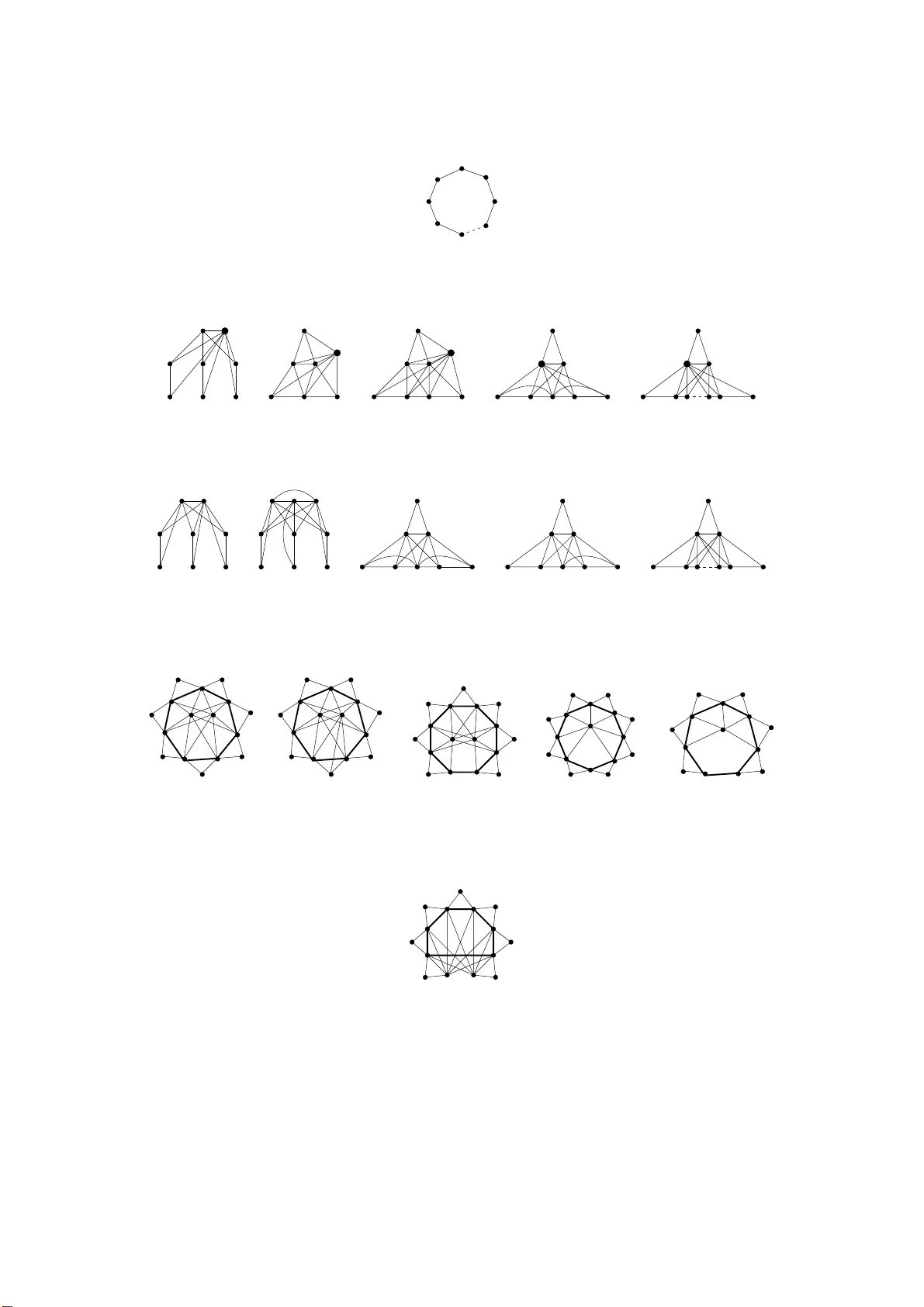
Characterizing path graphs b y forbidden induced subgraphs Benjamin L ´ ev ˆ eque ∗ F r ´ ed ´ eric Maffra y † Myriam Preissmann † Octob er 31, 2018 Abstract A path graph is the intersection graph of subpaths of a tree. In 1970, Renz asked for a characterization of path gra phs by forbidden induced subgr aphs. W e ans w er this ques tio n by determining the complete list of graphs that are not pa th graphs and are minimal with this prop erty . 1 In tro duction All graphs consid ered here are finite and ha v e no parallel edges and no lo op. A hole is a c hordless cycle of length at least four. A graph is chor dal (or triangulate d ) if it con tains no h ole as an indu ced subgraph . Ga vril [6] pr o ved that a graph is c hordal if and only if it is the in tersection graph of a family of sub trees of a tr ee. In this pap er, whenever w e talk ab out th e in tersection of su bgraphs of a graph we mean that the vertex sets of th e subgraphs int ersect. An interval gr ap h is the intersec tion graph of a family of int erv als on the real line; equiv alen tly , it is the intersectio n graph of a f amily of sub paths of a path. An aster oidal triple in a graph G is a set of three non adjacen t v ertices such th at for any tw o of them, there exists a path b et we en them in G that do es not intersect the neigh b orho o d of th e third. Lekk erke rke r and Bol and [11] pro v ed th at a graph is an interv al graph if and only if it is c hordal an d con tains n o asteroidal triple. They derived from this resu lt the list of minimal f orbidden su b graphs for int erv al graphs . An inte rmediate class is the class of path graphs . A graph is a p ath g r aph if it is the in tersection graph of a family of su bpaths of a tree. Clea rly , the class of p ath graphs is included in the class of chordal graphs and conta ins th e class of inte rv al graph s. Sev eral c haracterizat ions of path graphs hav e b een giv en [7, 13, 15] but no c haracterizatio n by forbidden sub grap h s was kno wn, whereas suc h results exist for in tersection graphs of subpaths of a path (in terv al graphs [11]), subtr ees of a tree (c hordal graphs [6]), and also for directed s u bpaths of a directed tree [14]. ∗ ROSE, EPFL, Lausanne, S witzerla nd † C.N.R.S., Lab oratoire G-SCOP , Grenoble, F rance 1 In 1970, Ren z [15] ask ed for a complete list of graphs that are chordal and not path graphs and are minimal with this prop erty , an d he ga ve t w o examples of su c h graphs. Reference [19] extends the list of minimal forbid d en su bgraphs for p ath graphs; but that list is incomplete. Here we ans w er Renz’s question and obtain a characte rization of p ath graphs by forbidd en ind u ced subgraph s . W e will prov e that the graphs presented in Figures 1–5 are all the m in imal non-p ath graphs. In other words: Theorem 1 A gr aph is a p ath gr aph if and only if it do es not c ontain any of F 0 , . . . , F 16 as an induc e d sub gr aph. 2 Sp ecial simplicial v ertices in c hordal graphs In a graph G , a clique is set of pairwise adjacen t ve rtices. Let Q ( G ) b e the set of all (inclusion wise) maximal cliques of G . When there is n o am biguit y w e will w rite Q instead of Q ( G ). Giv en t w o vertic es u, v in a graph G , a { u, v } -sep ar ator is a set S of v ertices of G suc h that u and v lie in t w o different comp onents of G \ S and S is minimal with this prop ert y . A set is a sep ar ator if it is a { u, v } -separator for some u, v in G . Let S ( G ) b e the set of separators of G . When there is no am biguit y we will write S instead of S ( G ). The neigh b orho o d of a vertex v is the s et N ( v ) of vertic es adjacen t to v . Let us say that a vertex u is c omplete to a set X of v ertices if X ⊆ N ( u ). A v ertex is simplicial if its n eigh b orh oo d is a clique. It is easy to see that a v ertex is simplicial if and only if it d oes not b elong to any separator. Giv en a simplicial v ertex v , let Q v = N ( v ) ∪ { v } and S v = Q v ∩ N ( V \ Q v ). Since v is simplicial, we h a ve Q v ∈ Q . Remark that S v is not necessarily in S ; for example, in the graph H with v ertices a, b, c, d, e an d edges ab, bc, cd, de, bd , we hav e S c = { b, d } and S ( H ) = {{ b } , { d }} . A c lassical result [ 10, 1] (see also [8]) states that, in a c hordal graph G , every separator is a clique; moreo v er, if S is a separator, then there are at least t wo comp onents of G \ S that con tain a verte x that is complete to S , and so S is the in tersection of t w o maximal cliques. A clique tr e e T of a graph G is a tree whose v ertices are the member s of Q and such that, f or eac h vertex v of G , those memb ers of Q that con tain v indu ce a s ubtree of T , whic h we will denote by T v . A classical result [6] states th at a graph is chordal if and only if it has a clique tree. F or a clique tree T , the lab e l of an ed ge QQ ′ of T is defin ed as S QQ ′ = Q ∩ Q ′ . Note that eve ry ed ge QQ ′ satisfies S QQ ′ ∈ S ; indeed, there exist vertices v ∈ Q \ Q ′ and v ′ ∈ Q ′ \ Q , and th e set S QQ ′ is a { v , v ′ } -separator. Th e num b er of times an elemen t S of S app ears as a lab el of an edge is equal to c − 1, where c is the n um b er of comp onen ts of G \ S that conta in a vertex complete to S [6 , 12]. Note that this num b er is at least one and that it dep ends only on S and n ot on T , so for a giv en S ∈ S it is the same in ev ery clique tree. Giv en X ⊆ Q , let G ( X ) denote the subgraph of G induced by all the v ertices th at 2 app ear in mem b ers of X . If T is a clique tree of G , then T [ X ] denotes the sub tr ee of T of minimum size wh ose ve rtices conta ins X . Note that if | X | = 2, then T [ X ] is a path. Giv en a su b tree T ′ of a clique-tree T o f G , let Q ( T ′ ) b e th e set of vertices of T ′ and S ( T ′ ) b e th e set of separators of G ( Q ( T ′ )). Dirac [5 ] pro v ed that a c hordal graph that is not a clique conta ins t w o non adj ace nt simplicial ve rtices. W e n eed to generalize this theorem to the follo wing. Let us say that a simplicial vertex v is sp e c i al if S v is a memb er of S and is (inclusionwise) maximal in S . Theorem 2 In a chor dal gr aph that is not a clique, ther e exist two non adjac ent sp e cial simplicial vertic es. Pr o of. W e pro v e the theorem b y induction on |Q| . By the hyp othesis, G is not a clique, so |Q| ≥ 2 and S 6 = ∅ . Case 1: S has only one maximal element S . Let Q, Q ′ b e t w o maximal cliques such that Q ∩ Q ′ = S . Let v ∈ Q \ Q ′ and v ′ ∈ Q ′ \ Q . Th e set S is the only maximal s eparator and it do es not con tain v or v ′ . So v and v ′ do n ot b elong to an y element of S , and so they are simp licial and S v = S v ′ = S , so they are sp ecial. Case 2: S has two distinct ma ximal elements S , S ′ . S o |Q| ≥ 3. Let T b e a clique tree of G . Let Q 1 , Q 2 , Q ′ 1 , Q ′ 2 b e memb ers of Q suc h that S = S Q 1 Q 2 , S ′ = S Q ′ 1 Q ′ 2 , and Q 2 , Q 1 , Q ′ 1 , Q ′ 2 app ear in this order along the path T [ Q 2 , Q 1 , Q ′ 1 , Q ′ 2 ] (p ossibly Q 1 = Q ′ 1 ). Let Y b e the subtree of T \ Q 1 that conta ins Q 2 , and let Z b e the tree that consists of Y plus the vertex Q 1 and the edge Q 1 Q 2 . The subtree Z d oes not con tain Q ′ 2 , so G ( Q ( Z )) has strictly fewer maximal cliques than G ; and G is not a clique. By the ind uction h yp othesis, there exist tw o n on adjacent simplicial v ertices v , w of G ( Q ( Z )) su c h that S v , S w are m aximal elemen ts of S ( Z ). A t m ost one of v , w is in Q 1 since they are n ot adjacen t, sa y v is not in Q 1 . W e claim that v is a simplicial v ertex of G and that S v is a maximal elemen t of S . V ertex v d oes not b elong to any elemen t of S ( Z ). If it b elongs to an elemen t of S \ S ( Z ), then it must also b elong to Q 1 ∩ Q 2 = S ∈ S ( Z ), a con tradiction. So v do es n ot b elong to any element of S an d so it is a simp licial v ertex of G . The set S v is a maximal elemen t of S ( Z ). If it is not a maximal elemen t of S , then it is included in S ∈ S ( Z ), a con tr adictio n. So v is a s p ecial sim p licial v ertex of G . Lik ewise, let Y ′ b e th e su btree of T \ Q ′ 1 that con tains Q ′ 2 , and let Z ′ b e th e tree that consists of Y ′ plus the vertex Q ′ 1 and the edge Q ′ 1 Q ′ 2 . Just lik e with v , we can fin d a simplicial vertex v ′ of G ( Q ( Z ′ )) n ot in Q ′ 1 that is a simplicial vertex of G with S v ′ b eing a maximal element of S . V ertices v and v ′ are not adjacen t since S is a { v , v ′ } -separator. S o v and v ′ are the desired v ertices. ✷ Algorithms LexBFS [16] and MCS [18] are linear time algorithms that w ere dev elop ed to fi nd a simplicial v ertex in a c hordal graph . But a simplicial v ertex found by these algorithms is not necessarily sp ecial. F or example, on the graph with vertic es a, b, c, d, e, f and edges ab, bc, cd, eb, ec, f b, f c , ev ery application of LexBFS or MCS w ill en d on one of simp licia l vertices a, d , w hic h are n ot sp ecial. The pr o of of Theorem 2 can b e turn ed 3 in to a p olynomial time algorithm to fi nd a s p ecial s im p licial v ertex in a c hordal graph. W e do not know ho w to fi nd such a v ertex in linear time. 3 F orbidden induced subgraphs A cliqu e p ath tr e e T of G is a clique tree of G such that, for eac h v ertex v of G , the subtree T v induced by cliques that conta in v is a path. Ga vril [7] pro v ed a graph is a path grap h if and only if it h as a clique path tree. Consider graph s F 0 , . . . , F 16 present ed in Fig ures 1–5. Let u s mak e a few remarks ab out them. Eac h graph in Figure 2 is obtained b y adding a univ ersal verte x to some minimal forbidd en subgraph for interv al graph s . C learly , in a path graph the neighbor- ho o d of ev ery ve rtex is an in terv al graph; so F 1 , . . . , F 5 are not path graphs. Graphs F 10 ( n ) n ≥ 8 are also forbidden in inte rv al graphs. Graphs F 6 and F 10 (8) are from Renz [15, Figures 1 and 5]. F or i ∈ { 0 , 1 , 3 , 4 , 5 , 6 , 7 , 9 , 10 , 13 , 15 , 16 } , P anda [14] pro v ed that F i is a minimal non directed p ath grap h , so F i \ x is a directed path graph for every v ertex x (ob viously ev ery directed path graph is a path graph). In general we h av e the follo wing: Theorem 3 F 0 , . . . , F 16 ar e minimal non p ath gr aphs. Pr o of. Clearly , F 0 is a m in imal n on path graph. F or the other graphs, w e pro v e the theorem in one case and then sho w ho w the same argumen ts can b e applied to all cases. Consider F = F 11 (4 k ), k ≥ 2; see Figure 4. Name its v ertices suc h that u 1 , . . . , u 2 k − 1 are the simplicial v ertices of degree 2, clo c kwise; v j − 1 , v j are the t wo neigh b ors of u j ( j = 1 , . . . , 2 k − 1), with sub scripts mo dulo 2 k − 1; and a, b are the remaining ve rtices. Let Q j b e the maximal clique that con tains u j ( j = 1 , . . . , 2 k − 1), and call these 2 k − 1 cliques “p eripheral”. Let R a = { a, v 1 , . . . , v 2 k − 1 } and R b = { b, v 1 , . . . , v 2 k − 1 } b e the maximal cliques that con tain r esp ectiv ely a and b , and call these t w o cliques “cent ral”. Th us Q ( F ) = { R a , R b , Q 1 , . . . , Q 2 k − 1 } . Since F is c hordal, it admits a clique tree. Let T b e an y clique tree of F . Th en R a and R b are adjacen t in T (for otherwise, there w ould b e at least one in terior v ertex Q on the path T [ R a , R b ], so we should hav e R a ∩ R b ⊆ Q , but no mem b er Q of Q ( F ) \ { R a , R b } satisfies this in clusion). By the same argument , eac h Q j ( j = 1 , . . . , 2 k − 1) m ust b e adjacen t to R a or R b in T . Su pp ose that w e are trying to build a clique p ath tree T for F . By sym metry , we ma y assume that Q 1 is adjacen t to R a . Th en, f or j = 2 , . . . , 2 k − 2 su ccessiv ely , Q j m ust b e adjacen t to R b (if j is ev en) and to R a (if j is o dd) in T , for otherwise, for some v ∈ { v j − 1 , v j } the subtree T v induced by the cliques that con tain v would not b e a path. Note that in this fashion w e obtain a clique path tr ee T ′ of F \ u 2 k − 1 . No w if Q 2 k − 1 is adjacent to R a , then the subtree T v 2 k − 1 is not a p ath, and if if Q 2 k − 1 is adjacent to R b , then the same holds for T v 2 k − 2 . T h is shows that F is n ot a p ath graph. No w consider an y ve rtex x of F . If x is one of the u j ’s, then by symmetry we ma y assume th at x = u 2 k − 1 , and w e h a ve seen ab ov e that F \ x is a p ath graph with clique 4 path tree T ′ . Su p p ose that x is one of th e v j ’s, sa y x = v 2 k − 1 . Then by add in g v ertex Q 2 k − 1 and edge Q 2 k − 1 R a to T ′ , it is easy to see that we obtain a clique p ath tree of F \ x . Finally , su pp ose that x is one of a, b , s ay x = b . T hen the tree with v ertices R a , Q 1 , . . . , Q 2 k − 1 and edges R a Q 1 , . . . , R a Q 2 k − 1 is a clique path tr ee of F \ x . So F is a minimal n on path graph. When F is any other F i ( i = 1 , . . . , 16) , th e same argum en ts app ly as follo ws. F or i = 1 , . . . , 10, call p eripheral the three cliques that conta in a s implicial ve rtex. F or i = 11 , . . . , 16, call p eripheral the cliques that con tain a simplicial v ertex of d egree 2, plus, in the case of F 12 , the clique th at con tain th e b ottom simplicial vertex (which has degree 3). Call cen tral all other maximal cliques. Then it is easy to p ro ve, as ab o v e, th at the cen tral cliques must f orm a su bpath in any clique tree of F , and all the p erip heral cliques except one ca n b e app ended to either end of th at su bpath, but w h ic hever wa y this is done, when the last clique is app ended, the subtree T v is n ot a path for some v ertex v of F . Moreo v er, when any v ertex x is remo v ed, it is p ossible to bu ild a clique path tr ee for F \ x . ✷ 4 Co-sp ecial simplicial v ertices Let u s say that a simplicial ve rtex v is c o-sp e cial if S v is a separator suc h th at G \ S v has exactly t w o comp onen ts. Note that in that case S v is a minimal element of S and it app ears exactly once as a lab el of any path tr ee of G . Lemma 1 L et G b e a minimal non p ath gr aph. Then either G is one of F 11 , . . . F 15 or every simplicial v ertex of G is c o-sp e cial. Pr o of. Supp ose on the con trary that G is a minimal n on path graph, differen t from F 11 , . . . F 15 , and there is a simplicial v ertex q of G that is not co-sp ecial. All simp licia l v ertices of F 0 , . . . F 10 , F 16 are co -sp ecial, so G is not an y of these graph s; moreo v er it do es n ot con tain any of them strictly (for otherw ise G would n ot b e m in imal). Therefore G con tains none of F 0 , . . . , F 16 . Let T 0 b e a clique path tree of G \ q . Let Q ′ ∈ Q ( G \ q ) b e suc h that S q ⊆ Q ′ . If Q ′ = S q , then w e can add q to Q ′ to obtain a clique path tree of G , a con tradiction. So Q ′ 6 = S q , and S q ∈ S (as there is a vertex q ′ ∈ Q ′ \ S q and S q is a { q , q ′ } -separator). Let T ′ b e the maximal su btree of T 0 that con tains Q ′ and such that no lab el of the edges of T 0 is includ ed in S q . Remark that T ′ plus verte x Q and edge QQ ′ is a clique tree of G ( Q ( T ′ ) ∪ { Q } ) (but not necessarily a clique path tree), and in that tree only one lab el is included in S q . Since q is not co-sp ecial , th er e is an ed ge of T 0 whose lab el is included in S q , and so T ′ has strictly fewer vertice s than T 0 . So G ( Q ( T ′ ) ∪ { Q } ) is a path grap h . Let T b e a clique path tree of this graph. W e claim that Q is a leaf of T . If n ot, then there are at least t w o lab els of T that are in cluded in S q , whic h contradict s the definition of T ′ (the num b er of times a lab el 5 app ears in a clique tr ee is constant ). Let T 1 , . . . , T ℓ b e the subtrees of T 0 \ T ′ ( ℓ ≥ 1). F or 1 ≤ i ≤ ℓ , let Q i Q ′ i b e the edge b etw een T i and T ′ with Q i ∈ T i and Q ′ i ∈ T ′ . Note that Q 1 , . . . , Q ℓ are pairwise disjoin t (but Q ′ , Q ′ 1 , . . . , Q ′ ℓ are not necessarily pairwise d isjoin t). Let S i = Q i ∩ Q ′ i and v i ∈ Q i \ Q ′ i . Let H = ( V H , E H ) b e the in tersectio n graph of S 1 , . . . , S ℓ , that is, V H = { S 1 , . . . , S ℓ } and E H = { S i S j | S i ∩ S j 6 = ∅} . Claim 1 H c ontains no o dd cycle. Pr o of. Supp ose on the con trary , without loss of generalit y , that S 1 - · · · - S p - S 1 is an o dd cycle in H , with length p = 2 r + 1 ( r ≥ 1). L et I j = S j ∩ S j +1 ( j = 1 , . . . , p ), with S p +1 = S 1 . Supp ose that for some j 6 = k we ha v e I j ∩ I k 6 = ∅ ; then there is a common v ertex in the cliques Q j , Q j +1 , Q k , Q k +1 , and the num b er of differen t cliques among these is at least three, wh ic h contradict s the fact that T 0 is a clique p ath tree as these three cliques do not lie on a common path of T 0 . F or 1 ≤ j ≤ p , let s j ∈ I j . By the p r eceding remark, the s j ’s are pairwise distinct. By the defi nition of T ′ , w e hav e S j ⊆ S q for eac h 1 ≤ j ≤ p , so the s j ’s are all in Q and Q ′ . Let q ′ ∈ Q ′ \ Q . Let u s consider th e subgraph in duced by q , q ′ , v 1 , . . . , v p , s 1 , . . . , s p . Each of the non-adjacen t v ertices q and q ′ is adjacent to all of th e clique formed by th e s j ’s. Each v ertex v j is adjacen t to s j − 1 and s j (with s 0 = s p ) an d not to an y other s i or to q . V ertex q ′ can ha v e at most t w o neighbors among the v j ’s. If q ′ has zero or one n eigh b or among them, then q , q ′ , v 1 , . . . , v p , s 1 , . . . , s p induce resp ectiv ely F 11 (4 r + 4) r ≥ 1 or F 12 (4 r + 4) r ≥ 1 . If q ′ has t w o consecutiv e neigh b ors v j , v j +1 , then q , q ′ , v j , v j +1 , s j − 1 , s j , s j +1 induce F 2 . I f q ′ has t w o non-consecutiv e neighbors v j , v k , then w e can assume that 1 ≤ j < j + 1 < k ≤ p and k − j is o dd, k − j = 2 s + 1 with s ≥ 1, and then q , q ′ , v j , . . . , v k , s j , . . . , s k − 1 induce F 14 (4 s + 5) s ≥ 1 . In all cases w e obtain a cont radiction. Thus the claim holds. ⋄ By the p receding claim, H is a bipartite graph. F or 1 ≤ i ≤ ℓ , let R i = { S ∈ S ( T ′ ) | S i ∩ S 6 = ∅ and S i \ S 6 = ∅} . Let X = { S i | R i 6 = ∅} . Claim 2 H c ontains no o dd p ath b etwe en two vertic es in X . Pr o of. Su p p ose on the cont rary , without loss of generalit y , that S 1 - · · · - S p is an o dd path in H b etw een t w o v ertices S 1 , S p of X (with p = 2 k , k ≥ 1), an d assume that p is minim um with this p rop ert y . By the minimalit y , all int erior vertices S j (1 < j < p ) are not in X . F or 1 ≤ j < p , let s j b e a v ertex in S j ∩ S j +1 . As in the preceding claim, the s j ’s are pairwise d istinct and lie in Q and Q ′ . Let P b e the path T ′ [ Q ′ 1 , Q ′ 2 ]. If p 6 = 2, then S 2 is n ot in X , so Q ′ 3 = Q ′ 1 , for otherwise T s 2 0 w ould not b e a path; th en S 3 is n ot in X , so Q ′ 4 = Q ′ 2 , and so on. T hus the tw o extremities of P are Q ′ 1 = Q ′ 3 = · · · = Q ′ p − 1 and Q ′ 2 = Q ′ 4 = · · · = Q ′ p . Since S 1 and S p are in X , the sets R 1 , R p are non empty . Let L 1 b e th e closest ve rtex to Q ′ 1 in P such that there exists an edge inciden t to L 1 with lab el in R 1 , and let L 1 K 1 b e suc h an edge and R 1 b e its lab el (suc h an edge exists 6 b ecause R 1 6 = ∅ ). Similarly , let L p b e the closest vertex to Q ′ p in P suc h that th ere exists an edge inciden t to L p with lab el in R p , and let L p K p b e such an edge and R p b e its lab el. So S 1 ⊆ L 1 , S 1 * K 1 and S p ⊆ L p , S p * K p . Eac h of K 1 , K p ma y b e in P or not. Since T ′ is a clique p ath tree, Q ′ lies b et w een Q ′ 1 and L 1 and b etw een L p and Q ′ p along P . S o Q ′ 1 , L p , Q ′ , L 1 , Q ′ p lie in this order on P , and S 1 is includ ed in all lab els b et ween Q ′ 1 and L 1 in P , and S p is included in all lab els b et ween Q ′ p and L p in P . Let v 0 ∈ K 1 \ L 1 and v p +1 ∈ K p \ L p . Since T 0 is a clique p ath tree, v 0 and v p +1 are distinct from v 1 , . . . , v p and not adjacen t to q . Let s 0 ∈ S 1 ∩ R 1 and s p ∈ S p ∩ R p . Then v 0 and s 0 are adjacen t, and v p +1 and s p are adjacen t. Since T 0 is a clique path tree, if K 1 or K p is not in P , th en s 0 and s p are differen t from eac h other, from s 1 , . . . , s p − 1 and from v 0 , . . . , v p +1 . F urtherm ore, if K 1 is not in P , then v 0 is not adjacen t to any of s 1 , . . . , s p ; and if K p is not in P , then v p +1 is not adjacen t to an y of s 0 , . . . , s p − 1 . Let s ′ 0 ∈ S 1 \ R 1 and s ′ p ∈ S p \ R p . Then v 0 and s ′ 0 are not adjace nt, and v p +1 and s ′ p are not adjacen t. Since T 0 is a clique path tree, if K 1 or K p is in P , then s ′ 0 and s ′ p are differen t from eac h other, from s 1 , . . . , s p − 1 and from v 0 , . . . , v p +1 . F urtherm ore, if K 1 is in P , th en v 0 is adjacen t to s ′ p and to s 1 , . . . , s p ; and if K p is in P , then v p +1 is adjacen t to s ′ 0 and to s 0 , . . . , s p − 1 . Note th at th e set { q , s ′ 0 , s 0 , s 1 , s 2 , . . . , s p , s ′ p } indu ces a clique in G . Moreo v er, v 1 is adjacen t to s ′ 0 , v p is adjacen t to s ′ p , for i = 1 , . . . , p , v i is adjacent to s i − 1 and s i , and there is no other edge b et ween v 1 , . . . , v p and that clique. Supp ose that K 1 = K p . Then L 1 = L p = Q ′ and K 1 is not in P . By the definition of T ′ , there exists y ∈ R 1 \ S q . V ertex y is distinct from all s i ’s as it is not in S q , and it is adjacen t to all of v 0 , s 0 , . . . , s p and to none of q , v 1 , . . . , v p . Then q , y , v 0 , . . . , v p , s 0 , . . . , s p induce F 12 (4 k + 4) k ≥ 1 , a con tradiction. So K 1 6 = K p , and v 0 and v p +1 are distinct non adjacen t ve rtices. W e can choose v ertices x 1 , . . . , x r ( r ≥ 1) not in S q and on the lab els of T ′ [ K 1 , K p ] su c h that v 0 - x 1 - . . . - x r - v p +1 is a chordless path in G . V ertices x 1 , . . . , x r are distinct f rom and adjacen t to s ′ 0 , s ′ p , s 0 , . . . , s p , and they are distinct from and not adjacen t to an y of v 1 , . . . v p . Supp ose that L 1 = Q ′ p and L p = Q ′ 1 . Then K 1 and K p are not in P . If r = 1, then q , v 0 , . . . , v p +1 , s 0 , . . . , s p , x 1 induce F 14 (4 k + 5) k ≥ 1 . If r = 2, then q , v 0 , . . . , v p +1 , s 0 , . . . , s p , x 1 , x 2 induce F 15 (4 k + 6) k ≥ 1 . If r ≥ 3, then q , v 0 , v p +1 , s 0 , s p , x 1 , . . . , x r induce F 10 ( r + 5) r ≥ 3 , a con tradiction. Supp ose n o w that L 1 6 = Q ′ p and L p = Q ′ 1 . Then K p is not in P and w e ma y assu me that K 1 is in P . If r = 1, then q , v 0 , . . . , v p +1 , s ′ 0 , s 1 . . . , s p , x 1 induce F 13 (4 k + 5) k ≥ 1 . If r ≥ 2, th en q , v 0 , v p +1 , x 1 , . . . , x r , s ′ 0 , s p induce F 5 ( r + 5) r ≥ 2 , a contradict ion. Supp ose fi n ally that L 1 6 = Q ′ p and L p 6 = Q ′ 1 . Then we ma y assume that K 1 and K p are in P . If r = 1, then q , v 0 , v p +1 , s ′ 0 , s 1 , s ′ p , x 1 induce F 2 . If r = 2, then q , v 0 , v p +1 , s ′ 0 , s 1 , s ′ p , x 1 , x 2 induce F 3 . If r ≥ 3, then q , v 0 , v p +1 , x 1 , . . . , x r , s ′ 0 , s ′ p induce F 10 ( r + 5) r ≥ 3 , a con tradiction. Thus the claim holds . ⋄ 7 By the preceding t wo claims, H is a b ip artite graph ( A, B , E H ) suc h that X ⊆ A . No w all the sub trees T i can b e linke d to T to get a clique path tree of G as follo ws. F or eac h S i ∈ A , we add an edge QQ i b et w een T and T i . This creates a clique p ath tree on the corresp ond ing su bset of cliques b ecause A is a stable set of H and Q is a leaf of T . F or eac h S i ∈ B , let Q ′′ i ∈ Q ( T ) b e suc h that Q ′′ i ∩ S i 6 = ∅ and the length of T [ Q, Q ′′ i ] is maximal. Sin ce S i ∈ B , we ha v e R i = ∅ , so S i ⊆ Q ′′ i and w e can add an edge Q ′′ i Q i b et w een T and T i . T his creates a clique p ath tree of G b ecause B is a stable set of H and b y the definition of Q ′′ i , a contradict ion. ✷ 5 Characterization of p ath graphs In this section w e p ro ve the main theorem, that is, p ath graphs are exactly the graphs that d o not con tain an y of F 0 , . . . , F 16 . W e could not find a c haracterizatio n similar to the one found b y L ekk erkerk er and Boland [11] for in terv al graphs (“an interv al graph is a c hordal graph with no asteroi dal triple”). W e kno w th at in a path graph , the neigh b orho o d of every v ertex con tains no asteroidal triple; but this condition is not sufficien t. S o w e p r o ve directly th at a grap h th at do es n ot con tain any of th e exclud ed subgraphs is a path graph. Lemma 2 In a gr aph that do es not c ontain any of F 0 , . . . , F 5 , F 10 , the neighb orho o d of every vertex do es not c ontain an aster oidal triple. Pr o of. I t suffices to c hec k that when a u niv ersal v ertex is added to a minimal forbidden induced s u bgraph for in terv al graphs ([11]), then one obtains a graph that conta ins one of F 0 , . . . , F 5 , F 10 . T h e easy details are left to the r eader. ✷ Giv en three non adjacen t v ertices a, b, c , w e sa y that a is the midd le of b, c if ev ery path b et w een b and c con tains a verte x f rom N ( a ). If a, b, c is n ot an asteroidal trip le, then at least one of them is th e middle of the others. Lemma 3 In a chor dal gr aph G with clique tr e e T , a vertex a is the midd le of two vertic es b, c if and only if for al l cliques Q b and Q c such that b ∈ Q b and c ∈ Q c , ther e is an e dge of the p ath T [ Q b , Q c ] such that a is c omplete to its lab el. Pr o of. S upp ose that a is the midd le of b, c . Let Q b and Q c b e cliques su c h th at b ∈ Q b and c ∈ Q c , and supp ose there is n o edge of T [ Q b , Q c ] su c h that a is complete to its lab el. F or eac h ed ge on T [ Q b , Q c ], one can select a v ertex that is not adjacen t to a . Then the set of selected v ertices forms a path from b to c that uses no v ertex fr om N ( a ), a con tradiction. Supp ose no w that f or all cliques Q b and Q c with b ∈ Q b and c ∈ Q c , ther e is an edge of the p ath T [ Q b , Q c ] such that a is complete to its lab el. Supp ose that there 8 exists a path x 0 - · · · - x r , with b = x 0 and c = x r and none of the x i ’s is in N ( a ). W e ma y assu me that this path is c hordless. F or 1 ≤ i ≤ r , let Q i b e a maximal clique con taining x i − 1 , x i . Th en Q 1 , . . . , Q r app ear in this order along a subp ath of T . On eac h T [ Q i , Q i +1 ] (1 ≤ i ≤ r − 1), ve rtex a is n ot adjacen t to x i , so a is not complete to an y lab el of T [ Q 1 , . . . , Q r ], but Q 1 con tains b and Q r con tains c , a con tradiction. ✷ No w we are ready to p ro ve the main theorem. P art of the pro of has b e done in the previous section. Lemma 1 deals with the case w here there exists a simplicial v ertex that is the midd le of tw o other vertice s; no w we hav e to lo ok at the case wh ere all simp licia l v ertices are not the middle of any pair of v ertices. Pro of of Theorem 1 By Th eorem 3, a path graph do es not cont ain an y of F 0 , . . . , F 16 . Supp ose n o w that there exists a graph G that do es not con tain any of F 0 , . . . , F 16 and is a minimal non path graph. Since G con tains no F 0 , it is c hordal. By Theorem 2, there is a sp ecial simp licial ve rtex q of G . By Lemma 1, q is co-sp ecial. Let Q = Q q and S Q = S q ∈ S . L et T 0 b e a clique path tree of G ( Q \ Q ). Let Q ′ ∈ Q \ Q b e su c h that S Q ⊆ Q ′ . W e add th e edge QQ ′ to T 0 to obtain a clique tree T ′ 0 of G . Claim 1 F or al l non-adjac ent vertic es u, w / ∈ Q , ther e exists a p ath b etwe en u and v that avoids the neighb ourho o d of q . Pr o of. S upp ose the con trary . Let U, W ∈ Q b e suc h that u ∈ U and w ∈ W . W e h a ve U 6 = W since u, w are not adjacen t. By Lemma 3, there is an edge of T 0 [ U, W ] wh ose lab el is includ ed in S Q , con tradicting that q is co-sp ecial . Thus the claim holds. ⋄ F or eac h clique L ∈ Q \ { Q, Q ′ } , let L ′ b e the neigh b or of L al ong T 0 [ L, Q ′ ]. Le t S L = L ∩ L ′ . Let S L b e the set of lab els of edges in ciden t to L in T 0 . Let L b e the clique in T 0 [ L, Q ′ ] \ { Q ′ } su c h that S L ⊆ S L and n o other edge of T 0 [ L, Q ′ ] h as a lab el includ ed in S L . (Possibly L = L .) Let L b e the set of cliques L of Q \ { Q, Q ′ } such that no elemen t of S L \ S L con tains S L . F or eac h clique L ∈ L , we defi ne a subtr ee T L of T ′ 0 , wh ere T L is the biggest subtree of T ′ 0 that con tains Q ′ and for which no lab el is includ ed in S L . Note th at L ′ is in T L and L is not in T L . Since q is sp ecial and co-sp ecial w e ha v e S Q * S L , so T L con tains Q . Claim 2 F or e ach clique L ∈ L we have L ′ ∈ T L . Pr o of. Supp ose on the con trary that L ′ / ∈ T L . Then L 6 = L . When w e remo v e the edges LL ′ and LL ′ from T ′ 0 , th er e r emain th r ee sub tr ees T 1 , T 2 , T 3 , where T 1 is the subtree that con tains L , T 2 is the subtree th at con tains L ′ and L , and T 3 is the subtree th at cont ains L ′ , Q ′ , Q . Let T 4 b e the tree f ormed b y T 1 , T 3 plus the ed ge LL ′ . Then, s ince S L ⊆ S L , T 4 is a clique tree of G ( Q ( T 4 )). The set Q ( T 4 ) con tains strictly fewe r maximal cliques than Q , s o there exists a clique path tree T 5 of G ( Q ( T 4 )). Lab el S L is on the edge L L ′ of T 4 , so it is also a lab el of T 5 . Consequently th ere is an edge LL ′′ of T 5 with a lab el 9 R su c h that S L ⊆ R ⊆ L . (Possibly L ′′ = L ′ ). Su pp ose that R 6 = S L . Then there is an edge of T 1 or T 3 with lab el R . But no lab el of T 1 can b e R by the defin ition of L ; and all th e lab els of T 3 that are included in L are also included in S L , so no lab el of T 3 can b e R , a contradict ion. So R = S L . Now if w e remo v e the ed ge LL ′′ from T 5 and replace it by the subtree T 2 and edges LL ′ and LL ′′ , w e obtain a clique p ath tree of G , a con tradiction. T h us the claim h olds. ⋄ Let L ∗ b e the set of all L ∈ L su c h that T L is a strict s u btree of T ′ 0 \ L . F or every v ertex x of G ( Q \ Q ) let T x 0 b e the sub tree of T 0 induced by the cliques th at conta in x . Recall that T x 0 is a path b ecause T 0 is a clique path tree. Let A b e the set of vertic es a of Q such that Q ′ is a v ertex of T a 0 that is not a leaf. Th en A is not empty , for otherwise T ′ 0 w ould b e a clique p ath tree of G . Moreo ver: Claim 3 F or any a ∈ A , the two le aves of T a 0 ar e in L and at le ast one of them is in L ∗ . Pr o of. Let L 1 , L 2 b e the lea v es of T a 0 , and, for i = 1 , 2, let ℓ i ∈ L i \ S L i . W e ha v e a ∈ S L 1 , and a is n ot in an y memb er of S ( L 1 ) \ S L 1 . Thus L 1 ∈ L . Similarly L 2 ∈ L . The three v ertices q , ℓ 1 , ℓ 2 are adjacent to a , so th ey do not form an asteroidal trip le b y Lemma 2, and so one of them is the middle of the other tw o. V ertex q cannot b e the middle of ℓ 1 , ℓ 2 b y C laim 1. So w e ma y assu me up to symmetry th at ℓ 1 is the m id dle of q , ℓ 2 . So, b y Lemma 3, there is an edge of T ′ 0 [ Q, L 2 ] with a lab el included in S L 1 . S o T L 1 is a strict subtree of T ′ 0 \ L 1 and so L 1 ∈ L ∗ . T hus the claim holds. ⋄ The preceding claim implies th at L ∗ is not emp t y . W e c ho ose L ∈ L ∗ suc h that the subtree T L is maximal. Let S Q ′ b e the label of the edge of T 0 [ L, Q ′ ] that is in ciden t to Q ′ . V ertex q is sp ecial and co-special, so there exists s Q in S Q \ S Q ′ , and w e ha v e s Q / ∈ S L . Therefore n o clique of Q \ Q ( T L ) cont ains s Q . W e add the ed ge LL ′ to T L to obtain a clique tree T ′ L of G ( Q ( T L ) ∪ { L } ). Sin ce T ′ L is a strict sub tree of T ′ 0 , we can consider a clique path tree T of G ( Q ( T ′ L )). Note that L is a leaf of T , for otherwise there are at least t w o lab els of T that are included in S L , wh ic h con tradicts the definition of T L . Claim 4 L et a ∈ A b e suc h that b oth le aves of T a 0 ar e not in T L . L et L a b e a le af of T a 0 that b elongs to L ∗ . Then L ′ a is in T L , and every e dge K K ′ of T 0 with K / ∈ T L , K ′ ∈ T L satisfies S K ⊆ S L a . Pr o of. By Claim 3, L a exists. Since the lab els of th e edges of T L are n ot in cluded in S L , they are also not in clud ed in S L a . S o T L is a su btree of T L a . By the maximalit y of T L , w e h av e T L = T L a . By Claim 2, L ′ a is in T L . By the definition of T L a , ev ery edge K K ′ of T 0 with K / ∈ T L , K ′ ∈ T L satisfies S K ⊆ S L a . Thus the claim holds. ⋄ Claim 5 Ther e exist U, W ∈ Q \ Q ( T ′ L ) such that U L is an e dge of T 0 , S U \ Q ′ 6 = ∅ , U ∩ W 6 = ∅ , W ′ ∈ Q ( T L ) and W ∩ Q 6 = ∅ . 10 Pr o of. W e d efine sets U , V as follo ws: U = { U ∈ Q \ Q ( T ′ L ) | U L is an edge of T 0 } V = { V ∈ Q \ Q ( T ′ L ) | V ′ ∈ Q ( T L ) } . W e observ e that the m em b er s of V are pairwise disj oint. F or if there is a v ertex v in V 1 ∩ V 2 for s ome V 1 , V 2 ∈ V , then v is on three lab els (namely S V 1 , S V 2 and S L ) of T 0 that do n ot lie on a common path, con tradicting that T 0 is a clique path tree. W e defin e sets U p ( p ≥ 1) and V p ( p ≥ 0) as follo ws: V 0 = { W ∈ V | W ∩ Q 6 = ∅} U p = { U ∈ U \ ( U 1 ∪ · · · ∪ U p − 1 ) | ∃ V ∈ V p − 1 suc h that U ∩ V 6 = ∅} ( p ≥ 1) V p = { V ∈ V \ ( V 1 ∪ · · · ∪ V p − 1 ) | ∃ U ∈ U p suc h that V ∩ U 6 = ∅} ( p ≥ 1) . Consider the smallest k ≥ 1 su c h that there exists U ∈ U k with S U \ Q ′ 6 = ∅ . If no such U exists, then let k = ∞ . The claim states that k = 1, so let us su pp ose on the con tr ary that k ≥ 2. F or all 1 ≤ p ≤ k − 1 and all U ∈ U p , w e ha v e S U ⊆ Q ′ ; let U ′′ ∈ Q ( T ) b e s uc h that U ′′ ∩ S U 6 = ∅ and the length of T [ L, U ′′ ] is maximal. Remark that S U is includ ed in U ′′ if and only if all m emb ers of Q ( T ) that in tersect S U con tain S U . Let us pr ov e that: S U ⊆ U ′′ for every U ∈ U p , 1 ≤ p ≤ k − 1. (1) Supp ose th at th ere exists U p ∈ U p , 1 ≤ p ≤ k − 1, such that S U p * U ′′ p , and let p b e minim um w ith this prop erty . L et V 0 , . . . , V p − 1 , U 1 , . . . , U p b e such that V i ∈ V i , U i ∈ U i , V i − 1 ∩ U i 6 = ∅ and U i ∩ V i 6 = ∅ . Pick u i ∈ U i \ S U i and v i ∈ V i \ S V i . Let x 1 , . . . , x r b e suc h that x 1 ∈ V 0 ∩ U 1 , x 2 ∈ U 1 ∩ V 1 , . . . , x r ∈ V p − 1 ∩ U p with r = 2 p − 1. W e claim that V ′ 0 = V ′ 1 = · · · = V ′ p − 1 . F or otherwise there exists i ∈ { 1 , . . . , p − 1 } such that V ′ i − 1 6 = V ′ i . Then one of V ′ i − 1 , V ′ i con tains elemen ts of S U i but not all, and so S U i * U ′′ i , whic h con tradicts the min im ality of p . By the definition of the V i ’s, none of x 2 , . . . , x r is in Q . L et x 0 ∈ V 0 ∩ Q (ma yb e x 0 = x 1 ). So x 0 ∈ S V 0 ⊆ S L ⊂ L . None of U 2 , . . . , U p can con tain x 0 b y the d efinition of U 1 . Note that x r is in U p and V ′ p − 1 = V ′ 0 ; on the other h and we ha v e S U p * U ′′ p . So th er e exists a clique Z o f T L suc h that Z ′ ∈ T x 0 0 , S U p ⊆ Z ′ , S U p ∩ Z 6 = ∅ and S U p \ Z 6 = ∅ . V ertex Q ′ is on T [ L, Z ′ ] as S U p ⊆ Q ′ . Let z ∈ Z \ Z ′ . W e can fi nd vertice s y 1 , . . . , y t on the lab els of T ′ 0 [ Z, Q ] suc h that none of them is in S L and z - y 1 - · · · - y t - q is a chordless path in G . L et ℓ ∈ L \ S L . By Claim 1, there exists a p ath P b et w een z and ℓ whose v ertices are not neighbors of q . If Z ∈ T x 0 0 , then let b ∈ S U p \ Z . As q is sp ecial and co-sp ecial, we h a ve S Q * S Z , so let c ∈ S Q \ S Z . T h en z , ℓ, q form an asteroidal triple (b ecause of p aths P , z - y 1 - · · · - y t - q and ℓ - b - c - q ), and th ey lie in the n eigh b orh oo d of x 0 , a con tradiction. So Z / ∈ T x 0 0 . Let x r +1 ∈ Z ∩ U p . If x r +1 ∈ Q , then z , ℓ, q form an asteroidal triple (b ecause of paths P , z - y 1 - · · · - y t - q and ℓ - x 0 - q ), and they lie in the neighborh oo d of x r +1 , a cont radiction. S o 11 x r +1 / ∈ Q . The S U i ’s are all included in Q ′ and so in S L to o. They are pairwise disjoint, for otherwise T 0 is not a clique path tree. V ertex ℓ is not in an y of the S U i ’s, and ℓ is adjacen t to all of x 0 , . . . , x r +1 and to n one of u 1 , . . . , u p , v 0 , . . . , v p − 1 , y 1 , . . . , y t , z , q . Supp ose that V 0 ∩ U 1 ∩ Q 6 = ∅ . Then w e ma y assume that x 0 = x 1 , so x 0 is in A and the t w o lea v es of T x 0 0 are not in T L . By Claim 4, the leaf L x 0 of T x 0 0 that is in L ∗ is suc h that L ′ x 0 is in T L , so L x 0 = V 0 . Bu t x r +1 is in Z ∩ U p , so it is not in S V 0 ; th us S L * S V 0 , whic h con tradicts the end of C laim 4. Therefore V 0 ∩ U 1 ∩ Q = ∅ , so x 0 6 = x 1 , x 0 / ∈ U 1 , x 1 / ∈ Q . No w, if t = 1, then u 1 , . . . , u p , v 0 , . . . , v p − 1 , x 0 , . . . , x r +1 , y 1 , q , z , ℓ induce F 14 (4 p + 5) p ≥ 1 . If t = 2, th en u 1 , . . . , u p , v 0 , . . . , v p − 1 , x 0 , . . . , x r +1 , y 1 , y 2 , q , z , ℓ induce F 15 (4 p + 6) p ≥ 1 . If t ≥ 3, then ℓ , x 0 , x r +1 , z , y 1 , . . . , y t , q induce F 10 ( s + 5) t ≥ 3 , a con tradiction. Therefore (1) holds. Supp ose th at k is finite. Let V 0 , . . . , V k − 1 , U 1 , . . . , U k b e su c h that V i ∈ V i , U i ∈ U i , V i − 1 ∩ U i 6 = ∅ , and U i ∩ V i 6 = ∅ . Let u i ∈ U i \ S U i and v i ∈ V i \ S V i . P ick v ertices x 1 ∈ V 0 ∩ U 1 , x 2 ∈ U 1 ∩ V 1 , . . . , x r ∈ V k − 1 ∩ U k with r = 2 k − 1. By the d efinition of V , none of x 2 , . . . , x r is in Q . Let x 0 ∈ V 0 ∩ Q . S upp ose that V 0 ∩ U 1 ∩ Q 6 = ∅ . Th en w e can assume that x 0 = x 1 , so x 0 is in A and the t w o lea v es of T x 0 0 are not in T L . By Claim 4, the leaf L x 0 of T x 0 0 that is in L ∗ is such that L ′ x 0 is in T L , so L x 0 = V 0 . But x 2 is in S V 1 and not in S V 0 , so S V 1 * S V 0 , wh ic h cont radicts the end of Claim 4. Therefore V 0 ∩ U 1 ∩ Q = ∅ , and x 0 6 = x 1 , x 0 / ∈ U 1 , x 1 / ∈ Q . Let s U k ∈ S U k \ Q ′ . V ertex s U k is not adjacen t to an y of q , s Q , v 0 , . . . , v k − 1 b ecause s U k / ∈ Q ′ , and b y the minimalit y of k , v ertex s U k is not adj acent to u 1 , . . . , u k − 1 . T hen u 1 , . . . , u k , v 0 , . . . , v k − 1 , x 0 , . . . , x r , s U k , s Q , q induce F 16 (4 k + 3) k ≥ 2 , a contradict ion. No w k is infin ite. Then the mem b ers of S p ≥ 0 U p are included in Q ′ and pairwise disjoin t, for otherwise T 0 is not a clique path tree. F or eac h mem b er M of U ∪ V , let T ′ 0 ( M ) b e th e comp onen t of T ′ 0 \ T ′ L that con tains M . Starting from the path tree T and the trees T ′ 0 ( M ) ( M ∈ U ∪ V ), w e build a new tree as follo ws. F or eac h V ∈ S p ≥ 0 V p , w e add the edge V L b et ween T ′ 0 ( V ) and T . F or eac h U ∈ S p ≥ 1 U p , w e add the edge U U ′′ b et w een T ′ 0 ( U ) and T . F or eac h U ∈ U \ ( S p ≥ 1 U p ), we add the edge U L b et w een T ′ 0 ( U ) and T . F or eac h V ∈ V \ ( S p ≥ 1 V p ), w e d efi ne V ′′ ∈ Q ( T ) such that V ′′ ∩ S V 6 = ∅ and the length of T [ L, V ′′ ] is m aximal. By the definition of V 0 , w e h a ve S V ∩ Q = ∅ , so V ′′ 6 = Q , so V ′′ is a v ertex of T L on T 0 [ L, V ] and it con tains S V as S V ⊆ S L . Then w e can add the edge V V ′′ b et w een T ′ 0 ( V ) and T . Thus we obtain a clique path tree of G , a contradictio n. So k = 1, and th er e exist U ∈ U 1 and W ∈ V 0 suc h that S U \ Q ′ 6 = ∅ , U ∩ W 6 = ∅ and W ∩ Q 6 = ∅ . Thus the claim holds. ⋄ Let U, W b e as in the preceding claim. Let s U ∈ S U \ Q ′ . V ertex s U is n ot adjacen t to s Q . Let u ∈ U \ S U and w ∈ W \ S W . Claim 6 S W = S L . Pr o of. Ass ume on the con trary that S W 6 = S L . Then S W is a prop er sub set of S L . Supp ose that there exists a ∈ U ∩ W ∩ Q 6 = ∅ . Then a is in A and the t wo lea ves of 12 T a 0 are not in T L . By Claim 4, th e leaf L a of T a 0 that is in L ∗ is suc h that L ′ a is in T L , so L a = W . But S L * S W , so Claim 4 is con tradicted. Therefore U ∩ W ∩ Q = ∅ . By the d efi nition of U and W , there exists b ∈ W ∩ Q and c ∈ U ∩ W . So b / ∈ U , c / ∈ Q , b 6 = c . Since s U is in S U \ Q ′ , w e ha ve S U * S W . The lab els of the edges of T L are not included in S L , so they are also not in S W . Thus we ca n c ho ose v ertices x 1 , . . . , x r on the lab els of T ′ 0 [ U, Q ] suc h that n one of th e x i ’s is in S W , x 1 ∈ U , x r ∈ Q , and u - x 1 - . . . - x r - q is a path from u to q that a v oids N ( w ). If r = 1, then x 1 is different from s U and s Q , and w , b, c, u, s U , x 1 , s Q , q induce F 8 . If r = 2, then, if x 1 is adjacen t to s Q , vertic es w , b, c, u, s U , x 1 , s Q , q induce F 9 , and if x 1 is not adjacen t to s Q , vertic es w, b, c, u, x 1 , x 2 , s Q , q indu ce F 9 . Finally , if r ≥ 3, then w, b, c, u, x 1 , . . . , x r , q in duce F 10 ( r + 5) r ≥ 3 . In all cases we obtain a con tradiction. Thus the claim holds. ⋄ Claim 7 W ∈ L ∗ . Pr o of. I f W ∈ L , then, by C laim 6, w e ha v e T W = T L and W ∈ L ∗ , as desired. So supp ose W / ∈ L . By the definition of W , th ere is a vertex a ∈ W ∩ Q , and so a ∈ L . Let L 1 , L 2 ∈ L b e the lea v es of T a 0 suc h that L 1 , L, Q ′ , W , L 2 lie in th is order on that path. Let K b e the mem b er of L that is closest to W on T 0 [ L 2 , W ]. Clearly W 6 = K . The ed ges of T L are not includ ed in S L , so they are also not in S W and not in S K . So T K con tains T L . If K ∈ L ∗ , then T K = T L b y the maximalit y of T L , so K ′ / ∈ T K , whic h con tradicts Claim 2. Thus K / ∈ L ∗ . This means that T K = T ′ 0 \ K , and so th e lab els of T ′ 0 \ K are not included in S K , in particular S W * S K . Let X X ′ b e the edge of T 0 [ K, W ] suc h that X ′ con tains S W and X do es not (maybe X ′ = W , X = K ). The set S X con tains a but not all of S X ′ , and the mem b ers of S X ′ \ { S X ′ , S X } do not con tain a . So n o element of S X ′ \ S X ′ con tains S X ′ , whic h means that X ′ ∈ L , a contradict ion to the definition of K . Thus the claim holds. ⋄ By C laim 7, we ha v e W ∈ L ∗ . By Claim 6, we h av e T W = T L , so T W is also maximal and what we ha v e pr o ved for L can b e done for W . Thus, by Claim 5, there exists X / ∈ T W suc h that X W is an edge of T 0 with S X \ Q ′ 6 = ∅ and X ∩ S W 6 = ∅ . Let x ∈ X \ W and s X ∈ S X \ Q ′ . V ertex s X is n ot in S W , for otherwise it wo uld also b e in S L and in Q ′ . V ertex s U is not in S L , for otherwise it w ould also b e in S W and in Q ′ . V ertex s Q is not in S W (= S L ). So s Q , s X , s U are pairwise non adjacen t. Supp ose that there exists a v ertex a ∈ U ∩ X ∩ Q 6 = ∅ . So a ∈ A , b u t n one of the t w o lea v es of T a 0 can satisfy Claim 4, a contradictio n. Th erefore U ∩ X ∩ Q = ∅ . Supp ose that U ∩ X 6 = ∅ , and let a ∈ U ∩ X . So a is not in Q . Let b ∈ S W ∩ Q (= S L ∩ Q ). S o b is n ot in U ∩ X . If b / ∈ X ∪ U , then q , u, x, s Q , s U , s X , a, b induce F 6 , a con tradiction. So b is in one of U, X , sa y b ∈ X \ U (if b is in U \ X the argument is similar). Since W is in L , th ere is a vertex c ∈ S W \ S X . V ertex c is adjacen t to a, b, s U , s Q and not to x . Then x, a, b, u, s U , c, s Q , q induce F 8 , F 9 or F 10 (8), a con tradiction. Th erefore U ∩ X = ∅ . 13 Let a ∈ U ∩ W , so a / ∈ X . S upp ose a / ∈ Q . If there exists b ∈ X ∩ Q , then b is also in L and q , u, x, s Q , s U , s X , a, b indu ce F 6 , a contradict ion. So X ∩ Q = ∅ . L et c ∈ W ∩ Q . Then c ∈ L and c / ∈ X . Let d ∈ X ∩ S W ; so d ∈ L , d / ∈ Q , d / ∈ U . If c is adjacen t to u , then q , u, x , s Q , s U , s X , c, d in d uce F 6 , else q , u, x, s Q , s U , s X , a, c, d induce F 7 , a cont radiction. So a ∈ Q . Let e ∈ X ∩ S W ; so e ∈ L . If e / ∈ Q , then q , u, x, s Q , s U , s X , a, e induce F 6 , a con tradiction. So e ∈ Q . Let f ∈ S W \ S Q ( f exists b ecause q is sp ecial and co-sp ecial) . S ince U ∩ X = ∅ , f is adjacen t to at most one of u, x , and then q , u, x, s U , s X , a, e, f induce F 9 or F 10 (8), a con tradiction. This completes the pro of of Th eorem 1. ✷ 6 Recognition algorithm The pro of that w e giv e ab ov e yields a new recognition algorithm for path graphs, which tak es any graph G as input and either builds a clique path tree for G or finds one of F 0 , . . . , F 16 . W e h a ve not analyzed the exact complexity of such a method but it is easy to see that it is p olynomial in the size of th e input graph. More efficien t algorithms w ere already giv en by Ga vril [7], Sch¨ affer [17] and Chaplick [3], whose complexit y is resp ectiv ely O ( n 4 ), O ( nm ) and O ( nm ) for graphs with n v ertices and m edges. Another algorithm w as prop osed in [4] and claimed to r un in O ( n + m ) time, b u t it has only app eared as an extended abstr act (see commen ts in [3, S ectio n 2.1.4]). There are classical linear time recognition algorithms for triangulated graphs [16], and, follo w in g [2 ], there ha v e b een seve ral linear time recog nition algorithms for interv al graphs, of wh ic h th e most r ecen t is [9]. W e hop e that the work presen ted h ere will b e helpful in the searc h for a linear time recognition algorithm for path graph s . References [1] C. Berge. Les probl` emes de coloration en th´ eorie des graphes. Pu b l. Inst. Stat. Univ. Paris 9 (1960) 123–160. [2] K.S. Bo oth, G.S. Lueker. T esting for the consecutiv e ones pr op ert y , in terv al graphs and graph planarit y using PQ-tree alg orithm. J. Comput. Syst. Sci. 13 (19 76) 335– 379. [3] S. Chaplick. PQR-tr e es and undir e cte d p ath gr aphs. M.Sc. Thesis, Dept. of Compu ter Science, Un iv ersity of T oront o, 2008. [4] E. Dahlhaus, G. Bailey . Recognition of path graphs in linear time. 5th Italian Con- ference on Th eoretic al Computer Science (Revell o, 1995) W orld Sci. Publish in g, Riv er Edge, NJ, 1996, 201–210 . [5] G.A. Dirac. O n rigid circuit graphs. Abh. Math. Sem. Univ. Hambur g 38 (1961) 71–76 . 14 [6] F. Ga vr il. T h e intersectio n graphs of s ubtrees in trees are exactly the c hordal graph s. J. Combin. The ory B 16 (1974) 47–56. [7] F. Ga vril. A r ecog nition algorithm for the in tersection graphs of paths in trees. Discr ete Math. 23 (1978) 211–22 7. [8] M. C. Golum bic. Algor ithmic gr aph the ory and p erfe ct gr aphs. An n als Disc. Math. 57, Elsevier, 2004. [9] M. Habib, R . McConnell, C. Paul, L. Viennot. Lex-BFS and partition refinement, with applications to transitive orientat ion, int erv al graph recognition and consecu- tiv e ones testing. The or etic al Computer Scienc e 234 (2000) 59–84. [10] A. Ha jnal and J. Sur´ anyi. ¨ Ub er d ie Aufl¨ osung vo n Graphen in v ollst¨ andige T eil- graphen. Ann. Univ. Sci. Budap est E¨ otv¨ os, Se ct. Math. 1 (1958) 113–121. [11] C. Lekke rke rker, D. Boland. Representat ion of fi nite graph s b y a set of in terv als on the real line. F und. M ath. 51 (1962) 45–64. [12] T.A. McKee and F.R. McMorris. T opics in interse ction gr aph the ory. SIAM Mono- graphs on Discrete Mathematics an d Applications, Philadelphia, 1999. [13] C.L. Monma, V.K. W ei. Int ersection graphs of paths in a tree. J. Combin. The ory B 41 (1986) 141–181 . [14] B. S. Panda. T he f orbidden subgraph c haracterization of directed v ertex graphs. Discr ete Mathematics 196 (1999) 239–256. [15] P .L. Renz. Intersecti on r epresen tatio ns of graphs b y arcs. Pacific J. Math. 34 (1970) 501–5 10. [16] D.J. Rose, R.E. T arjan, G.S. Lueker. Algorithmic asp ects of vertex elimination of graphs. SIAM J. Comput. 5 (1976) 266–283. [17] A.A. Sc h¨ affer. A f aster algorithm to recognize und irected p ath graphs. Discr ete Appl. M ath. 43 (1993) 261–295 . [18] R.E. T arjan, M. Y annak akis. Simp le linear time algorithms to test c hordalit y of graphs, test acyclicit y of hypergraph s, and selectiv ely redu ce acyclic hyp ergraphs. SIAM J. Comput. 13 (1984 ) 566–579. [19] S. T ondato, M. Gutierr ez, J. Szw arcfiter. A forbidd en subgraph c haracterizatio n of path grap h s. Ele c tr onic Notes in D iscr ete Mathematics 19 (2005) 281–287. 15 F 0 ( n ) n ≥ 4 Figure 1: F orbid den su bgraphs with no simplicial vertic es F 1 F 2 F 3 F 4 F 5 ( n ) n ≥ 7 Figure 2: F orbid den su bgraphs with a un iv ersal v ertex F 6 F 7 F 8 F 9 F 10 ( n ) n ≥ 8 Figure 3: F orb idden sub graphs with n o universal v ertex and exactly thr ee simplicial v ertices F 11 (4 k ) k ≥ 2 F 12 (4 k ) k ≥ 2 F 13 (4 k + 1) k ≥ 2 F 14 (4 k + 1) k ≥ 2 F 15 (4 k + 2) k ≥ 2 Figure 4: F orbid den subgraphs with at least one simplicial v ertex that is n ot co-sp ecial. (b old edges form a clique) F 16 (4 k + 3) k ≥ 2 Figure 5: F orb idden subgraphs with ≥ 4 simplicial v ertices that are all co-sp ecial. (b old edges form a clique) 16
Original Paper
Loading high-quality paper...
Comments & Academic Discussion
Loading comments...
Leave a Comment