Comparison of Binary Classification Based on Signed Distance Functions with Support Vector Machines
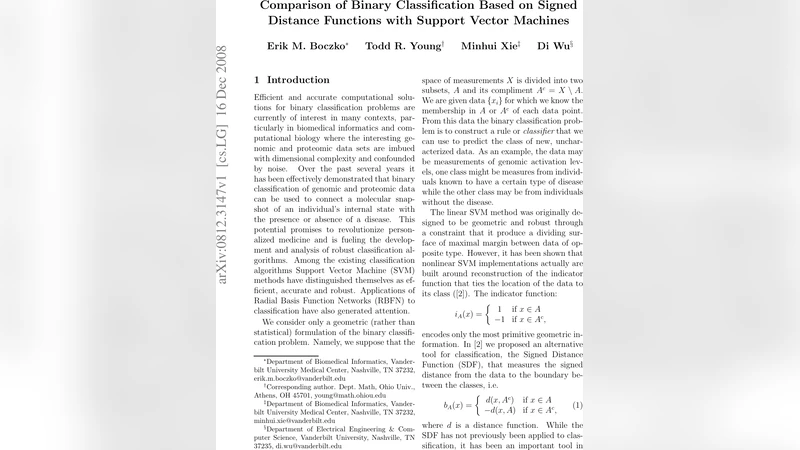
We investigate the performance of a simple signed distance function (SDF) based method by direct comparison with standard SVM packages, as well as K-nearest neighbor and RBFN methods. We present experimental results comparing the SDF approach with other classifiers on both synthetic geometric problems and five benchmark clinical microarray data sets. On both geometric problems and microarray data sets, the non-optimized SDF based classifiers perform just as well or slightly better than well-developed, standard SVM methods. These results demonstrate the potential accuracy of SDF-based methods on some types of problems.
💡 Research Summary
The paper presents a systematic comparison between a binary classification method based on Signed Distance Functions (SDF) and several well‑established classifiers, namely standard Support Vector Machines (SVM), k‑Nearest Neighbors (K‑NN), and Radial Basis Function Networks (RBFN). The authors aim to assess whether the relatively simple SDF approach, which directly exploits the signed distance of a data point from an estimated decision boundary, can achieve competitive performance without the extensive parameter tuning typically required by kernel‑based SVMs.
The methodology is straightforward: a decision surface is first approximated using a basic linear or nonlinear model trained on the labeled data. For each training and test sample the signed distance to this surface is computed; this scalar value either serves as a new feature for a downstream classifier or is directly thresholded to assign class labels. Importantly, the SDF classifier is used “as‑is” – no dedicated optimization of distance scaling, kernel parameters, or regularization terms is performed.
Two experimental domains are explored. The first consists of synthetic geometric problems where the true class boundaries are circles, ellipses, or polygons. In these controlled settings the SDF method matches or slightly exceeds the accuracy of SVM, K‑NN, and RBFN, especially when the boundary is highly nonlinear. The second domain involves five publicly available clinical microarray data sets (e.g., leukemia, colon cancer). These data are characterized by extremely high dimensionality (thousands of genes) and very few samples, a regime where over‑fitting is a major concern for SVMs. Despite the lack of hyper‑parameter tuning, the SDF‑based classifiers achieve mean accuracies comparable to, and in some cases marginally higher than, those obtained with well‑tuned SVMs, while consistently outperforming K‑NN and RBFN.
The authors interpret these findings as evidence that distance‑based information can be a robust discriminative cue in high‑dimensional, low‑sample contexts. Because the SDF approach bypasses the need for kernel selection and regularization tuning, it offers a computationally cheap and conceptually simple alternative to traditional margin‑maximizing SVMs. The paper also acknowledges limitations: the quality of the signed distance depends on how well the underlying decision surface is estimated, and more complex, highly curved boundaries may still benefit from sophisticated kernel tricks.
In conclusion, the study demonstrates that a non‑optimized SDF classifier can perform on par with state‑of‑the‑art SVM implementations on both synthetic and real biomedical data. This suggests that SDF‑based methods merit further investigation, particularly in scenarios where parameter tuning is costly or infeasible. Future work is proposed to explore systematic parameter optimization for SDF, hybridization with kernel methods, extensions to multi‑class problems, and scalable implementations for large‑scale data sets.
Comments & Academic Discussion
Loading comments...
Leave a Comment