A trivial formalization is given for the informal reasonings presented in a series of papers by Ya.D.Sergeyev on a positional numeral system with an infinitely large base, grossone; the system which is groundlessly opposed by its originator to the classical nonstandard analysis.
Deep Dive into A trivial formalization of the theory of grossone.
A trivial formalization is given for the informal reasonings presented in a series of papers by Ya.D.Sergeyev on a positional numeral system with an infinitely large base, grossone; the system which is groundlessly opposed by its originator to the classical nonstandard analysis.
arXiv:0808.1164v2 [math.GM] 13 Dec 2008
A. E. Gutman1
S. S. Kutateladze
A TRIVIAL FORMALIZATION
OF THE THEORY OF GROSSONE
Abstract.
A trivial formalization is given for the informal reasonings presented in
a series of papers by Ya. D. Sergeyev on a positional numeral system with an infinitely large
base, grossone; the system which is groundlessly opposed by its originator to the classical
nonstandard analysis.
Mathematics Subject Classification (2000):
26E35.
Keywords:
nonstandard analysis, infinitesimal analysis, positional numeral system.
c⃝A. E. Gutman, 2008
c⃝S. S. Kutateladze, 2008
1The work of the first author is supported by the Russian Science Support Foundation.
In recent years Ya. D. Sergeyev has published a series of papers [1–5] in which a positional
numeral system is advanced related to the notion of grossone2. Ya. D. Sergeyev opposes his
system to nonstandard analysis and regards the former as resting on different mathematical,
philosophical, etc. doctrines. The aim of the present note is to properly position the papers
by Ya. D. Sergeyev on developing numeral systems. It turns out that a model of Ya. D. Sergeyev’s
system is provided by the initial segment {1, 2, . . . , ν!} of the nonstandard natural scale up to
the factorial ν! of an arbitrary actual infinitely large natural ν.
Such a factorial serves as
a model of Ya. D. Sergeyev’s grossone, thus demonstrating the place occupying by the numeral
system he proposed.
As the main source we have chosen [4], the latest available paper by Ya. D. Sergeyev, which
contains a detailed description of his basic ideas.
[4]: . . . the approach used in this paper is different also with respect to the nonstandard analysis . . .
and built using Cantor’s ideas.
In the present note we are about to show that, contrary to what is expected by the author
of [4], his indistinct definitions of grossone and the concomitant notions admit an extremely
accurate and trivial formalization within the classical nonstandard analysis.
[4]: The infinite radix of the new system is introduced as the number of elements of the set N
of natural numbers expressed by the numeral O1 called grossone.
Use the formalism of the internal set theory IST by E. Nelson [6] or any of the classical external
set theories, for instance, EXT by K. Hrbaˇcek [7] or NST by T. Kawai [8] (see also the mono-
graphs [9,10]). As usual, ◦X denotes the standard core of a set X, i.e., the totality of all standard
elements of X. In particular, ◦N is the totality of all finite (standard) naturals. Fix an arbitrary
infinitely large natural ν and denote its factorial by O
1 :
O
1 = ν! ,
where ν ∈N, ν ≈∞.
Show that O
1 possesses all properties of “grossone” (postulated as well as implicitly presumed
in [4]).
A possible approach to an adequate formalization (in the sense of [4]) of the notion of size
or “the number of elements” of an arbitrary set A of standard naturals (i.e., of an external
subset A ⊂◦N) consists in assigning the natural ∥A∥= |∗A ∩{1, 2, . . . , O
1 }| to each A, where
∗A is the standardization of A and |X| is the size (in the usual sense) of a finite internal set X.
In this case it is clear that ∥◦N∥= O
1 , which agrees with the fore-quoted “definition” of grossone.
Note also that, due to the external induction, the function A 7→∥A∥possesses the additivity
property (presumed in [4]):
Sn
k=1 Ak
= Pn
k=1 ∥Ak∥for every family of pairwise disjoint sets
A1, . . . , An ⊂◦N, n ∈◦N.
Another approach (which is more trivial and considerably closer to that of [4]) to defining
the number of elements consists in “replacing” the set ◦N with the initial segment
N = {1, 2, . . . , O
1 }
of the natural scale and considering the usual size |A| ∈N of each internal set A ⊂N . In this
case, again, |N | = O
1 ; and the additivity of the counting measure A 7→|A| needs no argument.
2 The term “grossone” belongs to Ya. D. Sergeyev, has no relevance to the usual meaning of the noun “gross”
in English, and stems most likely from “groß” in German or “grosso” in Italian.
2
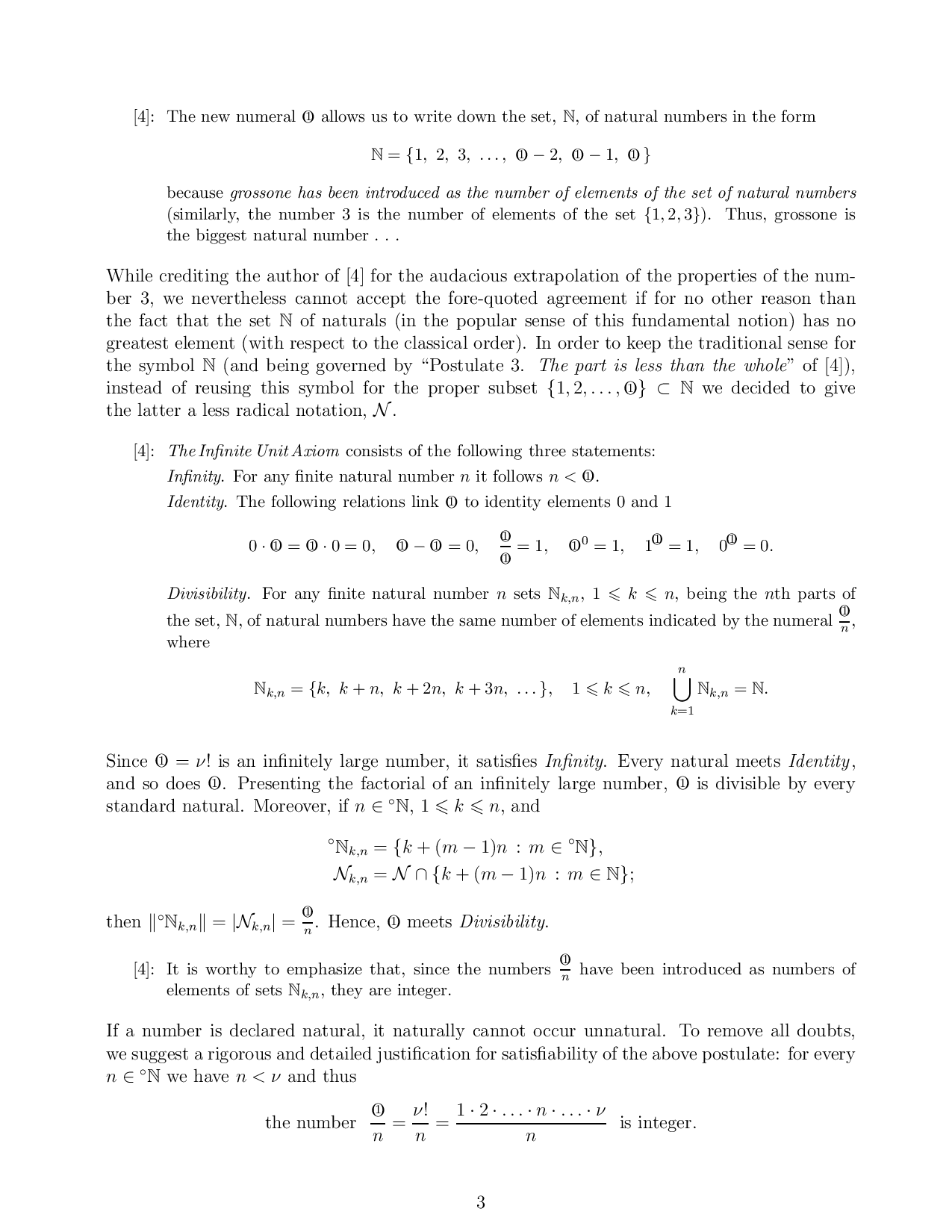
[4]: The new numeral O1 allows us to write down the set, N, of natural numbers in the form
N = {1, 2, 3, . . . , O1 −2, O1 −1, O1 }
because grossone has been introduced as the number of elements of the set of natural numbers
(similarly, the number 3 is the number of elements of the set {1, 2, 3}). Thus, grossone is
the biggest natural number . . .
While crediting the author of [4] for the audacious extrapolation of the properties of the num-
ber 3, we nevertheless cannot accept the fore-quoted agreement if for no other reason than
the fact that the set N of naturals (in the popular sense of this fundamental notion) has no
greatest element (with respect to the classical order). In order to keep the traditional sense for
the symbol N (and being governed by “Postulate 3. The part is less than the whole” of [4]),
instead of reusing this symbol for the proper subset {1, 2, . . . , O
1 } ⊂N we decided to give
the latter a less radical notation, N .
[4]: The Infinite Uni
…(Full text truncated)…
This content is AI-processed based on ArXiv data.