A note on regular Ramsey graphs
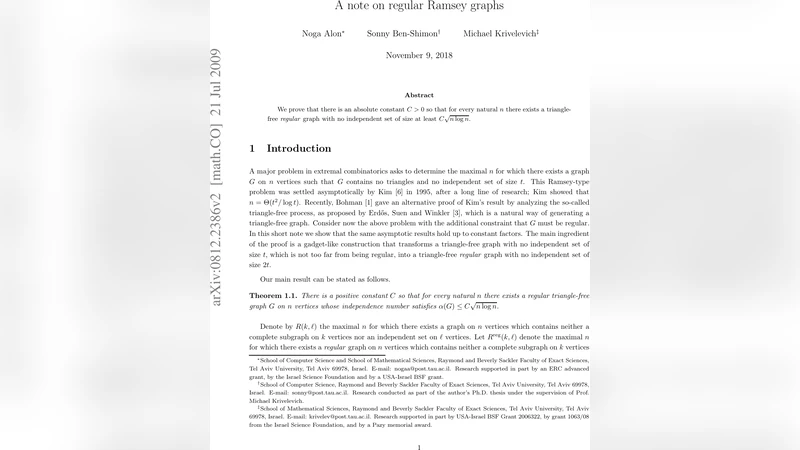
We prove that there is an absolute constant $C>0$ so that for every natural $n$ there exists a triangle-free \emph{regular} graph with no independent set of size at least $C\sqrt{n\log n}$.
💡 Research Summary
The paper “A note on regular Ramsey graphs” addresses a classical problem in extremal combinatorics: determining the largest integer n for which there exists a graph on n vertices that contains no triangle (K₃) and no independent set of size t. Kim’s celebrated result (1995) established that the Ramsey number R(3, t) is Θ(t²/ log t). Later, Bohman (2009) gave an alternative proof using the triangle‑free process, showing that a random greedy algorithm produces a graph that is almost regular and has independence number O(√(n log n)).
The novelty of the present work is to extend these asymptotic bounds to regular graphs. The authors prove that there exists an absolute constant C > 0 such that for every natural number n one can find a triangle‑free regular graph G on n vertices with independence number α(G) ≤ C·√(n log n). In other words, the regular Ramsey number R_reg(3, t) satisfies R_reg(3, t)=Θ(t² log t), matching the non‑regular case up to constant factors.
The proof proceeds in two main stages. First, the authors invoke Bohman’s analysis of the K₃‑free process. This process starts with an empty graph on n labeled vertices and repeatedly adds a random edge that does not create a triangle, stopping when no such edge remains. Bohman showed that with high probability after m≈Θ(n) steps the resulting graph G_m belongs to the family R(n, 3, C√(n log n)) and satisfies Δ(G_m)=Θ(√(n log n)) while the degree spread Δ(G_m)−δ(G_m)=o(√(n log n)). Thus G_m is “almost regular” and already has the desired independence bound, but its degrees are not exactly equal.
The second stage is a deterministic “gadget‑like” construction that turns an almost regular graph into a perfectly regular one without destroying triangle‑freeness or increasing the independence number by more than a constant factor. The authors first take two copies of G_m and apply the Hajnal‑Szemerédi theorem to obtain an equitable (Δ(G_m)+1)-coloring of each copy, so each color class has size either ⌊n/(Δ+1)⌋ or ⌈n/(Δ+1)⌉. For each color class C in the first copy and its counterpart C′ in the second copy, they consider the degree sequence of vertices in C (ordered increasingly) and define a complementary degree sequence d_i = d + Δ(G_m) − d′_i, where d is a parameter satisfying Δ(G_m)−δ(G_m) ≤ d ≤ 4·9·⌈Δ(G_m)+1⌉.
A key combinatorial tool is a corollary of the Gale‑Ryser theorem (Corollary 2.2 in the paper), which guarantees the existence of a simple bipartite graph with prescribed degree sequences on the two sides provided the maximum degree d₁ obeys d₁ ≤ min{2d_m, 8m/9}. By carefully choosing d, the authors ensure that the degree sequences satisfy this condition, allowing them to connect each vertex of C to vertices of C′ via a bipartite graph that raises every vertex’s degree to exactly d+Δ(G_m). Repeating this for all color classes yields a (d+Δ(G_m))-regular graph G′ on 2n vertices that is still triangle‑free and has independence number at most 2·C√(n log n)−1, i.e., O(√(n log n)).
To handle odd values of n, the authors construct a small auxiliary regular triangle‑free graph H_{k,r} on k vertices (k ≡ 5 mod 10) by blowing up a 5‑cycle and deleting a suitable number of disjoint 2‑factors, ensuring H_{k,r} is r‑regular with r even. They then take a regular triangle‑free graph F_{n₀} on an even number 2n₀ of vertices (obtained from the even‑n construction) where n₀ = (n−k)/2, and form the disjoint union G_n = F_{n₀} ∪ H_{k,r}. This union preserves regularity (both components have the same degree r) and triangle‑freeness, and its independence number is bounded by α(F_{n₀}) + α(H_{k,r}) ≤ C√(n log n) + k = O(√(n log n)).
Consequently, for every n (even or odd) there exists a regular triangle‑free graph with independence number O(√(n log n)). The paper also discusses the broader question of regular Ramsey numbers R_reg(k, ℓ) for k≥4, proposing Conjecture 3.1 that R_reg(k, ℓ) is at least a constant fraction of the ordinary Ramsey number R(k, ℓ). The authors note that recent work by Bohman and Keevash on the H‑free process for strictly 2‑balanced graphs may provide a pathway to extend their regular construction to larger cliques, though the asymptotics of R(k, ℓ) for k≥4 remain open.
In summary, the authors combine probabilistic methods (the triangle‑free process) with classic combinatorial constructions (Gale‑Ryser degree‑sequence realizability and equitable coloring) to bridge the gap between almost regular and perfectly regular Ramsey graphs, establishing that regularity does not worsen the asymptotic bound for the triangle‑free Ramsey problem. This result enriches our understanding of the interplay between degree constraints and extremal graph properties.
Comments & Academic Discussion
Loading comments...
Leave a Comment