Analysis of Discrete Signals with Stochastic Components using Flicker Noise Spectroscopy
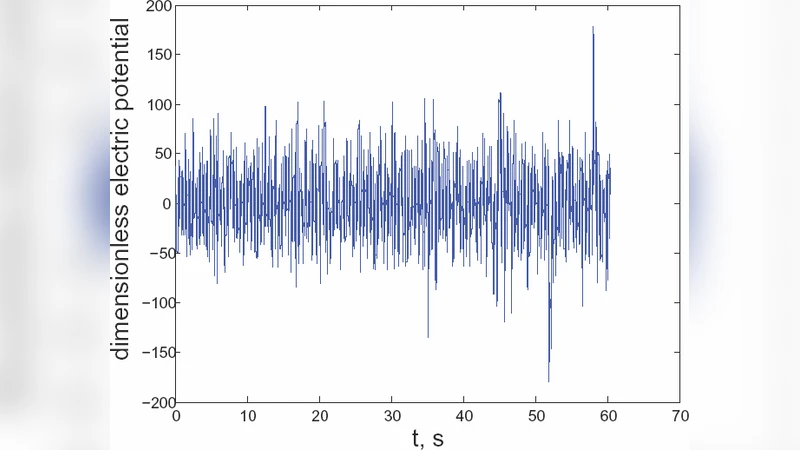
The problem of information extraction from discrete stochastic time series, produced with some finite sampling frequency, using flicker-noise spectroscopy, a general framework for information extraction based on the analysis of the correlation links between signal irregularities and formulated for continuous signals, is discussed. It is shown that the mathematical notions of Dirac and Heaviside functions used in the analysis of continuous signals may be interpreted as high-frequency and low-frequency stochastic components, respectively, in the case of discrete series. The analysis of electroencephalogram measurements for a teenager with schizophrenic symptoms at two different sampling frequencies demonstrates that the “power spectrum” and difference moment contain different information in the case of discrete signals, which was formally proven for continuous signals. The sampling interval itself is suggested as an additional parameter that should be included in general parameterization procedures for real signals.
💡 Research Summary
The paper addresses the challenge of extracting meaningful information from discrete stochastic time‑series that are recorded with a finite sampling frequency, using the framework of flicker‑noise spectroscopy (FNS). FNS is a general methodology for information extraction that relies on analyzing the correlation links between signal irregularities such as spikes, jumps, and bursts. Historically, the theory has been formulated for continuous signals, employing the Dirac delta function and the Heaviside step function to separate high‑frequency (HF) and low‑frequency (LF) stochastic components. The authors argue that when a signal is sampled discretely, these mathematical constructs can be re‑interpreted: the Dirac delta corresponds to instantaneous HF fluctuations occurring at the sampling instant, while the Heaviside step represents LF fluctuations that accumulate over the sampling interval. This reinterpretation provides a bridge between the continuous‑signal formalism and the realities of digital data acquisition.
Two fundamental statistical descriptors are examined: the power spectrum S(f) and the second‑order difference moment Φ^(2)(τ)=⟨
Comments & Academic Discussion
Loading comments...
Leave a Comment