Thermal emissions and climate change: Cooler options for future energy technology
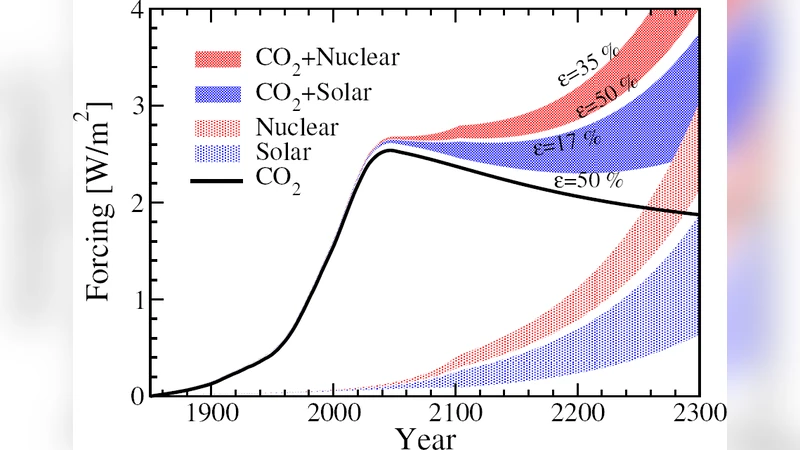
Global warming arises from ’temperature forcing’, a net imbalance between energy fluxes entering and leaving the climate system and arising within it. Humanity introduces temperature forcing through greenhouse gas emissions, agriculture, and thermal emissions from fuel burning. Up to now climate projections, neglecting thermal emissions, typically foresee maximum forcing around the year 2050, followed by a decline. In this paper we show that, if humanity’s energy use grows at 1%/year, slower than in recent history, and if thermal emissions are not controlled through novel energy technology, temperature forcing will increase indefinitely unless combated by geoengineering. Alternatively, and more elegantly, humanity may use renewable sources such as wind, wave, tidal, ocean thermal, and solar energy that exploit energy flows already present in the climate system, or act as effective sinks for thermal energy.
💡 Research Summary
The paper introduces the concept of “temperature forcing” – the net imbalance between incoming and outgoing energy fluxes in the Earth system – and argues that humanity contributes to this forcing not only through greenhouse‑gas emissions but also via direct thermal emissions from energy production. While most climate projections consider only CO₂‑driven radiative forcing and therefore predict a peak around 2050 followed by a decline, the authors show that if global primary energy use continues to grow at a modest 1 % per year (slower than the historical 2 % rate) and if the heat released during generation, transmission, and end‑use of electricity is not mitigated, the total forcing will keep rising indefinitely.
Using a simple accounting framework, the authors assume that nuclear, fossil‑fuel, and geothermal power plants operate at 35–50 % electrical efficiency, meaning that 50–65 % of the primary energy ends up as waste heat. When this waste heat is added to the CO₂‑driven forcing (taken from the “Coal Phase‑Out” scenario of Kharecha and Hansen), the combined forcing stabilises at roughly 3 W m⁻² for about a century – a level that corresponds to a 3–4 °C equilibrium temperature rise – and then begins to increase again. According to mainstream climate models, such a trajectory would push the planet into a period of dangerous climate change by the late 21st century.
The paper then evaluates renewable technologies in terms of their thermal impact. Wind, wave and tidal power harvest energy from existing dissipative flows and therefore add essentially no extra heat to the climate system; any heat generated later (e.g., by appliances) is simply a redistribution of the energy already present. Solar photovoltaic (PV) generation, however, lowers the surface albedo where panels are installed. The authors model the albedo change (Δα = α_terrain – α_PV) and calculate the global excess heat flux as ΔW_G = A·φ·Δα, where A is the total collector area and φ the incident solar flux. For a “global solar grand plan” covering 1.8 × 10⁶ km² (≈0.3 % of Earth’s surface) and PV efficiencies ranging from 17 % to 50 %, the resulting temperature forcing is comparable to that from nuclear power but consistently lower; higher PV efficiencies reduce the forcing further.
A particularly innovative proposal is the development of reflective PV cells that incorporate a high‑albedo back‑substrate. By selecting wide‑bandgap semiconductor materials (2–2.5 eV) and engineering the back layer to reflect sub‑bandgap photons, the cell can achieve thermal efficiencies of 55–65 % while attaining an effective albedo higher than the original terrain. In model simulations, a worldwide deployment of such reflective PVs could produce a net negative temperature forcing, effectively cooling the planet despite continued CO₂ emissions.
Finally, the authors examine Ocean Thermal Energy Conversion (OTEC). OTEC extracts electricity by pumping heat from warm surface waters to the cold deep ocean, thereby permanently removing heat from the surface climate system. Assuming a conversion efficiency ε ≈ 0.06 (near the theoretical maximum for OTEC) and that the heat associated with electricity use ultimately returns as waste heat, the net effect is a substantial heat sink. Their simple model predicts that if OTEC were to supply the entire global energy demand, the temperature forcing would become negative by 2100, potentially returning surface temperatures to pre‑industrial levels within the next century.
The overarching conclusion is that future energy policy must consider the full thermal lifecycle of technologies, not just CO₂ emissions. Technologies that inject additional heat (nuclear, fossil, geothermal) will exacerbate warming even if CO₂ is curtailed, whereas those that either do not add heat (wind, wave, tidal) or actively remove it (reflective PV, OTEC) can help keep temperature forcing within safe bounds. The paper calls for a re‑evaluation of research funding and development priorities, emphasizing that even if nuclear fusion becomes viable decades later, it will be too late to address the imminent thermal forcing problem. A strategic shift toward heat‑neutral or heat‑negative renewables is therefore essential for sustainable climate stewardship.
Comments & Academic Discussion
Loading comments...
Leave a Comment