We investigate, by "a la Marcinkiewicz" techniques applied to the (asymptotic) density function, how dense systems of equal spheres of $\rb^{n}, n \geq 1,$ can be partitioned at infinity in order to allow the computation of their density as a true limit and not a limsup. The density of a packing of equal balls is the norm 1 of the characteristic function of the systems of balls in the sense of Marcinkiewicz. Existence Theorems for densest sphere packings and completely saturated sphere packings of maximal density are given new direct proofs.
Deep Dive into On densest packings of equal balls of $rb^{n}$ and Marcinkiewicz spaces.
We investigate, by “a la Marcinkiewicz” techniques applied to the (asymptotic) density function, how dense systems of equal spheres of $\rb^{n}, n \geq 1,$ can be partitioned at infinity in order to allow the computation of their density as a true limit and not a limsup. The density of a packing of equal balls is the norm 1 of the characteristic function of the systems of balls in the sense of Marcinkiewicz. Existence Theorems for densest sphere packings and completely saturated sphere packings of maximal density are given new direct proofs.
The existence of densest sphere packings in R n , n ≥ 2, asked the question to know how they could be constructed. The problem of constructing very dense sphere packings between the bounds of Kabatjanskii-Levenstein and Minkowski-Hlawka type bounds (see Fig. 1 in [MVG1]) remains open [Bz] [Ca] [CS] [GL] [GOR] [R] [Z]. There are two problems: the first one is the determination of the supremum δ n over all possible densities, δ n being called the packing constant, as a function of n only (for n = 3 see Hales [H]); the second one consists in characterizing the (local, global) configuration of balls in a densest sphere packing, namely for which the density is δ n .
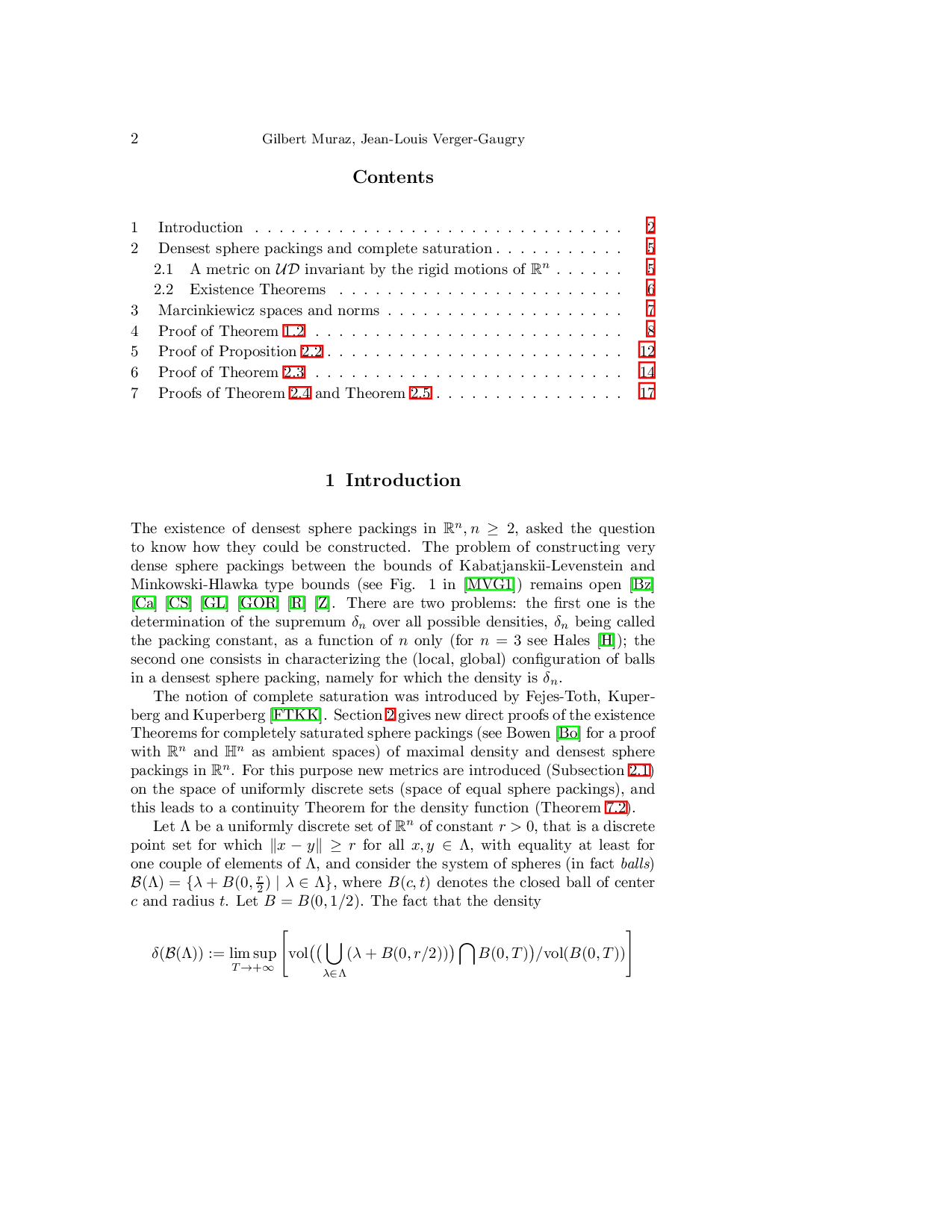
The notion of complete saturation was introduced by Fejes-Toth, Kuperberg and Kuperberg [FTKK]. Section 2 gives new direct proofs of the existence Theorems for completely saturated sphere packings (see Bowen [Bo] for a proof with R n and H n as ambient spaces) of maximal density and densest sphere packings in R n . For this purpose new metrics are introduced (Subsection 2.1) on the space of uniformly discrete sets (space of equal sphere packings), and this leads to a continuity Theorem for the density function (Theorem 7.2).
Let Λ be a uniformly discrete set of R n of constant r > 0, that is a discrete point set for which xy ≥ r for all x, y ∈ Λ, with equality at least for one couple of elements of Λ, and consider the system of spheres (in fact balls) where, for all p ∈ R + * and all f ∈ L p loc with L p loc the space of complexvalued functions f defined on R n whose p-th power of the absolute value |f | p is integrable over any bounded measurable subset of R n for the Lebesgue measure,
asks the following question: what can tell the theory of Marcinkiewicz spaces to the problem of constructing very dense sphere packings ? Obviously the problem of the determination of the packing constant or more generally of the density is associated with the quotient space L p loc /R where R is the Marcinkiewicz equivalence relation (Section 3): the density function is a class function, that is is well defined on the Marcinkiewicz space M p with p = 1. For instance any finite cluster of spheres has the same density, equal to zero, as the empty packing (no sphere); the Marcinkiewicz class of the empty sphere packing being much larger than the set of finite clusters of spheres. Then it suffices to understand the construction of one peculiar sphere packing per Marcinkiewicz class. It is the object of this note to precise the geometrical constraints given by such a construction.
Since any non-singular affine transformation T on a system of balls B(Λ) leaves its density invariant (Theorem 1.7 in [R]), namely
(1.4) we will only consider packings of spheres of common radius 1/2 in the sequel. It amounts to consider the space UD of uniformly discrete subsets of R n of constant 1. Its elements will be called UD-sets. Denote by f the class in
where L p loc is endowed with the M p -topology (Section 3), and by
Theorem 1.1 is a reformulation of the following more accurate theorem, since M p is complete [B] [B+]. For 0 ≤ λ ≤ µ denote
the closed annular region of space between the spheres centered at the origin of respective radii λ and µ.
Theorem 1.2. Let (Λ m ) m≥1 be a sequence of UD-sets such that the sequence (χ B(Λm) ) m≥1 is a Cauchy sequence for the pseudo-metric • 1 on L 1 loc ∩ L ∞ . Then, there exist (i) a strictly increasing sequence of positive integers (m i ) i≥1 ,
(ii) a strictly increasing sequence of real numbers (λ i ) i≥1 with λ i ≥ 1 and λ i+1 > 2λ i , such that, with
The situation is the following for a (densest) sphere packing B(Λ) of R n for which δ(B(Λ)) = δ n :
- either it cannot be reached by a sequence of sphere packings such as in Theorem 1.2, in which case there is an isolation phenomenon, * or there exists at least one sequence of sphere packings such as in Theorem 1.2, and it is Marcinkiewicz -equivalent to a sphere packing having the asymptotic annular structure given by Theorem 1.2, where the sequence of thicknesses of the annular portions exhibit an exponential growth. The sharing of space in annular portions as given by Theorem 1.2 may allow constructions of very dense packings of spheres layer-by-layer in each portion independently, since the intermediate regions C(λ i -1/2, λ i + 1/2) are all of constant thickness 1 which is twice the common ball radius 1/2. These intermediate regions do not contribute to the density so that they can be filled up or not by spheres. However the existence of such unfilled spherical gaps are not likely to provide completely saturated packings, at least for n = 2 [KKK].
Note that the value 2 which controls the exponential sequence of radii (λ i ) i by λ i+1 > 2λ i in Theorem 1.2 (ii) can be replaced by any value a > 1. This is important for understanding constructions of sphere packings iteratively on the dimension n: indeed, chosing a > 1 sufficiently small brings the problem back to fill up first o
…(Full text truncated)…
This content is AI-processed based on ArXiv data.