Monadic approach to Galois descent and cohomology
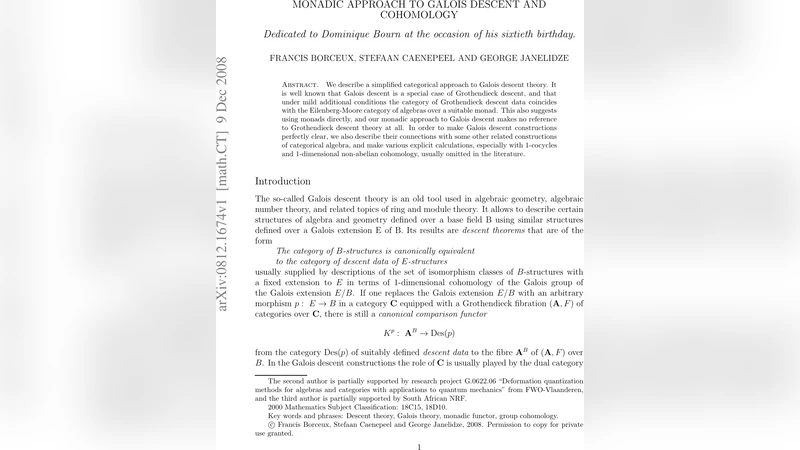
We describe a simplified categorical approach to Galois descent theory. It is well known that Galois descent is a special case of Grothendieck descent, and that under mild additional conditions the category of Grothendieck descent data coincides with the Eilenberg-Moore category of algebras over a suitable monad. This also suggests using monads directly, and our monadic approach to Galois descent makes no reference to Grothendieck descent theory at all. In order to make Galois descent constructions perfectly clear, we also describe their connections with some other related constructions of categorical algebra, and make various explicit calculations, especially with 1-cocycles and 1-dimensional non-abelian cohomology, usually omitted in the literature.
💡 Research Summary
The paper presents a streamlined, purely monadic treatment of Galois descent, deliberately avoiding any reference to Grothendieck descent theory. After recalling that classical Galois descent is a special case of Grothendieck descent and that, under mild completeness assumptions, the category of Grothendieck descent data coincides with the Eilenberg‑Moore category of algebras for a suitable monad, the author constructs that monad explicitly.
Given a finite Galois extension (L/K) with Galois group (G), the author defines a functor
(T\colon \mathcal{C}\to\mathcal{C})
on the category (\mathcal{C}) of (L)-objects (modules, algebras, or schemes) by
(T(X)=\prod_{g\in G} g^{*}X).
The unit (\eta\colon X\to T(X)) is the diagonal map and the multiplication (\mu\colon T^{2}(X)\to T(X)) is induced by the obvious product‑to‑product projection. This data makes (T) a monad, and a (T)-algebra ((A,\alpha)) consists of an object (A) together with a structure map (\alpha\colon T(A)\to A) satisfying the usual associativity and unit axioms. The crucial observation is that (\alpha) precisely encodes the “averaging” or invariance condition that appears in classical descent: it forces the (G)-action on the underlying (L)-object to descend to a (K)-object. Consequently, the category of (T)-algebras is canonically equivalent to the category of Grothendieck descent data for the extension (L/K).
Having identified the descent category with the Eilenberg‑Moore category, the paper turns to the explicit description of 1‑cocycles and non‑abelian first cohomology. For an (L)-object (X) with a (G)-action, a 1‑cocycle is a family of isomorphisms ({\phi_{g}\colon X\to g^{}X}{g\in G}) satisfying (\phi{gh}=g^{}(\phi_{h})\circ\phi_{g}). The author shows that such a family is exactly a morphism of (T)-algebras from the free (T)-algebra on (X) to itself, i.e. an element of the “weighted” automorphism group (\operatorname{Aut}{T}(X)). Two cocycles are cohomologous precisely when they differ by conjugation with an ordinary automorphism (\psi\in\operatorname{Aut}(X)); this translates to the statement that cohomology classes are orbits of (\operatorname{Aut}{T}(X)) under the natural action of (\operatorname{Aut}(X)). Hence the non‑abelian cohomology set (H^{1}(G,\operatorname{Aut}(X))) is identified with the set of isomorphism classes of (T)-algebra structures on (X).
The paper supplies detailed calculations for three typical contexts:
-
Vector spaces – For an (L)-vector space (V), the fixed subspace (V^{G}) is shown to be the underlying (K)-object of the free (T)-algebra on (V). The 1‑cocycles correspond to linear automorphisms satisfying the cocycle condition, and the cohomology set classifies twisted forms of (V).
-
Algebras – For an (L)-algebra (A), the invariant subalgebra (A^{G}) is identified with the centre of the corresponding (T)-algebra. The author computes (H^{1}(G,\operatorname{Aut}(A))) explicitly for cyclic groups, demonstrating how different cocycles give rise to non‑isomorphic (K)-algebra forms.
-
Schemes – For an (L)-scheme (X), the descent data are encoded by a morphism (\alpha\colon T(X)\to X) satisfying the monad axioms. The paper works out the case of a finite étale cover, showing that the usual gluing conditions are recovered from the monadic perspective.
Throughout these examples the author refrains from invoking the traditional “descent datum” language; instead, every step is expressed in terms of the monad (T) and its algebras. This not only simplifies the conceptual picture but also makes the calculations more transparent.
In the concluding section the author highlights several advantages of the monadic approach:
- Conceptual simplicity – The descent condition is reduced to the familiar unit and associativity equations of a monad, eliminating the need for separate coherence diagrams.
- Computational clarity – 1‑cocycles and non‑abelian cohomology become concrete problems about automorphisms of (T)-algebras, which can be tackled with standard algebraic tools.
- Extensibility – The same framework can be lifted to higher cocycles (2‑cocycles, etc.) and to non‑abelian higher cohomology, suggesting a pathway toward a monadic formulation of higher Galois descent and even non‑commutative stack theory.
Overall, the paper succeeds in recasting Galois descent as a problem entirely within the realm of monads and their Eilenberg‑Moore categories. By doing so it not only clarifies the underlying mechanisms of descent but also opens the door to systematic generalizations and more efficient computations in both algebraic and geometric contexts.
Comments & Academic Discussion
Loading comments...
Leave a Comment