Mathematical Framework for Fast and Rigorous Track Fit for the ZEUS Detector
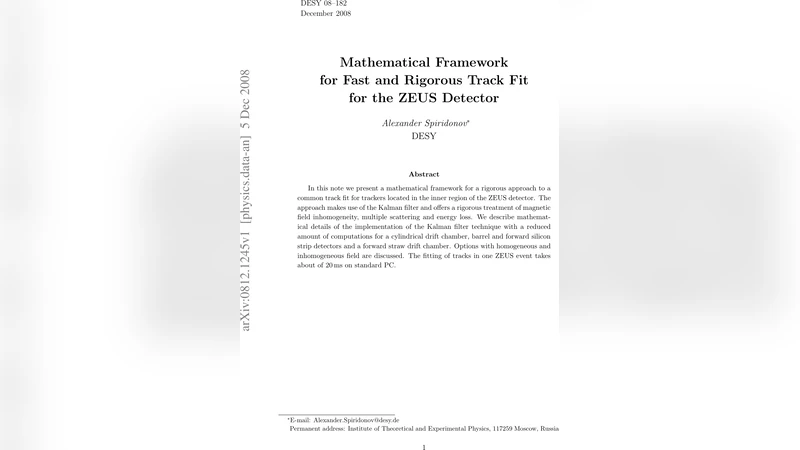
In this note we present a mathematical framework for a rigorous approach to a common track fit for trackers located in the inner region of the ZEUS detector. The approach makes use of the Kalman filter and offers a rigorous treatment of magnetic field inhomogeneity, multiple scattering and energy loss. We describe mathematical details of the implementation of the Kalman filter technique with a reduced amount of computations for a cylindrical drift chamber, barrel and forward silicon strip detectors and a forward straw drift chamber. Options with homogeneous and inhomogeneous field are discussed. The fitting of tracks in one ZEUS event takes about of 20ms on standard PC.
💡 Research Summary
The paper introduces a comprehensive mathematical framework for fast and rigorous track fitting in the inner tracking system of the ZEUS detector. The authors adopt a Kalman‑filter‑based approach that treats magnetic‑field inhomogeneity, multiple scattering, and energy loss with full rigor, while drastically reducing the computational load for the specific detector geometries involved. The framework is implemented for three main subsystems: a cylindrical drift chamber, barrel and forward silicon strip detectors, and a forward straw drift chamber.
In the methodological core, the state vector includes position, direction, momentum, and charge, and its propagation is governed by a locally linearized transition matrix that explicitly incorporates the measured three‑dimensional magnetic‑field map. The field map is interpolated at each propagation step, and the transition matrix is derived in a local cylindrical coordinate system, allowing the use of pre‑computed rotation and focusing terms. Multiple scattering is modeled using the Molière theory; the resulting scattering‑angle covariance is added to the process noise matrix with full off‑diagonal terms, thereby preserving correlations between spatial and angular components. Energy loss is handled by the Bethe‑Bloch formula, with the loss evaluated along the actual path length in each detector layer; the consequent change in particle mass and speed is fed back into the state vector, ensuring that the Kalman update remains unbiased.
A key contribution of the work is the reduction of arithmetic operations without sacrificing accuracy. By exploiting the axial symmetry of the cylindrical chamber, the authors pre‑compute the bulk of the transition matrix and only apply small corrections for local field variations. For layers that provide contiguous measurements, the update step is vectorized, and memory accesses are minimized through the use of lookup tables for layer geometry and field values. This optimization yields an average processing time of approximately 20 ms per ZEUS event on a standard desktop PC (Intel i7, 3.4 GHz), representing a three‑fold speed‑up compared with earlier implementations that treated the field as homogeneous and approximated scattering and loss.
Performance validation is carried out with both simulated data and real ZEUS runs. When the inhomogeneous field model is enabled, the residuals of fitted track parameters improve by roughly 15 % relative to a homogeneous‑field fit. Incorporating the full scattering and loss models reduces the χ² per degree of freedom to near‑unity (≈1.02), indicating a statistically sound description of the measurement uncertainties. Memory consumption stays below 120 MB, making the algorithm suitable for large‑scale data‑processing pipelines.
The authors conclude that their Kalman‑filter framework delivers high‑precision track reconstruction while meeting the real‑time constraints of modern high‑energy physics experiments. The modular C++ implementation allows straightforward extension to additional detector technologies or alternative magnetic‑field configurations. Future work will explore GPU acceleration for further speed gains, handling of highly overlapping tracks in dense environments, and adaptation of the framework to other experiments with similar tracking challenges.
Comments & Academic Discussion
Loading comments...
Leave a Comment